

What if repeated nights of lying awake aren’t a failure of willpower, but a sign that something deserves a closer look? If you’ve searched “can’t fall asleep insomnia specialist Seattle,” you may be tired of generic sleep tips and wondering whether stress, mood, medication, or another factor is keeping you awake. That frustration is understandable. You deserve to have your concerns heard without assumptions or judgment.
A thoughtful assessment can explore your sleep patterns, health and medication history, and related symptoms to help clarify possible next steps. This article explains when persistent difficulty falling asleep may warrant professional support, what to track before an assessment, and what a psychiatric evaluation for sleep concerns can involve. It also covers practical considerations for Seattle-area readers, including virtual appointments and care in Washington. The goal is to help you take an informed step toward care that considers your individual needs.
Key Takeaways
- Difficulty falling asleep is a symptom, not a diagnosis. Exploring possible contributors can clarify what support may be useful.
- A clinician may consider stress, mood, medication, daily routines, and physical or sleep-related concerns as part of a broader assessment.
- Primary care and psychiatric evaluations can play different roles. A psychiatric evaluation may be helpful when sleep concerns overlap with mental health symptoms or medication questions.
- Before an assessment, note sleep and wake times, awakenings, daytime effects, and relevant routine changes to help describe your experience.
- If you’re searching for a can’t fall asleep insomnia specialist Seattle, learn how an evaluation, medication management, or sleep treatment may fit into an individualized next step.
Can’t fall asleep in Seattle? Understand sleep-onset insomnia
You’re tired, the day is over, and yet sleep won’t come. Lying awake can feel frustrating and isolating, but difficulty falling asleep isn’t a personal failure. It can happen occasionally or become a recurring concern worth exploring, especially when its effects follow you into the day.
Sleep-onset difficulty means taking longer than you’d like to fall asleep after going to bed. It describes trouble beginning sleep, not waking during the night or waking too early. It’s a symptom, not a diagnosis on its own. Insomnia can involve different sleep complaints and affect daytime well-being. The general overview of Insomnia offers additional background.
When is trouble falling asleep more than an occasional bad night?
An isolated restless night is different from a pattern that keeps returning or leaves you distressed and struggling to function. Notice whether poor sleep is affecting concentration, mood, energy, or daily routines. Recurrence matters, but no single detail determines a diagnosis. A clinician considers how often it happens, how long it has been going on, and the circumstances around your sleep.
If you’re searching for a can’t fall asleep insomnia specialist Seattle, you may be trying to work out whether your experience deserves attention. You don’t need to prove that it’s “serious enough” before raising it. Describing what’s happening and how it affects you can help a clinician assess whether further evaluation may be useful.
What does an insomnia specialist help assess?
An assessment may explore your sleep patterns, health history, medications, and emotional symptoms. The conversation can help identify factors that may be interacting rather than assume there’s only one cause. For example, a clinician may consider changes in stress or mood alongside medication questions and your sleep routine, without treating any one factor as a conclusion.
Asking for help doesn’t automatically mean you’ll receive a particular diagnosis or be advised to take medication. A psychiatric evaluation is one way to discuss sleep concerns alongside mental health symptoms and history. This article offers general guidance, not a substitute for individualized clinical assessment. A clinician can consider your circumstances and help clarify possible next steps.
Why can’t I fall asleep? Causes a Seattle clinician may explore
There isn’t always one obvious reason a person lies awake. Stressful periods, changes in mood, medication effects, shifts in routine, and physical or sleep-related concerns may all be relevant. Several factors can overlap, so noticing a possible connection can be useful without treating it as proof of a cause.
Difficulty falling asleep doesn’t have one universal cause. An individualized assessment considers how sleep, health, medications, routines, and emotional well-being may fit together. If you’re searching “can’t fall asleep insomnia specialist Seattle,” approach the question with curiosity rather than trying to diagnose yourself from a list of possibilities.
How stress, anxiety, and mood can relate to sleep
Worry or emotional distress can make it harder to settle at bedtime, while poor sleep may affect how you feel the next day. These experiences don’t establish a diagnosis, but noticing whether sleep changes alongside shifts in anxiety or mood can give a clinician useful context. You can read more about anxiety treatment information for related background.
What else may affect your ability to fall asleep?
Other useful topics to discuss include a recent medication start, stop, or dose change; caffeine or other substance use; a changed work or sleep schedule; and health concerns that may affect rest. These are conversation points, not a checklist for deciding what’s wrong. Don’t change prescribed medication based on a guess about your sleep. Note what changed and when, then bring that information to an assessment.
A brief record can make patterns easier to describe. Note bedtime, your best estimate of when you fell asleep, wake time, nighttime awakenings, and how you felt during the day. Add relevant routine or medication changes. You don’t need perfect data; an approximate account can help a clinician understand the bigger picture and ask focused questions.
A psychiatric evaluation can explore sleep concerns alongside relevant health history, medication questions, and emotional symptoms. To understand how that kind of assessment works, review psychiatric evaluation information as one possible next step.
Insomnia care: specialists, primary care, and clinics
Finding the right kind of support starts with what you need help understanding. Clinicians may focus on different parts of a sleep concern, and their roles can overlap. No single route fits everyone. The table below describes common areas of focus, not a ranking or a recommendation.
| Care role | Possible focus |
|---|---|
| Primary care clinician | General health history, medication questions, and whether other health concerns may be relevant to sleep. |
| Sleep specialist | Sleep patterns and concerns that may need a more focused sleep-related assessment. |
| Psychiatric clinician | Sleep concerns alongside mood, anxiety, mental health history, or questions about psychiatric medication. |
When may psychiatric evaluation be relevant to insomnia?
A psychiatric evaluation may be relevant when difficulty sleeping occurs alongside changes in mood or anxiety, or when you have questions about how current medications fit into the picture. The clinician can explore your history and sleep patterns with you, then discuss possible next steps based on your needs. For a closer look at what an evaluation may involve, read this psychiatric evaluation guidance.
This kind of assessment isn’t a substitute for evaluating every physical or sleep-related concern. Its role is to consider relevant mental health symptoms, history, and medication questions as part of a broader understanding. Assessment findings can guide what to discuss next, but they don’t guarantee a diagnosis, prescription, or particular treatment.
What should you know about insomnia treatment and medication?
Seeking psychiatric help doesn’t automatically mean taking sleep medication. Treatment choices depend on the assessment, your history and goals, and potential benefits and risks. If medication is prescribed as part of an individualized plan, medication management can include monitoring how well it’s working and whether side effects arise.
Cognitive Behavioral Therapy for Insomnia (CBT-I) is a recognized insomnia treatment approach. It’s useful to know about as general background, but an assessment can help clarify which next steps are appropriate for your situation. If you’re searching for a can’t fall asleep insomnia specialist Seattle, look for an assessment that considers your concerns without assuming one answer fits everyone.
To learn more about Assure Psychiatry’s outpatient psychiatric care, visit Assure Psychiatry.
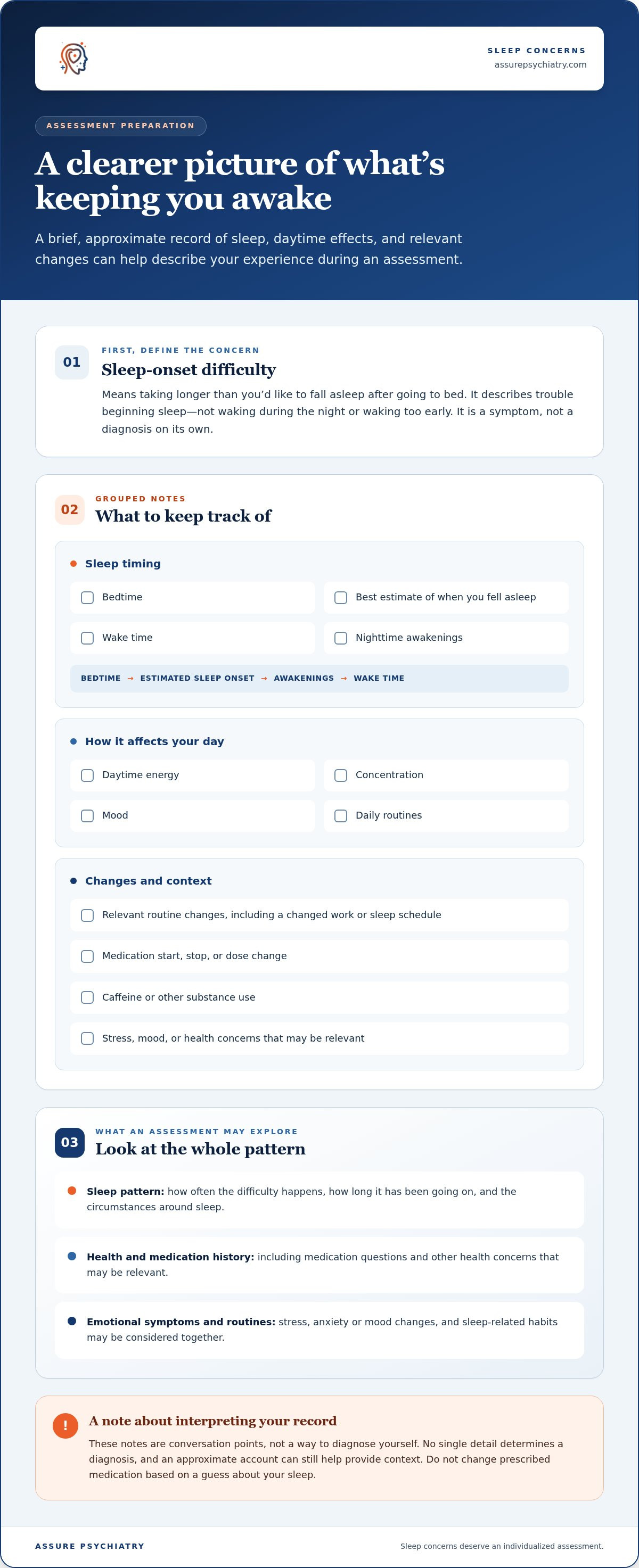
Can’t fall asleep? How to prepare for an assessment
You don’t need a perfect record or a complete explanation before an appointment. A few notes can help you describe what nights are like, how sleep difficulties affect your day, and what questions matter most to you.
For an insomnia assessment, bring a simple sleep record, relevant routine or medication changes, and the questions you want answered.
Keep a simple sleep record before your appointment
For several days or longer, jot down approximate details rather than watching the clock closely. Include:
- When you went to bed and got up, and roughly how long you tried to fall asleep.
- Any awakenings you remember and how rested you felt in the morning.
- Daytime effects, such as changes in focus, mood, energy, or routine.
- Relevant changes in caffeine or alcohol use, medications, stress, or schedule.
Keep it manageable. An imperfect record is still useful, and tracking shouldn’t become another source of pressure. Bring a current medication list, including recent changes, and share any concerns about side effects. Don’t stop or adjust a prescription on your own; discuss medication questions with a clinician.
Questions to bring to an insomnia appointment
Writing down questions beforehand can make it easier to use the appointment in a collaborative way. You might ask:
- What possible factors could be contributing to my difficulty falling asleep, and how will we explore them?
- What next steps might fit my history and goals?
- If medication is considered, what potential benefits or side effects should I understand, and how would we review progress?
- If the appointment is virtual, how does care work for someone in my location?
Assure Psychiatry’s Oregon telepsychiatry information provides background on virtual care in Oregon. For Seattle-area readers, telehealth care is also subject to the clinician’s authorization to practice where the patient is located.
If you’re looking for a can’t fall asleep insomnia specialist Seattle, preparation can help you explain your experience without arriving with a diagnosis. To explore an individualized psychiatric evaluation, learn about psychiatric care.
Finding a Seattle insomnia specialist: a supported next step with Assure Psychiatry
Repeated difficulty falling asleep can leave you unsure what kind of help makes sense. Assure Psychiatry provides psychiatric evaluations, medication management, and sleep or insomnia treatment. An evaluation gives you a place to describe what’s happening and explore possible next steps without assuming in advance that you need a particular diagnosis or medication.
What an individualized psychiatric care conversation can cover
A psychiatric evaluation may bring together several parts of your experience: sleep patterns, relevant mental health symptoms, medical history, medication history, and personal goals. The clinician can review the information with you, discuss a treatment plan, and consider what may be appropriate for your needs and preferences. You can raise concerns about medication, past experiences with care, or what you hope will change. Your perspective belongs in the conversation.
If medication is part of an individualized care plan, follow-up medication management includes monitoring its effectiveness and possible side effects. That ongoing review can inform discussions about next steps. It doesn’t mean a prescription is automatic, and no particular diagnosis, treatment approach, or result can be guaranteed.
How to take the next step from Seattle
Assure Psychiatry provides in-person care in Portland, Oregon, and virtual telepsychiatry. For Seattle-area readers, telehealth care is subject to the clinician’s authorization to practice where the patient is located. Assure Psychiatry accepts most major insurance plans, though coverage depends on the plan and service.
If you’re looking for a can’t fall asleep insomnia specialist Seattle, an informed next step is to seek an assessment that considers your circumstances and gives you room to ask questions. You can Explore care with Assure Psychiatry and learn about its psychiatric and sleep-related services.
If you’re concerned about immediate safety, seek urgent local support now rather than waiting for a routine appointment.
Take a thoughtful next step toward more restful nights
Repeated difficulty falling asleep deserves attention, but it doesn’t tell the whole story by itself. A clinician can explore possible contributors in context, including sleep patterns, health history, medication questions, and emotional well-being. Keeping a simple sleep record and noting how poor sleep affects your days can make that conversation more useful.
If you’re searching for a can’t fall asleep insomnia specialist Seattle, asking for help doesn’t commit you to a diagnosis or sleep medication. Assure Psychiatry offers outpatient psychiatric evaluations and medication management, with compassionate, culturally competent care. The practice provides virtual telepsychiatry and in-person visits in Portland, Oregon. Telehealth care in Washington is subject to the clinician’s authorization to practice where the patient is located.
When you’re ready, explore care with Assure Psychiatry and learn about possible next steps. You deserve to be heard, and you can move forward at a pace that feels manageable.
Frequently Asked Questions
Why can’t I fall asleep even when I’m tired?
Feeling tired doesn’t always mean your body and mind are ready to fall asleep. Stress, worry, changes in mood, daily routines, medication effects, and physical or sleep-related concerns can all be relevant, sometimes in combination. These possibilities aren’t a self-diagnosis checklist. If difficulty falling asleep keeps recurring or affects your days, a clinician can explore your sleep patterns and broader health context with you.
When should I see an insomnia specialist for trouble falling asleep?
Consider seeking guidance if trouble falling asleep keeps returning, causes distress, or affects your concentration, mood, energy, or daily routines. You don’t have to wait until the problem feels unmanageable. Duration and frequency matter, but a clinician considers the full context rather than diagnosing from one detail. If you’re searching for a can’t fall asleep insomnia specialist Seattle, an assessment can help clarify possible contributors and next steps.
Can a psychiatrist help if I can’t fall asleep?
Yes, a psychiatric evaluation may help explore sleep concerns alongside anxiety, mood changes, mental health history, or medication questions. The clinician can review your history and symptoms with you and discuss possible next steps collaboratively. Psychiatric care doesn’t assess every physical or sleep-related concern, so the appropriate evaluation depends on your circumstances. Seeking help doesn’t mean you’ll automatically receive a particular diagnosis or treatment.
Does seeing an insomnia specialist mean I have to take medication?
No. An appointment doesn’t automatically mean you’ll be prescribed sleep medication. Possible next steps depend on the assessment, personal history, goals, and potential benefits and risks. If medication is prescribed as part of an individualized plan, medication management can include monitoring its effectiveness and possible side effects. Share your preferences and concerns, and don’t start, stop, or change prescribed medication without discussing it with a clinician.
What should I track before an appointment for insomnia?
Note approximate bedtimes and wake times, how long you tried to fall asleep, awakenings you remember, and how rested you felt. Include daytime effects, such as trouble concentrating, and relevant changes in your routine, stress, caffeine or alcohol use, or medications. Bring a current medication list and questions you want answered. Your notes don’t need to be exact; an honest, manageable record can support a useful conversation.
Can I get virtual insomnia care from Seattle?
Assure Psychiatry offers virtual telepsychiatry, as well as in-person care in Portland, Oregon. For telehealth care in Seattle, Washington, the clinician must be authorized to practice where the patient is located. Telehealth requirements depend on the patient’s location at the time of the appointment.
What is the difference between insomnia and sleep apnea?
Insomnia involves dissatisfaction with sleep, which may include difficulty falling asleep, staying asleep, or waking too early, along with distress or daytime effects. Sleep apnea is a sleep-related breathing concern in which breathing can repeatedly become interrupted during sleep. Symptoms can overlap with tiredness, and signs such as snoring or gasping don’t confirm a diagnosis by themselves. A clinician can help determine what assessment may fit your experience.
Recent Comments