

What if the right OCD support depends less on a provider’s title and more on the kind of care you need? Intrusive thoughts or repetitive behaviors can feel exhausting and disruptive, and it isn’t always clear where to turn. If you’re searching for an OCD specialist Oregon residents can see in person or virtually, you don’t have to figure it all out alone or diagnose yourself before asking for help.
It makes sense to wonder whether a psychiatrist, therapist, or both might be part of your care. OCD treatment may involve therapy, medication, or a combination, but these supports serve different roles. A psychiatric evaluation offers space to discuss your symptoms, history, and goals. Medication management can be one part of an individualized plan. Assure Psychiatry provides in-person care in Portland and virtual telepsychiatry across Oregon.
This guide explains what OCD specialists do, how psychiatric care differs from therapy, and what to expect when seeking support. You’ll learn what an evaluation and ongoing medication-management relationship may involve, and how to prepare questions about care so you can consider a next step with greater clarity and less pressure.
Key Takeaways
- Distressing thoughts or repeated behaviors can be worth discussing with a clinician, but an article can’t determine whether you have OCD.
- OCD-focused care can involve different roles. Understanding each one can help you identify the support you’re looking for.
- When looking for an OCD specialist Oregon residents can access, focus on the type of assessment and treatment you’re seeking, not just a provider’s title.
- Prepare for an evaluation by noting your concerns, how they affect daily life, relevant history, and questions about care and medication.
- Assure Psychiatry provides psychiatric evaluations, OCD treatment, and medication management in Portland and through virtual telepsychiatry across Oregon.
OCD symptoms in Oregon: when specialized support may help
Distressing thoughts or repetitive behaviors can feel isolating, especially when it’s hard to explain why they keep returning. You don’t have to decide on your own what these experiences mean. Obsessive-compulsive disorder (OCD) involves obsessions, compulsions, or both. Obsessions are recurring, unwanted thoughts, images, or urges. Compulsions are repeated behaviors or mental acts a person feels driven to perform, often in response to distress or a sense that something isn’t right.
Not every unwanted thought or repeated routine points to OCD. A clinician considers the broader pattern, including how much distress it causes, how much time it takes, and whether it disrupts work, relationships, sleep, or everyday routines. This section offers general information, not a diagnosis. For a broader overview of symptoms and diagnosis, see Obsessive-compulsive disorder on Wikipedia. An individual assessment is needed to understand a person’s concerns in context.
What obsessions and compulsions can look like
Obsessions may involve fears of causing harm, uncertainty about whether something is right, unwanted taboo thoughts, or distressing images. Having these thoughts doesn’t mean someone wants them or intends to act on them. Compulsions can include washing or checking, but may also involve counting, silently repeating words, arranging items, seeking reassurance, or mentally reviewing events. Experiences vary, and examples alone can’t establish a diagnosis.
A habit is worth discussing with a clinician when a recurring pattern causes distress, takes substantial time, or gets in the way of daily life, not simply because it looks unusual.
When OCD-related concerns affect everyday life
Consider talking with a clinician if unwanted thoughts or repeated actions are hard to manage, take time away from responsibilities, or make it difficult to feel present with other people. For example, someone might repeatedly review a message long after sending it, avoid a routine task because of an intrusive fear, or feel unable to move on until a mental ritual feels complete. These examples can have different explanations, so no single behavior is proof of OCD.
It may help to notice what happens before and after a pattern: what tends to trigger it, how you respond, and which parts of the day it affects. You don’t need a perfect explanation or a label before starting a conversation. Seeking an assessment is a way to understand your experience and discuss possible support; it doesn’t define who you are. An OCD specialist Oregon residents consult can consider these concerns alongside personal history and goals, rather than drawing conclusions from one symptom in isolation.
What an OCD specialist does: assessment, psychiatry, and therapy
OCD-focused care starts with understanding the person, not matching everyone to the same treatment. A clinician considers the concerns being experienced, their impact, relevant history, and the person’s goals to help shape a care plan. “OCD specialist” can describe professionals with different roles. A psychiatrist may provide psychiatric assessment and medication management, while a psychotherapist may provide therapy. Some people work with more than one clinician as their needs and preferences become clearer.
Psychotherapy and medication are distinct forms of support, and neither is automatically right for every person. The NIMH Guide to Obsessive-Compulsive Disorder outlines treatment approaches that may include both. A conversation with a clinician can help clarify which kinds of care to consider.
What happens during a psychiatric assessment for OCD concerns
A psychiatric assessment may include a discussion of recurring thoughts or behaviors, when they occur, how they affect daily life, and what the person hopes will change. The clinician may also ask about health and treatment history to understand the broader picture. An evaluation is individualized; one symptom alone doesn’t establish a diagnosis. A psychiatric evaluation in Portland is an opportunity to share concerns, discuss care goals, and consider next steps collaboratively.
How medication management fits into OCD care
Medication decisions depend on an individual clinical assessment and shared discussion of potential options, personal preferences, and concerns. If medication is part of a plan, follow-up management may involve reviewing how the person is responding, discussing side effects, and considering ongoing needs. The purpose is to make thoughtful medical decisions over time, not to assume one medication or approach suits everyone. This Portland medication management guide explains the role of that ongoing care.
How psychotherapy and ERP differ from psychiatric care
Psychotherapy involves working with a therapist on emotional and behavioral patterns. One OCD-focused approach is Exposure and Response Prevention (ERP), a form of cognitive behavioral therapy in which a person works with a trained therapist to face feared situations or thoughts gradually while practicing not responding with compulsions. The process is tailored to the person; it isn’t simply being pushed into distressing situations. A psychiatric clinician’s role is different.
Psychiatric medication management focuses on medical assessment and medication decisions; psychotherapy focuses on therapeutic work and practicing skills. An OCD specialist Oregon residents consult may provide one type of care or help coordinate different roles, depending on the clinician and the person’s plan. Assure Psychiatry provides psychiatric evaluation and medication management for OCD concerns. Learn more about Assure Psychiatry’s psychiatric care.
Psychiatrist, therapist, or both: comparing OCD care options
Provider titles describe different kinds of care, not a ranking of what’s best. An OCD specialist Oregon residents see may focus on psychiatric assessment, medication management, psychotherapy, or coordination between care roles. The right mix depends on a person’s concerns, preferences, and clinical needs. Some people begin with one type of support; others may consider more than one over time.
| Care option | General purpose |
|---|---|
| Psychiatric evaluation | Explore symptoms, health history, daily impact, and goals to inform medical assessment and planning. |
| Medication management | Discuss medication options and review response, side effects, and ongoing needs over follow-up visits. |
| Psychotherapy | Work with a qualified mental health therapist on structured approaches, such as OCD-focused therapy. |
| Coordinated care | Bring distinct types of support together when that approach fits the person’s needs. |
Psychiatric care and psychotherapy serve different functions
Psychiatric care centers on assessment and medical treatment planning. A psychiatric clinician can discuss whether medication may be one part of care and monitor it over time. Psychotherapy is structured work with a qualified mental health therapist. For OCD, therapy may include approaches such as Exposure and Response Prevention (ERP). The International OCD Foundation Treatment Guide describes treatment options, including therapy and medication, without making one approach right for everyone.
Medication doesn’t replace psychotherapy, and not every person needs both. The choice depends on an individual assessment and shared discussion of goals and preferences. Assure Psychiatry provides psychiatric evaluation and medication management, including OCD treatment. Understanding the distinction between these types of care can help you decide what support you’re looking for.
When coordinated care may be part of the plan
When clinically appropriate, psychiatric care and psychotherapy may complement one another. For example, a person may discuss medication with a psychiatric clinician while doing therapy with a mental health therapist. Each role addresses different aspects of care, and an individual plan can change as needs or priorities evolve. Coordination doesn’t mean every person needs multiple clinicians or a particular arrangement.
Access can also shape how someone receives psychiatric care. Assure Psychiatry offers in-person visits in Portland and virtual telepsychiatry for people seeking care remotely in Oregon. The Oregon telepsychiatry guide explains this care format and may help you think through which setting suits you. Portland, Oregon and Seattle, Washington are separate care markets; Assure Psychiatry is based in Portland and offers virtual telepsychiatry across Oregon.
If psychiatric evaluation or medication management is the support you’re exploring, learn more about Assure Psychiatry’s OCD care.
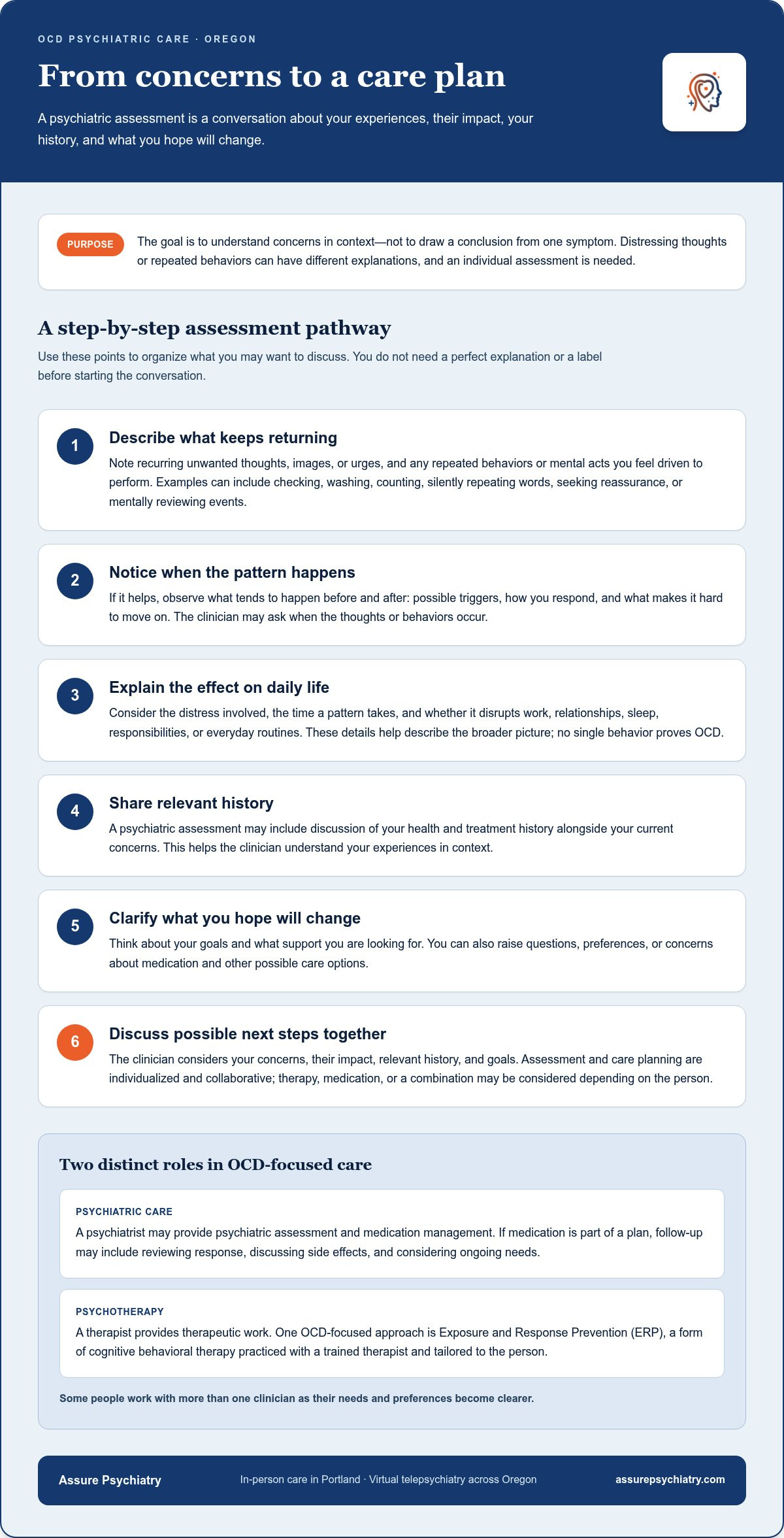
Preparing for OCD psychiatric care in Oregon: practical next steps
It’s understandable to feel unsure about what to say at an initial psychiatric visit. You don’t need a polished explanation or a definite label. A few notes can help you describe what’s been happening, how it affects you, and what you hope to understand. Use this short sequence to prepare at a pace that feels manageable.
- Describe your concerns. Note recurring thoughts, urges, or behaviors that have been troubling you. A brief example can be more useful than trying to explain everything at once.
- Record the impact. Consider whether these experiences affect your routines, responsibilities, relationships, or sense of well-being. Include when they tend to happen and what makes them harder or easier to manage.
- Gather relevant history. Write down current medications and relevant health or treatment history. If you don’t know every detail, bring what you have.
- Identify your goals and questions. Think about what you’d like help understanding, then note questions about the assessment, treatment choices, follow-up, and any medication concerns.
What to note before an initial appointment
A short list can serve as a reminder if it’s difficult to find the words during a conversation. You might record a few examples, when they occur, and which parts of daily life they affect. Include questions about possible next steps, medication options, and how follow-up works. Share what feels manageable; an evaluation is a conversation, not a test you have to pass.
Questions can be practical and personal. For instance: What will the assessment cover? What care options might fit my situation? How will we review progress or concerns? What should I know about possible medication effects? Bringing questions doesn’t commit you to a particular treatment. It helps make space for a collaborative discussion about your needs and preferences.
Choosing an Oregon visit format that feels manageable
Assure Psychiatry offers in-person visits at its Portland office and virtual telepsychiatry for people seeking care remotely in Oregon. Thinking about which setting feels more comfortable or practical may help you prepare. If anxiety is also part of what you’d like to discuss, the Portland anxiety treatment guide provides related information.
The practice accepts most major insurance plans. Coverage details can vary, so keep insurance questions alongside your care questions as you prepare. Finding an OCD specialist Oregon residents can access may begin with a psychiatric evaluation and an honest conversation about what you’re experiencing and what support you’re seeking.
If psychiatric evaluation or medication management feels like a useful next step, explore OCD psychiatric care with Assure Psychiatry.
OCD treatment at Assure Psychiatry: a supported next step
Finding a place to begin can feel like a lot, especially if you’re still making sense of your concerns. Assure Psychiatry is a Portland outpatient mental health clinic offering psychiatric evaluations and OCD treatment. Care focuses on understanding your needs and discussing medical support options, including medication management as part of an individualized psychiatric plan.
A personalized psychiatric approach to OCD concerns
A psychiatric evaluation is a chance to talk through what you’ve been experiencing, relevant health and treatment history, and what you’d like help with. The conversation can also cover how concerns affect everyday life and which questions matter most to you. You don’t need to arrive with a diagnosis or a complete account of everything; sharing what feels manageable can help create a useful starting point.
Care planning is individualized rather than based on a single approach for everyone. If medication is considered, decisions are discussed in the context of your assessment, preferences, and needs. Medication management can include follow-up conversations about response, possible side effects, and whether the plan still fits. The goal is to make decisions collaboratively, not to assume that medication is right for every person or that one choice will suit everyone.
It’s also helpful to understand the different roles in OCD care. Psychiatric evaluation and medication management address medical assessment and treatment planning. Psychotherapy is a separate form of care with a therapist; approaches such as CBT and Exposure and Response Prevention (ERP) involve therapeutic work and practice with a therapist. Knowing these distinctions can help you identify what kind of support you’re looking for and whether psychiatric care is a relevant next step.
Explore psychiatric care with Assure Psychiatry
For people seeking care in Oregon, Assure Psychiatry offers in-person visits at its Portland office and virtual telepsychiatry. The practice accepts most major insurance plans. These options can help you consider a visit format that feels practical, whether you prefer meeting in person or accessing care remotely.
You can start by exploring OCD treatment and psychiatric care through the clinic. Reviewing the care options can help you decide whether a psychiatric evaluation or medication-management conversation aligns with what you need. Bring questions and take part in decisions about your care at a pace that feels comfortable.
If you’re searching for an OCD specialist Oregon residents can access for psychiatric evaluation and medication management, Assure Psychiatry offers both in-person Portland visits and virtual telepsychiatry across Oregon. An evaluation provides an opportunity to discuss your concerns and goals, ask questions, and consider a personalized care plan.
Take a next step at your own pace
Looking for an OCD specialist Oregon residents can turn to may bring up questions before you feel ready to make a decision. You don’t need every answer first. A small step, such as noting what you want to understand or what would make care feel comfortable, can help you move forward without pressure.
If psychiatric care is the kind of support you’re considering, Assure Psychiatry is a Portland outpatient clinic offering psychiatric evaluation and OCD treatment. You can choose between in-person visits in Portland and virtual telepsychiatry across Oregon, and the practice accepts most major insurance plans. Exploring these options can help you decide whether a conversation about your concerns and care goals feels right for you.
Learning about care doesn’t commit you to a diagnosis or a specific treatment. It creates room to ask questions and consider support that respects your needs. Explore psychiatric care for OCD with Assure Psychiatry to learn more and take the next step toward an evaluation.
Frequently Asked Questions
Is every intrusive thought a sign of OCD?
No. Intrusive or unwanted thoughts can happen without indicating OCD, and a thought by itself can’t establish a diagnosis. What matters is the broader experience, including whether thoughts recur, cause significant distress, or lead to responses that interfere with daily life. If you’re worried, you can describe what’s happening to a clinician without deciding what it means in advance.
Can OCD involve mental compulsions without visible rituals?
Yes. Compulsions can be mental acts that others may not notice, such as silently repeating phrases, reviewing memories, counting, or trying to neutralize a thought. Someone might appear to be going about an ordinary task while internally repeating a sequence or seeking certainty. Sharing these private experiences during an assessment can help a clinician understand the full picture.
Can medication alone treat OCD?
Medication may be one part of OCD care, but whether it’s appropriate and whether it’s used alone or alongside psychotherapy depends on the person’s clinical assessment and preferences. Medication doesn’t provide the same kind of therapeutic work as approaches such as Exposure and Response Prevention. A psychiatric clinician can discuss medication options and follow-up; a therapist can address psychotherapy options.
How much does OCD treatment cost in Oregon?
There isn’t one cost for OCD treatment in Oregon. The amount can depend on the type of care, insurance benefits, and whether a visit is covered or paid for privately. Assure Psychiatry accepts most major insurance plans, but coverage and out-of-pocket expenses vary by plan. Review your benefits and the clinic’s current fee information as you plan for care.
Can I receive OCD psychiatric care by telehealth in Oregon?
Yes. Oregon residents can access virtual telepsychiatry through Assure Psychiatry, alongside in-person care at its Portland office. Before a virtual visit, consider choosing a private space where you can speak comfortably and have relevant notes or medication details nearby. If you’re outside Portland, telehealth may offer a remote way to discuss psychiatric care without traveling to the office.
What should I do if OCD symptoms become an immediate safety concern?
If you or someone else may be in immediate danger, call 911 or go to the nearest emergency department. For urgent emotional distress or thoughts of suicide in the United States, call or text 988 for the Suicide & Crisis Lifeline. Don’t wait for a routine psychiatric appointment if safety can’t be maintained. If possible, stay with a trusted person while seeking urgent help.
Recent Comments