

What if stability isn’t about never having difficult periods, but having steady support to respond when they arise? If you’re exploring long-term stability for bipolar disorder Portland care can support, it’s understandable to wonder whether a steadier path is possible and what ongoing care should look like. Progress isn’t guaranteed, and stability can mean different things for different people.
Continuing psychiatric care can give you time to review how you’re feeling, discuss medication effects or concerns, and consider your plan collaboratively. This guide explains what stability may mean, what to bring up during medication reviews, and how a few practical notes can help you prepare for appointments. It also covers how psychiatric support can fit alongside your existing healthcare team.
Assure Psychiatry is a Portland outpatient mental health clinic providing psychiatric evaluations and evidence-based, conservative medication management for bipolar disorder. Care is collaborative and personalized, with attention to your needs and broader healthcare support. Understanding the options can make it easier to decide what you’d like to discuss next.
Key Takeaways
- Stability is an individual care goal, not a guarantee that mood changes will never happen.
- Ongoing medication management provides time to share updates, discuss concerns, review your plan, and agree on next steps.
- Routine outpatient psychiatric care, therapy referrals, and urgent crisis support serve different needs.
- A few notes about your experience and questions can help you prepare for appointments and raise changes that concern you.
- Assure Psychiatry provides outpatient psychiatric evaluation and medication management for Oregon residents ages 10 to 65.
What long-term stability with bipolar disorder can mean in Portland
Wanting steadier days is understandable, especially if mood changes have affected your plans or relationships. Progress can look different for each person, and a difficult period doesn’t erase the work you’ve done. Long-term stability with bipolar disorder is an individual care goal: building a steadier, manageable life over time without expecting mood changes to disappear forever.
This is general educational information, not a diagnosis or individualized medical advice. A qualified mental health professional can help assess your needs and discuss care options. For a broad overview of symptoms, types, and general treatment approaches, see this resource on understanding bipolar disorder.
The phrase long-term stability for bipolar disorder Portland care can support doesn’t mean a particular result is assured. It describes an ongoing process: noticing what matters to you, discussing changes, and shaping care around your circumstances. Stability may include periods of better balance while leaving room to respond if your needs shift.
How can stability look different from one person to another?
For one person, a meaningful goal might be keeping up with work or school more consistently. Another might focus on restoring a daily routine, feeling more present in relationships, or managing responsibilities with less disruption. Goals can change as life changes, too. A single symptom, fixed timeline, or universal standard can’t capture what wellbeing means for everyone.
Consider what you’d like to make easier in everyday life. Are you hoping to follow through on plans, communicate more comfortably with loved ones, or manage responsibilities with greater ease? These aren’t measures of success or a checklist to complete. They’re starting points for a conversation with a qualified mental health professional, who can help you consider personal goals in the context of your health and circumstances.
Why is continuing care part of the conversation?
A diagnosis can offer a framework for understanding experiences, but it isn’t a complete long-term plan. Needs and priorities may evolve, and ongoing psychiatric care creates opportunities to discuss what has changed, what’s helping, and what still feels difficult. Follow-up appointments also provide time to ask questions that weren’t clear at first or raise concerns that have come up since your last visit.
Bring a few observations to help focus the conversation. You might note a change in daily functioning, a concern about your care plan, or a goal you want to revisit. There’s no single correct way to describe your experience. Sharing what feels relevant gives you and your clinician a basis for discussing next steps together. If you’re beginning your search for specialized support, a Portland guide to a bipolar disorder specialist can also help you think about what to look for in ongoing psychiatric care.
How ongoing medication management supports bipolar care over time
Medication management is an ongoing conversation, not a promise of a particular outcome. A follow-up gives you and your clinician a chance to consider how your current plan fits your experience and circumstances. You can describe what has changed, ask about medication effects or concerns, and discuss whether next steps may be appropriate. Medication decisions should be made with your clinician, who can consider your individual needs and health history.
The National Institute of Mental Health offers an overview of medication and ongoing care for bipolar disorder. During an appointment, everyday language is enough. You might describe a change in sleep, a concern about how a medication feels, or a question about your care plan. Raising a concern doesn’t mean a change must be made. It helps your clinician understand what matters to you.
What might a follow-up medication management visit cover?
A follow-up may include reviewing your experience with the current plan, discussing medication effects or concerns, and considering what you’d like to prioritize next. Raise questions even if they seem small or difficult to explain. Your clinician can help weigh the information and talk through options with you, so decisions are made collaboratively and with your circumstances in mind.
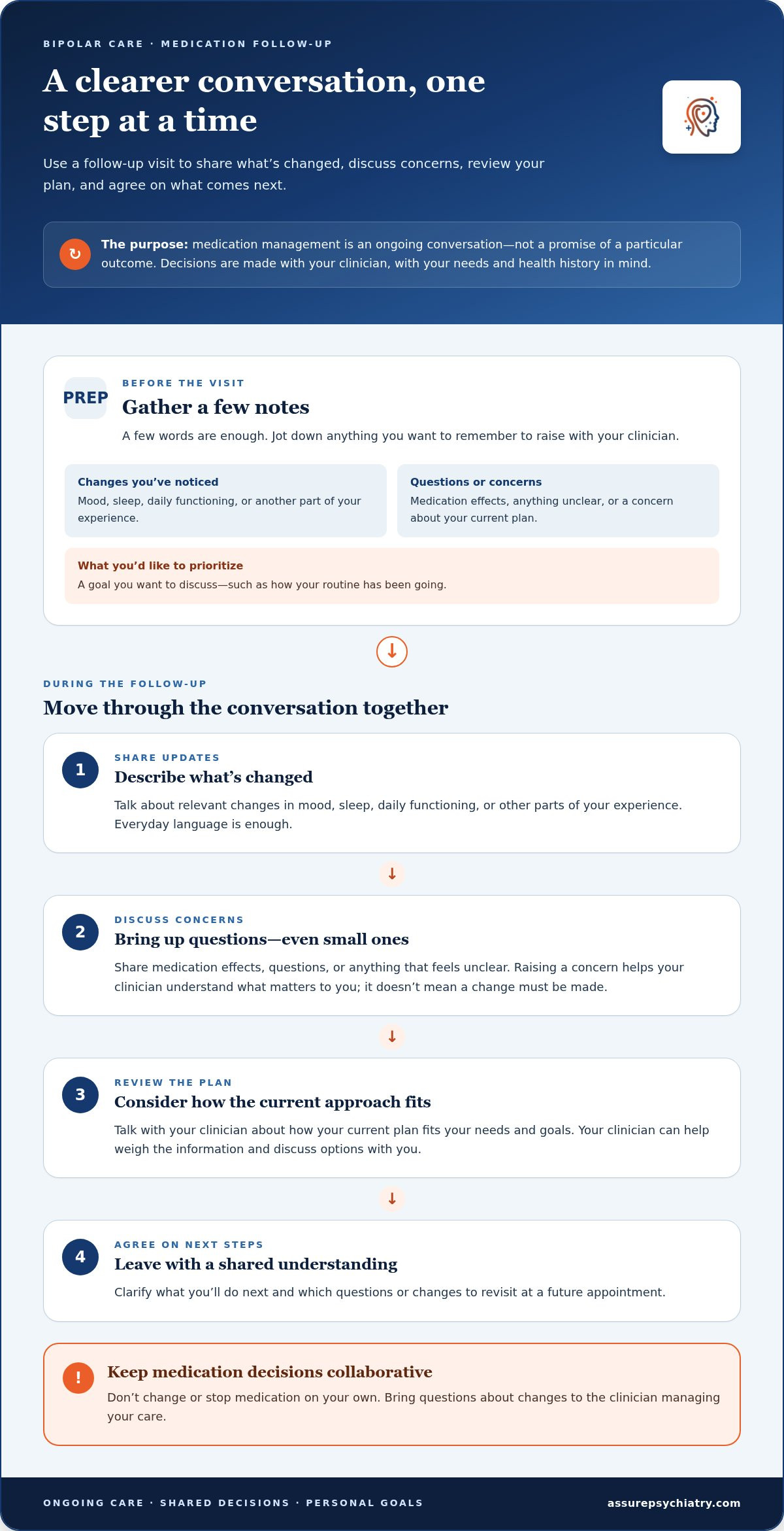
A clear sequence can help you prepare for the conversation:
- Share updates: Describe relevant changes in mood, sleep, daily functioning, or other parts of your experience.
- Discuss concerns: Bring up medication effects, questions, or anything that feels unclear.
- Review the plan: Talk with your clinician about how the current approach fits your needs and goals.
- Agree on next steps: Clarify what you’ll do next and what questions or changes to revisit at a future appointment.
How can patients prepare for a more useful appointment?
Before your visit, jot down questions, changes you’ve noticed, concerns about your current plan, and goals you want to discuss. A few words are enough. You might write, “I have a question about this effect,” or “I’d like to talk about how my routine has been going.” These prompts can help you remember what matters, especially if you’re unsure where to begin.
During the visit, focus on what you’ve observed and use everyday language. If you’re unsure whether something is relevant, mention it and let your clinician help assess its importance. Don’t change or stop medication on your own; bring questions about changes to the clinician managing your care. Assure Psychiatry provides collaborative, evidence-based, conservative Medication Management in Portland. To learn more, explore Assure Psychiatry’s outpatient medication management.
Comparing ongoing outpatient care with other support needs
Different kinds of support serve different purposes. Routine psychiatric follow-up helps you review your care plan over time. Therapy may provide a separate setting to work on emotional, behavioral, or relationship concerns. Urgent crisis support is for situations where immediate safety or urgent assessment matters more than a scheduled appointment. Knowing the difference can help you identify an appropriate next step without expecting one kind of care to meet every need.
| Type of support | Main purpose | How it differs |
|---|---|---|
| Outpatient psychiatric care | Evaluation and ongoing Medication Management for bipolar and other mood disorders. | Appointments support continuing care and discussion of an individualized plan. They aren’t emergency or inpatient services. |
| Therapy or psychologist services | Support for concerns that may benefit from psychotherapy or psychological services. | This is a distinct form of care. Assure Psychiatry provides referrals for therapy or psychologist services. |
| Urgent crisis support | Immediate help when there’s a serious safety concern or urgent need for assessment. | It shouldn’t wait for a routine follow-up. Emergency services or an appropriate crisis resource can help address immediate needs. |
What can outpatient psychiatric care address?
Outpatient psychiatric care can include an evaluation and ongoing Medication Management. At Assure Psychiatry, care is collaborative and tailored to each person’s needs, with attention to their experience and care plan over time. The aim is to support an ongoing clinical conversation, not to promise a specific result. For people seeking long-term stability for bipolar disorder, Portland outpatient care may be one part of broader support, alongside other services suited to their circumstances.
Outpatient appointments aren’t a substitute for emergency assessment or inpatient care when those levels of support are needed. Assure Psychiatry provides outpatient care, not inpatient crisis stabilization. If your needs change, your care team can help discuss appropriate next steps, including referrals for therapy or psychologist services where relevant.
When is urgent support different from a routine appointment?
A scheduled visit is generally for reviewing care and discussing concerns that can be addressed in an appointment. If you or someone else is in immediate danger, don’t wait for a routine appointment. Contact emergency services or go to an emergency department. If urgent support is needed but there’s no immediate danger, reach out to an appropriate crisis resource in your area. A crisis concern deserves timely attention, not a place on the list for your next medication review.
For a non-urgent question, make a note to bring it to your next appointment or follow the existing care plan for communicating with your clinician. If you’re unsure whether a situation is urgent, prioritize safety and seek guidance from emergency services or a crisis resource rather than relying on a routine outpatient visit. Knowing which support fits the moment can make it easier to take the next step.
Build a practical routine for discussing stability between appointments
You don’t need to keep a detailed log or interpret every change on your own. A few personal notes can help you remember what you want to discuss and make appointments more focused. Treat them as conversation prompts, not a treatment plan or a way to diagnose yourself. The aim is to share what matters to you and consider it with your clinician.
What information may be useful to bring to a follow-up?
Choose a format that feels manageable, such as a note on your phone, a paper list, or a few thoughts to remember. There’s no required schedule or amount to record. You might note a change that stood out, a concern about your care, or a question you didn’t have time to ask at your last visit.
- Changes that matter to you: Mention observations about mood, sleep, energy, or routines if they feel relevant. You don’t need to label or explain them.
- Daily life: Note whether anything has felt different at work or school, in relationships, or with responsibilities.
- Treatment questions: Write down questions about your current plan, medication effects, or concerns you want to raise.
- Personal priorities: Include a goal or part of life you’d like your care to support.
These notes support discussion, but they don’t replace professional assessment. If a change concerns you, bring it to your clinician rather than relying on your own interpretation. You can say, “I’m not sure if this is relevant, but I’ve noticed…” and let your clinician help explore what it may mean. A useful routine should reduce pressure, not become another responsibility you feel you must perform perfectly.
How can care stay connected across a healthcare team?
If you receive care from more than one clinician, sharing relevant updates can help each person understand what you want them to know. You might raise a medication concern with your psychiatric clinician and discuss related health information with another member of your care team. Ask what information is useful to share and how you’d like your care conversations to stay connected. Assure Psychiatry works collaboratively with patients’ existing healthcare teams, while each clinician remains responsible for care within their role.
Changes in clinicians can make continuity feel uncertain. If your psychiatric care is changing, a guide to switching psychiatrists can help you think through questions about the transition and information you may want to discuss with your next clinician.
Small, patient-led steps can make ongoing care easier to navigate. If you’re looking for collaborative psychiatric evaluation or medication management as part of long-term stability for bipolar disorder, Portland care at Assure Psychiatry may be a place to start. Explore ongoing care with Assure Psychiatry.
Explore ongoing bipolar disorder care with Assure Psychiatry in Portland
Continuing care gives you space to discuss your needs, ask questions, and consider next steps with a psychiatric clinician. Assure Psychiatry is a Portland outpatient mental health clinic serving Oregon residents ages 10 to 65. Its services include Psychiatric Evaluation and Medication Management, with personalized, collaborative care for bipolar disorder and other mental health concerns. Care is provided by a Psychiatric Mental Health Nurse Practitioner (PMHNP-BC).
What can patients expect from Assure Psychiatry’s approach?
Care is empathetic and culturally competent, with attention to your individual circumstances and priorities. Medication management is evidence-based and conservative, and decisions are discussed collaboratively rather than treated as one-size-fits-all. With your involvement, Assure Psychiatry also works with your existing healthcare team, supporting communication about relevant aspects of your care without promising a particular outcome.
Psychiatric care can be one part of a broader support plan. When therapy or psychologist services may be appropriate, Assure Psychiatry provides referrals. This can connect psychiatric evaluation and medication management with other kinds of support suited to your needs.
Assure Psychiatry offers telepsychiatry for eligible patients in Oregon through secure, HIPAA-compliant video. Specific criteria must be fulfilled to access remote appointments. The clinic accepts most major insurances, and it’s wise to verify your coverage. Discounted cash rates are available for uninsured patients.
How can Portland and Oregon residents take the next step?
A Psychiatric Evaluation can be a starting point for discussing your experience, questions, and care needs. You don’t need to arrive with a complete plan. It can help to think about what you hope to address, what concerns you have, and what you’d like a clinician to understand. For more context, Assure Psychiatry’s Portland psychiatric evaluation guide offers related information about this first step.
Searching for long-term stability for bipolar disorder in Portland, Washington, Oregon, or Seattle? Location matters: Assure Psychiatry provides outpatient care to Oregon residents, including people in Portland. Seeking support is a personal process, and talking with a clinician can be a meaningful place to begin. For questions about taking the next step, call 971-244-8844. The clinic’s team can help you understand the process for exploring outpatient psychiatric care. The goal is a thoughtful conversation about support that fits your needs, not a guaranteed outcome.
Take one thoughtful step toward steadier days
Working toward long-term stability for bipolar disorder Portland care can support doesn’t require you to have every answer before you begin. You might start by identifying one concern you want help understanding, one change you’ve noticed, or one part of daily life you hope to feel more supported in. Bringing that starting point into a psychiatric conversation can make the next step feel more personal and manageable.
Care is a partnership, and your questions belong in it. If you’re considering support, Assure Psychiatry offers collaborative, evidence-based, conservative medication management with care from a Psychiatric Mental Health Nurse Practitioner (PMHNP-BC). The clinic accepts most major insurances; coverage verification is encouraged.
Explore outpatient bipolar disorder care with Assure Psychiatry and consider what you’d like your first conversation to focus on. A steadier path can begin with one honest question and support shaped around your needs.
Frequently Asked Questions
Can someone with bipolar disorder work toward long-term stability?
Yes, a person with bipolar disorder can work toward greater stability, though no care plan can guarantee a particular outcome. If you’re searching for “long-term stability for bipolar disorder Portland,” remember that stability isn’t a pass-or-fail standard. A psychiatric clinician can help you explore support that may fit your situation, revisit your goals as life changes, and discuss concerns without treating a difficult period as a personal failure.
How long does ongoing medication management for bipolar disorder usually continue?
There’s no single timeline for everyone. Bipolar disorder may involve ongoing care, but the length and type of medication management depend on a person’s history, needs, and response to treatment. Your clinician can discuss the purpose of follow-up visits and review your plan over time. If you’re wondering whether your current care should continue, bring that question to the clinician managing your medication rather than trying to determine the duration alone.
Is it safe to stop bipolar medication when symptoms improve?
Don’t stop or change prescribed bipolar medication on your own, even if you’re feeling better. A change may affect your wellbeing, so discuss your reasons with the clinician who manages your medication. You can raise concerns about side effects, the plan, or whether treatment is still needed. Together, you can consider your options and decide how to proceed based on your circumstances.
What should I do if bipolar symptoms change between appointments?
If you notice a change that concerns you, contact your clinician using the communication process established for your care. Describe what has changed and when you noticed it, and ask what next step is appropriate rather than waiting for a scheduled visit if you’re worried. If you or someone else is in immediate danger, contact emergency services or seek urgent help. Routine appointments aren’t a substitute for emergency support.
Can lifestyle changes replace professional bipolar disorder care?
No. Lifestyle practices may support general wellbeing, but they shouldn’t replace professional assessment or prescribed care for bipolar disorder. If a change in routine, sleep, or another daily habit seems to affect how you feel, share that observation with your clinician. They can consider it alongside your overall care needs. Discuss changes to medication or your treatment plan with the clinician responsible for your care.
Is telepsychiatry available for bipolar care in Portland?
Assure Psychiatry offers telepsychiatry to eligible patients in Oregon, including those seeking care in Portland. Appointments use secure, HIPAA-compliant video, and specific criteria must be fulfilled to access remote appointments. A Psychiatric Evaluation can provide a starting point for discussing your needs and appropriate outpatient care.
Does Assure Psychiatry accept insurance for bipolar disorder care?
Assure Psychiatry accepts most major insurances, and patients are encouraged to verify coverage with their insurance plan. Before arranging care, you can ask your insurer how your benefits apply to psychiatric evaluation and medication management. Coverage details can vary by plan, so reviewing your benefits can help you understand what to expect. Discounted cash rates are available for uninsured patients.
Recent Comments