

Seeking psychiatric care shouldn’t mean having to prove that your concerns are serious enough. If you’re looking for a psychiatrist for women Portland residents can feel comfortable speaking with, it’s reasonable to want a provider who listens and considers the full picture, including your health history, daily pressures, and changes over time.
Emotional or behavioral changes can leave you wondering whether an evaluation might help. You may also have questions about medication, insurance, or what happens at a first appointment. Those questions deserve clear, judgment-free answers. At Assure Psychiatry, a Psychiatric Mental Health Nurse Practitioner provides individualized psychiatric evaluations and conservative medication management in collaboration with you and your healthcare team.
This guide explains what to look for in care that respects your experiences, what an initial evaluation and ongoing medication support may involve, and how to prepare for your first conversation. You’ll also learn about in-person appointments in Portland, telepsychiatry for eligible Oregon residents who meet specific criteria, and insurance considerations. The aim is to help you understand your options and choose a comfortable next step at your own pace.
Key Takeaways
- Ongoing changes in mood, sleep, focus, or daily routines may be worth discussing with a psychiatric provider, even if you’re unsure what they mean.
- A psychiatric evaluation connects your concerns and personal history to possible care options; no single symptom determines a diagnosis.
- Understand how psychiatric evaluation, medication management, and psychotherapy differ so you can consider what kind of support fits your needs.
- Looking for a psychiatrist for women Portland residents can turn to? Learn how individualized, collaborative care can help you feel heard and involved in decisions.
- A few notes about your concerns, symptom patterns, medications, history, and questions can help you feel more prepared for an initial appointment.
When to consider a psychiatrist for women in Portland
Asking for psychiatric support can feel like a big step, especially if you’re unsure whether what you’re experiencing is “serious enough.” You don’t need a diagnosis or a complete explanation before starting a conversation. A psychiatrist for women Portland residents seek should make room for questions and help you consider whether an evaluation fits your needs.
Notice changes that persist or begin to affect everyday life. A shift in mood, disrupted sleep, difficulty focusing, or trouble keeping up with work, school, relationships, or familiar routines may be worth discussing with a psychiatric provider. These signs can have different explanations, and none alone confirms a mental health condition. You can seek an evaluation to understand your options without committing to a specific treatment.
A psychiatric consultation is an opportunity to understand your concerns and explore care options, not a diagnosis in itself or a promise of a particular outcome.
What concerns can lead someone to seek psychiatric support?
People may consider an evaluation when dealing with anxiety, depression, grief, trauma-related concerns, or ongoing sleep difficulties. The question isn’t whether your experience matches someone else’s. It’s whether it’s affecting your well-being or making daily responsibilities harder to manage.
For example, worry might disrupt your rest, low mood might make ordinary tasks feel unusually difficult, or changes in focus might affect school or work. Grief and trauma can also affect people in different ways. Some new parents experience postpartum depression, while others don’t. Feeling uncertain about what you’re experiencing is a reason to ask questions, not to judge yourself.
Women’s experiences can be shaped by personal, social, cultural, and biological factors. The overview of women’s mental health describes some of this broader context. Sharing what’s relevant to you, such as changes in health, relationships, responsibilities, or life circumstances, may help a provider understand your concerns more fully. You don’t have to decide in advance which details matter.
What should supportive care feel like?
Supportive psychiatric care should feel like a conversation, not an interrogation or a rushed judgment. You should have room to explain what has changed, what concerns you, and what you hope might improve. A provider may ask about your history and current circumstances, then discuss possible next steps in language you can understand.
Culturally competent care makes space for how your identity, values, community, and lived experiences shape your perspective. You should be able to share what feels important and take part in decisions rather than feeling that choices are being made for you. A provider’s gender may matter to your comfort, but gender alone doesn’t determine whether care is a good fit. Feeling heard, respected, and included matters, too.
How psychiatric evaluations connect symptoms, history, and care options
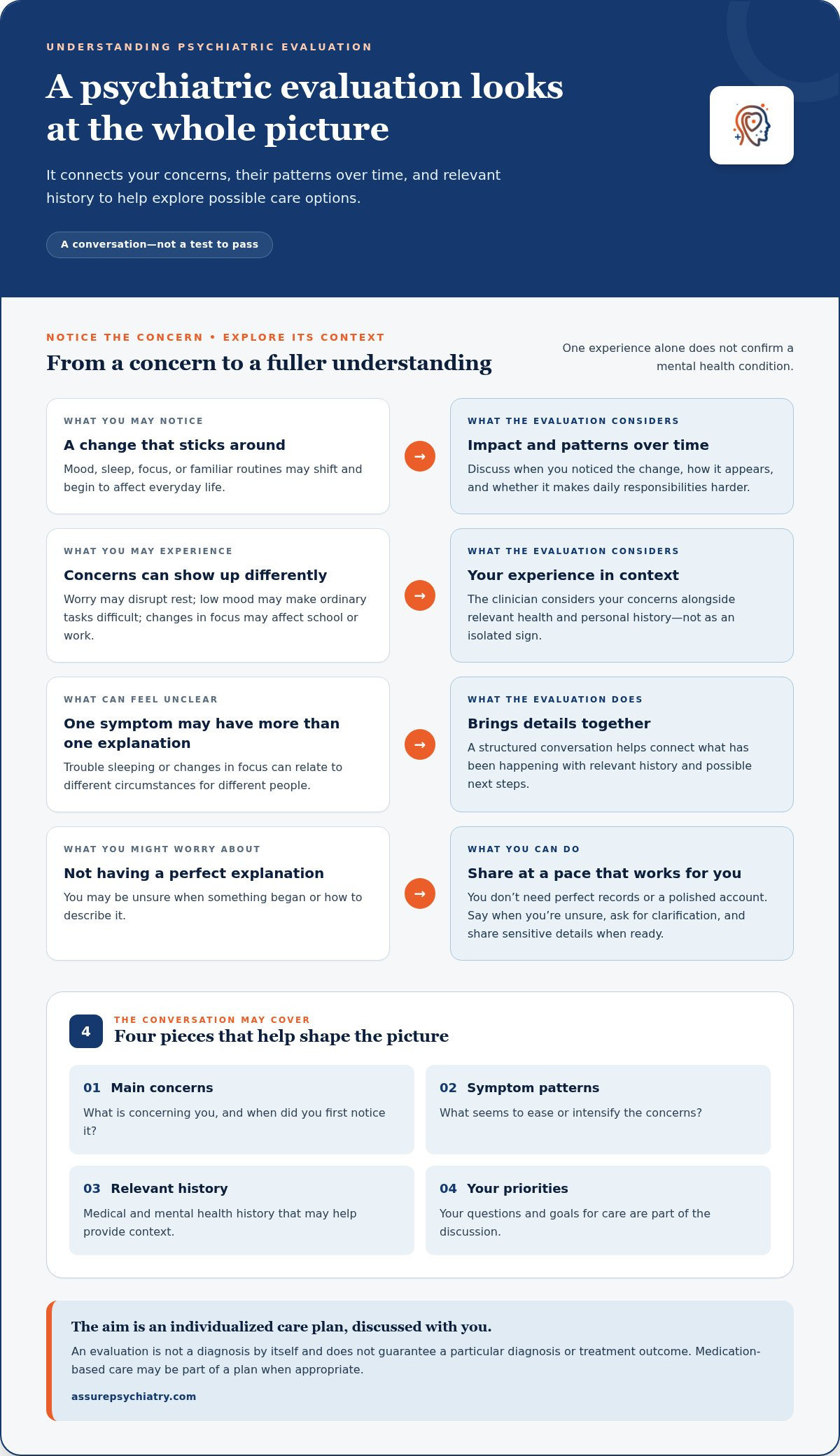
A psychiatric evaluation is a structured conversation to understand what’s been happening, learn relevant health and personal history, and consider possible next steps. It isn’t a test you need to pass or a quick judgment based on one symptom. The clinician considers how concerns appear over time and in context, then discusses what care options may make sense.
Context can change how a concern is understood. Trouble sleeping, for example, may relate to different circumstances for different people. Focus changes can have more than one possible explanation, too. An evaluation brings together details rather than treating a single experience as proof of a diagnosis. You can share what feels relevant at a pace that works for you and ask for clarification whenever you need it.
An evaluation helps shape an individualized care plan; it doesn’t guarantee a particular diagnosis or treatment outcome.
During an initial appointment, the clinician may ask about:
- Your main concerns and when you first noticed them
- Patterns in symptoms, including what seems to ease or intensify them
- Relevant medical and mental health history
- Your priorities, questions, and goals for care
These topics help the clinician consider the whole picture before discussing next steps. You don’t need perfect records or a polished explanation. If you’re unsure when something began or how to describe it, say so. Your questions are part of the conversation, and you can share sensitive details when you feel ready. The clinician uses the assessment to formulate a treatment plan with you, which may include medication-based care when appropriate.
For women, relevant context may include life changes, family or work responsibilities, relationships, cultural experiences, and health events. None should be assumed to explain symptoms on its own. The Office on Women’s Health also describes how mental health concerns can involve individual experiences and circumstances. Sharing what feels connected to your well-being can help the clinician understand your perspective without reducing it to one factor.
Postpartum depression is one of the concerns Assure Psychiatry treats, but every person’s situation is different. A psychiatric evaluation can help explore what you’re experiencing and discuss care options without presuming that parenthood, reproductive history, or hormonal changes are the cause.
If you’re searching for a psychiatrist for women Portland residents can speak with about individualized, medication-based care, learn more about Assure Psychiatry’s psychiatric evaluations.
Medication management, therapy, and the questions women may weigh
Psychiatric care and psychotherapy can serve different purposes, and neither is automatically right for everyone. An evaluation helps a clinician understand your concerns and discuss possible care. Medication management focuses on prescribed medication and how it’s working over time. Psychotherapy, often called therapy, offers a space to work through thoughts, feelings, and life experiences. Some people use one approach; others find that different forms of support complement each other.
If you’re looking for a psychiatrist for women Portland patients can turn to for medication-based care, it may help to understand what each option is designed to do:
| Type of care | Main purpose | What it may involve |
|---|---|---|
| Psychiatric evaluation | Understand concerns and consider care options | Discussing symptoms, relevant history, and possible treatment planning |
| Medication management | Review prescribed medication as care continues | Discussing how it’s working, side effects, and possible adjustments |
| Psychotherapy | Explore emotional experiences and develop ways to respond to challenges | Ongoing conversations with a therapist or psychologist |
What does follow-up medication management involve?
Follow-up visits give you time to talk about your experience with prescribed medication, including whether you’ve noticed changes and whether you’re having side effects. If an adjustment is being considered, decisions are guided by your progress and the clinician’s assessment, with your perspective included in the discussion. For a closer look at this ongoing care, explore the Portland medication management guide.
Medication isn’t necessary or suitable for every person or situation. You can raise questions about potential benefits, concerns, and monitoring before deciding on a plan with your provider. The goal is a thoughtful, individualized conversation, not pressure to choose a particular treatment.
Can psychiatric care work alongside therapy?
Yes. Psychiatric evaluation and medication management address assessment and medication-based care, while psychotherapy provides a different kind of support. Assure Psychiatry provides psychiatric evaluations and medication management, and offers referrals for therapy or psychologist services when appropriate. These options may complement one another, but the right mix depends on a person’s needs and preferences.
If you’re weighing what to expect from an assessment, the psychiatric evaluation guide explains how an initial conversation can inform care options. You can bring questions about medication and therapy to that discussion, then consider next steps with your clinician.
Preparing for a first psychiatric appointment in Portland
A first appointment can feel easier when you have a few notes to refer to, but you don’t need a perfect timeline or complete medical file to begin. Preparation is meant to help you remember what matters to you, not to prepare a case or arrive with a diagnosis. A short list can be enough to guide the conversation.
What information can help you prepare?
Before your visit, consider jotting down what brought you in and a few examples of how it affects everyday life. You might note when you first noticed a change, whether it comes and goes, or what seems to make it easier or harder. Bring medication names and doses if you have them, including supplements, and any relevant medical or mental health history you can recall. If a detail escapes you, that’s okay.
- Your main concerns and the changes you’ve noticed
- Patterns in sleep, mood, focus, or daily routines that feel relevant
- Current medications and supplements, plus relevant health history
- Questions about the evaluation, follow-up visits, or treatment choices
It can also help to write down what you hope to get from care, even if your goal is simply to understand your options. You can ask how follow-up medication management works or what choices may be considered after an evaluation. There’s no requirement to decide on treatment before you’ve had a chance to talk it through.
For practical planning, Assure Psychiatry accepts most major insurance plans. Verify coverage with your insurance plan, since benefits can vary. Discounted cash rates are available for uninsured patients. Checking your benefits ahead of time may help you understand your coverage and plan for the appointment.
How do in-person and virtual appointments differ?
Assure Psychiatry offers in-person appointments at its Portland office. For some patients in Oregon, appointments may also be available through secure, HIPAA-compliant telepsychiatry, provided specific criteria are fulfilled. The format can affect practical details, such as where you attend from, so consider which option feels workable while keeping eligibility requirements in mind.
If you’re considering a remote visit, the Oregon telepsychiatry guide offers more information about virtual mental health appointments. Whether you meet in person or by video, you can bring your notes and questions and share information at a pace that feels manageable.
If you’re ready to explore an appointment with a psychiatrist for women Portland residents can access for individualized evaluation and medication support, learn about psychiatric care with Assure Psychiatry.
How Assure Psychiatry supports women seeking care in Portland
Finding psychiatric care is about more than locating an appointment. It also means finding a setting where your concerns are taken seriously, your experiences are considered in context, and you can participate in decisions about care. Assure Psychiatry is a Portland outpatient mental health clinic offering empathetic, culturally competent psychiatric evaluations and medication management for Oregon residents ages 10-65.
Care is provided by a Psychiatric Mental Health Nurse Practitioner (PMHNP-BC). Assure Psychiatry takes a collaborative approach, working with you and your existing healthcare team. The clinic supports people with a range of needs, including women looking for care that respects their individual circumstances. The focus is on listening and understanding, not assuming that everyone’s symptoms or goals are the same.
What makes Assure Psychiatry’s approach collaborative?
A care plan begins with your concerns and treatment goals. The clinician considers your assessment and discusses appropriate options with you, including evidence-based, conservative medication management when it’s part of the plan. You can share questions or concerns as decisions are considered, so the discussion reflects your experience as well as clinical judgment.
With your involvement, care can also be coordinated with your existing healthcare team. Sharing relevant information across clinicians can help keep care connected, especially when more than one provider is involved in your health. Medication choices and follow-up planning are individualized; no particular response or outcome can be promised. Your plan can be revisited through ongoing conversations about your needs and experience.
What is a simple next step for Portland patients?
You don’t need to have every question answered before exploring care. If ADHD is one of your concerns, the Portland ADHD psychiatrist guide offers information related to that specific search. For a broader overview, Assure Psychiatry’s care and appointment information explains psychiatric evaluations and medication support. For people comparing Portland, Oregon, with Seattle, Washington, the important local detail is that Assure Psychiatry serves Oregon residents.
If you’re searching for a psychiatrist for women Portland residents can approach for respectful, individualized psychiatric care, explore what an initial evaluation involves or call 971-244-8844 with questions. Taking time to learn about your options is a valid step, whether or not you’re ready to schedule.
Take a steady, informed step toward support
You don’t have to know exactly what you need before reaching out. A first step can simply be learning more, gathering your questions, and noticing what would help you feel comfortable in a conversation about care. The right plan should make room for your priorities and can be discussed collaboratively, without pressure to decide everything at once.
If you’re considering a psychiatrist for women Portland patients can turn to for individualized psychiatric care, Assure Psychiatry offers care with a Psychiatric Mental Health Nurse Practitioner (PMHNP-BC). The clinic accepts most major insurance plans, and patients are encouraged to verify coverage. Secure, HIPAA-compliant telepsychiatry is available to patients who fulfill specific criteria.
When you’re ready, explore care options with Assure Psychiatry. You deserve to have your concerns heard and your choices treated with care. Moving toward support can begin with one question.
Frequently Asked Questions
How do I find a psychiatrist for women in Portland who will listen to my concerns?
Look for psychiatric care that makes room for your perspective, questions, and treatment goals. At Assure Psychiatry, care is provided by a Psychiatric Mental Health Nurse Practitioner (PMHNP-BC) and emphasizes listening, cultural competence, and collaboration. You can share what you want help with, ask for explanations in plain language, and discuss what matters most to you. A supportive conversation should leave space for you to participate in decisions.
Can a psychiatrist help with postpartum depression or anxiety?
Yes. A psychiatric evaluation can help explore concerns such as postpartum depression or anxiety and discuss appropriate care options. Assure Psychiatry treats depression, including postpartum depression, and anxiety. Each person’s experience is individual, so symptoms shouldn’t automatically be attributed to parenthood or a particular health change. If symptoms are affecting daily life, you can describe what you’re noticing and ask whether an evaluation may help clarify possible next steps.
What happens during an initial psychiatric evaluation?
An initial evaluation is a conversation that helps the clinician understand your concerns and consider care options. You may be asked what prompted the appointment, about your relevant health history, and what you hope to address. It’s okay if you don’t remember every detail. You can bring notes, ask the clinician to explain unfamiliar terms, and say if a question feels unclear. The assessment informs an individualized treatment plan.
Do I have to take medication after seeing a psychiatrist?
No. Having an evaluation doesn’t mean you must agree to medication. The appointment is an opportunity to discuss what you’re experiencing and consider options with the clinician. If medication is proposed, you can ask about its purpose, possible side effects, and how follow-up would work before making a decision together. Medication may not be suitable or necessary for everyone, and a plan should reflect your individual assessment and preferences.
Can I see a Portland psychiatrist through telepsychiatry in Oregon?
Assure Psychiatry offers secure, HIPAA-compliant video telepsychiatry for Oregon patients who fulfill specific criteria. Remote appointments aren’t automatically available to every patient, so eligibility requirements apply. In-person appointments are also offered at the Portland office. If you’re considering a video visit, think about whether the format suits your needs and review the clinic’s telepsychiatry information as part of planning your next step.
Does Assure Psychiatry accept insurance for psychiatric care?
Assure Psychiatry accepts most major insurance plans, but coverage varies by plan and service. Verify your benefits with your insurer so you understand your coverage before your appointment. Discounted cash rates are available for uninsured patients. You can also write down questions about whether your plan includes psychiatric evaluations or medication management to make it easier to discuss your options.
What ages does Assure Psychiatry serve in Oregon?
Assure Psychiatry serves Oregon residents ages 10-65. This age range can help families and individuals understand whether the clinic’s outpatient psychiatric care may be relevant for them. Services include psychiatric evaluations and medication management. If you’re looking into care for a young person, it may be useful to note the concerns you’ve observed and any questions about how an evaluation is approached, so those priorities can be raised during the appointment process.
Can psychiatric medication management happen alongside therapy?
Yes. Psychiatric medication management and therapy can be part of a person’s broader care, addressing different needs. Assure Psychiatry provides psychiatric evaluations and medication management, and offers referrals for therapy or psychologist services when appropriate. If you already work with a therapist or psychologist, you can mention that during your psychiatric care conversation. With your involvement, relevant coordination with your existing healthcare team can help keep care connected.
Recent Comments