

If depression hasn’t improved with treatment, you may be looking for a more focused review rather than another version of the same conversation. It’s understandable to feel discouraged or unsure what comes next. Searching for “help for treatment-resistant depression Oregon” can be a way to find information, but the term doesn’t define you or determine which care may suit you.
Clinicians may use “treatment-resistant depression” when symptoms haven’t responded sufficiently to at least two antidepressant trials at an adequate dose and duration. The definition and clinical context can vary, so the term isn’t a diagnosis you need to reach on your own. A psychiatric evaluation can review your symptoms, health and treatment history, and medication experiences to make the conversation specific to you.
This guide explains what the term can mean, what a medication-focused psychiatric review may cover, and what details to bring, such as medication names, doses, how long you took them, benefits, and side effects. It also describes a next step for Oregon residents considering outpatient psychiatric care. The aim is a clearer, collaborative conversation, not a promise of a particular outcome.
Key Takeaways
- If you have them, bring a medication list, past treatment details, and questions to help make a psychiatric evaluation more specific.
- A careful review can consider symptoms, health history, side effects, and how depression affects daily life.
- Medication management and therapy referrals have different roles. Which options may fit depends on an individual assessment.
- For help for treatment-resistant depression Oregon, a collaborative psychiatric evaluation can offer a supported next step without promising a particular result.
- Assure Psychiatry provides outpatient psychiatric evaluations and medication management for Oregon residents ages 10 to 65, with care delivered by a psychiatric mental health nurse practitioner.
What Does Treatment-Resistant Depression Mean, and When Should You Seek Help in Oregon?
When depression symptoms continue despite care, it can be hard to know whether to try another conversation or what to ask. You may wonder whether you missed something or whether treatment should have helped by now. Ongoing symptoms aren’t a personal failure. They’re a reason to review what’s happening with a healthcare professional, especially if low mood or loss of interest is affecting everyday life.
“Treatment-resistant depression” describes depression symptoms that haven’t improved enough with previous treatment; the term alone doesn’t diagnose you or determine what treatment should come next. Definitions vary. The National Alliance on Mental Illness (NAMI) describes a common use of the term as continued symptoms after trying two or more antidepressant medications over several months. This can be a starting point for discussion, not a do-it-yourself diagnostic rule. The broader Treatment-resistant depression overview also reflects that definitions and approaches vary.
A clinician can consider your symptoms and treatment history before deciding whether the label fits. Persistent symptoms deserve attention even if your history doesn’t match a particular threshold. In a psychiatric evaluation, you can explain what you’ve experienced and tried, then review the full picture with the clinician.
Why the term does not tell the whole story
A medication review looks at more than the number of treatments you’ve tried. Dose and duration can help determine whether a treatment was an adequate trial. Side effects or difficulty taking a medication consistently can also affect the experience. These details are topics for discussion, not automatic proof of a diagnosis.
For example, two people who stopped the same medication may have had very different experiences. One may have stopped because of difficult side effects; another may have taken it as prescribed without enough relief. Those details help a clinician understand what a past treatment can and can’t tell you. Needing another review doesn’t mean you did anything wrong. If you’re seeking help for treatment-resistant depression Oregon, a careful assessment can make your treatment history useful context rather than a judgment about your choices.
When persistent symptoms deserve another conversation
Consider speaking with a healthcare professional if low mood, loss of interest, or other depression symptoms continue, return, or interfere with work, relationships, sleep, or everyday responsibilities. You don’t have to be certain that “treatment-resistant” applies before reaching out. If symptoms worsen or you have new concerns, tell a healthcare professional promptly what has changed.
If you’re having suicidal thoughts, call or text 988 for immediate crisis support. If you or someone else is in immediate danger, call 911. These steps are about safety, not diagnosis. For other ongoing concerns, a clinical conversation can help clarify what’s happening and what support may be appropriate.
How a Careful Review Can Clarify Depression Treatment That Has Not Helped
A review of treatment that hasn’t helped enough is more than a count of medications. It’s an opportunity to discuss how symptoms have changed, what care you’ve received, and how you experienced it. When the response has been limited, a clinician may revisit the working diagnosis or treatment plan. That doesn’t mean earlier care was pointless or that you need to start over without explanation.
What a psychiatric evaluation can help examine
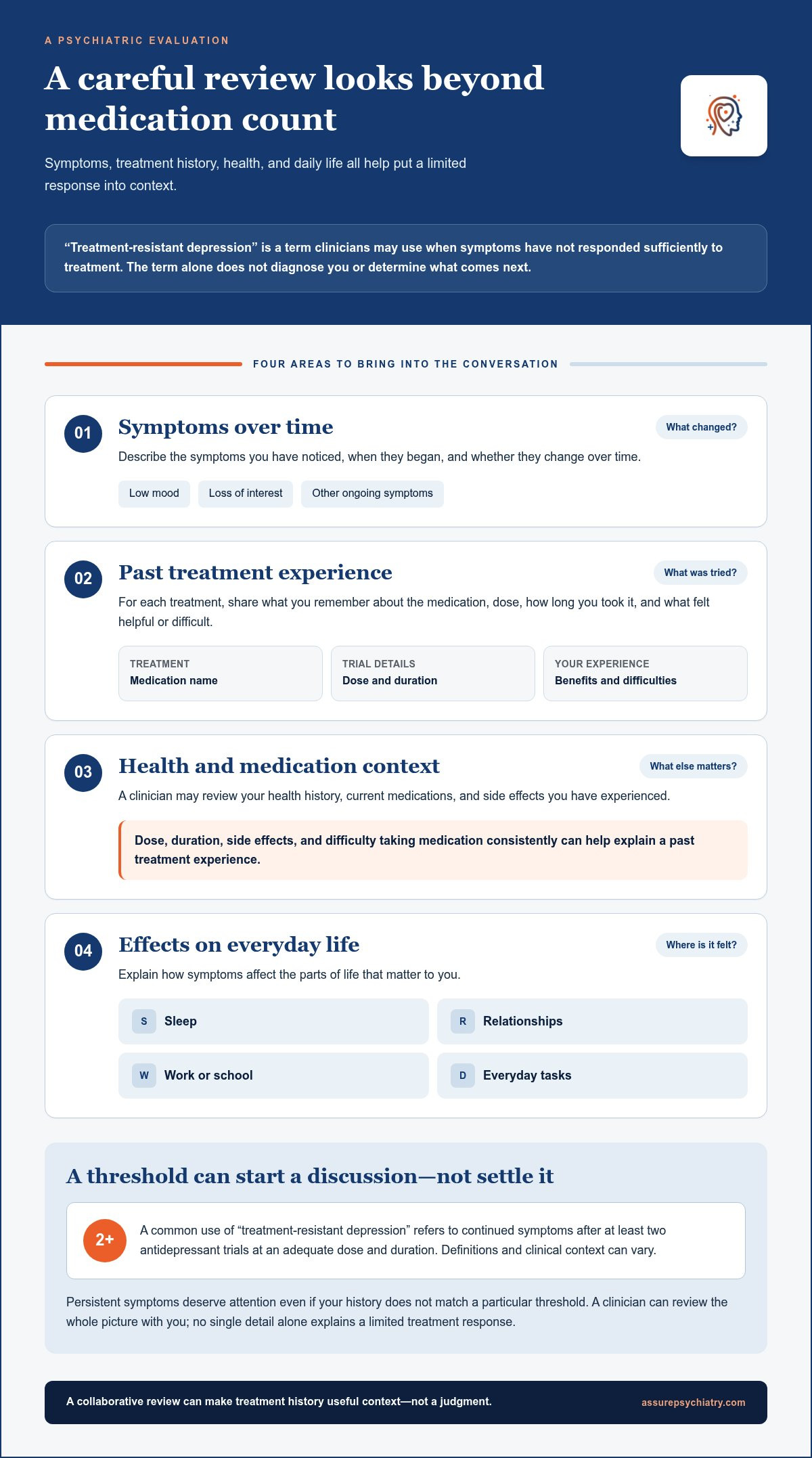
A psychiatric evaluation can bring several parts of your experience into one conversation. A clinician may ask about:
- Which symptoms you’ve noticed, when they began, and whether they change over time
- Previous treatments, how long you used them, and what felt helpful or difficult
- Health history, current medications, and side effects you experienced
- How symptoms affect sleep, relationships, work, school, or everyday tasks
These details provide context, but none alone explains why a treatment response was limited. Side effects, for example, may have made it difficult to continue a medication, or your symptoms may have changed over time. A clinician can ask what you hoped would change, what did change, and what concerns remain. You can also mention if a past conversation felt rushed or if you’re worried the next one will repeat the same questions. The NAMI overview of treatment-resistant depression offers additional background; decisions about your care depend on an individual clinical review.
Why treatment response can differ from person to person
Symptoms, health histories, daily demands, and experiences with medication differ from person to person. A clinician may explore whether other health concerns, life circumstances, or treatment effects are relevant in your situation. These are possibilities to assess, not assumptions about the cause of your symptoms or a disappointing response.
Treatment response makes the most sense when it’s reviewed alongside your symptoms, health history, and lived experience, not judged by a single rule. Dose and duration are also clinician-guided considerations. A prescriber can discuss whether a past trial provides useful information and review possible next steps with you. Don’t stop, increase, decrease, or otherwise change a medication without guidance from your prescriber. If you’re seeking help for treatment-resistant depression Oregon, sharing what you tried and how it affected you can make the conversation more focused.
A psychiatric evaluation is a collaborative process, not a test you have to pass. Oregon residents considering a medication-focused review can explore psychiatric evaluation and medication management with Assure Psychiatry. Care is provided by a Psychiatric Mental Health Nurse Practitioner and can include coordination with your existing healthcare team.
How Do Medication Management and Other Depression Treatment Approaches Differ?
When depression symptoms persist, treatment can involve different kinds of support. A medication review looks at past treatment and current needs; ongoing medication management follows how a plan is working over time. Therapy referrals and other clinician-directed approaches have different roles. Which options may be appropriate depends on an individual clinical assessment, not simply on a label or a list of treatments.
| Approach | What it may involve | How it differs |
|---|---|---|
| Medication review | Discussing medication history, response, side effects, and treatment goals | Helps clarify what has been tried and what questions remain |
| Medication management | Follow-up monitoring of efficacy, side effects, and progress | Supports ongoing, clinician-guided medication decisions |
| Therapy referral | Connecting with therapy or psychologist services when appropriate | Adds a non-medication perspective to coordinated care |
| Other clinician-directed options | Assessment of options such as TMS or esketamine in relevant clinical settings | Suitability and access depend on clinical factors and the treatment setting |
The National Institute of Mental Health’s information on depression treatment describes medication and psychotherapy among treatment approaches. The table is a general guide, not a recommendation for any one person. TMS, esketamine, and other specialized approaches are examples to discuss with qualified clinicians; they should not be assumed to be suitable for every patient.
What ongoing medication management involves
Follow-up visits provide time to discuss how medication is affecting you, including benefits, side effects, concerns, and changes in symptoms or daily functioning. At Assure Psychiatry, Medication Management is evidence-based and conservative, with decisions made collaboratively rather than treated as automatic steps. Your preferences matter. Discuss medication or dosage changes with the prescribing clinician instead of making changes on your own.
For a closer look at follow-up care, the medication management guide explains how ongoing review can support informed conversations about care.
How coordinated care can include more than medication
With your consent, depression care can involve coordination with your existing healthcare team so relevant information can inform treatment decisions. When appropriate, Assure Psychiatry can also provide referrals for therapy or psychologist services as part of coordinated care. A referral is different from medication management, but both may have a place in an individualized plan.
A psychiatric evaluation can help organize questions about symptoms, history, and treatment needs before you discuss next steps. The psychiatric evaluation guide offers more context. For people seeking help for treatment-resistant depression Oregon, a thoughtful discussion can clarify which care paths may be worth considering without promising a particular result.
What to Prepare Before Seeking Help for Treatment-Resistant Depression
Preparing for an evaluation doesn’t mean you’re responsible for finding the answer or proving that a treatment failed. A few notes can help you explain your experience, but you don’t need a perfect timeline or a complete set of medical records to ask for support. Bring what you have and work with the clinician to fill in the picture.
Build a clear treatment and symptom timeline
If it feels manageable, gather medication and symptom details in one place. Approximate information is useful. If you don’t know something, mark it as unknown rather than guessing. You might note:
- Medication names, approximate dates taken, prescribed doses if known, and any benefits or side effects you noticed
- How symptoms changed over time, including periods when things felt better or harder
- Effects on school, work, relationships, sleep, or daily routines
- Relevant health history and current medications, including those prescribed for other concerns
A brief note such as “sleep became difficult after starting the medication” can help, even if you can’t recall the exact date. The goal isn’t to interpret the information on your own. It’s to give your psychiatric clinician useful context for discussing your care.
Prepare questions and practical appointment details
Think about what you most want the appointment to address. You might write down a change you hope for, a concern about side effects, or a question such as, “How will we know whether this plan is helping?” If you’ve felt dismissed or had the same conversation before, it’s okay to say so. Your questions and preferences belong in the discussion.
Keep your notes and medication list nearby during an appointment, whether on paper or on a device. For remote appointments in Oregon, specific criteria must be fulfilled to access telepsychiatry. The Telepsychiatry in Oregon guide explains more about virtual mental health care.
Assure Psychiatry accepts most major insurances. Verify coverage with your insurance plan because benefits can vary. Discounted cash rates are available for uninsured patients. If you don’t have your records yet, you can still ask about an evaluation. Share what you remember and add details later if they become available.
Writing down your current concerns can make a first conversation feel more manageable. If you’re looking for help for treatment-resistant depression Oregon, you can explore a psychiatric evaluation with Assure Psychiatry as a supported next step.
Finding Support for Treatment-Resistant Depression in Oregon with Assure Psychiatry
If depression symptoms haven’t improved as you hoped, a useful next step may be a conversation focused on your needs and history, rather than an assumption about what you should try next. Assure Psychiatry is an outpatient mental health clinic in Portland, Oregon, serving Oregon residents ages 10 to 65. Its Psychiatric Evaluation and Medication Management services provide a setting to discuss your concerns, previous care, and treatment questions in a collaborative clinical review.
What patients can expect from Assure Psychiatry
Care is provided by a Psychiatric Mental Health Nurse Practitioner (PMHNP-BC). During a psychiatric evaluation, you can discuss symptoms, health and medication history, and what has or hasn’t felt helpful. The clinician works with you to understand your situation and consider appropriate next steps, rather than reducing your experience to a label.
Medication decisions are individualized, evidence-based, and conservative. If you continue with Medication Management, follow-up care includes monitoring medication efficacy, side effects, and progress. You can share your preferences and concerns as the plan is considered. With your consent, Assure Psychiatry can also collaborate with your existing healthcare team to coordinate relevant care information.
Assure Psychiatry offers Telepsychiatry through secure, HIPAA-compliant video for Oregon residents who meet specific criteria for remote appointments. Specific criteria must be fulfilled to access remote appointments. In-person visits are available at the Portland office.
Choose a manageable next step in Oregon
You don’t need a complete record or a firm conclusion about whether your experience fits treatment-resistant depression. It can be enough to explain what has been difficult and what you want help understanding. The psychiatric evaluation process offers more detail about beginning that conversation.
Assure Psychiatry accepts most major insurances, and patients are encouraged to verify their coverage. Discounted cash rates are available for uninsured patients. For information about outpatient care, call 971-244-8844.
If you’re considering help for treatment-resistant depression Oregon, you can take time to decide whether an evaluation feels like a useful next step. Explore care with Assure Psychiatry when you’re ready. An evaluation offers an opportunity to review your situation with a clinician and consider a path forward together, without a promised outcome.
Take One Step Toward More Supported Care
You don’t have to know exactly what kind of treatment you need before asking for another perspective. A first conversation can make room for what you’ve been carrying, what you hope to change, and which questions remain unanswered. The phrase “treatment-resistant” is not a verdict on your future. It can be a starting point for a more thoughtful discussion about your experience.
If you’re considering help for treatment-resistant depression Oregon, choose a next step that feels manageable. You might learn more, consider whether an evaluation feels right, or take time to decide. Moving at a pace that feels comfortable can be part of making care collaborative.
Assure Psychiatry offers a place to begin that conversation without a promise of a particular outcome. Explore care with Assure Psychiatry and consider what support could look like for you. A clearer next step can begin with a simple question.
Frequently Asked Questions
Is treatment-resistant depression the same as depression that never improves?
No. The term commonly describes depression symptoms that continue after multiple treatment attempts, but definitions vary and it doesn’t mean you’ve failed. Symptoms can change over time, and a person may experience some relief without feeling well enough. A qualified clinician can review your treatment history and current concerns to discuss what the term means in your situation. It isn’t a prediction of your future.
How many antidepressants must someone try before depression is called treatment-resistant?
A commonly used definition refers to persistent symptoms after trying two or more antidepressants, but the threshold and clinical context can vary. The number alone can’t establish a diagnosis. A clinician may consider whether each medication was suitable, how it was taken, the prescribed dose and duration, side effects, and relevant health history. If you’re unsure about a past trial, approximate details are still useful to discuss.
Can depression symptoms continue even when someone is taking medication?
Yes. Medication response differs from person to person, and symptoms may continue for reasons that require an individual review. You may still have trouble concentrating or getting through daily responsibilities while taking medication. Tell your prescribing clinician what remains difficult, along with any side effects or concerns. Don’t stop or change medication on your own; your prescriber can help assess the situation and discuss appropriate next steps.
What happens during a psychiatric evaluation for depression in Oregon?
A psychiatric evaluation may include a conversation about symptoms, previous treatment, medical history, current medications, side effects, and how you’re functioning day to day. You can share what you most want help with, such as persistent low mood or difficulty managing work or school. The clinician uses this information to understand your needs and discuss possible care collaboratively. An evaluation doesn’t guarantee a diagnosis, medication change, or particular outcome.
Does treatment-resistant depression always require a different medication?
No. A different medication isn’t automatically the next step. A clinician may first discuss what happened with previous treatment, including whether side effects made it difficult to continue or whether symptoms changed during the trial. Your preferences and overall health matter too. If you’re considering help for treatment-resistant depression Oregon, use the appointment to ask what options may fit your situation. Don’t stop, increase, or switch medication without your prescriber’s guidance.
Can I get telepsychiatry for depression treatment in Oregon?
Assure Psychiatry offers secure, HIPAA-compliant video appointments for Oregon patients who meet specific criteria. Specific criteria must be fulfilled to access remote appointments, so this option isn’t available to everyone. Before a virtual visit, consider whether you can discuss your concerns privately and have your current medication information available. Telepsychiatry is a way to access outpatient psychiatric care, not an emergency response service.
What should I do if I have suicidal thoughts while seeking depression care?
If you may act on suicidal thoughts or someone is in immediate danger, call 911 or go to an emergency department. In the United States, call or text 988 for crisis support. If it feels safe, tell someone you trust what’s happening and ask them to stay with you while you seek help. Contact your healthcare professional when you’re safe. A routine outpatient appointment isn’t a substitute for urgent crisis support.
Recent Comments