

What if the greatest obstacle to your mental tranquility isn’t the symptoms you’re experiencing, but the fear of a surprise medical bill? It’s a common anxiety for many Oregonians who find themselves caught between long wait times at public clinics and the confusing price tags of private care. You shouldn’t have to choose between your financial stability and your emotional well-being. Understanding psychiatric care costs Oregon is the first step toward a predictable path to health, allowing you to focus on restorative action rather than administrative stress.
I understand how overwhelming it feels to compare specialist copays against out-of-pocket rates, especially with recent 2026 shifts in the Oregon Health Plan fee schedule and local network changes. This guide promises to demystify those numbers. You’ll gain clarity on the investment required for psychiatric evaluations, the ongoing costs of medication management, and how the federal No Surprises Act protects your right to a Good Faith Estimate. We’ll also examine the long-term ROI of choosing a private provider who prioritizes your individual identity and offers a clear, collaborative path forward.
Key Takeaways
- Distinguish between the comprehensive deep-dive of an initial diagnostic assessment and shorter medication management visits to accurately forecast your monthly wellness budget.
- Navigate the complexities of understanding psychiatric care costs Oregon by exploring how commercial insurance, superbills, and private-pay rates impact your access to specialized care.
- Uncover strategies to manage hidden expenses, such as lab tests for ADHD monitoring and the potential delays caused by insurance prior authorizations.
- Learn how to leverage out-of-network benefits to bypass long waitlists at public clinics while securing a partnership with a provider who prioritizes culturally competent care.
- Gain a clear framework for achieving mental tranquility through financial transparency and an active, collaborative role in your own treatment planning.
Navigating the Landscape of Psychiatric Care Costs in Oregon
When we talk about the financial side of mental health, it helps to view psychiatric care costs as a specialized investment in diagnostic and pharmacological expertise. Unlike general wellness visits, a psychiatric session involves a deep dive into your biological and psychological history to create a safe, effective medication plan. In Oregon, the landscape of these costs is shifting. While the Portland metro area traditionally saw higher rates due to urban overhead, 2026 healthcare labor trends have created a more uniform pricing structure across the state. Whether you’re in Bend, Eugene, or a rural coastal town, the demand for high-quality psychiatric providers remains high, which influences local pricing models.
It’s also vital to distinguish between psychiatry and psychology billing. While both are essential components of healing, they represent different clinical paths. Psychology sessions focus on talk therapy and behavioral interventions, typically billed in consistent time blocks. Psychiatry, however, is a medical specialty. Billing here accounts for the complexity of medication interactions, physical health monitoring, and the clinical responsibility of managing controlled substances. For those seeking an integrated approach to wellness, HealthWorksPros offers a comprehensive suite of medical and psychiatric services that prioritize total health. Understanding psychiatric care costs Oregon requires looking past the “session price” and seeing the value of a medical professional who ensures your treatment plan is both safe and restorative.
Why Psychiatric Pricing Feels Complex
The billing process often relies on specific CPT codes that reflect both the length of your visit and the medical complexity of your case. A session involving a new diagnosis or a complicated medication change naturally requires more clinical resources than a routine check-in. Additionally, provider credentials play a role. Whether you’re seeing a Board-Certified Psychiatrist (MD/DO) or a Psychiatric Mental Health Nurse Practitioner (PMHNP), their specific fee schedules reflect years of specialized training. This structure is supported by the Mental Health Parity and Addiction Equity Act, which mandates that insurance companies treat mental health benefits with the same weight as physical health services. However, the “value of time” in a comprehensive diagnostic session remains the primary driver of cost, as your provider must carefully weigh every aspect of your history before recommending a path forward.
Telepsychiatry vs. In-Person Visits in Oregon
Virtual care has revolutionized how we approach mental wellness. Choosing telepsychiatry in Oregon often proves more cost-effective for patients, especially those living in rural areas or across the border in Washington. Beyond the session fee, virtual visits eliminate the indirect costs of travel, parking, and significant time off work. Does insurance treat these visits differently? In 2026, most major Oregon insurers provide parity for telehealth, meaning your copay or deductible responsibility remains the same as an in-person visit. This shift has lowered the barrier to entry for many, making it easier to find a provider who truly understands your needs without the added burden of a long commute.
Decoding the Invoice: Initial Evaluation vs. Medication Management
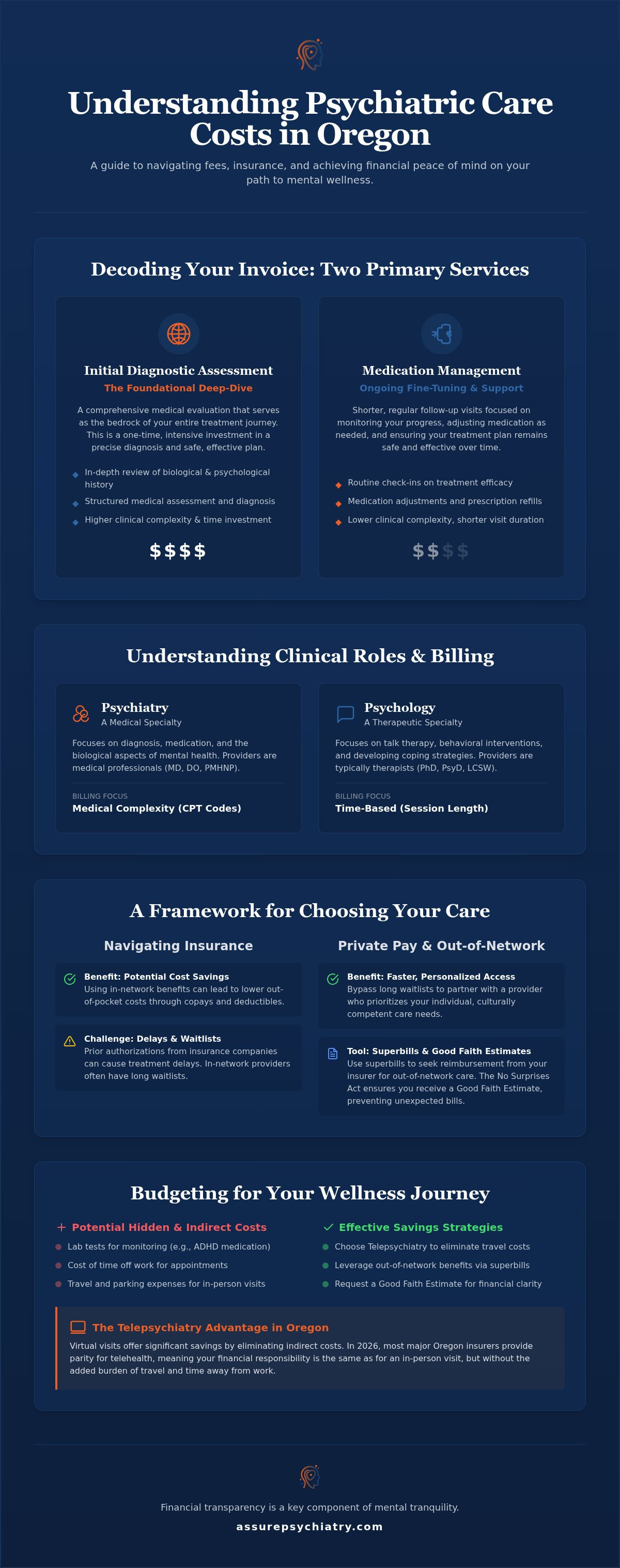
When you receive your first bill or insurance statement, the variation in pricing between visits might feel confusing. Understanding psychiatric care costs Oregon begins with distinguishing between these two primary types of clinical encounters. The difference isn’t arbitrary; it reflects the intensity of the clinical work performed. Even the Oregon Health Plan Fee Schedule recognizes this distinction, with adjusted 2026 rates for health behavior assessments seeing a $6.21 increase over 2025 levels to account for the rising complexity of diagnostic work. Your first visit is a foundational investment, while subsequent check-ins focus on fine-tuning and maintenance.
A comprehensive psychiatric evaluation in Portland serves as the bedrock of your treatment journey. This isn’t just a brief conversation about how you feel. It’s a structured medical assessment where your provider synthesizes your biological, psychological, and social history. By the end of this session, you aren’t just a diagnosis; you’re a partner in a tailored treatment plan designed for long-term mental tranquility.
The Diagnostic Investment: Your First 60 Minutes
The initial diagnostic assessment is a deep-dive that typically lasts about an hour. During this time, your provider reviews medical records, analyzes symptom clusters, and rules out physical conditions that might mimic mental health issues. Whether you’re seeking ADHD treatment or navigating the complexities of PTSD, this session is where the heavy clinical lifting happens. It requires a high level of expertise to formulate a safe pharmacological path forward, which is why the initial fee is higher than follow-up care.
Medication Management: The Path to Stability
Once a plan is in place, you move into the maintenance phase. A typical 15-30 minute medication management visit focuses on monitoring your response to treatment. Your provider checks for side effects, adjusts dosages, and ensures the medication is helping you reach your goals. Initially, these check-ins might happen every few weeks during the stabilization phase. As you find your balance, they may shift to once every few months. These regular check-ins are vital because they prevent small issues from becoming costly emergency interventions. If you’re looking for a provider who values transparency, you can explore how our team at Assure Psychiatry approaches this collaborative process.
Insurance vs. Private Pay: A Framework for Choosing Your Care
Choosing how to fund your mental health journey is a deeply personal decision that balances immediate budget needs with long-term wellness goals. For many, commercial insurance feels like the natural choice. However, the path isn’t always straightforward. While insurance can significantly lower your out-of-pocket expenses, it often involves navigating complex networks and waiting for approvals that can delay your start date. Understanding psychiatric care costs Oregon requires looking at the total picture, including how your specific plan interacts with specialized providers.
Many Oregonians find themselves in the “high deductible trap.” In this scenario, even if a provider is in-network, you may still pay the full negotiated rate until you meet a deductible that could range from $1,000 to $5,000 or more. During this period, the financial experience of using insurance is nearly identical to private pay, yet you remain bound by insurance company requirements. Conversely, some patients opt for “Out-of-Network” care. This allows you to see the specialist of your choice and receive a “superbill,” which you can submit to your insurance company for potential reimbursement. It’s a way to maintain clinical freedom while still leveraging your benefits.
Understanding Your In-Network Benefits
If you plan to use insurance, a little preparation goes a long way in preventing billing anxiety. Before your first appointment, it’s helpful to have a direct conversation with your carrier. Ask specifically about your specialist copay, whether you’ve met your annual deductible, and if your plan requires a prior authorization for psychiatric services. Mental Health Parity laws ensure that your insurer cannot place more restrictive limits on mental health care than they do for physical health. At Assure Psychiatry, we accept most major insurance plans because we believe that high-quality, inclusive care should be accessible to as many people as possible.
The Private Pay Advantage: Speed and Specialty
Why would someone choose to pay out of pocket when they have insurance? For many, the answer is speed and privacy. Private pay removes the insurance “middleman,” often resulting in much faster access to specialized anxiety treatment and diagnostic evaluations. When you pay directly, your clinical records aren’t shared with an insurance company for “medical necessity” reviews, offering an extra layer of confidentiality. This model also allows your provider to focus entirely on your restorative journey rather than administrative paperwork. You gain the peace of mind that comes with knowing exactly what you owe before you even step into the virtual or physical office, making your budget as predictable as your treatment plan.
Hidden Costs and Savings Strategies for Oregon Patients
When you budget for mental health, it’s easy to focus solely on the session fee. However, a truly comprehensive view of understanding psychiatric care costs Oregon includes the “ripples” of care that occur between appointments. These indirect expenses, such as laboratory monitoring and prescription costs, can impact your monthly budget if you aren’t prepared. By identifying these factors early, you can move from a state of financial uncertainty toward a place of mental tranquility and predictable planning.
One of the most common “time-costs” in psychiatry is the prior authorization process. This occurs when an insurance company requires your provider to justify the use of a specific medication before they’ll agree to cover it. While this doesn’t always carry a direct dollar amount, the delay can lead to gaps in treatment or the need for temporary, expensive out-of-pocket fills. To minimize these hurdles, it’s helpful to work with a practice that understands the 2026 Oregon insurance landscape and proactively manages these administrative requirements.
Lab Work and Diagnostic Testing
Safe medication management occasionally requires objective data. For those taking mood stabilizers like Lithium or certain antipsychotics like Clozapine, regular blood work is a non-negotiable safety standard. These tests monitor therapeutic levels and ensure your internal organs are processing the medication effectively. To save on these costs, consider using independent laboratories in the Portland area rather than hospital-affiliated labs, which often carry higher facility fees. You can also ask your psychiatric provider to coordinate with your primary care physician; sharing recent lab results can prevent you from paying for duplicate testing.
Prescription Savings in the Digital Age
The pharmacy counter shouldn’t be a place of stress. In 2026, several digital tools have made medication more affordable than ever. Platforms like GoodRx or Mark Cuban’s Cost Plus Drugs often provide prices lower than an insurance copay, especially for Tier 1 generics. It’s also worth asking your provider for a 90-day prescription rather than a 30-day fill. Many Oregon pharmacies and mail-order services offer a “two-copay” discount for a three-month supply, essentially giving you one month of medication for free.
Understanding your insurance plan’s “tier” system is also vital. A formulary is a list of drugs covered by a specific plan as of 2026. Medications in lower tiers (1 and 2) are typically preferred generics with the lowest out-of-pocket cost, while higher tiers involve brand-name drugs that may require a higher coinsurance percentage. If you’re ready to start a treatment plan that prioritizes both your health and your financial peace of mind, schedule a consultation with Assure Psychiatry to discuss our transparent approach to care.
Assure Psychiatry: Financial Transparency for Your Mental Wellness
At Assure Psychiatry, we believe that financial transparency is the cornerstone of a trusting clinical partnership. You’ve spent time understanding psychiatric care costs Oregon because you value your mental well-being and deserve to know how your investment translates into restorative care. We view ourselves as your ally, removing the administrative fog that often surrounds mental health pricing so you can focus entirely on your journey toward mental tranquility. Our commitment to transparent rates and collaborative planning ensures that you’re an active participant in every decision, from your initial diagnostic assessment to your long-term maintenance plan.
Verifying your insurance shouldn’t be a source of stress. Our team is here to help you navigate your specific benefits, whether you’re using a major commercial plan or exploring private-pay options to bypass long public waitlists. We encourage you to view psychiatric care not as a recurring expense, but as a long-term investment in your quality of life. When your mental health is stable and supported, every other aspect of your life benefits from that foundational peace.
Our Approach to Inclusive and Accessible Care
Led by Dr. Olumide Aruwajoye, our practice is built on a foundation of clinical authority and deep empathy. We recognize that seeking help is a courageous step, especially for those from diverse backgrounds who may have faced barriers to care in the past. This spirit of empowerment is shared by practices like Courage Point Counseling and Wellness, which provides professional mental health therapy focused on individual wellness. We prioritize cultural competence and inclusive care standards, ensuring every patient feels seen and heard rather than just diagnosed. Our environment is designed to be a stable, welcoming space for all identities in Portland and throughout the Pacific Northwest.
If you’re currently working with another provider but feel that a change in approach would better serve your needs, we’ve made the transition as seamless as possible. You can follow our how to switch psychiatrists guide to ensure your care continues without interruption. We handle the transition with the same care and organization we apply to our treatment plans, prioritizing your comfort at every step.
Take the First Step Toward Peace of Mind
Are you ready to move past the confusion of medical billing and toward a predictable path for your wellness? Booking your initial evaluation is a straightforward process designed to lower the barrier for those seeking help. We offer the flexibility of in-person visits at our Portland location, as well as comprehensive telepsychiatry services for residents across Oregon and Washington. This dual approach ensures that geography never stands in the way of high-quality, specialized support for ADHD, depression, or anxiety.
Your path to mental tranquility begins with a single, informed choice. By prioritizing financial clarity and clinical expertise, you’re setting the stage for a restorative experience that respects your identity and your budget. Contact Assure Psychiatry today to discuss your care options and discover how a collaborative, transparent approach can change your perspective on mental health care.
Your Path to Mental Tranquility and Financial Clarity
Your journey toward mental wellness shouldn’t be clouded by financial uncertainty. By distinguishing between initial evaluations and routine medication management, you gain the power to budget for your care with confidence. We’ve explored how navigating the choice between insurance and private pay, alongside identifying hidden costs like laboratory monitoring, transforms a confusing process into a clear, manageable plan. Understanding psychiatric care costs Oregon is ultimately about reclaiming your agency and ensuring your restorative journey is sustainable.
At Assure Psychiatry, we’re committed to being your compassionate ally. We accept most major insurance plans and provide culturally competent care that respects your individual identity. Whether you prefer in-person visits in Portland or the convenience of telepsychiatry across Oregon and Washington, we’re here to support you. You deserve a treatment plan that values both your health and your peace of mind.
Schedule your transparently priced psychiatric evaluation today.
Take this step for yourself. You don’t have to navigate the path to wellness alone; we’re ready to walk beside you.
Frequently Asked Questions
Does insurance cover psychiatric evaluations in Oregon?
Yes, most major commercial insurance plans and the Oregon Health Plan cover psychiatric evaluations as a standard benefit. Because of federal parity laws, insurers must provide coverage for mental health services that is comparable to physical health services. You should check your specific plan for “behavioral health” benefits to understand if you need to meet a deductible or pay a specialist copay before your visit.
What is the average cost of a psychiatric follow-up visit in Portland?
The cost of a follow-up visit depends on whether you are using insurance or paying out of pocket. These appointments are generally shorter than the initial evaluation, lasting between 15 and 30 minutes, and are priced lower to reflect that. While rates vary by provider and credentials, follow-up visits are designed to be a more affordable way to maintain your long-term stability and medication efficacy.
Can I use my HSA or FSA for psychiatric medication management?
Yes, psychiatric services are considered a qualifying medical expense for both Health Savings Accounts (HSA) and Flexible Spending Accounts (FSA). You can use these pre-tax funds to cover your session fees, copays, and even the cost of your prescriptions. Utilizing these accounts is a smart way to manage your budget while understanding psychiatric care costs Oregon and investing in your mental tranquility.
Why is the first psychiatric appointment more expensive than others?
The initial appointment is a comprehensive diagnostic evaluation that requires significantly more time and clinical expertise than a routine check-in. Your provider must perform a deep dive into your medical history, current symptoms, and lifestyle factors to create a safe treatment plan. This foundational session establishes the clinical roadmap for your care, ensuring that every subsequent step is grounded in an accurate diagnosis.
What happens if my insurance denies coverage for a prescribed medication?
If your insurance denies a medication, your provider can often submit a prior authorization to explain the medical necessity of the drug. If the denial continues, you can explore generic alternatives or use prescription savings tools to lower the out-of-pocket cost. Your provider will work with you to find a medication that is both clinically effective and fits within your plan’s specific 2026 formulary guidelines.
Are there low-cost psychiatric options for people without insurance in Oregon?
Oregon residents without insurance can access care through county behavioral health clinics or Federally Qualified Health Centers, which often use a sliding scale based on income. Some private practices also offer transparent private-pay rates that allow patients to bypass the long waitlists common at public facilities. Always request a Good Faith Estimate before your appointment to ensure you have a clear picture of the expected costs.
Does Assure Psychiatry offer a sliding scale for fees?
Assure Psychiatry does not offer a sliding scale, but we maintain a strong commitment to accessibility by accepting most major insurance plans. For those choosing to pay out of pocket, we provide clear and transparent private-pay rates so you never face a surprise bill. This approach allows us to focus on providing high-quality, culturally competent care while giving you total clarity regarding your financial investment.
How much should I budget monthly for ADHD medication management?
Your monthly budget for ADHD care should include the cost of your medication and a portion of your follow-up visit fee. Once your dosage is stabilized, you may only need to see your provider every few months rather than every few weeks. You can further reduce these costs by asking for 90-day prescriptions and choosing generic versions of your medication whenever they are available at your local pharmacy.
Recent Comments