

Your current therapist or doctor can contribute relevant history or records to an adult ADHD evaluation, alongside a focused assessment. A comprehensive ADHD assessment for adults in Oregon may include a clinical interview, questionnaires, developmental and health history, and a review of how symptoms affect daily life.
It’s understandable to want the people who already know you to be part of the process. Their perspective can add context, while an assessment brings information together to clarify what may be contributing to your difficulties and what support could help.
You’ll learn what an evaluation may involve, which records or background details could be useful, and how your existing therapist or doctor may contribute. We’ll also explain how findings are reviewed and how they can inform next steps, so you can approach the process with a clearer sense of what to expect.
Key Takeaways
- A thorough evaluation brings together an interview, questionnaires, and information about how attention-related challenges affect daily life.
- Academic records and previous assessments can add useful context; your current therapist or doctor may also contribute relevant history.
- Developmental, mental health, and medical history help the professional consider when symptoms began and what else may affect them.
- Screening tools and rating scales support the assessment, while the full picture guides discussion of diagnosis and possible next steps.
Clinical interview, questionnaires, and diagnostic tools
A comprehensive ADHD assessment for adults in Oregon brings together a clinical interview and structured questions about symptoms and daily functioning. Some evaluation formats also include a follow-up appointment with activities and questionnaires to clarify ADHD-related concerns.
Clinical Interviews and Self-Report Scales
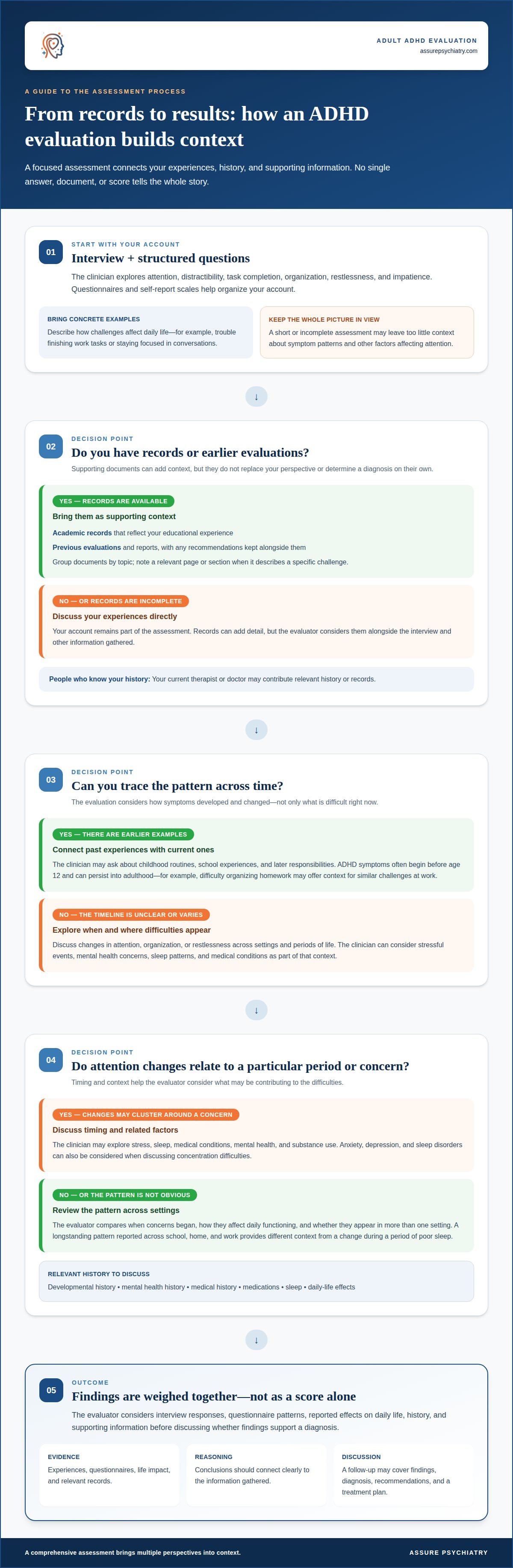
A clinical interview explores attention, distractibility, task completion, organization, restlessness, and impatience. Questionnaires and self-report scales help organize your account, while specific examples show how challenges affect daily life. For instance, you might discuss trouble finishing work tasks alongside difficulty staying focused in conversations. No single answer tells the whole story.
Virtual interview-based assessments can use conversation and questionnaires remotely. They can help adults in rural Oregon discuss concerns without making every step depend on travel to Portland.
Without insurance, the cost depends on the evaluation’s scope and is provided after a quote request.
Adults can seek an assessment in Portland and elsewhere in Oregon. Virtual appointments may make access more practical for rural residents who meet the criteria for telepsychiatry.
Appointment timing depends on availability and the steps involved in an evaluation, such as reviewing questionnaires or records.
A brief or incomplete assessment may leave too little context to understand symptom patterns and their effects on daily life. It may also make it harder to consider other factors that affect attention.
Interpreting Assessment Results
Results are considered together, not as a score alone. The evaluator weighs interview responses, questionnaire patterns, and reported effects on daily life before discussing whether the findings support a diagnosis. A comprehensive ADHD assessment for adults in Oregon should connect its conclusions to the information gathered and explain the reasoning clearly.
A follow-up discussion may cover the assessment findings, diagnosis, recommendations, and treatment plan. You can ask how each conclusion relates to your experiences and which next steps may address your needs.
Collateral reports and supporting documentation
Records can put current concerns in context. Useful documents for an adult ADHD assessment include academic records and previous evaluation reports. These materials can add details to discuss, rather than leaving you to rely on memory alone. An earlier report may also show which questions were explored and what recommendations were made.
Before sharing documents, organize them by topic. Keep school records together and prior assessment reports in a separate group. If a document describes a specific challenge, such as difficulty completing assignments, note the relevant page or section. This makes details easier to find during the evaluation and discuss in relation to current concerns.
- Academic records: Bring copies that reflect your educational experience.
- Previous evaluations: Include earlier assessments and reports that may provide context.
- Recommendations: Keep any prior recommendations with the report they came from.
Supporting material can add detail to conversations about challenges across different stages of life. It doesn’t replace your perspective or determine a diagnosis on its own. The evaluator considers documents alongside information gathered during the assessment, then explains how the pieces fit together. If records describe different experiences, those differences can be discussed rather than used to dismiss your concerns.
After reviewing the information, the assessment report can outline findings, recommendations, and a treatment plan. You can use the discussion to clarify which records shaped the conclusions and how proposed next steps connect to your current needs. If you’re ready to discuss how an ADHD evaluation can inform care, bring the documents you have available to that conversation.
Developmental, mental health, and medical history
An evaluation considers how symptoms developed and changed, rather than focusing only on current difficulties. ADHD symptoms often begin before age 12 and can persist into adulthood. The clinician may ask about childhood routines, school experiences, and later responsibilities. For example, trouble organizing homework may offer context for similar challenges managing work tasks now.
Your history can help show whether difficulties arise across settings or mainly during particular periods. The clinician may discuss changes in organization, attention, and restlessness alongside stressful events, mental health concerns, sleep patterns, and medical conditions. A change in focus during a period of poor sleep, for example, provides different context from a longstanding pattern reported at school, home, and work.
Oregon health insurance and Medicaid coverage depend on the benefits of the individual plan and how the evaluation is billed. Review your plan’s behavioral health benefits and ask the insurer how adult ADHD evaluations are handled, including any referral or authorization requirements.
To distinguish ADHD from anxiety, depression, sleep disorders, or substance use, an evaluator compares symptom patterns, timing, and context. Difficulty concentrating, for example, may occur alongside worry, low mood, disrupted sleep, or substance use. The clinician discusses when each concern began, how it affects daily functioning, and whether symptoms appear in more than one setting. These details can clarify whether ADHD, another condition, or overlapping concerns may be involved.
Your mental and medical history also informs the discussion about next steps. The evaluator can consider how existing diagnoses, medications, or health concerns relate to attention and activity levels. Sharing the sequence of changes, such as when sleep problems began compared with concentration challenges, adds useful context. The aim is to understand the overall pattern, not reduce your experience to one symptom or label.
ADHD screening tools and rating scales
Questionnaires and rating scales give an ADHD evaluation a structured way to capture symptoms. They may ask how often you experience difficulties with attention, organization, or restlessness. For example, you might lose track of tasks during meetings but stay focused on an engaging project. That contrast helps the evaluator understand your experience in more detail instead of reducing it to a single score.
A clinician reviews each response in context. Patterns across questions can point to areas for closer discussion, while specific examples explain what an answer means in daily life. A rating scale supports clinical judgment, but doesn’t establish a diagnosis by itself. The evaluator considers the results alongside the interview and other assessment information.
- Look at patterns: Repeated difficulties with time management may call for more discussion than one isolated response.
- Consider settings: Note whether challenges arise at work, at home, or in social situations.
- Explain differences: If answers vary by task, describe what changes, such as interest or structure.
Questionnaires can also help focus the next session. The clinician can use your responses to clarify symptoms, ask about a specific example, or explore an answer that’s difficult to interpret. If a question doesn’t fit your experience, explain why rather than forcing your response into a simple yes or no. That detail can make the discussion clearer.
Tools are most useful when they support a conversation, not replace it. A completed scale doesn’t capture every influence on attention, and a lower score doesn’t erase challenges you experience. The evaluator weighs the overall pattern and explains how the findings inform recommendations and next steps. If you’re ready to discuss a structured psychiatric evaluation, take that step toward clearer guidance.
Assure Psychiatry: ADHD Treatment
Assure Psychiatry provides psychiatric evaluations and ADHD treatment for adults seeking to understand their concerns and consider next steps. If symptoms affect focus, organization, or daily responsibilities, a psychiatric evaluation can help inform a care plan. Medication management may also be part of ongoing ADHD care when appropriate.
ADHD concerns can overlap with anxiety, so discussing both may help clarify what support fits your needs. Assure Psychiatry also provides anxiety treatment, allowing care discussions to address related concerns rather than viewing symptoms in isolation. You can take part in decisions about care at a pace that feels manageable.
If you’d like to discuss ADHD treatment or a psychiatric evaluation, contact Assure Psychiatry.
Take the Next Step Toward Care That Fits
A comprehensive ADHD assessment for adults in Oregon can be a starting point for understanding what support may fit your life. You don’t need every answer before discussing your concerns. Bring the questions that matter most, such as how attention challenges affect work, relationships, or everyday routines.
Assure Psychiatry provides psychiatric evaluations, ADHD treatment, and medication management in Oregon. These services can help you discuss your concerns and consider care options with a mental health professional. Your needs and preferences belong in that conversation.
If you’re ready to talk about possible next steps, contact Assure Psychiatry. Taking one thoughtful step can help make the path ahead feel clearer.
Frequently Asked Questions
Can my current therapist or doctor be involved in the process?
Yes. Your current therapist or doctor can contribute relevant context, especially observations from care over time. Their perspective may help explain when concerns first became noticeable or how they change under stress. Mention your existing providers and ask how information from your care team can be included. This keeps established care relationships part of the conversation rather than treating an evaluation as isolated.
Is ADHD testing completed online or in person?
Assure Psychiatry offers in-person appointments in Portland, Oregon, and virtual telepsychiatry for eligible patients. Specific criteria must be fulfilled to access remote appointments, so online access isn’t automatic. If you live elsewhere in Oregon, a virtual format may make distance less of a barrier when you meet those criteria. Whatever the format, discussing your concerns carefully with a professional matters.
Is it normal to feel nervous about the assessment?
It’s understandable to feel nervous about discussing personal experiences and concerns. You don’t need to prepare a perfect account or use clinical terms. Consider what you most want help understanding, such as a recurring difficulty that affects your routine. At the start, tell the clinician you feel anxious. This gives them a chance to explain the conversation and respond to your immediate concerns.
What does the process of the ADHD evaluation look like?
An evaluation moves from understanding what led you to seek help to discussing findings and possible care options. Describe your main concerns and identify the questions you hope to answer. During the results discussion, ask how the conclusions relate to your goals and what follow-up might involve. This helps connect assessment findings with care decisions that matter to you.
Who Provides the Evaluation?
At Assure Psychiatry, a psychiatric mental health nurse practitioner, or PMHNP-BC, provides psychiatric evaluations. The evaluation helps assess mental health needs and inform treatment planning. If your therapist or doctor is already involved in your care, that relationship can remain part of the broader conversation. The aim is to discuss findings collaboratively, with your experiences and preferences included.
Why Consider an Adult ADHD Evaluation?
Consider an evaluation if recurring attention or organization difficulties affect work, relationships, or everyday responsibilities. A professional perspective can help you discuss whether ADHD may explain the pattern and which care options could fit your needs. The purpose isn’t to reduce you to a diagnosis. It’s to create a clearer basis for discussing challenges and support that reflects your priorities.
Recent Comments