

Practical strategies for managing OCD at work in Seattle can make daily tasks feel more manageable, but they are not a substitute for professional care. Exposure and response prevention (ERP), delivered with a trained therapist, can help people approach triggers without relying on compulsions. Everyday work strategies may support you alongside treatment.
It makes sense to want more control over intrusive thoughts, rituals, or anxiety without feeling pressure to explain everything at work. OCD can affect concentration and everyday tasks, and workplace triggers may make routine responsibilities feel harder. You do not have to manage every challenge alone or share more than you are comfortable sharing.
This article explains how OCD may affect work, how ERP can help you approach work-related fears gradually, and how to consider accommodations and talk with HR. It also covers setting boundaries and deciding whether to take a mental health day when you need time to care for your well-being.
Key Takeaways
- Notice how intrusive thoughts and compulsive rituals may affect focus, routines, and work tasks.
- Learn how ERP can help you approach workplace triggers gradually, with support from a trained therapist.
- Prepare to discuss possible workplace adjustments with HR while sharing only what feels relevant.
- Set limits around work demands and consider a mental health day when you need time to care for your well-being.
How can OCD show up in the workplace?
OCD can make routine work tasks feel consuming. Intrusive thoughts may bring fears about mistakes, safety, or causing harm, while compulsions can include repeated checking, washing, or mental rituals. Someone might reread a report before sending it, wash their hands after touching shared equipment, or seek reassurance from a coworker. These patterns can interrupt focus, delay tasks, and add stress.
Practical strategies include breaking assignments into smaller steps, setting realistic priorities, and following a consistent routine. For example, use a task list to choose which report comes first, then move on after completing the usual review process. Relaxation practices may help manage stress. You might also work on reducing repeated reassurance-seeking, since asking others for certainty can keep an OCD cycle going.
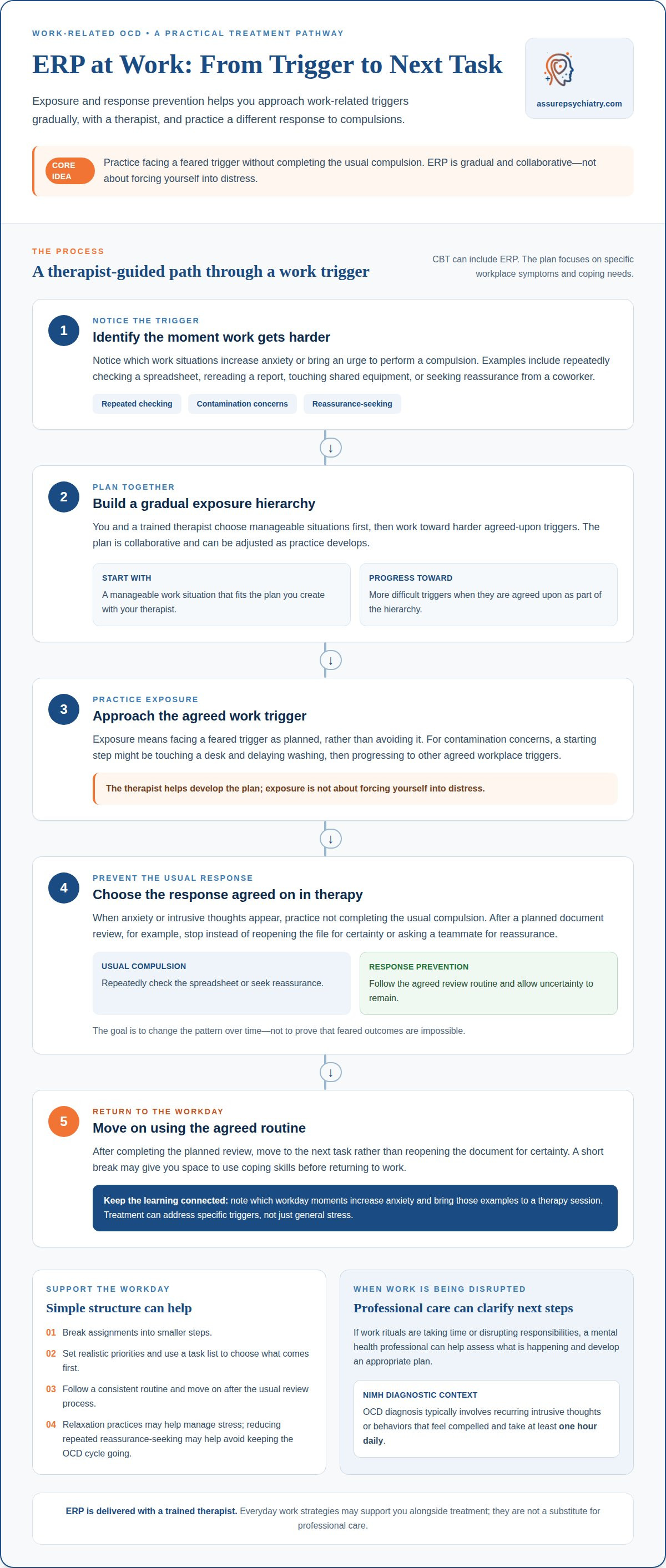
Cognitive behavioral therapy (CBT) can include exposure and response prevention (ERP), which helps people face a feared trigger without completing the usual compulsion. Exposure is gradual and collaborative: a person and therapist create a hierarchy, starting with manageable situations and moving toward harder ones. For contamination concerns, steps might begin with touching a desk and delaying washing, then progress to other agreed-upon workplace triggers. ERP is not about forcing yourself into distress; a therapist helps develop the plan.
ERP also involves response prevention: practicing a different response when anxiety or intrusive thoughts appear. Instead of repeatedly checking a spreadsheet or asking a teammate for reassurance, you might follow the agreed task routine and allow uncertainty to remain. CBT and ERP work on changing this pattern over time, not proving that feared outcomes are impossible.
According to the National Institute of Mental Health, OCD diagnosis typically involves recurring intrusive thoughts or behaviors that feel compelled and take at least an hour daily. If work rituals are taking time or disrupting responsibilities, a mental health professional can help assess what’s happening and develop an appropriate plan. Selective serotonin reuptake inhibitors may also be prescribed in some cases to help manage OCD symptoms, according to the National Institute of Mental Health.
ERP therapy for work-related OCD triggers
Treatment for work-related OCD connects care with situations that trigger obsessive thoughts or compulsive responses. A useful plan addresses workplace symptoms and coping needs, not just general stress.
Therapy Approaches for Work Triggers
Exposure and response prevention (ERP), a form of cognitive behavioral therapy (CBT), helps people face triggers without completing compulsions. For example, someone who repeatedly checks work can practice following the usual review process and then stopping. A therapist and patient build a gradual plan together, choosing manageable steps and adjusting them as practice develops.
Outpatient therapy offers scheduled support, but symptoms can arise between sessions. If checking or other rituals disrupt work, discuss how treatment can support practice outside appointments. Individual sessions can focus on personal work-related fears; family or group therapy may offer other kinds of support. The key is whether OCD treatment includes a plan for specific triggers.
Strategies for managing OCD at work in Seattle can include identifying a trigger, noticing the urge to perform a compulsion, and using a response-prevention step agreed on in therapy. For instance, after completing a planned review of a document, move to the next task rather than reopening it for certainty. A short break may give you space to use coping skills before returning to work.
Workday Triggers and Peer Support
Seattle adults can look for OCD-focused peer resources through mental health organizations. Peer connection may offer shared understanding, while individual treatment can address one person’s symptoms and work situations. Strategies for managing OCD at work in Seattle can also include noting which moments in the workday increase anxiety and bringing those examples to a therapy session.
A group does not replace individualized care. If work triggers are affecting daily functioning, an OCD treatment evaluation can help clarify clinical support options.
Workplace accommodations and communicating with HR
OCD symptoms can affect concentration, communication, and task completion, particularly when anxiety or intrusive thoughts disrupt a work routine. A clear accommodation request can identify the specific barrier and an adjustment that may help.
Accommodation Requests and HR Communication
In the United States, employees may disclose OCD to an employer to request accommodations under the Americans with Disabilities Act (ADA). You can consider approaching HR before speaking with a supervisor, then describe how symptoms affect a work task and what change could help.
For example, someone whose symptoms worsen in a busy office might request a private workspace or short breaks. Flexible hours, working from home, or leaving early when symptoms worsen may also be considered. Many reasonable adjustments do not cost the employer anything. Keep the request focused on work needs; you do not have to share every intrusive thought or personal detail to explain the impact.
Social anxiety can make these conversations difficult. Preparing a short written outline, such as “I’m seeking an adjustment to help me complete tasks consistently,” may make the discussion easier. Open communication with HR or a supervisor can reduce misunderstandings, while you decide what information to share.
Workplace Protections and Discrimination
For employees in Seattle and Washington State, the federal protection discussed here is the ADA. Employees may disclose OCD to request accommodations, and employers must keep medical information confidential under the ADA. HR can explain workplace processes and options such as the Family and Medical Leave Act (FMLA) or short-term disability if symptoms require a higher level of care.
If OCD symptoms affect your job performance or you experience possible discrimination, write down the work impact, the adjustment requested, and relevant conversations. Consider raising the concern with HR and explaining what change could help you do your job. For instance, a written task plan or brief breaks may address a specific barrier. If anxiety makes speaking difficult, notes can help organize your thoughts before the meeting.
Setting boundaries and taking mental health days
Boundaries can protect your time and attention when OCD symptoms make work feel relentless. Choose a clear stopping point, such as closing work messages at the end of your scheduled day, and avoid extending tasks to achieve certainty. For example, complete the agreed review process, note the next step, and move on rather than reopening the task.
Make limits specific and workable. You might tell a manager, “I can finish the report today, but I can’t take on another assignment before the deadline.” A written priority list can help separate urgent work from tasks that can wait. If a compulsive urge interrupts your focus, use the response-prevention step planned with your therapist, then return to the next task on your list.
A short break can give you time to reset during a stressful workday. Step away from your desk, take a brief walk, or try a calming practice before returning to a defined task. These choices support boundaries without requiring you to explain private thoughts to coworkers. If repeated interruptions or extended hours are worsening your mental health, note which situations are hardest and discuss them in treatment.
A sick day or mental health day can give you space to care for your well-being and recharge. Consider taking one when OCD symptoms make it hard to function at work or when continuing the day would leave no time for basic care. Follow your workplace’s usual absence process, and decide what needs attention before returning. Time away may support recovery, but it does not replace ongoing care for obsessive-compulsive disorder.
Boundaries are not a test of whether you can control every thought. They’re practical limits around work tasks, time, and rest. If anxiety or another mental health condition is making those limits difficult to maintain, seek support for mental health concerns and discuss what care may fit your needs.
Assure Psychiatry
Assure Psychiatry provides psychiatric evaluations and medication management for people seeking professional support with OCD symptoms affecting work. An evaluation can help assess your concerns and guide next steps. OCD treatment and medication management may be relevant depending on your needs, and anxiety treatment may also be considered when anxiety affects daily functioning.
Consider an evaluation if intrusive thoughts, compulsions, or workplace stress interfere with your responsibilities or well-being. Bring specific examples, such as tasks that take longer because of repeated checking or situations that increase anxiety. These details can help you discuss symptoms and treatment goals without making your diagnosis the whole story.
If you’re ready to discuss support, contact Assure Psychiatry.
Choose a next step that fits your work life
You do not need to solve every workplace difficulty at once. Choose one situation that feels most disruptive, then write down what happens, what support might help, and what you would like to discuss with a clinician. Starting with a specific concern can make the next conversation more manageable and keep the focus on changes that matter to you.
Building strategies for managing OCD at work in Seattle can begin with an evaluation of how symptoms affect your daily responsibilities and well-being. Assure Psychiatry offers psychiatric evaluations and medication management, as well as ADHD treatment. A conversation can help you explore care options and identify questions to bring into your next steps.
Contact Assure Psychiatry today to discuss support. Moving forward at a pace that feels workable is a meaningful step toward greater steadiness at work.
Frequently Asked Questions
How can colleagues support someone with OCD?
Colleagues can support someone with OCD by asking what kind of help would be useful, then respecting that preference. Instead of repeatedly assuring a coworker that nothing bad will happen, they can listen without debating intrusive thoughts or joining a ritual. If a deadline is affected, offer practical, neutral help, such as clarifying the next task or sharing written instructions. Keep personal details private and let the person decide whether to discuss OCD with others.
How can someone talk to their employer about OCD without fear of stigma or discrimination?
Someone can talk with an employer about OCD by focusing on work needs rather than sharing every symptom. Before the conversation, decide what to disclose, describe a specific barrier, and identify an adjustment that could help. For instance, explain that noise makes focused tasks harder and ask to discuss a quieter workspace. An employee may speak with HR first and keep the conversation to relevant work information.
How can employees with OCD talk to a manager or HR about workplace support?
Employees can approach a manager or HR with a brief, specific request and a clear work-related reason. For example: “I’d like to discuss a workplace adjustment related to a health condition.” Then identify the affected task and the support you are seeking. Bring notes if anxiety makes it hard to speak, and ask how the workplace handles requests. Choose a private conversation and share only information relevant to discussing support.
What reasonable accommodations can employers provide for OCD under the ADA?
Under the ADA, employees with OCD may request workplace accommodations addressing how symptoms affect job tasks. Examples include flexible hours, a private workspace, and short breaks to manage stress. Working from home or leaving early when symptoms worsen may also be considered. Explain how the adjustment would address a work barrier, such as reducing interruptions during focused tasks.
How do you request an ADA accommodation for OCD in Washington State?
In Washington State, an employee can request an ADA accommodation by telling the employer they need a workplace change related to OCD. A practical request names the affected job task, describes the barrier plainly, and proposes a change to discuss. For example, someone who struggles to concentrate in a shared space could ask HR about a quieter setting. The employee can ask HR or a manager how the organization handles requests.
What workplace accommodations for OCD are available in Seattle?
Seattle employees may discuss adjustments such as flexible hours, a private workspace, or short breaks, depending on the work barrier. Working from home or leaving early when symptoms worsen are also examples of possible support. Someone whose role requires on-site tasks might instead discuss a quieter workspace or brief breaks. Describe the work situation and requested adjustment so the employer can consider the arrangement.
Recent Comments