

What if the reason you feel stuck in your mental health journey isn’t a lack of effort, but a missing map? It’s exhausting to feel like just another number in a clinical system, especially when you’re searching for a sense of peace that feels out of reach. You might even wonder if a standard therapy session is enough to address the weight you’re carrying. A comprehensive psychiatric assessment changes this narrative. It’s not a test to pass or fail, but a collaborative discovery process designed to anchor your journey toward lasting mental tranquility.
You deserve to be seen as a whole person, and we understand the need for a partnership that validates your unique experience. In this guide, you’ll discover how a thorough evaluation provides the clarity and personalized roadmap you need to regain emotional balance. We’ll break down exactly what happens during the process, the significance of 2026 clinical standards like CPT code 90792 for medical evaluations, and how this step integrates with your long-term care. Whether you’re seeking help for anxiety, depression, or ADHD, you’ll learn how this first step moves you away from confusion and toward a clear, actionable plan for your well-being.
Key Takeaways
- Understand the vital differences between a standard therapy intake and a diagnostic evaluation to ensure you receive the specific level of care you need.
- Explore how a comprehensive psychiatric assessment utilizes the Biopsychosocial model to create a holistic map of your biological, psychological, and social well-being.
- Learn to recognize when emotional challenges become clinical concerns that require specialized intervention to protect your quality of life.
- Discover how to reframe a diagnosis as an empowering tool for accessing evidence-based treatment rather than a label that defines your identity.
- Gain insights into the collaborative partnership between you and your provider, including how virtual options make expert care accessible for busy lifestyles.
What is a Comprehensive Psychiatric Assessment?
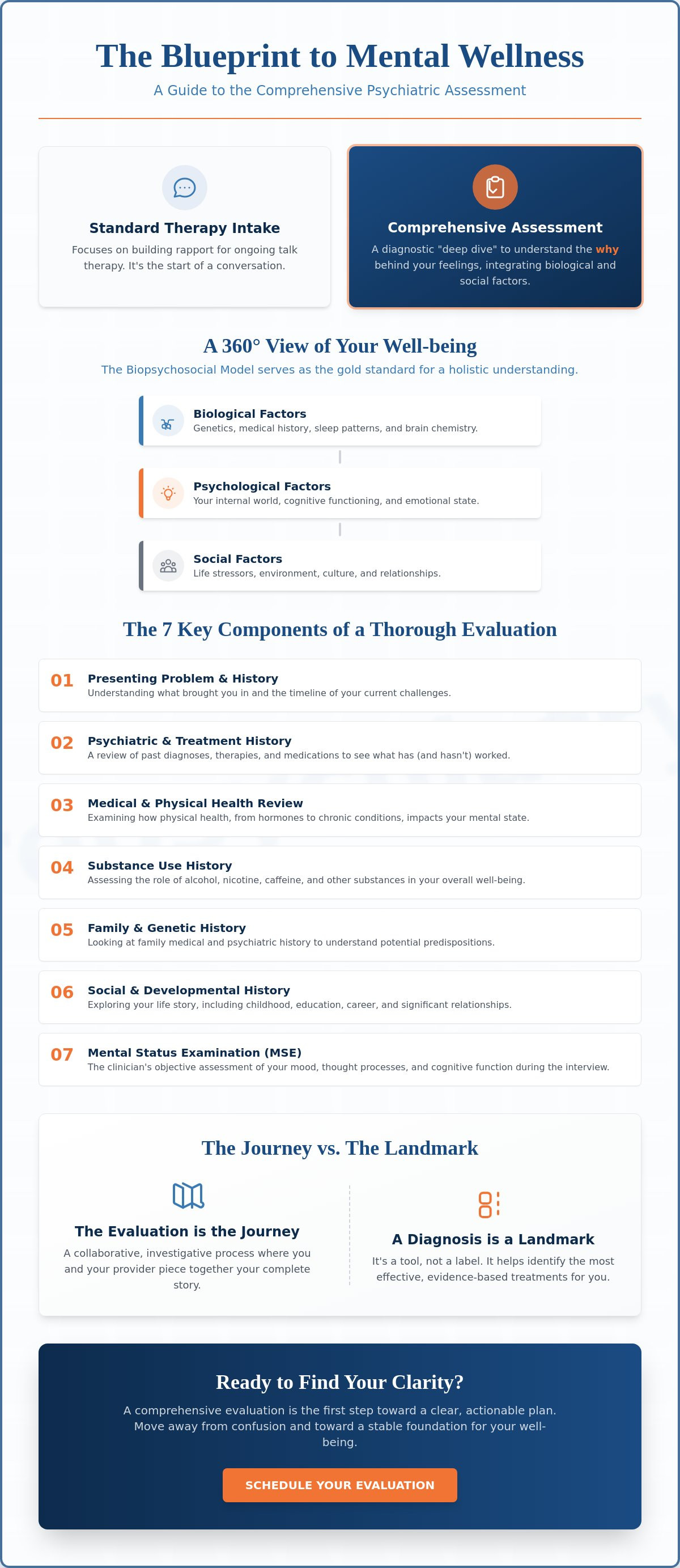
A comprehensive psychiatric assessment is far more than a simple mental health check-up. It’s a detailed exploration of your life’s landscape, designed to provide a clear picture of your emotional and biological health. While a standard therapy intake often focuses on building rapport for ongoing talk therapy, this evaluation serves a different purpose. It’s a diagnostic deep dive. It examines how your physical health, genetics, and social environment intersect to influence your current state of mind. We don’t just want to know how you feel; we want to understand why you feel that way.
This process looks at you as a whole person. We examine your medical history, sleep patterns, and even your family’s health background. By looking at these biological and social factors, we can move beyond mere symptom management. The ultimate goal is to establish a path toward lasting mental tranquility. It’s about creating a stable foundation where you feel empowered to take the next steps in your wellness journey. This is a restorative action, one that prioritizes your individual identity over a clinical checklist.
The Difference Between Evaluation and Diagnosis
It’s helpful to view the evaluation as the journey and the diagnosis as just one potential landmark. The evaluation is a collaborative investigative process where you and your provider work together to piece together your history. A diagnosis is simply a medical term that helps us identify the most effective treatments for your specific needs. It’s a tool that opens doors to specialized care, not a label that defines who you are as an individual.
A psychiatric evaluation portland serves as a foundational pillar for this clarity. During the session, your provider may conduct a Mental Status Examination (MSE) to objectively assess your current cognitive and emotional functioning. This helps us look for the “why” behind your experiences, ensuring your treatment plan is grounded in clinical evidence rather than guesswork.
Who Conducts the Assessment?
These assessments are performed by medical experts, typically Psychiatrists or Psychiatric Mental Health Nurse Practitioners (PMHNPs). These clinicians possess advanced training in both the psychological and physiological aspects of mental health. Providers such as Solid Foundation Psychiatry utilize this specialized expertise to understand how brain chemistry, hormones, and physical ailments can mimic or worsen emotional distress.
Specialized training in medication management and diagnostics allows these providers to see patterns that others might miss. They act as collaborative guides, blending clinical authority with deep empathy. They also prioritize cultural competence, ensuring that your unique identity, background, and values are a central part of the assessment. You aren’t just a set of symptoms to be categorized; you’re a partner in a professional relationship built on safety and mutual respect.
The 7 Key Components of a Thorough Evaluation
The Biopsychosocial model serves as the gold standard of modern psychiatry, examining the intricate interplay between your biology, your internal world, and your external environment. This framework ensures that your comprehensive psychiatric assessment isn’t just a list of symptoms. Instead, it becomes a meaningful exploration of your life. By combining what you share with what the clinician observes, we create a 360-degree view of your wellness. This collaborative partnership relies on both your honest self-reporting and our clinical expertise to find the most effective path forward for your unique needs.
A structured interview process guides this journey, moving through specific domains of your life to ensure nothing is overlooked. It helps us see you as a whole person rather than just a collection of diagnostic criteria. This thoroughness is what allows for a truly personalized treatment plan. If you’re ready to begin, scheduling a professional psychiatric evaluation can provide the clarity you’ve been searching for.
1. Clinical Interview and Personal History
This phase is dedicated to your story. We’ll discuss everything from your early childhood development to the current life stressors that might be weighing you down today. We also take a close look at your family’s medical history. Understanding genetic predispositions helps us anticipate how you might respond to certain treatments or why specific patterns have emerged in your life. To feel more confident during this conversation, you might find it helpful to review how to prepare for a psychiatric evaluation before your first appointment.
2. The Mental Status Examination (MSE)
While the interview covers your history, the MSE provides a snapshot of your current cognitive and emotional state. Think of it as a clinical pulse check. Your provider gently observes your thought patterns, mood stability, and memory during the conversation. This isn’t about judgment or “testing” you. It’s about gathering objective data to understand how your mind is processing information in real-time. We believe in demystifying these observations so you feel like an informed, active participant in your own care journey.
3. Physical Health and Diagnostic Testing
Mental health doesn’t exist in a vacuum. Emotional symptoms often have physical roots. Your provider might request blood work to rule out thyroid imbalances or vitamin deficiencies that can mimic depression or anxiety. We also utilize standardized screening tools to help clarify complex conditions like ADHD or OCD. As outlined in the Comprehensive Psychiatric Evaluation standards from Johns Hopkins Medicine, integrating physical health is essential for an accurate diagnosis. When we anchor your emotional stability in physical wellness, your treatment plan becomes far more effective.
Recognizing the Signs: When to Seek a Specialist Evaluation
How do you distinguish between a temporary rough patch and a deeper clinical need? For many professionals in Portland and Seattle, the pressure to maintain peak performance can often mask underlying struggles. You might find yourself pushing through exhaustion or dismissing persistent worry as just part of a high-stress career. However, when these feelings start to interfere with your presence in your community or your productivity at work, a comprehensive psychiatric assessment becomes an essential tool for clarity. It isn’t just for those in an immediate crisis. It is for anyone who feels their current emotional state is no longer sustainable or aligned with the life they want to lead.
Seeking help is a proactive, restorative action. It’s an investment in your long-term mental tranquility. By identifying the “why” behind your experiences early on, you can prevent symptoms from becoming deeply entrenched. This process moves you from a state of reactive “coping” to a state of active wellness and partnership with your provider.
Persistent Symptoms That Require Attention
There are specific red flags that suggest your brain and body are struggling to maintain balance. Sleep disturbances are often the first sign; they aren’t just about being tired, but rather a disruption in how your system resets. Chronic anxiety or a persistent “brain fog” often signals that your nervous system is in a state of constant overwhelm. You might also notice a significant crossover between physical sensations and mental health. A racing heart, unexplained fatigue, or tension headaches are often the body’s way of signaling emotional distress. When these symptoms persist for weeks or months, a comprehensive psychiatric assessment can help determine if there is an underlying condition that requires specialized care.
The Value of a Second Opinion
What happens if you are already receiving treatment but feel like you’ve hit a plateau? If your current medication management portland isn’t delivering the relief you expected, a fresh perspective is often the missing piece. It is perfectly okay to switch psychiatrists to find a provider who offers a more collaborative or inclusive approach. A thorough specialist evaluation can uncover nuances that were previously overlooked, such as adult ADHD or specific mood disorders that mimic simple depression. This patient- and family-friendly overview highlights how a detailed look at your history can refine a stagnant treatment plan. You deserve a roadmap that actually leads to peace of mind.
Addressing Common Concerns: Beyond Labels and Diagnoses
It’s natural to feel a sense of hesitation when considering a psychiatric diagnosis. Many people worry that a label will somehow rewrite their identity or limit their potential. You might fear being reduced to a clinical code or placed in a “box” that doesn’t capture the complexity of your life. However, a comprehensive psychiatric assessment is actually designed to do the opposite. It isn’t about defining who you are; it’s about providing the keys to unlock the specific resources you need to thrive. We view a diagnosis as a medical tool for access to care, much like identifying a physical injury allows for the correct physical therapy.
At Assure Psychiatry, we believe you are the ultimate expert on your own life. Our role is to act as a collaborative guide, blending our clinical expertise with your lived experience. This partnership is built on mutual respect and shared decision-making. One of the most common fears we hear involves “forced” medication. We want to be clear: your treatment is always your choice. We provide the education and clinical data regarding medication management, but the final decision rests with you. Our goal is to empower you with information so you can make the best choices for your own mental tranquility.
The Myth of the “Cold” Clinical Diagnosis
Older medical models sometimes felt sterile or detached, leaving patients feeling like just another number in a system. Modern assessments have shifted toward a human-centered, conversational approach. We prioritize empathy and safety, creating a space where you can speak freely without fear of judgment. This process often shifts the focus from “what is wrong with you” to “what happened to you.” By understanding your history through a trauma-informed lens, we can build a restorative plan that honors your resilience rather than just cataloging your struggles.
Privacy, Stigma, and Your Professional Life
For professionals in high-stakes environments, privacy is often a primary concern. You may worry about how seeking help could impact your career or reputation. It’s important to understand that your mental health record is protected by strict HIPAA regulations and remains confidential. Far from being a liability, prioritizing your mental health is an act of professional strength. Untreated symptoms like chronic anxiety or depression often cause far more disruption to your career than a private, effective treatment plan ever will. By seeking a comprehensive psychiatric assessment early, you are taking a proactive step to protect your long-term success and your relationships.
If you’re ready to move beyond labels and find a partnership focused on your unique needs, schedule your initial consultation today to begin your journey toward lasting peace of mind.
Choosing Your Path: The Collaborative Approach at Assure Psychiatry
Finding a provider who truly understands the nuances of life in the Pacific Northwest makes a significant difference in your care journey. Whether you are navigating the high-pressure tech environments of Seattle or the creative, community-focused life in Portland, your mental health needs are unique. At Assure Psychiatry, we serve patients across the broader Oregon and Washington region, offering a partnership that prioritizes your individual identity. Our goal is to move you from a place of feeling “stuck” to a state of mental tranquility through a highly personalized wellness plan. A comprehensive psychiatric assessment is the first step in this alliance, providing the clarity needed to build a stable foundation for your future.
We integrate medication management with a trauma-informed and culturally competent lens. This means we don’t just look at your symptoms; we respect the history and values you bring to each session. By combining clinical authority with a humble, inclusive approach, we ensure you are an active participant in your treatment. Once the assessment is complete, we don’t just hand you a diagnosis. We work together to create an actionable roadmap that addresses conditions like anxiety, depression, or PTSD with precision and care.
In-Person vs. Telepsychiatry in the PNW
We believe that high-quality care should be accessible, regardless of your schedule or location. For those who prefer a grounded, face-to-face experience, our Portland office provides a warm and stable environment. However, we recognize that many busy professionals require more flexibility. As of 2026, telehealth for mental health services is permanently extended, and we have optimized our process to ensure a virtual psychiatric evaluation is just as thorough and connective as an in-person visit. We maintain the same “Assure” standard of care across all platforms, using secure technology to protect your privacy while providing expert diagnostics and medication management from the comfort of your home.
Navigating Insurance and Fees
Understanding the financial side of care is a vital part of lowering the barrier to seeking help. We work with major insurance plans, including Aetna and Blue Cross, to help make our services more accessible to the community. For those curious about out-of-pocket costs or how mental health parity laws affect their coverage, we recommend reviewing our guide on the psychiatric consultation fee. While the initial cost of a comprehensive psychiatric assessment may seem like a significant step, the long-term ROI of an accurate diagnosis is invaluable. Getting the right treatment for conditions like ADHD or OCD early on prevents the emotional and financial drain of ineffective, trial-and-error care. You are investing in your peace of mind, and we are here to ensure that investment leads to lasting results.
Embrace the Clarity You Deserve
Choosing to seek clarity is a powerful act of self-care that moves you closer to the life you want to lead. You’ve seen how a comprehensive psychiatric assessment serves as a detailed map for your wellness journey, bridging the gap between your physical health and emotional state. This process ensures you receive a personalized treatment plan that respects your unique identity rather than reducing you to a clinical label. You don’t have to navigate these challenges in isolation anymore.
At Assure Psychiatry, Dr. Olumide Aruwajoye provides compassionate, culturally competent care for individuals across Portland, Seattle, Oregon, and Washington. We accept most major insurance plans to ensure our expert medication management and evaluations remain accessible to our community. Whether you prefer to meet in our Portland office or through a flexible virtual visit, we’re ready to act as your collaborative guide. Schedule Your Comprehensive Psychiatric Assessment in Portland or Virtually today. Your journey toward lasting mental tranquility is a partnership, and we’re honored to walk it with you.
Frequently Asked Questions
Is a comprehensive psychiatric assessment the same as a therapy session?
No, a therapy session focuses on ongoing emotional processing and coping strategies, whereas a comprehensive psychiatric assessment is a diagnostic medical evaluation. It examines the biological, psychological, and social factors contributing to your mental health to establish a clinical foundation. While therapy is about the “how” of healing, this assessment focuses on the “why” and the “what” to ensure your treatment plan is accurate from the start.
How long does a typical psychiatric evaluation take at Assure Psychiatry?
A standard initial evaluation typically lasts between 60 and 90 minutes. This timeframe allows us to conduct a thorough review of your medical history, current symptoms, and life circumstances without feeling rushed. We believe in a collaborative rhythm that ensures you feel seen and heard. This duration provides enough space to establish a partnership and begin crafting a personalized roadmap toward your mental tranquility.
Can I get a diagnosis for ADHD during my first assessment?
Yes, it is possible to receive an ADHD diagnosis during your first comprehensive psychiatric assessment if the clinical evidence and history are clear. We use standardized screening tools and a deep clinical interview to evaluate focus, executive function, and behavioral patterns. If your history is particularly complex, we might suggest a follow-up session to ensure your diagnosis is precise and your treatment plan is safely tailored to your needs.
Do I have to start medication immediately after the evaluation?
No, the decision to begin medication management is entirely your choice. Our role is to provide you with clinical expertise and evidence-based options, but we view treatment as a collaborative partnership. We’ll discuss the potential benefits and side effects of various treatments for conditions like anxiety or depression. You are the expert on your life, and we empower you to decide the best timing for any restorative action.
What happens if I already have a diagnosis but want a second opinion?
We frequently provide second opinions for patients who feel “stuck” or misunderstood in their current care. A fresh perspective can often uncover nuances in conditions like bipolar disorder or PTSD that may have been overlooked. We’ll review your previous records alongside our own evaluation to refine your treatment plan. This process helps ensure you aren’t just managing symptoms but are actually moving toward lasting peace of mind.
Is a virtual psychiatric assessment as effective as an in-person visit?
Yes, telepsychiatry is just as effective as an in-person visit for diagnosing and treating mental health conditions. As of 2026, federal regulations permanently recognize the patient’s home as a valid site for these services. We use secure, high-definition platforms to maintain the same “Assure” standard of care virtually. This flexibility allows busy professionals across Oregon and Washington to access expert care without the stress of a commute.
What should I bring with me to my first psychiatric appointment?
You should bring a list of any current medications, past medical records, and a summary of your symptoms or concerns. If you’ve had previous psychiatric care, bringing those records or contact information for your former provider can be very helpful. Having these details ready helps us build an accurate picture of your health during the comprehensive psychiatric assessment. It also allows more time for us to focus on your personal story and goals.
Does insurance usually cover a comprehensive psychiatric assessment?
Most major insurance plans, including Aetna and Blue Cross, cover psychiatric evaluations under mental health benefits. Federal parity laws require that these services be covered similarly to medical visits. We recommend checking your specific plan for copay or deductible details before your visit. We work to lower the barrier to care by accepting a variety of plans, helping you focus on your wellness journey rather than administrative stress.
Recent Comments