

Did you know that over 122 million Americans currently live in areas facing a critical shortage of mental health professionals? When providers are stretched thin, it’s easy to feel like just another number in a crowded system or a diagnosis on a chart rather than a human being. You deserve a partnership where your voice is heard and your identity is respected. Knowing how to find a psychiatrist you trust is the first step toward moving past the fear of judgment and the confusion of clinical credentials. It’s natural to feel anxious about medication or feel like your symptoms define you, but your care should always feel safe, inclusive, and deeply validated.
Trust isn’t just a preference; it’s a clinical requirement for successful outcomes and lasting mental tranquility. This guide will help you identify a provider who prioritizes your safety and long-term wellness through a truly collaborative approach. We’ll explore the essential questions to ask during an initial evaluation, the current state of telehealth regulations, and the specific markers of a compassionate care partnership. Discover how to find a path forward that supports your unique journey toward peace and restorative health.
Key Takeaways
- Understand why a collaborative therapeutic alliance is the foundation of successful treatment and how it directly impacts your medication’s effectiveness.
- Learn the clinical differences between various practitioner credentials to determine how to find a psychiatrist you trust who specializes in your specific needs.
- Discover five essential questions to ask during your initial evaluation to gauge a provider’s philosophy on medication and their commitment to inclusive care.
- Evaluate the importance of local continuity versus national platforms to ensure you have a stable partner who understands your regional healthcare landscape.
- Identify how a personalized, identity-affirming treatment plan can help you move beyond a diagnosis toward a state of lasting mental tranquility.
Why the Therapeutic Alliance is Your Most Important Treatment Tool
The journey toward mental wellness often begins with a single, daunting question: how to find a psychiatrist you trust? While clinical expertise is essential, the most effective tool in any treatment plan isn’t a prescription pad or a list of credentials. It’s the therapeutic alliance. This term describes the collaborative bond between you and your provider. It’s a partnership built on mutual respect and shared goals. When this bond is strong, your path toward mental tranquility becomes much clearer. You’re no longer a passive recipient of care; you’re an active participant in your own healing.
In many traditional medical settings, a paternalistic approach can leave patients feeling small or unheard. You might fear a doctor who dictates orders rather than guiding you through options. A true ally rejects this dynamic. They recognize that you’re the expert on your own lived experience. Trust is the foundation for everything that follows. Without it, symptom reporting becomes guarded and medication adherence often falters. When you feel safe, you’re more likely to share the subtle nuances of your emotional state. This allows for more precise adjustments in your care.
The Link Between Trust and Clinical Outcomes
Feeling seen and heard in a clinical setting is a powerful catalyst for change. For many, “white coat” anxiety is a real barrier that makes it difficult to open up during an initial psychiatric evaluation. A non-judgmental environment acts as an antidote to this stress. Validation is not just about being polite; it’s a clinical necessity. When a provider validates your struggle, it lowers your physiological defenses. This openness leads to more accurate data, which is vital for effective medication management. If you trust that your provider will listen to your concerns about side effects, you’re far more likely to stay committed to the process.
Moving Beyond the Diagnosis
A diagnosis of ADHD, Bipolar Disorder, or OCD provides a roadmap, but it doesn’t define your identity. It’s easy to feel like a label when you’re looking for help. However, a supportive and empathetic clinical voice can be restorative. It reminds you that you’re a whole person with a unique history and future. Understanding how to find a psychiatrist you trust is about identifying someone who sees the person behind the symptoms. A collaborative treatment plan is the best way to honor that individuality. Instead of being told what to do, you work together to set objectives that align with your lifestyle. This shared decision-making process ensures your treatment respects your identity while moving you toward lasting peace.
Practical Vetting: Narrowing Your Search for a Specialist
Searching for mental health support can feel overwhelming, especially when you’re trying to figure out how to find a psychiatrist you trust among a sea of clinical titles. You might see MD, DO, or PMHNP behind a name and wonder what it means for your care. Psychiatrists (MDs or DOs) are medical doctors who specialize in mental health. Psychiatric Mental Health Nurse Practitioners (PMHNPs) are advanced practice nurses with specialized training in the same field. Both roles are highly qualified to provide psychiatric evaluations and medication management. The Mayo Clinic offers excellent tips on finding a mental health provider that highlight the importance of understanding these professional roles before you book an appointment.
Vetting a provider goes beyond checking if they’re in your Aetna or Blue Cross Blue Shield directory. While insurance coverage is a practical necessity, it shouldn’t be the only factor. If you’re seeking treatment for a specific condition like OCD, PTSD, or ADHD, look for a specialist who mentions these in their practice focus. Generalists are wonderful, but sub-specialty expertise ensures your provider stays current on the latest clinical research for your specific needs. Understanding the benefits of medication management can also help you evaluate whether a provider’s approach aligns with your goals for precise, collaborative care. With over 122 million Americans living in areas with a shortage of mental health professionals, finding a provider who truly listens is a significant step toward your wellness.
Credentials and Cultural Competence
A safe clinical space is built on inclusive care standards. When you review provider bios, look for markers of trauma-informed care and cultural competence. These phrases signal that the provider respects diverse identities and understands how social factors impact mental health. In the Pacific Northwest, community-specific stressors can influence your well-being. A provider with local expertise in the Portland or Seattle areas understands the unique regional landscape in a way that large, national platforms often can’t. If you’re ready to take the first step, reviewing a guide on what to expect during a psychiatric evaluation in portland can help demystify the process and lower your anxiety.
Logistics That Support Mental Peace
Your comfort level with the format of care is just as important as the provider’s credentials. Many people now prefer the convenience of telepsychiatry, while others find peace in a traditional office setting. As you narrow your search, consider whether you value the flexibility of virtual check-ins or the grounded feeling of an in-person visit. You should also evaluate fee structures. While insurance-based care is common, some choose private pay models to avoid the limitations often imposed by large insurers. At Assure Psychiatry, we believe your treatment should be a collaborative partnership that prioritizes your individual identity and long-term wellness. If you’re struggling with anxiety or depression, finding a stable and reliable ally is the key to achieving mental tranquility.
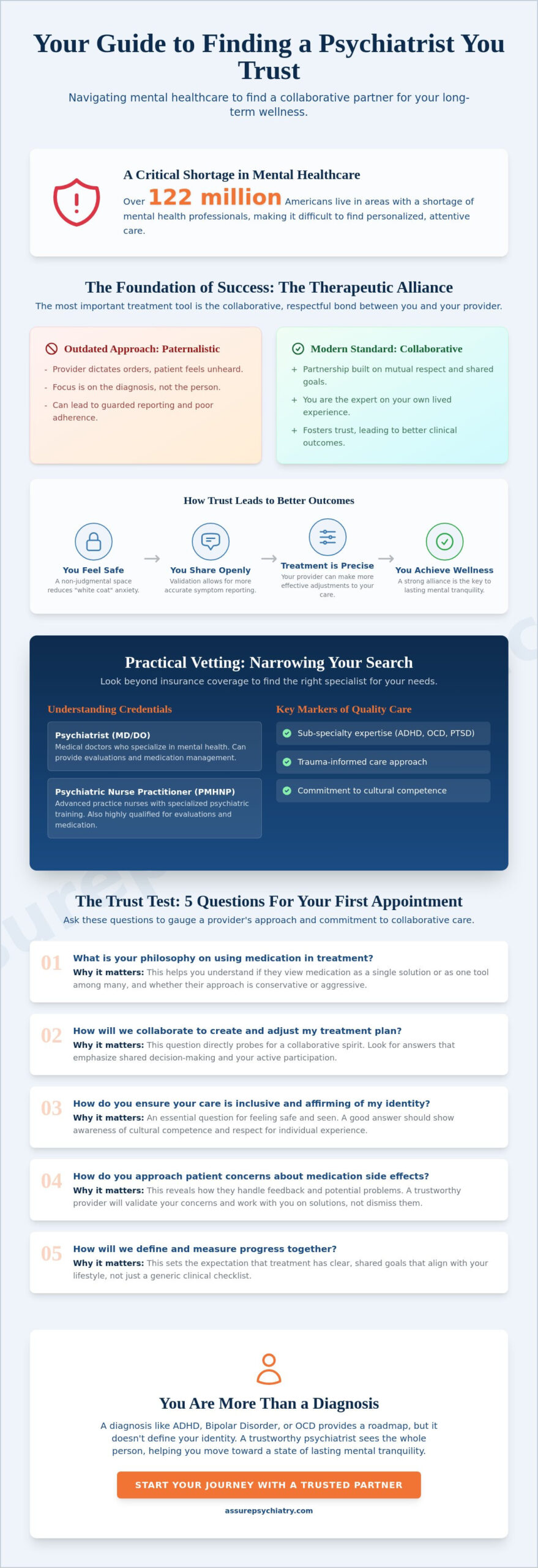
The Trust Test: 5 Questions to Ask During Your First Appointment
Once you have narrowed down your list of potential providers, the first appointment serves as a vital bridge between searching and healing. While resources like the American Psychiatric Association’s Find a Psychiatrist tool are excellent for verifying credentials, they cannot measure the human connection. This initial consultation is your opportunity to evaluate the provider’s empathy and clinical style. Knowing how to find a psychiatrist you trust requires looking beyond the diploma on the wall to see if they truly value a collaborative partnership.
To determine if a provider is the right ally for your wellness journey, consider asking these five targeted questions:
- What is your philosophy on medication? You want to know if they view prescriptions as the only solution or as one of many tools to help you achieve mental tranquility. Learning about the benefits of medication management beforehand can help you ask more informed questions and better evaluate their response.
- What is your experience working with my specific identity and background? A provider who prioritizes inclusive care will be open about their commitment to diverse standards and how they respect your individual history.
- How do you handle side effects or concerns that arise between visits? Their answer will reveal their level of responsiveness and whether you will feel safe and supported during the more difficult days of your treatment. If you’re concerned about what to expect, our guide on managing antidepressant side effects can help you prepare for these conversations.
- Observe their listening style. Do they interrupt you to fill out a checklist, or do they allow you the space to finish your story? A provider who listens without judgment is more likely to offer a diagnostic process that validates your experience.
- Can you explain clearly what happens in medication management during our follow-up sessions? Transparency regarding the frequency of appointments and what to expect during check-ins reduces the anxiety of the unknown.
Evaluating the Clinical ‘Vibe’
Trust your gut. Within the first 15 minutes of a session, you can often sense whether the environment feels stable and reliable. A professional who uses a non-judgmental tone creates a safe space where you can be honest about your symptoms. If you leave the call or office feeling more anxious than when you started, it may be a sign that the therapeutic alliance isn’t a strong fit. An honest provider will discuss both the risks and benefits of treatment options clearly, empowering you to make informed decisions about your own care.
Setting Expectations for the Partnership
A successful treatment journey depends on clear communication about the road ahead. Discuss the frequency of your follow-up appointments early on to ensure they align with your needs. The ultimate goal is to move past the immediate distress of symptoms and toward a state of lasting mental tranquility. By asking about the provider’s approach to collaborative decision-making, you ensure that your voice remains the most important part of the treatment plan. This empowerment is the hallmark of a provider who sees you as a partner rather than just a diagnosis.
Local Continuity vs. National Platforms: Why Proximity Matters
In an era where digital convenience is often prioritized, the decision of how to find a psychiatrist you trust frequently comes down to a choice between large national platforms and local practitioners. National telepsychiatry apps often promise immediate access, but this speed can come with the risk of “provider churn.” When a platform is managed by venture-backed startups, clinicians may rotate frequently, forcing you to retell your story to a new face every few months. This disruption breaks the therapeutic alliance we discussed earlier and can make you feel like a data point rather than a person. Choosing a provider with local ties ensures that your care remains stable and reliable over the long term.
Proximity also plays a vital role in clinical coordination. A local psychiatrist understands the specific Oregon and Washington healthcare landscape, including the regional pharmacy networks and local emergency resources. They can better coordinate with your primary care physician or local specialists to create a unified circle of care. While some believe local care is harder to find due to the fact that 65% of non-metropolitan counties in the U.S. lack a single psychiatrist, many local practices now offer the same telepsychiatry flexibility as national apps. You don’t have to sacrifice the convenience of virtual visits to gain the security of a provider who is actually part of your community.
The Benefit of Local Roots in Portland and Seattle
When you work with a provider who has local roots in Portland or Seattle, you’re partnering with someone who understands the regional stressors that impact your mental health. Whether it’s the impact of seasonal shifts on depression or the specific pressures of the PNW tech industry, local knowledge adds a layer of empathy that a national algorithm cannot replicate. This connection also allows for a seamless transition from virtual to in-person care if your clinical needs change. A local practice like Assure Psychiatry offers a level of consistency that venture-backed startups often struggle to maintain, providing a steady environment where you can focus on achieving mental tranquility.
Navigating the Transition
If you’re currently using a large platform and feel like “just a number,” you might be ready for a change. Switching providers can feel like a setback, but it’s often the most restorative step you can take for your wellness. To ensure your treatment momentum continues, it’s essential to have your records transferred smoothly so your new provider has a clear history of your medication management. Having a single point of contact, such as Dr. Aruwajoye, allows you to build trust faster than you would with a rotating team of clinicians. If you’re ready to make a move, you can follow our guide on how to switch psychiatrists for a step-by-step path to continuing your care. Ready to find a partner who values your individual identity? Reach out to Assure Psychiatry to begin your journey toward lasting peace.
Starting Your Journey Toward Tranquility with Assure Psychiatry
Finding a partner who understands your unique narrative is the most critical step toward healing. At Assure Psychiatry, we believe that your wellness journey should be defined by safety, validation, and a deep sense of partnership. When you are exploring how to find a psychiatrist you trust, you are looking for more than a clinical diagnosis. You are seeking a sanctuary where your identity is respected and your voice is heard. Our mission is to provide compassionate, culturally competent care that helps you move past the weight of your symptoms and toward a state of lasting mental tranquility.
Dr. Olumide Aruwajoye acts as a knowledgeable authority and a collaborative guide for every patient. He understands that a diagnosis of Bipolar Disorder, Depression, or OCD is a starting point for treatment, not a definition of who you are. By prioritizing your individual identity, we create personalized treatment plans that focus on restorative health. We don’t believe in paternalistic medicine where a provider simply dictates orders. Instead, we invite you to be an active participant in your own care, ensuring that every decision aligns with your personal goals and lifestyle.
Our Commitment to Diverse and Inclusive Care
We recognize that the barriers to seeking help for ADHD, anxiety, or PTSD are often rooted in a fear of judgment. To counter this, we have anchored our practice in inclusive care standards that offer non-judgmental support for individuals from all backgrounds. Whether you are navigating the complexities of a new diagnosis or looking for more reliable medication management, our promise is one of total consistency. We strive to be the stable environment you need to find peace. This commitment to reliability ensures that you feel seen as a human being, not just a set of clinical data points, in every follow-up appointment.
A Clear Path Forward
For residents across Oregon and Washington, we have designed a simple and transparent onboarding process to reduce the anxiety of starting care. We understand that the search for trust is ultimately a search for mental wellness. By choosing a local practice with deep roots in the Pacific Northwest, you gain a partner who truly understands the community resources and stressors unique to our region. Scheduling your initial psychiatric evaluation is the first step toward reclaiming your tranquility and peace of mind. We invite you to find a restorative path through medication management portland. Let’s begin the work of building a future where you feel empowered, safe, and fully supported in your journey toward wellness.
Your Path to Mental Tranquility Begins Today
Your journey toward wellness is a deeply personal endeavor that requires a steady, reliable partner. We have explored why the therapeutic alliance is the most powerful tool in your treatment. By focusing on local expertise and asking the right questions, you now have a clear roadmap for how to find a psychiatrist you trust who sees you as a human being. Whether you’re seeking help for ADHD, PTSD, or anxiety, you deserve a clinical space where validation and safety are the standard of care.
Assure Psychiatry, led by Dr. Olumide Aruwajoye, is committed to providing this restorative environment for patients across Oregon, Washington, and Seattle via telehealth. Don’t let the fear of being “just a number” hold you back from the peace you deserve. You’re ready to take the next step toward a life defined by mental tranquility rather than your symptoms. We act as your compassionate ally throughout your wellness journey.
Schedule Your Compassionate Psychiatric Evaluation at Assure Psychiatry
You don’t have to navigate this path alone. Peace of mind is within your reach.
Frequently Asked Questions
How do I know if I need a psychiatrist or a therapist?
Psychiatrists are medical providers who specialize in the biological aspects of mental health, including psychiatric evaluations and medication management. If your symptoms are significantly disrupting your daily life or if you’re seeking help for conditions like ADHD, bipolar disorder, or clinical depression, a psychiatrist is the right choice. While therapists focus on talk-based emotional processing, a psychiatrist manages the clinical and physiological side of your treatment plan.
Can I find a psychiatrist who accepts my insurance in Portland?
Yes, many local providers in the Portland area are in-network with major insurance carriers like Aetna and Blue Cross Blue Shield. It’s always best to verify your specific plan’s behavioral health benefits before your first appointment. At Assure Psychiatry, we prioritize making care accessible for the Oregon and Washington communities, helping you focus on achieving mental tranquility rather than worrying about complex logistics.
What should I do if I don’t feel a connection after the first visit?
You should trust your gut and consider looking for a different provider if you don’t feel a sense of safety or validation. The therapeutic alliance is a partnership, and it’s essential that you feel seen as an individual rather than just a diagnosis. If the clinical “vibe” feels dismissive or paternalistic, it’s perfectly acceptable to continue your search for a compassionate ally who respects your identity.
How long does it typically take to build trust with a new provider?
Trust usually develops over the first few sessions as you experience the provider’s consistency and responsiveness to your concerns. While the initial evaluation sets the foundation, you’ll likely feel more secure after seeing how they handle medication adjustments or between-visit questions. A reliable provider will demonstrate through their actions that they’re a stable guide in your wellness journey, slowly reducing any initial anxiety you may feel.
Is telepsychiatry as effective as in-person visits for building trust?
Telepsychiatry is highly effective for building a strong bond, and many patients find it easier to open up from the comfort of their own homes. Modern virtual platforms allow for the same level of eye contact and non-verbal communication as an office visit. This format lowers the barrier to seeking help for anxiety or PTSD, providing a safe and private environment where a collaborative partnership can thrive.
What are the signs of a ‘red flag’ psychiatrist?
Red flags include a provider who interrupts you frequently, dismisses your concerns about medication side effects, or fails to explain treatment risks clearly. If you feel like a “number” in a high-volume system or if the provider’s tone feels judgmental, these are signs that the relationship lacks the necessary empathy. A trustworthy psychiatrist will always invite you to be an active participant in your own treatment plan.
How often will I need to see my psychiatrist for medication management?
Follow-up appointments typically occur every 4 to 12 weeks once your treatment is stable, though they may be more frequent at the start. For conditions like bipolar disorder or severe depression, your provider will want to monitor your progress closely to ensure your safety and wellness. These regular check-ins are vital for maintaining mental tranquility and ensuring your medication continues to support your unique needs over time.
Can I switch to a local psychiatrist if I’m currently using a national app?
Yes, you can transition to a local practitioner to ensure better continuity of care and regional expertise. Local providers offer a single point of contact and a deeper understanding of the Pacific Northwest healthcare landscape, which national apps often lack. Understanding how to find a psychiatrist you trust involves choosing a partner who is rooted in your community and committed to your long-term, stable recovery.
Recent Comments