

What if your psychiatric appointment wasn’t a rushed exchange for a prescription, but a collaborative step toward true mental tranquility? It’s completely natural to feel a sense of unease before a visit. You might worry about being over-medicated or feel like just another name on a chart in a busy medical system. Many people feel a knot in their stomach wondering exactly what happens in medication management and whether their concerns about side effects will truly be heard.
You deserve to feel seen and heard rather than just diagnosed. This guide will demystify the process, showing you how these visits serve as a roadmap to long-term stability rather than just a quick refill. We’ll explore the typical appointment structure, the difference between this and therapy, and how to communicate effectively with your provider. By the end, you’ll have the confidence to be an active participant in a treatment plan that honors your unique journey toward peace and health.
Key Takeaways
- Understand that medication management is a specialized clinical partnership designed to optimize your health, not just a passive prescription service.
- Learn exactly what happens in medication management appointments, from the initial symptom check-in to real-time adjustments that prioritize your comfort and safety.
- Discover the vital differences between a comprehensive 60-minute psychiatric evaluation and the focused, efficient nature of regular follow-up care.
- Gain practical tools for your journey, such as how to keep a simple symptom journal to ensure your provider hears every concern.
- Shift your perspective from being defined by a diagnosis to becoming an empowered participant in your own path toward mental tranquility.
Defining Medication Management: More Than Just a Prescription
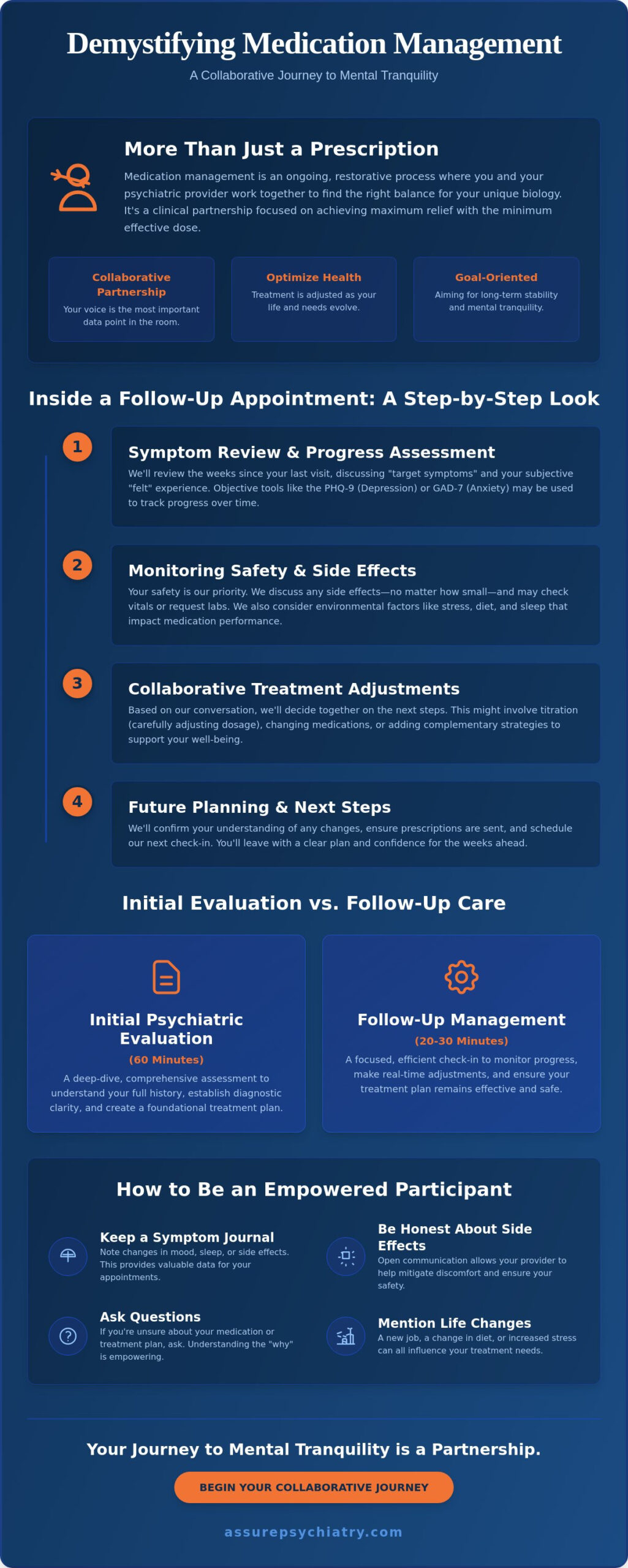
Medication management is a specialized clinical service that goes far beyond simply receiving a prescription. It’s an ongoing, restorative process where you and your psychiatric provider work together to find the right balance for your unique biology. Unlike a standard medical visit, this service focuses deeply on the nuances of your mental wellness and brain chemistry. The ultimate goal is to help you achieve the highest level of therapeutic relief while using the minimum effective dose of medication.
Many people feel uncertain about what happens in medication management because they expect a one-way conversation. In reality, it’s a dynamic partnership. This clinical approach is built on the foundational principles of Medication therapy management, ensuring that every treatment choice is intentional, safe, and effective. It’s a space where your voice is the most important data point in the room. By focusing on your specific needs, your provider helps you move toward a state of mental tranquility.
Why Medication Management is Essential for Mental Health
Psychiatric medications aren’t one-size-fits-all. They often require a process called titration, where dosages are carefully adjusted over time to find your sweet spot. Life doesn’t stand still, and your treatment shouldn’t either. Regular check-ins allow your provider to monitor how life changes, such as a new job or a shift in sleep patterns, affect your stability. This dedicated time ensures that subtle shifts in your mood or focus are addressed before they become overwhelming hurdles. It’s a proactive way to maintain your health as your circumstances evolve.
The Role of the Psychiatric Provider as Your Collaborative Guide
Whether you’re working with a Psychiatrist or a Psychiatric Mental Health Nurse Practitioner (PMHNP), you’re accessing a high level of expertise in managing complex drug interactions. To maintain this level of precision, many providers and healthcare students use specialized review platforms like PharmEDU to stay updated on the latest pharmacological research. These professionals don’t just look at a diagnosis; they see you as a whole person. They act as an ally, validating your experiences while providing the clinical perspective needed to navigate treatment for conditions like ADHD, depression, or anxiety. They help you understand how different medications interact with your body and other supplements you might be taking.
A strong therapeutic alliance is the foundation of successful outcomes. It’s about building a relationship based on trust and reliability. You aren’t just a number in a medical system; you’re an active participant in a plan designed to foster peace. This collaborative spirit ensures you feel empowered rather than just managed. When you understand the “why” behind your treatment, you can approach your recovery with confidence and clarity.
Inside the Appointment: A Step-by-Step Look at What Happens
Understanding exactly what happens in medication management can ease the anxiety of the unknown. These visits are structured to be predictable yet deeply personal. It’s not just a checklist; it’s a conversation that flows through your recent experiences to ensure your treatment remains aligned with your goals for mental tranquility. Every appointment serves as a vital touchpoint in your journey toward stability.
The Symptom Review: Assessing Your Progress
We begin with a look back at the weeks since your last visit. Your provider might use objective tools like the PHQ-9 for depression or the GAD-7 for anxiety to track symptom severity over time. These scales provide a clear baseline, but they only tell part of the story. We’ll dive into “target symptoms,” such as your ability to focus if you’re receiving ADHD treatment, or the frequency of intrusive thoughts in OCD. Your subjective “felt” experience is just as vital as clinical data in this collaborative space.
Monitoring Safety and Side Effects
Safety is our shared priority. Depending on your specific treatment plan, your provider might check your vitals or request periodic blood work to monitor how your body is processing the Mental Health Medications you’ve been prescribed. This is also the time to mention any side effects, even the small ones. Whether it’s a slight change in appetite or a shift in your sleep patterns, every detail helps us fine-tune your care. We’ll work together to create strategies that mitigate discomfort while protecting the benefits of your medication.
Beyond the biological, we discuss the environmental. Factors like high stress at work, changes in your diet, or inconsistent sleep can all impact how well a medication performs. By looking at these lifestyle elements, we make collaborative decisions about dosage adjustments or renewals. If a change is needed, it’s a mutual choice. This ensures you feel confident and empowered as you move through the next few weeks of your psychiatric journey.
Telehealth vs. In-Person: What Changes?
For our patients in Portland and Seattle, the choice between in-person and telepsychiatry is about convenience, not a difference in quality. Virtual visits offer the same warm connection and clinical depth as an office visit. To get the most out of a telehealth session, find a private, quiet space where you can speak freely. Once the plan is finalized, digital prescriptions are sent directly to your local pharmacy, and your follow-up is scheduled to ensure ongoing, reliable support. This rhythmic progression helps reduce the anxiety often associated with seeking care, providing a sense of order and predictability.
The Difference Between Your First Evaluation and Follow-up Care
Your psychiatric journey is built on two distinct but equally vital pillars: the initial evaluation and ongoing medication management. While they share the goal of improving your well-being, their purpose and rhythm differ significantly. Think of the evaluation as drawing the map for your journey, while management is the actual act of navigating the path, making course corrections as needed to reach your destination of mental tranquility.
Understanding these stages helps lower the barrier to seeking help. When you know what to expect, the process feels less like a clinical hurdle and more like a supportive partnership. Both appointment types are essential for a comprehensive mental health plan that prioritizes your long-term stability and peace.
The Initial Evaluation: Setting the Foundation
The first time you meet with a psychiatric provider, the session is a deep dive into your life story. This Psychiatric Evaluation typically lasts 60 minutes or longer. It’s a comprehensive review of your medical history, family background, and any past experiences with treatment. We aren’t just looking for symptoms; we’re looking for the “why” behind your current emotional state. This allows us to create a diagnostic formulation that respects your individual identity rather than just labeling it. This first visit is fundamentally about establishing a foundation of trust and providing the clarity you need to move forward with confidence.
The Follow-up: Fine-Tuning Your Path to Peace
Once the foundation is set, the focus shifts toward optimization. These follow-up visits are shorter, usually lasting 20 to 30 minutes. This is precisely what happens in medication management: we look at the “here and now.” We compare how you’re functioning today to how you felt during our last conversation. Are you sleeping better? Is your focus sharper? These real-time adjustments ensure your treatment stays effective as your life evolves. Small changes in dosage or timing can often lead to significant breakthroughs in how you feel.
By referencing clinical standards like the NIMH Guide to Mental Health Medications, we ensure your plan is grounded in the latest research while remaining tailored to your specific biology. These sessions are where we transition from managing acute symptoms to maintaining long-term mental tranquility. It’s a steady, calm progression that helps reduce the anxiety of the unknown, ensuring you always have a compassionate ally by your side as you navigate your wellness journey.
Your Role in the Process: How to Prepare for Success
Achieving mental tranquility is a shared effort. While your psychiatric provider brings clinical expertise, you bring the most valuable data: your lived experience. Preparation isn’t about being a perfect patient; it’s about giving yourself a voice in the room. By organizing your thoughts before you arrive, you ensure that the conversation remains focused on your specific needs and goals. Understanding what happens in medication management involves recognizing your role as an active partner in your own wellness journey.
To get the most out of your time, consider these simple steps before your visit:
- Keep a brief journal: You don’t need to write pages. Just note any patterns in your mood or energy levels that stand out.
- Update your medication list: Include all current prescriptions, along with over-the-counter vitamins and supplements. These can interact with psychotropic medications in subtle ways.
- Monitor physical changes: Note any new headaches, shifts in appetite, or disruptions in your sleep. These physical markers are vital clues for your provider.
- Write down your questions: It’s easy to forget concerns once the session begins. Having a list ensures every worry is addressed.
If you’re ready to start this collaborative journey with a team that values your individual identity, you can schedule your medication management visit here.
Tracking Your ‘Target Symptoms’
Focusing on two or three “target symptoms” can make your progress much clearer. For example, if you’re seeking help for anxiety, you might track how often you feel “on edge” in the morning. If you’re managing ADHD, you might track your ability to finish tasks at work. Try rating these on a scale of 1 to 10 between appointments. It’s also incredibly helpful to mention your “wins.” Did you have a day where you felt more like yourself? Sharing these moments helps your provider understand what’s working just as much as what isn’t.
Asking the Right Questions
Empowerment comes through understanding. Never hesitate to ask about the long-term outlook for your treatment or the potential for dependency with certain medications. You might want to know how to handle a missed dose or how your medication works in synergy with lifestyle changes. Your provider is there to act as a collaborative guide, ensuring you understand the “why” behind every dosage change. This transparency builds the trust necessary for a stable, restorative environment where you can truly find peace.
Choosing a Collaborative Partner in Portland and Seattle
Selecting a psychiatric provider is one of the most personal decisions you will make for your health. In the Pacific Northwest, Assure Psychiatry offers a space where clinical expertise meets deep, human-centered empathy. We understand that knowing what happens in medication management is only half the battle. The other half is feeling safe, respected, and validated while it happens. Our practice is designed to be a restorative environment where you are more than just a diagnosis on a chart. If you’re still in the process of finding a psychiatrist you trust, our guide to compassionate care can help you identify the right collaborative partner for your unique needs.
We believe that a diagnosis is simply a tool for growth, not a label that defines your identity or your future. Whether you are seeking help for anxiety, bipolar disorder, or OCD, our approach centers on your unique wellness goals. By providing culturally competent care, we honor the diverse backgrounds and identities of our neighbors in Portland and Seattle. This commitment to inclusivity ensures that every patient feels seen and heard, creating the stable foundation necessary for true mental tranquility.
Accessibility is a cornerstone of our service. For those who prefer a face-to-face connection, we offer in-person care in Portland. For patients across Oregon and Washington, our telepsychiatry options provide the same level of clinical depth and connection from the comfort of your own home. This flexibility ensures that reliable support is always within reach, regardless of your schedule or location.
A Human-Centered Approach to Medication
Dr. Olumide Aruwajoye and the team at Assure Psychiatry prioritize a non-judgmental style that emphasizes safety and understanding. We don’t just manage symptoms; we partner with you to achieve a state of peace and health. By using metaphors of partnership and allyship, we move away from paternalistic medicine and toward a collaborative model. We are dedicated to providing inclusive care for the diverse populations of Seattle and Portland, ensuring that every individual has access to a compassionate guide on their journey toward mental tranquility.
Next Steps: Starting Your Journey Toward Tranquility
Taking the first step toward stability should feel empowering rather than overwhelming. Your journey begins with an initial psychiatric evaluation, where we spend the time necessary to build your personalized treatment roadmap. We strive to make our services accessible by offering both insurance-friendly and private-pay options. Once you understand what happens in medication management, you can approach your follow-up visits with confidence and clarity.
Ready to find your peace? Schedule your medication management appointment today.
Empowering Your Path to Lasting Peace
Your mental wellness journey is a deeply personal experience that deserves a compassionate, expert ally. By understanding exactly what happens in medication management, you can replace the weight of uncertainty with a clear, collaborative roadmap for your health. This process is never about just a prescription; it’s about fine-tuning your treatment to ensure you feel like yourself again. Whether you’re tracking target symptoms or preparing questions for your next visit, your active participation is the key to achieving true mental tranquility.
At Assure Psychiatry, we’re committed to providing culturally competent care that respects your individual identity. We accept most major insurance plans and offer the flexibility of telehealth across Oregon and Washington; this ensures that professional support is always accessible. You don’t have to navigate these complexities alone. Our team is here to provide the stable, non-judgmental environment you need to thrive.
Schedule Your Medication Management Appointment at Assure Psychiatry
Taking this step is a profound act of self-care. We look forward to walking alongside you as you rediscover your balance and peace.
Frequently Asked Questions
How long does a medication management appointment usually last?
A follow-up medication management visit typically lasts between 20 and 30 minutes. This is shorter than your initial psychiatric evaluation, which usually takes 60 minutes or more. These sessions are designed to be focused and efficient, allowing us to review your progress and make real-time adjustments. It’s a rhythmic check-in that ensures your treatment remains aligned with your goals for mental tranquility while respecting your busy schedule.
Is medication management the same thing as therapy or counseling?
No, medication management is not the same as long-term psychotherapy. While both are essential pillars of mental health, medication management focuses specifically on the clinical monitoring and optimization of psychotropic medications. We assess your symptoms, check for side effects, and adjust dosages. If you’re wondering what happens in medication management compared to therapy, think of us as your clinical guides for brain chemistry and symptom stability.
How often will I need to see my psychiatrist for medication management?
The frequency of your visits depends entirely on your unique needs and where you are in your journey. When you’re starting a new medication or adjusting a dose, we may meet every two to four weeks to ensure your safety. Once you achieve a state of stability and mental tranquility, visits often shift to every one to three months. We’ll always collaborate to decide on a schedule that feels supportive and reliable.
Can I do my medication management appointments via telehealth?
Yes, you can absolutely attend your appointments via telehealth. Assure Psychiatry provides virtual visits for patients throughout Oregon and Washington, offering the same high standard of care as an in-person visit. This option is particularly helpful for those with busy schedules or those living in areas with fewer local providers. You’ll just need a private, quiet space and a stable internet connection to connect with your compassionate ally.
What should I do if I experience side effects before my next appointment?
Please reach out to your provider right away if you notice new or concerning side effects rather than waiting for your next scheduled visit. Nothing is too small to mention. Your provider can offer guidance on whether the symptoms are temporary or if we need to adjust your plan. Open communication is a vital part of what happens in medication management, ensuring your comfort and safety remain our top priorities throughout your treatment.
Does insurance cover psychiatric medication management visits?
Most major insurance plans do cover psychiatric medication management visits. Because these are medical appointments focused on treating a diagnosable condition, they’re typically treated similarly to other specialist visits. We also offer private-pay options for those who prefer them. It’s always a good idea to check with your specific plan to understand your coverage, but our goal is to keep the path to wellness as accessible as possible.
Can my primary care doctor handle my psychiatric medications instead?
While primary care doctors can prescribe some psychiatric medications, a specialized psychiatric provider offers a deeper level of expertise. Psychiatrists and PMHNPs focus exclusively on mental health conditions like Bipolar Disorder, PTSD, and OCD. We have advanced training in complex drug interactions and the nuances of brain chemistry. Choosing a specialist ensures your treatment plan is as personalized and precise as possible, leading to better long-term stability and peace.
What happens if I want to stop taking my medication?
If you’re considering stopping your medication, it’s essential to discuss this with your provider first to create a safe tapering plan. Stopping suddenly can lead to uncomfortable withdrawal symptoms or a return of previous struggles. We respect your autonomy and your desire to change your treatment. By working together, we can ensure you transition safely while maintaining your hard-earned mental tranquility and overall wellness.
Recent Comments