

Last Tuesday, Sarah realized she hadn’t checked her email five times before breakfast, a small but monumental sign that her generalized anxiety disorder treatment was finally working. You’ve likely spent years feeling like your mind is a high-speed engine that won’t shut off, leaving you with physical fatigue and muscle tension that rest cannot fix. It’s exhausting to live in a state of constant vigilance, especially when you fear that seeking help might change the parts of your personality you value most. We understand that your anxiety is a heavy burden, but it’s not who you are.
This guide will show you that modern care is about restoration and finding your way back to mental tranquility. You’ll learn exactly how clinical pathways, psychiatric evaluations, and advanced medication options can create a clear, manageable plan for your daily life. We’ll preview the latest 2026 treatment trends, including updated FDA medication guidelines and therapeutic strategies that prioritize your comfort and safety. By the end of this article, you’ll see a path forward that leads to improved sleep, physical relaxation, and a significant reduction in daily worry.
Key Takeaways
- Understand how modern care shifts the focus from merely suppressing symptoms to restoring long-term emotional balance and mental tranquility.
- Explore how generalized anxiety disorder treatment targets specific neurobiological pathways to help regulate the constant ‘what-if’ thinking and physical tension.
- Learn why a comprehensive psychiatric evaluation is the vital first step in developing a personalized plan that respects your individual identity and health history.
- Discover the clinical benefits of combining symptom regulation with skill-building strategies to achieve more robust relief for moderate-to-severe anxiety.
- Find out how telepsychiatry is expanding access to expert care for residents across Oregon and Washington, making professional support more accessible than ever.
The Framework of Generalized Anxiety Disorder Treatment
Effective generalized anxiety disorder treatment in 2026 is no longer about just “managing” a list of symptoms. It is a comprehensive, multi-modal framework designed to restore the emotional and physiological balance that chronic worry often strips away. For many, anxiety feels like a constant background noise that never quite fades. A structured clinical approach seeks to silence that noise by combining medical expertise with a deep understanding of your personal history. This journey begins with a professional psychiatric evaluation, which serves as the essential roadmap for everything that follows.
By using evidence-based standards from the DSM-5, clinicians can move beyond surface-level observations to create a plan tailored to your specific needs. This isn’t a one-size-fits-all process. Instead, it’s a collaborative effort that respects your identity while providing the clinical precision necessary for lasting change. You aren’t just a diagnosis; you’re an individual seeking a return to your true self. Understanding the structure of your care helps lower the barrier to seeking help, as it replaces uncertainty with a predictable path toward wellness.
The Goal of Restorative Mental Health
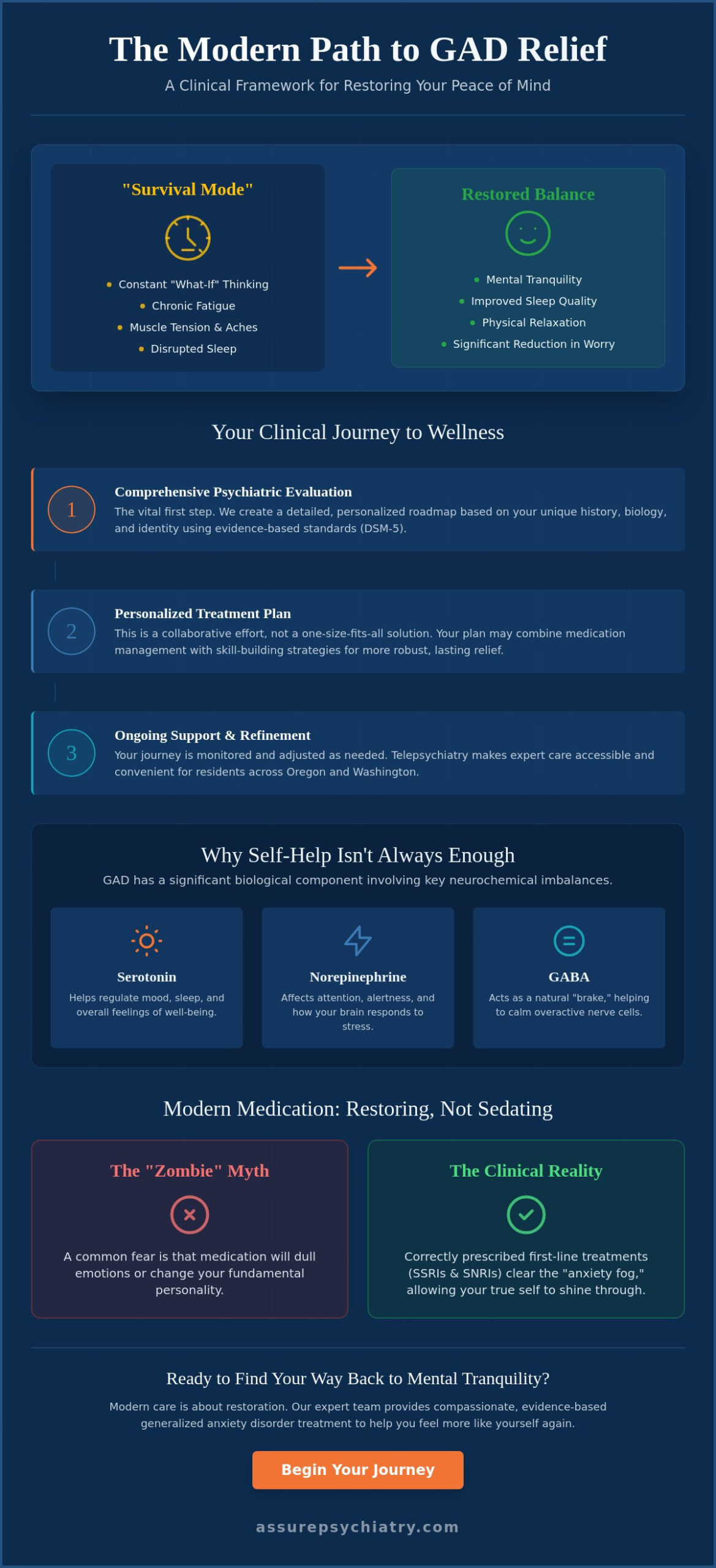
Many people living with GAD exist in what we call “survival mode.” This is a state where your nervous system is constantly on high alert, leading to physical symptoms like chronic fatigue, muscle tension, and disrupted sleep. The ultimate goal of restorative care is to help you transition from this exhausting state into a place of functional, daily peace. A non-judgmental clinical environment is vital here. It provides the safety you need to explore your symptoms without fear of being misunderstood or defined by your condition. True mental tranquility happens when you can finally trust your mind to rest and your body to relax.
Why Self-Help Isn’t Always Enough for GAD
It’s common to feel that you should be able to “think your way out” of anxiety. However, GAD has a significant biological component that willpower alone cannot address. For a more detailed look at these factors, you can explore this Generalized Anxiety Disorder overview. Chronic worry often stems from neurochemical imbalances involving serotonin, norepinephrine, and GABA. When anxiety crosses the line into a clinical condition, it’s no longer just a personality trait or a stress response; it’s a physiological event. A psychiatrist plays a crucial role in identifying these imbalances and determining if generalized anxiety disorder treatment requires pharmacological intervention to help level the playing field for your recovery.
Pharmacological Interventions: How Anxiety Medications Work
Anxiety is often more than a state of mind; it’s a complex chemical conversation happening within your nervous system. When we discuss generalized anxiety disorder treatment, we are looking at how to balance three primary messengers: Serotonin, Norepinephrine, and GABA. Serotonin helps regulate mood and sleep, while Norepinephrine affects how your brain responds to stress. GABA acts as a natural “brake,” helping to calm overactive nerve cells. When these systems are out of sync, your brain stays in a state of high alert. Understanding this neurobiology is the first step toward reclaiming your peace of mind.
One of the most common fears people express is the “zombie” myth. You might worry that medication will dull your emotions or change your fundamental personality. In reality, modern medication management aims to do the exact opposite. When prescribed correctly, these tools should clear the “anxiety fog,” allowing your true personality to shine through without the weight of constant worry. It’s about restoration, not sedation. You should feel more like yourself, not less. For a deeper look at these clinical pathways, you can consult Harvard Medical School’s guide to GAD, which details how these interventions support long-term recovery.
First-Line Treatments: SSRIs and SNRIs
Selective Serotonin Reuptake Inhibitors (SSRIs) and Serotonin-Norepinephrine Reuptake Inhibitors (SNRIs) are considered the gold standard for daily maintenance. They don’t work instantly; instead, they act as a “bridge” to wellness by gradually shifting your brain chemistry over several weeks. 2026 updates to clinical standards, including the revised FDA drug label for Escitalopram, emphasize the efficacy of these treatments when managed with precision. You can typically expect the following during the first month:
- Weeks 1-2: Your body begins to adjust. You might experience mild, temporary side effects as your system finds a new equilibrium.
- Weeks 3-4: The “background noise” of worry starts to diminish. You may notice you’re reacting less intensely to typical stressors.
- Month 2 and beyond: Full therapeutic benefits usually take hold, leading to improved sleep and physical relaxation.
Alternative and Adjunctive Medications
Not every person requires the same approach. If SSRIs aren’t the right fit, options like Buspirone offer a non-habit-forming alternative that specifically targets anxiety without the sedative effects of older classes. In some cases, a provider might suggest short-term, fast-acting relief for acute spikes in worry, though these are used sparingly. The key is ongoing communication. By fine-tuning your dosage based on your feedback, we can minimize side effects and maximize your sense of tranquility. If you’re looking for a partner to help you find the right balance, professional medication management can provide the clinical expertise you need to move forward safely.
Psychotherapy vs. Medication Management: A Comparison
Choosing between therapy and medication doesn’t have to be an “either-or” decision. It’s a common dilemma for those seeking relief. Both paths offer unique benefits, but they work through different mechanisms. Psychotherapy, specifically Cognitive Behavioral Therapy, focuses on building a toolkit of mental skills. In contrast, generalized anxiety disorder treatment through medication management focuses on regulating the physiological symptoms that make those skills hard to use. Think of it this way: if your anxiety is a stormy sea, therapy teaches you how to sail, while medication helps calm the waters so you don’t capsize while learning.
Research consistently indicates that for moderate-to-severe GAD, the “Combined Approach” yields the highest success rates. This isn’t just about doubling up on treatments; it’s about synergy. Medication can provide the stability needed to attend therapy sessions, while therapy provides the long-term coping mechanisms that may eventually allow for a reduction in medication. It’s a partnership between your biology and your behavior. When you prioritize a psychiatric evaluation to explore generalized anxiety disorder treatment, you’re taking a vital step toward understanding which combination will best serve your journey toward mental tranquility.
Your choice often depends on your current capacity and the intensity of your symptoms. Therapy typically involves weekly sessions and active “homework” between visits. Medication management usually requires less frequent appointments once a stable dose is found. This makes it a highly manageable option for those with demanding schedules who still need high-level clinical support. The goal is to find a path that fits your life, not one that adds more stress to it.
Cognitive Behavioral Therapy (CBT) Basics
CBT is the most studied form of talk therapy for anxiety. It works by helping you identify “cognitive distortions,” which are essentially the lies your anxiety tells you. Do you find yourself constantly imagining the worst-case scenario? That’s a distortion. Through therapy, you learn to challenge these thoughts and reduce avoidance behaviors. It’s a structured, skill-based process that provides a lifelong toolkit for managing stress. While we focus on the medical side of care, we recognize that these skills are a powerful partner in your recovery journey.
The Clinical Case for Medication Management
There are times when the biological “volume” of anxiety is simply too loud for therapy to be effective on its own. This is where professional medication management becomes essential. A psychiatrist acts as your collaborative guide, ensuring that your treatment is safe, effective, and tailored to your unique chemistry. Through ongoing monitoring, we can adjust dosages and track your progress, ensuring that the medication continues to serve its purpose without interfering with your personality. This clinical oversight provides a stable foundation, allowing you to engage more fully in your daily life and any additional therapeutic work you choose to pursue.
Navigating Your Clinical Journey: From Evaluation to Relief
Many people delay seeking help because they don’t know what to expect once they walk through the clinic door. Will the provider truly listen? Is it just a list of generic questions? The path toward effective generalized anxiety disorder treatment is a structured, intentional progression designed to replace uncertainty with a sense of order. It begins with a deep dive into your unique experience, followed by a collaborative plan that moves at a pace you find comfortable. This journey is about more than just reducing symptoms; it’s about building a stable foundation for your future.
The first phase of your care involves a comprehensive psychiatric evaluation. This is a detailed diagnostic interview where you can feel seen and heard as an individual rather than just a set of symptoms. We look beyond the surface to understand how your history, biology, and current environment intersect. By the end of this session, your provider will formulate a personalized treatment plan that identifies your specific goals for mental tranquility and outlines the clinical steps needed to reach them.
Once we move into the initial prescription phase, we typically follow a “start low and slow” philosophy. This approach minimizes potential side effects while allowing your body to gently adjust to the new support. As you begin generalized anxiety disorder treatment, you’ll work closely with your provider to track your symptoms and progress. This ongoing feedback loop is what transforms a standard prescription into a precise clinical tool, eventually allowing for adjustments that prioritize long-term wellness and emotional balance.
What to Expect in Your Initial Evaluation
During your first visit, we conduct a thorough review of your medical history and current challenges. It’s common for GAD to coexist with other conditions like ADHD or depression. Identifying these co-occurring issues early ensures your plan is truly comprehensive. We’ll establish a clear baseline for your symptoms, from the frequency of ‘what-if’ thoughts to physical manifestations like muscle tension. This collaborative process ensures you’re an active participant in your own recovery from day one.
The Importance of Follow-Up Care
Expert medication management is never a “set it and forget it” process. It requires a consistent relationship with your provider to ensure safety and efficacy. These appointments allow us to monitor how you’re feeling and make micro-adjustments to your dosage as your life circumstances change. We focus on the transition from acute relief to long-term maintenance, helping you maintain the peace you’ve worked so hard to achieve. If you’re ready to begin this partnership, you can schedule your psychiatric evaluation to start your journey today.
Generalized Anxiety Disorder Treatment in Portland and the PNW
Living in the Pacific Northwest offers a unique blend of natural beauty and urban energy, but the region faces a stark reality regarding mental health access. Washington currently has only one mental health provider for every 360 people, and nearly half of its 39 counties don’t have a single psychiatrist. These shortages often lead to long wait times and significant barriers for those seeking generalized anxiety disorder treatment. At Assure Psychiatry, we act as a collaborative ally to bridge this gap, providing residents in Portland, Seattle, and Vancouver with the high-level clinical expertise they deserve.
We understand that the logistics of starting care can feel overwhelming. To lower these hurdles, we work with major insurance plans such as Aetna and Blue Cross. Our goal is to ensure that your journey toward mental tranquility isn’t stalled by administrative frustration. By focusing on streamlined medication management and psychiatric evaluations, we help you move quickly from a state of constant worry to a clear, manageable plan for wellness. For those navigating the broader landscape of mental health services in the region, our comprehensive guide to anxiety treatment in Portland can help you understand your options and choose the right level of care in 2026.
Telehealth vs. In-Person Care in Oregon
Telepsychiatry has become a vital tool for busy professionals across the PNW. In 2022, 65% of mental health visits in Washington were conducted virtually, a rate much higher than the national average. Oregon’s HB 4070 further supports this shift by requiring health benefit plans to reimburse for telehealth services at the same rate as in-person visits. This means you can receive expert generalized anxiety disorder treatment from your home in Portland or a quiet office in Seattle without any loss in the quality of care. Our virtual platform ensures your privacy and comfort, allowing you to maintain a strong clinical connection with your provider regardless of your location.
Finding a Culturally Competent Provider
The Pacific Northwest values diversity and inclusivity, and we believe your mental health care should reflect those same standards. We prioritize an environment where your individual identity is respected and your voice is heard. Our practitioners are trained to look beyond the diagnosis to see the person behind the symptoms. This human-centered approach is essential for building the trust necessary for successful treatment. If anxiety symptoms extend beyond chronic worry into sudden, intense episodes, exploring panic disorder treatment in Portland may also be an important part of your comprehensive care plan. If you’re ready to move beyond ‘what-if’ thinking and reclaim your daily peace, the next step is simple. You can begin your journey by scheduling your evaluation at Assure Psychiatry today.
Your Path Toward Lasting Mental Tranquility
Finding the right generalized anxiety disorder treatment is a transformative step toward reclaiming your life from chronic worry. We’ve explored how balancing your neurobiology through precise medication management creates the stability needed for long-term wellness. By moving beyond survival mode and embracing a clinical framework tailored to your unique history, you can finally experience the physical relaxation and improved sleep you’ve been searching for.
For families specifically seeking support for adolescents or young adults, it is often helpful to consult with clinics focused on that age group; for instance, you can visit Thrive Teen Therapy Alberta to learn about specialized mental health services for youth.
Assure Psychiatry is here to serve as your compassionate ally in this process. We prioritize culturally competent care and accept most major insurance plans, including Aetna and Blue Cross. Whether you prefer to visit our Portland office in person or utilize our telepsychiatry services across Oregon and Washington, expert support is within your reach. You don’t have to navigate this journey alone.
Begin your journey toward mental tranquility. Schedule an evaluation with Assure Psychiatry today. Your future self will thank you for the peace you choose to prioritize now.
Frequently Asked Questions
Is generalized anxiety disorder curable with treatment?
Generalized anxiety disorder is a chronic condition, but it is highly manageable with the right clinical support. While the word “cure” implies a permanent disappearance, most patients achieve a state of long-term remission where symptoms no longer interfere with their quality of life. The goal of care is to reach a place of mental tranquility where you feel in control of your thoughts rather than being controlled by them.
How long does it take for anxiety medication to start working?
Most patients begin to notice subtle shifts in their physical tension or sleep patterns within the first two weeks of starting a new regimen. However, it typically takes four to six weeks to experience the full therapeutic benefits for mood and worry reduction. Your brain needs this time to safely adjust to the neurochemical changes that support a calmer state of being.
Will I have to stay on anxiety medication for the rest of my life?
You don’t necessarily need to stay on medication indefinitely. Many individuals use pharmacological support as a temporary bridge during particularly stressful seasons or while they work on other areas of their wellness. Your provider will collaborate with you to monitor your progress and determine when it’s appropriate to discuss a maintenance plan or a gradual reduction in dosage.
What is the most common medication prescribed for GAD?
SSRIs and SNRIs are the gold standard for generalized anxiety disorder treatment because they are non-habit-forming and effective for long-term use. Common options include Sertraline and Escitalopram, the latter of which received updated FDA drug label information in 2026. These medications work by regulating the messengers in your brain that manage your stress response and emotional stability.
Can I get GAD treatment through telehealth in Oregon or Washington?
Yes, telepsychiatry is a widely available and highly effective option for residents in the Pacific Northwest. In 2026, Oregon’s HB 4070 ensures that virtual mental health visits are covered by insurance at the same rate as in-person appointments. Additionally, federal flexibilities for Medicare beneficiaries have been extended through December 31, 2027, making it easier than ever to access care from your home.
What happens if the first medication I try doesn’t work?
It’s quite common for the first medication to require a dosage adjustment or a switch to a different class of medicine. If you don’t find relief initially, your psychiatrist may use tools like pharmacogenomic testing to analyze how your body metabolizes different compounds. This clinical precision helps us move past the trial-and-error phase to find the specific treatment that fits your unique biology.
How do I know if my anxiety is ‘bad enough’ to see a psychiatrist?
If your worry feels constant, causes physical symptoms like muscle tension, or prevents you from fully engaging in your work or relationships, it is time to seek a psychiatric evaluation. You don’t have to wait for a total breakdown to deserve support. Professional intervention is about restorative action, helping you return to a functional state before your symptoms become overwhelming. If you’re unsure whether your symptoms cross a clinical threshold, understanding when to see a psychiatrist for anxiety — and the common myths that hold people back — can help you make a more informed decision. For those whose anxiety manifests as sudden, intense physical episodes, learning more about panic disorder treatment in Portland can help clarify whether a different diagnosis may better explain your experience.
Does insurance typically cover psychiatric evaluations for anxiety?
Most major health insurance plans, including Aetna and Blue Cross, provide coverage for psychiatric evaluations and ongoing medication management. The Affordable Care Act mandates that mental health services are an essential benefit. While your specific copay or deductible will vary by plan, seeking generalized anxiety disorder treatment is a covered medical necessity for the vast majority of patients.
Recent Comments