

You don’t need a perfect script to make your first telepsychiatry visit worthwhile. It’s understandable to wonder what the provider will ask, whether your connection will hold, or how to explain your symptoms and treatment history. Preparing for your first telepsychiatry visit can help you feel more at ease, but you don’t need every detail organized or every answer ready. The goal is an honest conversation, not a flawless presentation.
A little planning can make that conversation feel more comfortable. This guide will help you gather useful notes, set up a private space, check your technology, and think about questions you’d like to raise. You’ll also learn what may happen during a psychiatric evaluation and how the conversation can inform practical next steps. Assure Psychiatry provides telepsychiatry through HIPAA-compliant video conferencing for Oregon residents ages 10-65. Specific criteria must be fulfilled to access remote appointments. Your first visit is a chance to share what matters to you and take part in collaborative care planning.
Key Takeaways
- Preparing for your first telepsychiatry visit can be simple: brief, imperfect notes about symptoms, medications, and questions are a useful starting point.
- Learn what topics may come up during a psychiatric evaluation, while remembering the conversation can follow your individual needs.
- Use a private, comfortable space and check your internet, camera, and microphone before joining as directed.
- If explaining symptoms feels difficult, simple opening phrases can help you begin. Ask for clarification when you need it.
- Next steps depend on your conversation. Assure Psychiatry offers Psychiatric Evaluation and Medication Management to Oregon residents ages 10-65. Specific criteria must be fulfilled to access remote appointments.
What Happens During Your First Telepsychiatry Visit?
A first mental health appointment can feel unfamiliar, hopeful, or nerve-wracking, sometimes all at once. You might wonder whether you’ll know what to say or whether the provider will expect a clear explanation right away. You don’t need to arrive with a diagnosis or a polished account of everything you’ve experienced. A first telepsychiatry visit is a collaborative conversation to understand your concerns, history, and goals, then consider possible next steps.
The appointment takes place by video, but the focus is still on you and what support may be appropriate. For a broader overview of the approach and its applications, see What is Telepsychiatry? The conversation can follow your needs, rather than a fixed agenda that everyone must complete.
What might a psychiatric provider ask about?
Your provider may invite you to describe what led you to seek care, when you first noticed a concern, and how it affects everyday life. For example, you might talk about concentration at work or school, changes in your routines, or feeling less able to enjoy activities. Questions may also touch on sleep, mood, stress, and what you hope will change. Relevant medical and mental health history can add context, but you can share what you know without having every date or detail at hand.
These questions are meant to build understanding, not test your memory or judge your choices. If a question feels too broad, ask for an example or say, “Could you explain what you mean?” You can also pause to think. When preparing for your first telepsychiatry visit, remember that it’s okay to describe an experience in your own words, even if you’re unsure how to label it.
How is a Psychiatric Evaluation different from a follow-up?
An initial Psychiatric Evaluation gives the provider time to understand your needs and discuss an individualized treatment plan. The conversation may cover current concerns, relevant history, and your goals. It’s an opportunity to consider options together, not a promise of a particular diagnosis, prescription, or outcome. Assure Psychiatry provides Psychiatric Evaluations through telepsychiatry with a Psychiatric Mental Health Nurse Practitioner. Specific criteria must be fulfilled to access remote appointments.
Follow Up Medication Management Visits have a different focus: they can review how a treatment plan is going, discuss changes or concerns, and monitor progress. Next steps depend on your situation and the conversation. Learn more about what an evaluation may involve in this guide to psychiatric evaluation.
If nerves make it hard to begin, try a simple opener: “I’m not sure where to start, but lately I’ve been feeling…” Or say, “I’m having trouble explaining this.” Naming the difficulty is useful information too. The first conversation doesn’t need to tell your whole story at once. It can help you and your provider find a place to begin.
What to Prepare Before Your First Telepsychiatry Visit
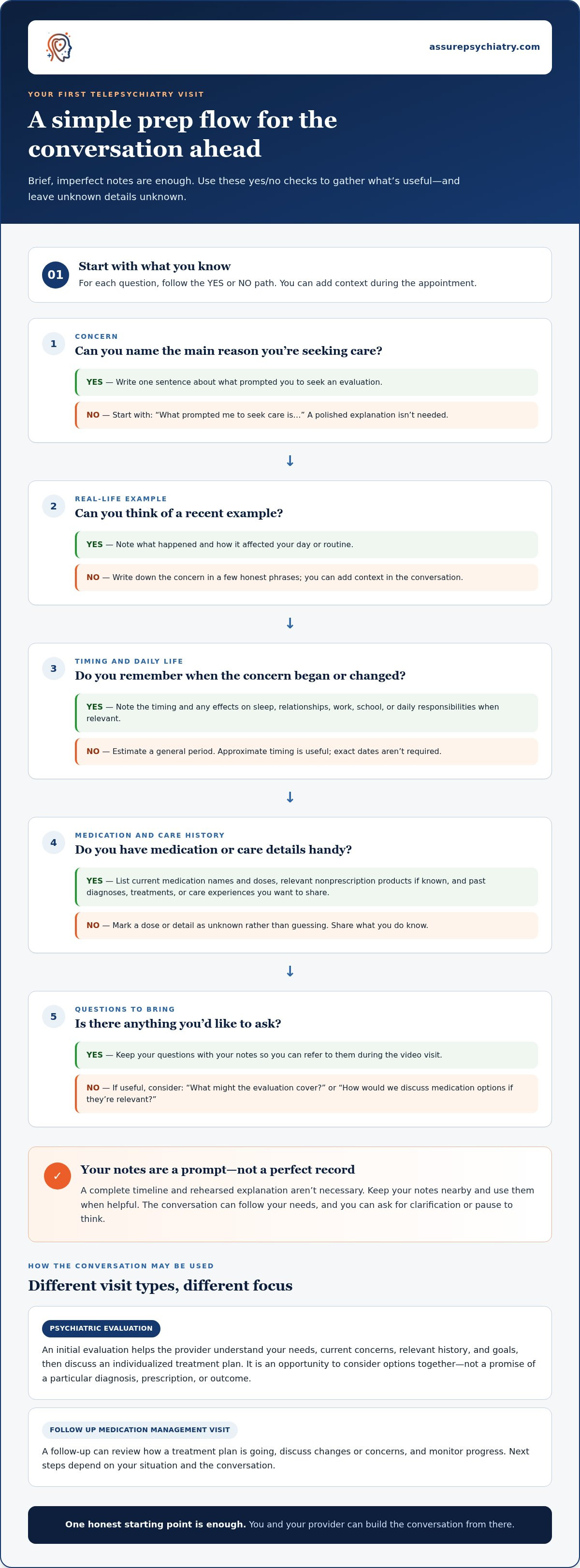
You don’t need a complete timeline or a carefully rehearsed explanation to get ready. A few brief notes can make it easier to recall details during the conversation, and it’s okay to leave gaps. Think of preparation as a prompt for yourself, not homework you need to finish perfectly.
Useful items to gather include a short list of current concerns and examples, approximate timing and effects on daily life, current medication names and doses, relevant medical or mental health history, and questions you’d like to ask. The American Psychiatric Association also offers practical guidance in Preparing for Your Telepsychiatry Appointment.
Make a short symptom and concern list
Start with what feels most important to discuss. For each concern, jot down a recent example, when it began or changed, and how it affects your routine. Approximate timing is useful if you don’t remember exact dates. Include effects on sleep, relationships, work, school, or daily responsibilities when they’re relevant. A few honest phrases are enough; you can add context during the appointment.
Gather medication and care-history details
Make a list of current medications and doses, along with relevant nonprescription products if you know them. Add past diagnoses, treatments, or care experiences you want the provider to understand. If you don’t know a dose or can’t recall a detail, mark it as unknown rather than guessing. Preparing for your first telepsychiatry visit should help you feel supported, not pressured to produce a perfect record.
- Choose your main concern. Write one sentence about what prompted you to seek an evaluation.
- Add a real-life example. Note what happened recently and how it affected your day.
- Estimate the timeline. Record when the concern started or changed, even if you can only name a general period.
- Collect care details. List medications, doses, and relevant history that are readily available.
- Write down questions. Include anything you’d like to understand about the evaluation, treatment options, or Medication Management.
Questions can be simple: “What might the evaluation cover?” or “How would we discuss medication options if they’re relevant?” If you want to understand how ongoing medication-focused appointments may work, the Medication Management guide provides additional context. Keep your notes open during the video visit and refer to them when useful. They’re there to help you remember, not to control the conversation.
Assure Psychiatry provides Psychiatric Evaluations and Medication Management through telepsychiatry for Oregon residents ages 10-65. If you’re considering an evaluation, learn about Assure Psychiatry’s care and take the next step at a pace that feels manageable.
How to Set Up a Private, Reliable Video Appointment
A few practical checks can help you settle in and focus on the conversation instead of troubleshooting. You don’t need a special room or a complicated setup. Aim for a place where you can hear clearly, speak comfortably, and limit interruptions. A private space and a little preparation can make it easier to feel settled and speak openly during a video appointment.
Assure Psychiatry conducts telepsychiatry visits through HIPAA-compliant video conferencing. Once your visit is arranged, follow the instructions provided for that appointment rather than relying on a familiar video app or an old link.
Test your device and connection before the appointment
Before the visit, review the clinic’s instructions and check which device and access method you’ll use. A phone, tablet, or computer may work if it can connect to the appointment as directed. Test the camera and microphone, and check that you can hear sound through the device. If you use headphones, test those too. A quick practice call with someone you trust can help you catch muted audio or a blocked camera.
- Review the visit instructions. Find the appointment access details and note how you’re directed to join.
- Check your internet connection. Use the connection and location you expect to have during the visit. If the signal seems unreliable, consider another spot with a stronger connection.
- Test the camera and microphone. Make sure your face is visible and your voice can be heard. Adjust the device position so you’re not holding it throughout the conversation.
- Allow time for setup. Try the steps before the appointment rather than waiting until the moment you need to join. If something doesn’t work, you’ll have time to try a basic adjustment, such as moving closer to the router or restarting the device.
Create a space where you can speak comfortably
Choose a place with limited background noise and interruptions, such as a room where you can close the door. Let household members know you need privacy for the appointment, if that feels comfortable. Silence nonessential notifications, and place your notes and water nearby so you don’t have to step away. Headphones are optional. They may make it easier to hear or help keep the conversation from being overheard by others nearby.
If a fully private room isn’t available, consider a small change that could make you more comfortable: another room, a quieter time, or a spot where people are less likely to pass through. You can also think ahead about what you’d like to do if someone interrupts, such as pausing briefly to regain privacy. The goal isn’t a perfect environment. It’s a setup that gives you the best chance to take part without unnecessary distractions.
As part of preparing for your first telepsychiatry visit, choose an arrangement that fits your needs and feels manageable. If you use accessibility settings or assistive technology, set them up in advance when possible. Keep the appointment instructions within reach, join as directed, and give yourself a moment to get comfortable before the conversation begins.
How to Talk About Symptoms When You Feel Nervous
You don’t need polished wording to talk about what’s been happening. If you feel nervous, lose your train of thought, or aren’t sure where to begin, that’s okay. A Psychiatric Evaluation isn’t a performance. It’s a collaborative conversation, and you can start with one concern in your own words.
Preparing for your first telepsychiatry visit may help you organize your thoughts, but your notes don’t have to tell the whole story. Share one example, pause, and add details as they come to mind. The provider may ask follow-up questions to better understand what you’re experiencing. You’re allowed to take the conversation one step at a time.
Start with what feels most important today
Begin with the concern that prompted you to seek care, even if it’s hard to describe. You might say, “I have been feeling different, and I’m not sure where to start,” or “The main thing I want help with today is…” A recent example can make an experience easier to explain, such as trouble getting through a usual routine or a change in sleep.
You don’t have to move through every note in order. Share what feels most urgent, then let the provider guide the conversation with questions if more context would help. If you’re unsure how to answer, describe what you noticed, when it tends to happen, or what feels different from your usual experience. Specific examples can support understanding without requiring you to disclose everything at once.
Ask for clarification or a moment to think
It’s reasonable to ask for a question to be repeated or explained another way. You could say, “Could you rephrase that?” or “I’m not sure what you mean by that question.” If you need a moment, try, “Can I pause and check my notes?” A short pause can help you gather your thoughts instead of feeling pressured to answer immediately.
If a topic feels difficult to discuss, you can say so. For example, “I’m finding this hard to talk about,” or “I’m not ready to share all the details yet.” You can still explain what you’re comfortable sharing now. Being honest about uncertainty or discomfort helps the provider understand how to approach the conversation with care.
You can also ask about the purpose of a question, what the evaluation is intended to explore, or what the next step in care might involve. Questions like “Can you explain why you’re asking?” and “What happens after this conversation?” help you take an active role in understanding your care. If you’re ready to discuss an evaluation with Assure Psychiatry, learn about arranging a telepsychiatry visit. The clinic serves Oregon residents ages 10-65.
After the Visit: Understand Your Next Steps with Assure Psychiatry
It’s natural to leave a first appointment with more to think about. You may have discussed important concerns, shared personal history, and considered possible ways forward. The next step depends on what you and the provider discussed, so there’s no single outcome to expect. An evaluation may inform a personalized treatment plan, but it doesn’t guarantee a particular diagnosis, prescription, or result.
What might happen after the first conversation?
Your provider may talk through options based on the evaluation and your goals. You can ask what each possible next step involves, what questions remain, and how you’ll know when to follow up. If Medication Management is part of your plan, follow-up visits can provide an opportunity to review treatment, discuss concerns, and monitor progress. Medication isn’t appropriate for every person, and decisions are made in the context of your individual needs.
Before the appointment ends, make sure you understand any agreed-upon next steps. You might ask, “What should I expect after today?” or “When should we revisit this plan?” If a recommendation feels unclear, ask the provider to explain it in different words. You can also note information you want to remember or questions that come up later. Preparing for your first telepsychiatry visit can help you start the conversation, while follow-up discussions allow care planning to continue over time.
Explore Assure Psychiatry’s Oregon telepsychiatry care
Assure Psychiatry is an outpatient mental health clinic serving Oregon residents ages 10-65. Its care is empathetic, culturally competent, collaborative, and evidence-based. Psychiatric Evaluations and Medication Management are available through telepsychiatry using HIPAA-compliant video conferencing.
The clinic accepts most major insurances, and patients are encouraged to verify coverage. Discounted cash rates are available for patients without insurance. These practical details can help you consider how care may fit your circumstances, while the clinical conversation remains centered on your needs and preferences.
For people searching in Portland, Oregon, or comparing care from Washington, including Seattle or Portland, Washington, Assure Psychiatry’s service area is Oregon. If you’re exploring virtual psychiatric care in Oregon, learn more about telepsychiatry and consider whether an evaluation is a helpful next conversation for you.
Take the Next Step at Your Own Pace
Preparing for your first telepsychiatry visit isn’t about having every answer ready. It’s about giving yourself permission to begin a conversation, even if your thoughts are still taking shape. Bring questions, name what feels difficult, and work with your provider to understand possible next steps. Progress can start with simply showing up as you are.
Assure Psychiatry offers empathetic, culturally competent, collaborative care with a Psychiatric Mental Health Nurse Practitioner (PMHNP-BC) through HIPAA-compliant video conferencing. If you’re considering a Psychiatric Evaluation, explore telepsychiatry care with Assure Psychiatry and take the next step when it feels right. You deserve care that makes room for your experiences and supports you in moving toward greater peace of mind.
Frequently Asked Questions
What should I have ready for my first telepsychiatry appointment?
Gather any current medication names and doses, relevant medical or mental health history, a short symptom list, and questions you’d like to ask. These details can help you recall information, but they aren’t a checklist you must complete before your appointment. Preparing for your first telepsychiatry visit can be as simple as jotting down a few reminders. Your provider can guide the conversation if you don’t have every detail.
How do I make my telepsychiatry appointment more private?
Choose a quiet place where you can speak openly, and reduce interruptions by silencing nonessential notifications or letting others know you need privacy. Before joining, consider whether nearby people can hear your conversation and position your device comfortably. Headphones may help you hear more clearly or limit what others nearby can hear. These steps can improve comfort, but no setup can promise absolute privacy in every setting.
What if my internet or video stops working during a telepsychiatry visit?
Review the appointment instructions beforehand and keep the visit details accessible, such as on paper or in a separate window from the video. If your connection fails, follow the directions provided for your appointment. You can first check whether your device has reconnected to the internet, but don’t assume a specific backup method is available. Knowing where to find your instructions can help you decide what to do next.
Will I receive a diagnosis or medication during my first telepsychiatry visit?
Not necessarily. An initial Psychiatric Evaluation helps the provider understand your concerns and discuss a treatment plan, but it doesn’t guarantee a diagnosis or prescription during that visit. Next steps depend on the individual evaluation and your needs. Assure Psychiatry describes its care as evidence-based, with a conservative approach to Medication Management. You can ask what the provider is considering and why, then discuss questions before deciding on next steps together.
Do I need a referral for a telepsychiatry appointment in Oregon?
Referral requirements may depend on your insurance plan and individual circumstances, so there isn’t one answer for every patient. Review your plan’s referral rules and appointment instructions before your visit. If you’re in Portland or elsewhere in Oregon, having that information handy can help you understand any steps your plan requires. Another person’s referral experience may differ from your coverage requirements.
Can I have a telepsychiatry appointment with Assure Psychiatry if I live outside Oregon?
Assure Psychiatry serves Oregon residents. Its Portland, Oregon, care is for people in Oregon, not residents of Washington, including Seattle or Portland, Washington. The clinic serves individuals ages 10-65, and
How much does a first telepsychiatry appointment cost at Assure Psychiatry?
Assure Psychiatry accepts most major insurances, and patients are encouraged to verify coverage with their plan because coverage details can vary. Discounted cash rates are available for patients without insurance. Review your benefits and coverage information to understand your own costs.
Recent Comments