

You spent eight hours at your desk in South Lake Union, yet your to-do list is longer than when you started. If you’re struggling with trouble focusing and concentrating adult ADHD Seattle residents often find that the high-pressure environment of the city only amplifies the challenge. It’s incredibly draining to put in maximum effort only to receive work performance reviews that mention a lack of attention to detail. You aren’t lazy, and you aren’t failing. You’re likely navigating the hidden exhaustion of masking symptoms in a city that demands constant, high-level output.
Finding a path forward doesn’t mean losing your unique spark. We believe that a diagnosis is a tool for empowerment rather than a label that defines you. This guide explores how a clear psychiatric evaluation and a personalized medication plan can help you regain control of your day without sacrificing your personality. You’ll discover how to move past the frustration of unfinished projects toward a sense of mental tranquility and improved productivity. Let’s look at how specialized care in the Pacific Northwest can help you finally bridge the gap between your potential and your daily reality.
Key Takeaways
- Understand how Seattle’s high-pressure professional environment can amplify neurobiological challenges, making focus feel like an uphill battle.
- Identify the roles of dopamine and executive function in your brain’s “project manager” system and why they sometimes go offline.
- Discover how a psychiatric evaluation for trouble focusing and concentrating adult ADHD Seattle residents face can lead to a medication plan that respects your individual identity.
- Learn the benefits of telepsychiatry in Washington, offering a path to mental tranquility that bypasses the stress of a city commute.
- Gain practical, immediate strategies like “body doubling” and environmental design to help you regain control of your productivity today.
Understanding the Focus Struggle for Adults in Seattle
Living in a city that moves as fast as Seattle can make anyone feel a bit scattered. However, for those dealing with Adult attention deficit hyperactivity disorder, the challenge goes far beyond simple distraction. It’s often a persistent, invisible barrier that stands between your intentions and your actions. For many, the experience of trouble focusing and concentrating adult ADHD Seattle presents is less like a wandering mind and more like a radio stuck between stations. You’re trying to tune into the right frequency, but the static of competing thoughts makes it nearly impossible to hear the music.
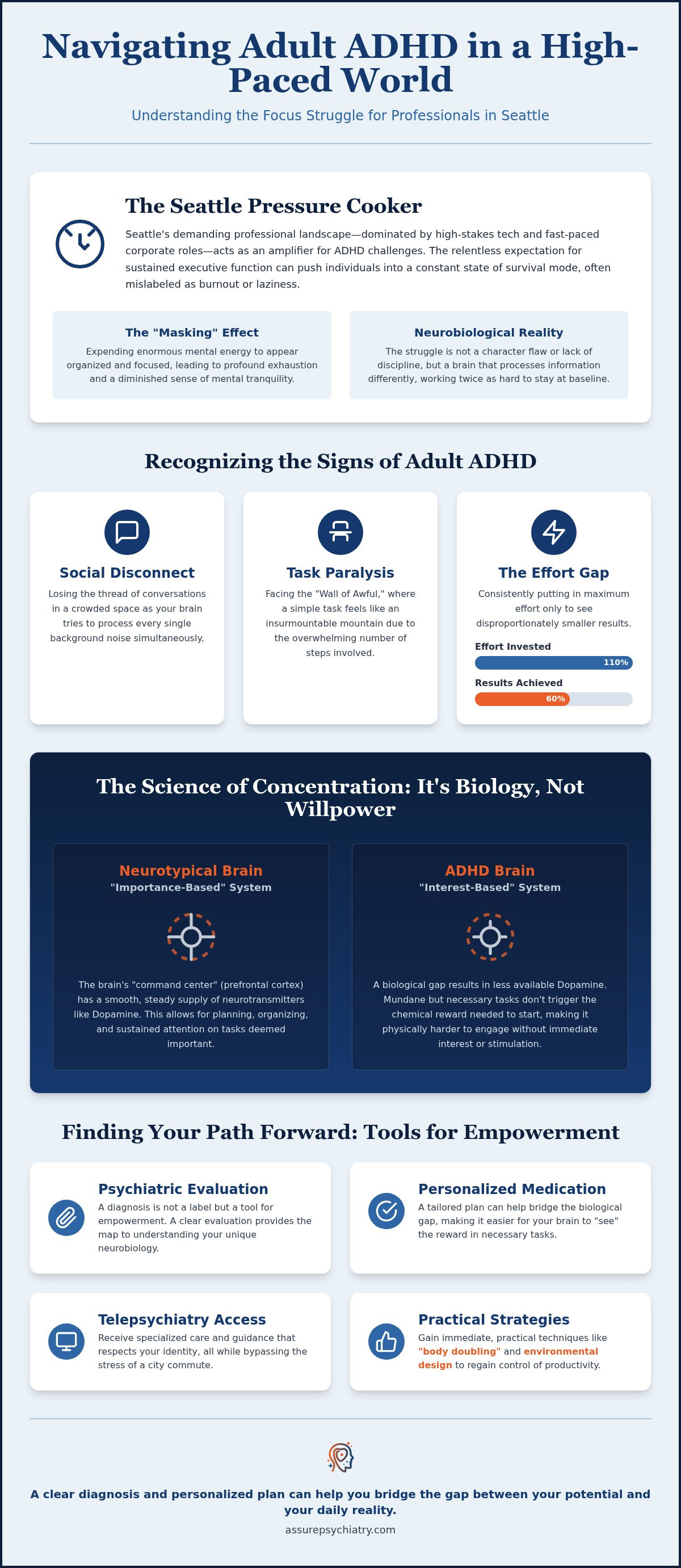
Seattle’s unique professional landscape often acts as a pressure cooker for these symptoms. In a city dominated by high-stakes tech roles and fast-paced corporate environments, the demand for sustained executive function is unrelenting. When your brain’s internal “project manager” isn’t functioning optimally, the expectation to be “always on” can lead to a state of constant survival mode. This isn’t a character flaw or a lack of discipline. It’s a neurobiological reality that often gets mislabeled as burnout or laziness, leaving many high achievers feeling like they’re working twice as hard just to stay at baseline.
Signs You Are Not Just “Distracted”
Distraction happens to everyone, but ADHD focus issues have a specific signature. You might find it physically painful to sit through a long meeting at a South Lake Union office, even when the topic is important. Others describe the “Wall of Awful,” where a simple task like answering an email feels like staring at a mountain you’re unable to climb. Paradoxically, you might also experience hyper-focus, where you become so absorbed in a specific interest that the rest of the world, including basic needs like food or sleep, simply disappears. This inconsistency is a hallmark of the condition.
- Social disconnect: Losing the thread of a conversation at a crowded Capitol Hill coffee shop because your brain is processing every background noise.
- Task paralysis: Feeling overwhelmed by the sheer number of steps required to start a project.
- The effort gap: Putting in 110% effort but only seeing 60% of the results.
When Focus Issues Affect Your Seattle Career
In the professional world, these struggles often manifest as missed deadlines or overlooked details in a complex spreadsheet. You might be the person who is brilliant in a brainstorm but struggles to follow through on the administrative steps that follow. This often leads to “masking,” where you spend an enormous amount of mental energy pretending to be organized and focused. While masking might help you pass a performance review, it leads to profound exhaustion and robs you of your mental tranquility. Realizing that your brain simply processes information differently is the first step toward finding a sustainable way to thrive in your career without the constant fear of being “found out.”
The Science of Concentration: Why the ADHD Brain Struggles
Understanding the biology of your brain is a powerful step toward self-compassion. For many, the experience of trouble focusing and concentrating adult ADHD Seattle residents describe is rooted in the chemistry of the prefrontal cortex. This area of the brain acts as a command center, responsible for planning, organizing, and sustaining attention. In a neurotypical brain, neurotransmitters like dopamine and norepinephrine act as messengers that help these signals travel smoothly. However, in an ADHD brain, these messengers are often less available or are reabsorbed too quickly. This isn’t a matter of willpower; it’s a biological gap that makes it physically harder to engage with tasks that don’t provide immediate stimulation.
Dopamine and the Reward System
Dopamine is often called the “reward chemical,” but it’s actually more about motivation and anticipation. Most people have an “importance-based” nervous system; if a task is important, their brain releases enough dopamine to help them do it. The ADHD brain operates on an “interest-based” system. This means that mundane but necessary tasks, like filling out a weekly status report, simply don’t trigger the chemical reward needed to start. According to the NIMH on Adult ADHD, these biological differences are present throughout the lifespan. Medication management can help by bridging this gap, making it easier for your brain to “see” the reward in necessary tasks.
Executive Dysfunction Explained
Think of executive function as your brain’s internal project manager. When this manager goes offline, several critical systems are affected. Working memory becomes unreliable, explaining why you might walk into a room and immediately forget your purpose. Emotional regulation also suffers; when you can’t focus, the resulting frustration can lead to irritability or “rejection sensitivity.” Task switching becomes another hurdle. Stopping one activity to start another requires a surge of mental energy that a neurodivergent brain might not have readily available. This is why “trying harder” often leads to burnout rather than results.
Mapping these specific patterns is essential for long-term mental tranquility. Whether you are seeking a psychiatric evaluation in Portland or right here in Seattle, a professional assessment provides the blueprint for your treatment. By identifying which executive functions are most impacted, we can move away from generic advice and toward a plan that honors your specific needs. If you’re ready to stop the cycle of frustration, a comprehensive psychiatric evaluation can help you understand the “why” behind your struggle and provide a clear path toward reclaiming your focus.
ADHD Treatment Options in Seattle: Virtual vs. In-Person
Modern mental health care has evolved to meet the specific needs of high-performing professionals in the Pacific Northwest. If you’ve been experiencing trouble focusing and concentrating adult ADHD Seattle specialists offer several evidence-based paths to help you regain your edge. The journey usually starts with a detailed psychiatric evaluation, which serves as a foundation for a personalized treatment plan. This assessment isn’t just about a diagnosis; it’s a collaborative process to understand how your unique brain functions in your specific work and home environments.
Medication Management for Focus
For many adults, medication management is a transformative tool that helps level the playing field. We don’t view medication as a way to change who you are, but as a bridge to help your brain’s executive functions work more effectively. Finding the right balance requires a nuanced approach and professional guidance.
- Stimulants vs. Non-stimulants: Stimulants are often the first line of treatment because they quickly increase dopamine availability. However, non-stimulants can be an excellent alternative for those who need 24-hour coverage or have sensitivities to stimulants.
- “Start Low, Go Slow”: This philosophy is central to our care. We begin with the lowest possible dose and adjust gradually. This ensures we find the “sweet spot” where you feel focused and calm without experiencing unwanted side effects.
- Ongoing Support: Regular follow-up appointments allow us to monitor how the medication is impacting your daily productivity and mental tranquility, making adjustments as your life and work demands change.
The Benefits of Telepsychiatry in Washington
For many Seattleites, the biggest obstacle to starting treatment isn’t a lack of desire; it’s the logistics of the city itself. Telepsychiatry eliminates the stress of the I-5 commute or finding parking in crowded neighborhoods like Capitol Hill or South Lake Union. By offering virtual care, we provide a safe, non-judgmental space where you can be seen and heard from your own home or a private office. This consistency is essential for those managing the trouble focusing and concentrating adult ADHD Seattle life demands, as it ensures your treatment doesn’t become just another stressor on a crowded calendar.
Choosing the right partner in your wellness journey is a deeply personal decision that should prioritize both expertise and accessibility. Whether you are looking for a local provider or are interested in finding the right ADHD psychiatrist in Portland who offers virtual services to Washington residents, the focus should be on restorative action. Virtual visits allow you to integrate professional psychiatric care into your busy life seamlessly, providing the stability you need to move toward a more productive and peaceful future.
Practical Strategies to Improve Concentration Today
While understanding the biology of your brain is the first step toward peace, practical tools provide the scaffolding for your daily success. If you’re managing the trouble focusing and concentrating adult ADHD Seattle life often demands, you know that willpower alone isn’t enough. One effective technique is “body doubling,” which simply involves working in the presence of another person. Whether it’s a virtual session or sitting in a quiet corner of a local library, having another person nearby helps keep your brain anchored to the task at hand. It creates a gentle sense of accountability that makes the “Wall of Awful” feel much shorter.
Environmental and Digital Cues
Your Seattle home office should be a sanctuary for focus rather than a source of distraction. Digital tools like app blockers can silence the noise of social media, while visual timers help make the abstract concept of time more concrete. By seeing time “disappear” on a red dial, your brain can better prioritize tasks and avoid the trap of “time blindness.” Designing your workspace to minimize visual clutter is another form of restorative action that supports long-term mental tranquility. When your environment is organized, your mind has more room to breathe and innovate.
- Notification Management: Turn off all non-essential pings on both your phone and desktop to protect your deep work states.
- Workspace Zoning: Designate specific areas for high-focus work and separate areas for relaxation to help your brain switch modes more easily.
- Sensory Tools: Use noise-canceling headphones or brown noise to mask the urban sounds of the city, creating a private bubble for concentration.
Lifestyle Foundations for Focus
Physical health is the bedrock of cognitive function. Regular exercise isn’t just about fitness; it’s a natural way to boost dopamine production, which is essential for concentration. Similarly, prioritizing “sleep hygiene” is critical. Sleep deprivation mimics and worsens ADHD symptoms, making it impossible to stay focused regardless of your effort. We also recommend incorporating brief mindfulness exercises to help settle a busy mind after a high-pressure workday. These small moments of stillness can help you transition from the demands of the office to the peace of your home life.
These lifestyle changes are most effective when paired with professional clinical support. Integrating these habits with medication management in Portland or Seattle allows you to address both the biological and environmental factors of your condition. If you’re ready to build a personalized roadmap for your productivity, scheduling a psychiatric evaluation is the next natural step in your journey toward wellness. You don’t have to navigate these challenges alone; we’re here to act as your compassionate ally in finding the balance you deserve.
Finding Your Path to Focus with Assure Psychiatry
At Assure Psychiatry, we believe that mental wellness is the foundation for a fulfilling life. Led by Dr. Olumide Aruwajoye, our practice is dedicated to helping you move beyond the daily struggle of scattered thoughts and missed potential. We understand that the trouble focusing and concentrating adult ADHD Seattle residents experience isn’t just about productivity; it’s about the deep-seated desire for mental tranquility. Our mission is to provide a stable, supportive environment where you can find the clarity you need to thrive in a high-pressure city. We don’t just treat symptoms; we partner with you to build a sustainable path toward peace and health.
Our process is designed to be as seamless and stress-free as possible. It begins with a comprehensive psychiatric evaluation, where we take the time to understand your history, your challenges, and your goals. From there, we develop a personalized medication management plan that respects your individual identity and lifestyle. Our practice bridges the gap between clinical excellence and accessibility, offering telepsychiatry in Oregon and Washington to ensure your care is never interrupted by a commute or a busy schedule. This collaborative approach ensures you’re an active participant in your treatment every step of the way.
A Compassionate Ally in Your Journey
We prioritize the person over the diagnosis. In our sessions, your experience is validated, and your voice is the most important one in the room. We know that many adults with ADHD have spent years feeling misunderstood or labeled as “difficult,” which is why we emphasize a non-judgmental, human-centered approach. Feeling seen and heard is a vital part of the healing process. We’re also committed to inclusive care standards, ensuring that our services are accessible and culturally competent for all members of the diverse Seattle community. Your identity is respected here, and your wellness journey is our shared priority.
How to Get Started
Taking the first step toward help can often feel like the hardest part of the process. We’ve simplified our scheduling to remove as many barriers as possible for Washington and Oregon residents. Whether you’re working in a downtown high-rise or from a home office in the suburbs, our virtual platform brings expert care directly to you. We also prioritize insurance and payment transparency, so you can focus on your health rather than administrative stress. If you’re ready to address the trouble focusing and concentrating adult ADHD Seattle life can bring, we invite you to reach out. Together, we can find the focus and tranquility you’ve been seeking.
Reclaiming Your Focus and Peace of Mind
Navigating life with adult ADHD in a high-pressure environment like the Pacific Northwest doesn’t have to be a constant uphill battle. We’ve explored how your brain’s chemistry impacts your ability to stay on task and why “trying harder” isn’t a sustainable solution. By combining practical environmental strategies with professional medication management, you can finally bridge the gap between your intentions and your daily results. You aren’t lazy; you’re simply navigating a neurobiological challenge that requires the right tools to manage effectively.
If you’re tired of the frustration caused by trouble focusing and concentrating adult ADHD Seattle residents can find a clear path forward through our virtual clinic. Dr. Olumide Aruwajoye provides compassionate, expert care designed to make you feel seen and heard rather than just diagnosed. Our telepsychiatry services offer a convenient, inclusive, and culturally competent way to access psychiatric evaluations without the stress of a city commute. You deserve to experience the mental tranquility that comes with a balanced, personalized treatment plan.
When you’re ready to take the next step toward a more productive and peaceful life, we’re here to act as your collaborative guide. Schedule Your ADHD Evaluation with Assure Psychiatry and begin your journey toward lasting wellness today. Your path to focus starts with a single, restorative action.
Frequently Asked Questions
Is telepsychiatry in Seattle as effective as seeing a doctor in person for ADHD?
Yes, telepsychiatry is a highly effective way to manage ADHD. Virtual visits provide the same level of clinical expertise and diagnostic accuracy as in-person appointments. For many high-performing professionals, removing the stress of a long Seattle commute actually supports a more relaxed and honest conversation. This digital approach ensures you can receive consistent care and medication management from the comfort of your own home or private office space.
Do I need a prior diagnosis to start medication management at Assure Psychiatry?
You don’t need a previous diagnosis to begin your journey with us. Every new patient starts with a comprehensive psychiatric evaluation. This initial assessment allows Dr. Olumide Aruwajoye to understand your unique history and current challenges. We prefer to conduct our own thorough diagnostic process to ensure that your treatment plan is based on an accurate, culturally competent understanding of your neurobiology and personal goals.
What is the difference between a psychiatrist and a therapist for ADHD?
Psychiatrists and psychiatric providers focus on the biological and medical aspects of mental health. They specialize in psychiatric evaluations and medication management to help balance brain chemistry. Therapists typically provide long-term psychotherapy to discuss emotional patterns and coping skills. At Assure Psychiatry, we specialize in the medical side of ADHD treatment. We focus on stabilizing your focus through clinical expertise rather than offering long-term psychotherapy services.
How long does it take to see improvements in focus once I start treatment?
The timeline for improvement depends on the specific treatment plan we develop together. Many patients notice a significant shift in their concentration within a few days of starting stimulant medications. Non-stimulant options may take several weeks to reach their full effect. We schedule regular follow-up appointments to monitor your progress and adjust your plan. Our goal is to help you achieve mental tranquility and improved productivity as safely and efficiently as possible.
Can I get an ADHD evaluation if I live in Seattle but you are based in Portland?
Yes, we provide virtual care to patients throughout both Washington and Oregon. If you’re struggling with the trouble focusing and concentrating adult ADHD Seattle life often brings, you can access our services from anywhere in the state. Our telepsychiatry platform is secure and easy to use. This allows us to serve the Seattle community effectively without requiring you to spend hours traveling for a professional psychiatric evaluation.
What should I expect during my first psychiatric evaluation for ADHD?
Your first visit is a collaborative, 60 to 90 minute conversation designed to help you feel seen and heard. We’ll discuss your medical history, your current work and home environment, and specific symptoms you’ve noticed. This isn’t just a clinical checklist; it’s a supportive dialogue to understand how your brain works. By the end of the session, we’ll have the foundation for a personalized plan that prioritizes your wellness and long-term stability.
Does Assure Psychiatry accept insurance for ADHD visits in Washington?
We accept most major insurance plans for our patients in Washington. We believe that professional psychiatric care should be accessible and transparent. During your initial inquiry, we can help verify your coverage to ensure you understand your benefits. This commitment to financial transparency helps reduce the anxiety often associated with seeking mental health services. It allows you to focus entirely on your restorative journey toward better focus and mental peace.
Recent Comments