

What if the exhaustion you feel from a mind that never stops isn’t just a personality trait, but a sign that your current care plan is missing a vital piece of the puzzle? It’s incredibly draining to feel like you’re constantly fighting against your own thoughts, especially when you’ve felt misunderstood by providers in the past. If you’re searching for ADHD and bipolar comorbidity treatment Portland specialists provide, you’re likely looking for more than just a checklist; you’re looking for a collaborative partner who sees the whole you.
We understand that living with racing thoughts and unstable moods can make maintaining your career and relationships feel like an uphill battle. You deserve to know that your experience is valid and that a reliable path toward mental tranquility exists. In 2026, we’ve refined our understanding of how these conditions overlap. This article provides a clear guide to the distinctions between these diagnoses, explaining how ADHD affects your information processing while Bipolar Disorder impacts your emotional regulation, and outlines the exact steps to finding a treatment plan that works.
Key Takeaways
- Learn why symptoms like impulsivity and high energy often lead to confusion between ADHD and Bipolar Disorder, especially among adult women and high achievers.
- Understand the fundamental difference between the chronic, constant nature of ADHD and the episodic cycles of Bipolar Disorder to better identify your own patterns.
- Discover how sleep habits serve as a vital clue in distinguishing these conditions, focusing on whether you struggle to fall asleep or simply don’t feel the need for rest.
- Explore how specialized ADHD and bipolar comorbidity treatment Portland providers offer can help you find a tailored medication management plan for long-term mental tranquility.
- See how a collaborative psychiatric evaluation moves beyond a simple checklist to validate your unique experience and create a clear, supportive path forward.
The Diagnostic Dilemma: Why Bipolar Disorder and ADHD are Often Confused
Feeling like your mind is a high-speed engine without brakes is exhausting. For many, this restlessness leads to a search for answers, yet the path isn’t always linear. In 2026, we recognize that the symptoms of Attention-Deficit/Hyperactivity Disorder and Bipolar Disorder often mirror one another, creating a diagnostic shadow where one condition hides the other. This is especially true for high-achievers and adult women, who may have spent years masking their struggles or receiving partial diagnoses that don’t quite fit their internal reality.
If you’ve felt that previous providers didn’t quite get it, your frustration is a valid starting point for wellness. Research indicates that about 1 in 13 adults with ADHD also lives with Bipolar Disorder, and when these conditions coexist, they can amplify each other’s challenges. Finding specialized ADHD and bipolar comorbidity treatment Portland residents can trust is about more than just managing symptoms; it’s about uncovering the nuanced truth of your unique brain chemistry.
Shared Symptoms: The Great Overlap
The confusion often stems from behaviors that look identical on the surface. Rapid speech, or logorrhea, can be a sign of ADHD-driven excitement or a hypomanic episode. Both conditions involve high levels of impulsivity that can disrupt your life. You might find yourself making sudden, high-stakes decisions in your professional career or struggling with emotional dysregulation that makes you feel overly sensitive to rejection. A deeper dive into Understanding Bipolar Disorder reveals that while the energy levels look similar, the timing is a key differentiator. ADHD is typically a constant, chronic presence in your life, whereas Bipolar Disorder usually moves in distinct, episodic waves that represent a departure from your baseline self.
The Cost of Misdiagnosis
Getting the diagnosis right isn’t just about labels; it’s about safety. If a clinician treats Bipolar Disorder with ADHD stimulants alone, it can unintentionally trigger a manic episode, leading to a cycle of failed treatment plans and growing despair. Adults with both conditions are almost 11 times more likely to have received an initial ADHD diagnosis before uncovering the Bipolar component. This delay can postpone the mental tranquility you deserve. Differential diagnosis is the clinical process of distinguishing between two or more conditions that share similar symptoms to ensure your care plan is accurate and restorative. By looking at the patterns of your history rather than just a snapshot of your current state, we can act as a collaborative guide toward the clarity you’ve been seeking.
Understanding Adult ADHD: The Chronic Engine of Distraction
While Bipolar Disorder is defined by its episodic nature, adult ADHD is a pervasive, lifelong trait that functions like an engine that never quite shuts off. For many adults in Portland’s professional environments, ADHD doesn’t always look like the stereotypical hyperactivity seen in children. Instead, it manifests as a quiet, internal restlessness and a constant struggle with executive dysfunction. This includes difficulties with task initiation, complex planning, and a phenomenon known as time blindness, where the ability to gauge how much time has passed or is needed for a project feels fundamentally skewed.
Living with ADHD in a high-pressure career often leads to masking, where you expend immense mental energy to appear organized and “together” while feeling chaotic inside. This masking is exhausting and can lead to burnout that mimics depressive episodes. You might also experience hyperfocus, an intense state of concentration on a specific interest that makes the rest of the world disappear. While hyperfocus can be a professional asset, it’s often the exhausting flip side of distractibility, leaving you depleted when the focus finally breaks.
The Consistency of ADHD Symptoms
The primary hallmark of ADHD is its consistency. Unlike mood cycles that come and go, ADHD symptoms are “always on.” This is largely due to a baseline dopamine deficiency; your brain is constantly searching for stimulation to reach a functional level of engagement. Because these symptoms are chronic, they require a different approach than episodic mood disorders. If you feel like your “on” switch is stuck, finding the right ADHD psychiatrist in Portland is an essential step toward understanding your brain’s unique wiring. Accurate identification is the first step toward achieving the mental tranquility you’ve been working so hard to maintain.
Emotional Impulsivity in ADHD
Emotional regulation is another area where ADHD and Bipolar Disorder overlap, yet the quality of the emotion differs. ADHD often involves “hot tempers” or quick bursts of frustration that resolve as quickly as they began. This is distinct from the sustained, week-long emotional highs associated with mania. Many adults also struggle with Rejection Sensitive Dysphoria (RSD), an intense emotional pain triggered by the perception of being criticized or rejected. This sensitivity can create significant social anxiety and a feeling of being constantly “on edge.” When seeking ADHD and bipolar comorbidity treatment Portland specialists provide, we look closely at these emotional patterns to ensure your care plan addresses the root cause rather than just the surface behavior. If you are ready to move beyond masking, a comprehensive psychiatric evaluation can help you find a clearer path forward.
Understanding Bipolar Disorder: Riding the Episodic Wave
While ADHD functions as a constant background hum, Bipolar Disorder is defined by its distinct, episodic nature. It’s a common misconception that being bipolar simply means you’re “moody” or experience quick shifts in temperament throughout the day. In reality, Bipolar Disorder is a mood disorder characterized by sustained cycles of high and low energy that can last for days, weeks, or even months. These cycles represent a significant departure from your baseline self, often making you feel like a different person depending on where you are in the wave.
The experience varies significantly between Bipolar I and Bipolar II. Bipolar I is characterized by full manic episodes that are often intense and can disrupt your ability to function safely. Bipolar II, which is frequently misdiagnosed as simple depression or ADHD, involves hypomania. This is a less severe but still impactful “high” that can feel like a sudden burst of extreme productivity or creativity. However, these peaks are almost always followed by a severe depressive crash, leaving you feeling physically and emotionally drained. Understanding these patterns is a vital component of the ADHD and bipolar comorbidity treatment Portland specialists provide, as it allows for a more targeted approach to stabilizing your mood.
The Anatomy of a Manic or Hypomanic Episode
Identifying a manic or hypomanic episode requires looking for specific physiological and psychological markers that differ from ADHD symptoms. One of the most telling signs is a decreased need for sleep. While someone with ADHD might struggle to fall asleep because their mind is racing, a person in a manic state may go days with only three hours of rest and still feel completely energized the next morning. Other key indicators include:
- Grandiosity: An inflated sense of self-esteem or power that feels out of character for your normal personality.
- Pressured Speech: A physical need to keep talking, which feels different from the conversational talkativeness common in ADHD.
- Risk-Taking: Engaging in impulsive behaviors, such as excessive spending or sudden career changes, that you wouldn’t consider during a baseline period.
Stability Between the Waves
One of the most important concepts in managing this condition is euthymia, which refers to the periods of baseline mood stability between episodes. These are times when you feel like yourself, capable of calm and clear decision-making. Because Bipolar symptoms fluctuate over long periods rather than hour-to-hour, tracking your mood over several months is essential for an accurate diagnosis. If you’ve been riding these emotional waves without relief, consulting a Bipolar disorder specialist in Portland can provide the collaborative guide you need to find long-term stability. Achieving mental tranquility is possible when we work together to understand the timing and intensity of your unique cycles.
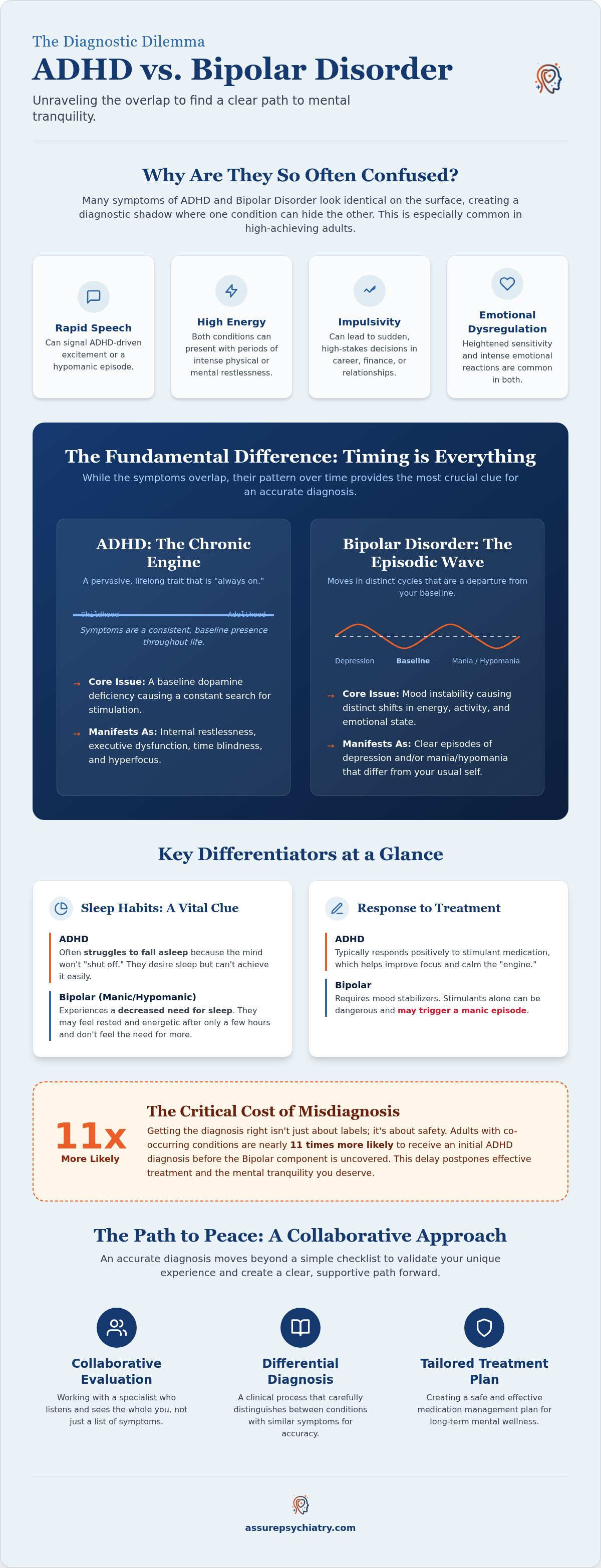
Key Differentiators: How to Tell the Difference
Distinguishing between ADHD and Bipolar Disorder requires looking beyond surface-level restlessness to the underlying rhythm of your experience. A helpful framework is to view ADHD as a challenge in how you process information, while Bipolar Disorder is a challenge in how you process emotion. One is a constant trait; the other is a recurring state. Understanding this distinction is the cornerstone of the ADHD and bipolar comorbidity treatment Portland clinicians use to build effective, personalized care plans.
One major difference lies in the nature of triggers. ADHD symptoms are often situational. You might feel more distracted when a task is boring or more impulsive when you’re overwhelmed by a crowded environment. In contrast, Bipolar cycles are frequently internal or biological. While stress can certainly play a role, manic or depressive episodes often arrive regardless of what is happening in your external life. Similarly, the “speed” of thoughts differs. An ADHD brain feels crowded, like dozens of browser tabs are open at once. A manic brain feels expansive and racing, often jumping between grand ideas that feel interconnected in a way that baseline thinking does not.
Sleep and Energy: The Ultimate Litmus Test
A significantly reduced need for sleep, where an individual feels fully rested and energized after just a few hours, is a primary hallmark of Bipolar mania. This is fundamentally different from the “night owl” patterns common in ADHD. If you have ADHD, you likely want to sleep but find that your brain won’t shut off, leading to morning exhaustion. A person in a manic state simply doesn’t feel the need for rest. Additionally, medication responses offer a clue. For those with ADHD, stimulants can often have a paradoxically calming effect that may even improve sleep. However, for someone with Bipolar Disorder who isn’t on a mood stabilizer, stimulants can sometimes act as a trigger for mood instability.
The Question of Comorbidity
It’s also possible to experience both conditions simultaneously. Research suggests that up to 20% of individuals with Bipolar Disorder also live with ADHD. Managing this dual diagnosis requires a careful, sequential approach to ensure that treating one doesn’t exacerbate the other. We typically focus on stabilizing the mood first to create a foundation of safety before addressing executive function. Because the stakes are high, a detailed psychiatric evaluation in Portland is the most reliable way to untangle these overlapping threads. If you’re ready to find a path toward mental tranquility, schedule your evaluation today to begin your journey with a compassionate ally.
The Path to Peace: Finding the Right Diagnosis and Care
Finding a path toward mental tranquility shouldn’t feel like a solo effort. If you’ve spent years feeling misdiagnosed or misunderstood, it’s natural to feel some hesitation when seeking help again. However, the clarity you deserve is within reach. Accessing the specialized ADHD and bipolar comorbidity treatment Portland residents rely on means you no longer have to guess which condition is driving your restlessness. In 2026, we view your psychiatric evaluation not as a cold clinical assessment, but as a collaborative partnership designed to map out your unique journey toward peace of mind.
We believe that a diagnosis does not define you; rather, it serves as a tool to help us understand how your brain processes information and emotion. Whether you prefer the personal connection of in-person visits or the accessibility of telepsychiatry in Oregon, our goal is to lower the barriers to care. By providing a stable and reliable environment, we help you transition from a state of constant exhaustion to one of predictable stability.
What to Expect During Your Evaluation
Your first step begins with a comprehensive review of your medical history and lifetime symptom patterns. We provide a safe, inclusive space where you can share your experiences without fear of judgment. During this time, we look for the subtle cues that distinguish chronic ADHD traits from episodic bipolar cycles, ensuring no detail is overlooked. Together, we’ll set clear goals for your wellness, focusing on what daily stability looks like for your specific lifestyle. This collaborative approach ensures you are an active participant in your own treatment plan from day one.
Next Steps Toward Mental Tranquility
Once we’ve established a clear diagnostic picture, we focus on fine-tuning your brain chemistry through expert medication management in Portland. We understand that every individual’s identity and cultural background influence their mental health experience, so we tailor our care plans to respect your unique needs. Successful treatment is measured by your ability to maintain stability in your work and relationships while finally silencing the racing thoughts that have held you back. You don’t have to navigate this overlap alone. Schedule your initial psychiatric evaluation today and take the first step toward the restorative care you deserve.
Embracing Clarity and Your Path to Lasting Calm
Understanding whether your restlessness is a constant trait or an episodic wave is the first step toward reclaiming your life. We’ve explored how the chronic engine of ADHD differs from the distinct cycles of Bipolar Disorder, and why a precise diagnosis is vital for your safety and success. By untangling these overlapping symptoms, you can finally move away from the frustration of failed treatments and toward a plan that truly respects your brain’s unique chemistry. You are more than a diagnosis, and mental tranquility is a goal we can achieve together.
If you’re seeking specialized ADHD and bipolar comorbidity treatment Portland providers offer, you deserve a partner who values your identity and your peace of mind. Assure Psychiatry provides expert medication management for complex cases through both in-person and virtual care options across the Pacific Northwest. Our compassionate, insurance-friendly approach ensures that expert care remains accessible, supportive, and non-judgmental.
You don’t have to navigate this journey alone. Begin your journey toward mental tranquility with a professional evaluation at Assure Psychiatry. We’re here to act as your collaborative guide, providing the consistent support you need to find the balance you deserve.
Frequently Asked Questions
Can you have both ADHD and Bipolar Disorder at the same time?
Yes, it’s entirely possible to live with both conditions simultaneously. Research indicates that about 1 in 13 adults with ADHD also has a bipolar diagnosis. This overlap requires a nuanced approach to care. At Assure Psychiatry, we specialize in these complex dual diagnoses to help you find a stable environment. Managing both requires a collaborative guide to ensure one treatment doesn’t negatively impact the other condition’s stability.
Does ADHD medication make Bipolar Disorder worse?
ADHD stimulants can potentially trigger manic episodes if Bipolar Disorder isn’t stabilized first. This is why we prioritize mood stabilization before introducing ADHD medications. It’s a delicate balance that requires expert medication management. When you seek ADHD and bipolar comorbidity treatment Portland specialists provide, the goal is to fine-tune your regimen safely. We monitor your response closely to ensure you find mental tranquility without unwanted mood swings.
How long does a typical Bipolar manic episode last compared to ADHD restlessness?
Bipolar manic episodes typically last at least four days to a week, representing a distinct departure from your normal self. In contrast, ADHD restlessness is a chronic, daily experience that has usually been present since childhood. While ADHD feels like a motor that never shuts off, Bipolar Disorder moves in episodic waves. Distinguishing between these patterns is a key part of our comprehensive psychiatric evaluation process in Portland.
Is Bipolar Disorder or ADHD more common in adults?
Both conditions affect a significant portion of the population. Approximately 3% to 6% of adults live with ADHD, while an estimated 4.4% of U.S. adults will experience Bipolar Disorder at some point. Because the prevalence rates are similar and the symptoms often overlap, misdiagnosis is frequent. We provide detailed assessments to ensure you receive the correct support for your specific needs, whether you’re in Portland or seeking telepsychiatry in Oregon.
What happens if I have been treated for depression but actually have Bipolar Disorder?
Treating Bipolar Disorder with standard antidepressants alone can sometimes trigger a manic or hypomanic episode. If your previous depression treatments felt ineffective or caused sudden bursts of high energy, it might indicate an underlying bipolar cycle. We take a restorative approach by reviewing your full history to uncover these patterns. Correcting the diagnosis allows us to implement mood-stabilizing strategies that offer a more reliable path toward peace and stability.
Can a psychiatrist tell the difference between ADHD and Bipolar in one visit?
A thorough initial psychiatric evaluation can often identify key differentiators, but complex comorbid cases may require ongoing observation. We look at your lifetime symptom patterns, sleep needs, and how you respond to previous medications. It’s a collaborative process where your input is vital. We don’t just check boxes; we act as a compassionate ally to understand the nuances of your experience over time for a truly accurate and helpful diagnosis.
Are there specific tests to diagnose Bipolar vs. ADHD?
There isn’t a single blood test or brain scan for these conditions. Instead, we use a blend of clinical interviews, validated symptom rating scales, and a deep dive into your medical history. We analyze your executive function and mood cycles to see where they intersect. This comprehensive method helps us build a personalized care plan that respects your individual identity while targeting the root causes of your emotional or cognitive challenges.
Does insurance cover psychiatric evaluations for ADHD and Bipolar in Oregon?
Yes, most major insurance plans cover psychiatric evaluations and medication management for these conditions. At Assure Psychiatry, we aim to keep care accessible and insurance-friendly for our patients in Portland and across the Pacific Northwest. We’ll work with you to understand your coverage and ensure you can access the professional support you need. Our team prioritizes transparent communication so you can focus entirely on your own wellness journey.
Recent Comments