
What if the most “natural” thing you could do for your health was to embrace the medical tools designed to restore your inner balance? In the fast-paced tech corridors of Seattle and the creative communities of Portland, there’s often an invisible pressure to “fix” mental health through sheer grit or lifestyle optimization. You might worry that seeking help makes you a failure or that a prescription will somehow dim the unique personality that defines you. It’s deeply painful to feel like you’re falling short of a social standard that doesn’t account for your biological reality.
We understand that overcoming stigma of psychiatric medication Washington requires more than just clinical facts; it requires a compassionate shift in perspective. This guide will show you how to manage the cultural hurdles of the Pacific Northwest while reclaiming your mental tranquility. We’ll validate medication as a legitimate medical partner in your wellness journey, provide strategies for difficult conversations with loved ones, and help you find a provider who prioritizes your individual identity over a label. Your path to peace doesn’t have to be walked alone, and it certainly shouldn’t be hindered by fear.
Key Takeaways
- Understand that psychiatric medication is a biological bridge rather than a personal failure, functioning much like corrective lenses or insulin for your brain’s chemistry.
- Learn how to navigate the “naturalistic” cultural pressures of the Pacific Northwest while overcoming stigma of psychiatric medication Washington through evidence-based insights.
- Gain peace of mind by exploring your legal rights under Washington law and HIPAA, ensuring your mental health journey remains a private and protected matter.
- Discover practical steps for validating your own needs and carefully choosing who to trust when discussing your path toward mental tranquility.
- Explore how a collaborative, telepsychiatry-based evaluation can help you build a restorative treatment plan tailored to your unique identity.
The Reality of Mental Health Stigma in Washington and the PNW
Stigma is essentially a biological misunderstanding. It’s the gap between what we know about the brain’s complex chemistry and how we judge the people living with those complexities. In our corner of the Pacific Northwest, this misunderstanding often wears a mask of wellness. Understanding Psychiatric Medication is the first step toward realizing that these clinical tools aren’t a departure from health, but a path toward it. Fortunately, we’re seeing a shift toward mental health transparency in modern Seattle and Portland communities as more people share their stories of recovery.
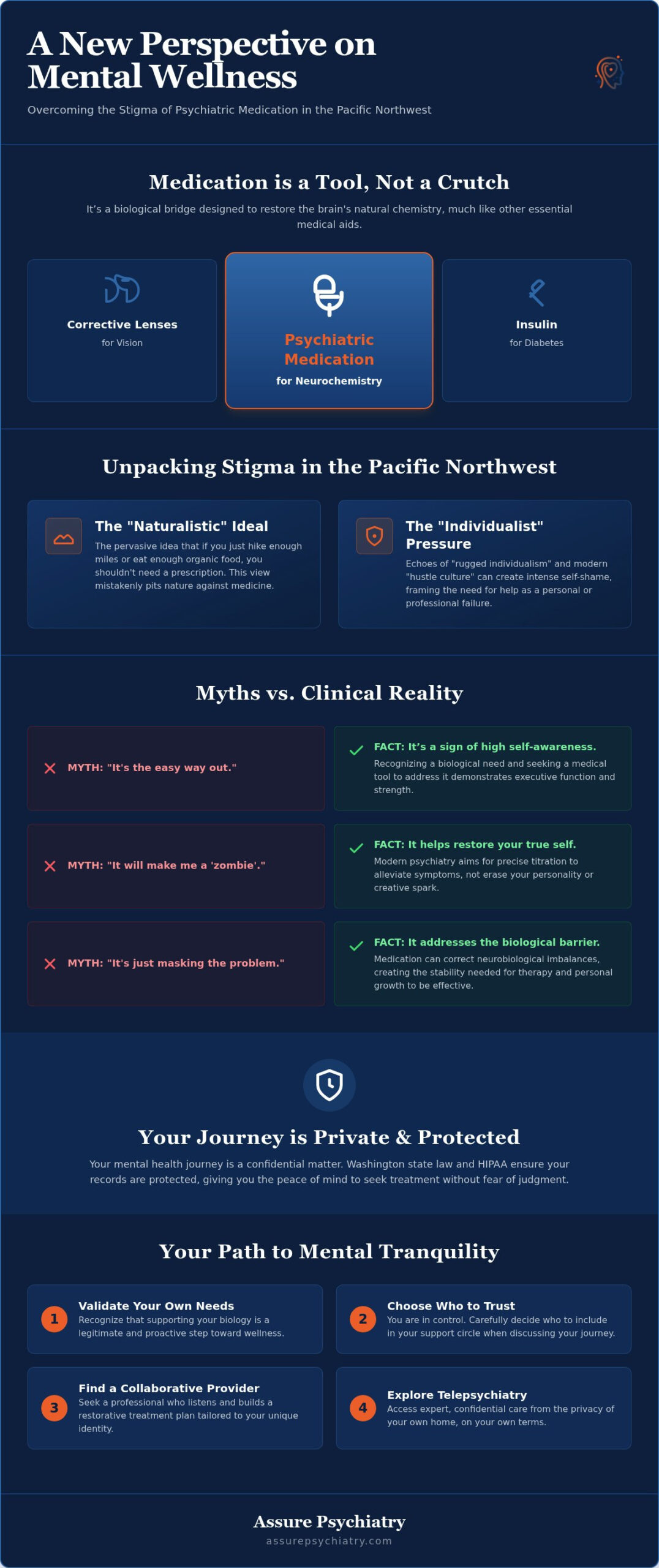
Washington and Oregon residents often face a unique “naturalistic” stigma. There’s a pervasive idea that if you just eat enough organic greens or hike enough miles of trail, you shouldn’t need a prescription. While these lifestyle choices are wonderful for your body, they aren’t always enough to correct a neurobiological imbalance. Overcoming stigma of psychiatric medication Washington means acknowledging that medical intervention is just as “natural” as setting a broken bone or wearing corrective lenses to see the world clearly.
Public vs. Internalized Stigma in our Local Culture
The “rugged individualism” of the American West still echoes through the streets of Seattle and Portland. It tells us we should be able to pull ourselves up by our own bootstraps. When you can’t, self-shame sets in. This is often reinforced by the subtle, judgmental language used in local wellness circles. Have you ever heard someone call medication “the easy way out” or “masking the problem”? That’s stigma in disguise. In our local tech and creative scenes, “hustle culture” also suggests that seeking help is a professional risk. Overcoming stigma of psychiatric medication Washington means rejecting these outdated community expectations to prioritize your own well-being.
Why Mental Tranquility is Often Blocked by Shame
Shame isn’t just an emotion; it’s a physiological stressor. When you carry the weight of being “broken,” your body stays in a state of high alert. This chronic stress actually worsens the very symptoms you’re trying to manage. It’s a painful paradox: many people avoid treatment to stay “pure” while their internal world is in total chaos. They choose silent suffering over a medical tool that could provide relief and long-term stability. Mental tranquility is a state of balance, not just the absence of symptoms. By choosing to support your biology, you move past the barrier of shame and toward a life defined by restorative action and genuine peace.
Deciphering the Science: Why Medication is a Tool, Not a Crutch
We often view physical aids like glasses or insulin as essential supports that help us function, yet we hesitate when it involves the brain. Psychiatric medication isn’t a crutch; it’s a precision tool designed to restore biological balance. Just as a person with diabetes uses insulin to manage blood sugar, someone dealing with a mental health condition may use medication to manage neurochemistry. This perspective is vital for overcoming stigma of psychiatric medication Washington, as it shifts the focus from a perceived character flaw to a manageable medical reality.
The Biological Reality of Mental Health
The brain is a complex organ governed by neurotransmitters like serotonin, dopamine, and norepinephrine. In conditions such as ADHD or Depression, the physical structure and chemical signaling can deviate from a functional baseline. When these systems are out of sync, it becomes incredibly difficult to regulate emotions or maintain focus. Seeking help is a sign of high executive function and self-awareness. It shows you have the clarity to recognize a biological need and the strength to address it. In the context of Washington’s mental health crisis, acknowledging these physical realities helps us move toward collective healing. Effective medication management in Portland ensures that these tools are used safely to restore your internal equilibrium.
Common Myths vs. Clinical Facts
The “zombie” myth is perhaps the most persistent fear we encounter. People worry they’ll lose their creative spark or feel numbed to the world. However, modern psychiatry utilizes precise titration, starting with low doses and adjusting slowly to find the “sweet spot” where you feel like yourself again, only without the crushing weight of symptoms. Overcoming stigma of psychiatric medication Washington requires us to look at the clinical facts rather than outdated tropes. Treatment plans are dynamic; you aren’t necessarily tied to a specific regimen forever. Plans change as your life and health improve. Most importantly, medication doesn’t change who you are. It allows your true self to emerge from the fog of illness. This journey always begins with a comprehensive psychiatric evaluation in Portland to ensure we’re targeting the right biological pathways from day one. If you’re feeling overwhelmed by the options, remember that you deserve a life defined by tranquility, not just survival.
Navigating Your Rights and Privacy in Washington State
Many professionals in the Seattle tech corridor or the creative hubs of Olympia worry that seeking psychiatric care creates a “permanent record” that might one day hinder their career. This fear is a major hurdle in overcoming stigma of psychiatric medication Washington, but it’s largely based on a misunderstanding of current privacy protections. Your medical records aren’t public documents. They’re protected by robust federal HIPAA regulations and the Washington Uniform Health Care Information Act (Chapter 70.02 RCW). These laws ensure that your treatment remains a private matter between you and your provider. Professional licensing boards generally focus on functional impairment rather than the mere presence of a diagnosis or a prescription. In many cases, managing your health responsibly is actually viewed as a sign of professional stability and self-awareness.
Workplace Protections and Mental Health
The Americans with Disabilities Act (ADA) provides a safety net for employees who choose to utilize psychiatric tools. You have the right to keep your medical history private from your employer. In Washington, you aren’t required to disclose your medications to a supervisor unless you’re specifically requesting a workplace accommodation. If you do choose to share this information to access support, your employer is legally bound to keep that data confidential and separate from your general personnel file. If you ever feel you’ve faced discrimination due to your treatment, resources like the Washington State Human Rights Commission offer pathways for protection. Choosing to prioritize your mental tranquility shouldn’t cost you your professional standing.
Discretion Through Virtual Care
For many residents, the most stressful part of a psychiatric appointment isn’t the clinical conversation; it’s the physical act of sitting in a public waiting room. This “waiting room anxiety” is particularly acute in smaller Washington communities where the chance of running into a neighbor or colleague is high. Utilizing telepsychiatry in Oregon and Washington removes this barrier entirely. It allows you to consult with a specialist from the sanctuary of your own home, ensuring total discretion.
Modern virtual platforms use high-level, end-to-end encryption to keep your data secure, mirroring the safety of an in-person clinic. This digital privacy is a powerful ally in overcoming stigma of psychiatric medication Washington, as it allows you to focus on restorative action without the weight of external judgment. By removing the logistical and social hurdles of traditional visits, virtual care makes it easier to maintain the consistency required for long-term health. You deserve a care environment where you feel safe, seen, and completely protected.
Practical Strategies for Overcoming Judgment
The process of overcoming stigma of psychiatric medication Washington often begins in the quiet of your own mind. While societal shifts take time, you can implement immediate strategies to protect your peace and stay focused on your recovery. The goal isn’t necessarily to become a public advocate for mental health; it’s to navigate your daily life with a sense of dignity and tranquility. By following a structured approach to self-validation and disclosure, you can reclaim your narrative from those who don’t understand your medical needs.
- Step 1: Validate your experience. Before seeking understanding from others, acknowledge that your symptoms are real and your need for support is valid. You don’t need permission to feel better.
- Step 2: Select your inner circle. You aren’t obligated to share your medical history with everyone. Choose a small, trusted group for initial disclosure where you feel safe and supported.
- Step 3: Script your responses. When met with suggestions to “just try yoga” or “spend more time outdoors,” have a polite, firm response ready. A simple “I appreciate your concern, but I’m following a medical plan tailored to my biology” is often enough to end the debate.
- Step 4: Focus on outcomes. Instead of focusing on the name of a medication or a diagnosis, track your functional improvements. Are you sleeping better? Is your focus sharper at work? These tangible results are the true measures of success.
Communicating with Family and Friends
Family dynamics can be complicated, especially when loved ones hold “anti-medication” views. Use the medical tool analogy to lower the emotional temperature of these conversations. Explain that just as some people require glasses to see, your brain requires specific support to maintain balance. It’s okay to set firm boundaries with those who remain unsupportive. You don’t have to defend the “natural” vs. “chemical” debate. Remind them that your priority is restorative action and maintaining your health, which allows you to show up more fully in your relationships.
Reframing the “Crutch” Metaphor
We often hear medication described as a crutch, implying a lack of strength. In reality, a crutch is a vital tool that allows a broken bone to heal without further injury. Similarly, psychiatric medication is a tool that allows a healing brain to find its baseline. This shift in perspective is a cornerstone of overcoming stigma of psychiatric medication Washington. By reducing the noise of symptoms, you create the mental space needed for deeper growth. This is the ultimate aim of anxiety treatment in Portland: enabling you to engage with your life again with genuine peace of mind. If you’re ready to partner with a provider who respects your individual journey, contact us to begin your path toward mental tranquility.
Finding Mental Tranquility with Assure Psychiatry
Dr. Olumide Aruwajoye leads Assure Psychiatry with a clear philosophy: psychiatric care should be a restorative action that returns you to your true self. We recognize that the journey toward overcoming stigma of psychiatric medication Washington is often paved with hesitation and external pressure. That’s why we’ve built a practice that functions as a compassionate ally rather than a distant medical authority. Our goal is to help you achieve lasting mental tranquility through a partnership based on mutual respect and clinical excellence. We don’t just manage symptoms; we support your entire wellness journey.
The evaluation process at Assure Psychiatry is a collaborative, non-judgmental conversation. We take the time to listen to your history, your fears, and your goals for the future. Whether you’re seeking ADHD treatment in Portland or help with anxiety in Washington, our focus remains on the whole person. Once a plan is in place, we provide consistent follow-up care that includes safety monitoring and adjustments. This ensures your treatment remains effective and aligned with your changing needs over time.
A Compassionate Ally in Your Wellness Journey
Our commitment to inclusive care is a cornerstone of our practice. Washington is home to diverse communities with unique cultural perspectives on health and healing. We prioritize a culturally competent approach that respects your individual identity and background. We value empowerment over paternalism, inviting you to be an active participant in every decision regarding your care. It’s helpful to view your first appointment as an act of courage and self-care that sets the stage for a more peaceful life. By choosing a provider who understands the nuances of overcoming stigma of psychiatric medication Washington, you’re already taking a significant step toward restorative health.
Taking the First Step Toward Peace of Mind
Starting your journey is designed to be as low-pressure as possible. You can book an initial evaluation through our secure online portal or by calling our office directly. To prepare for your first visit, whether virtual or in-person, simply gather a brief history of your symptoms and any questions you’ve been hesitant to ask. We provide a stable, reliable environment where your concerns are met with professional expertise and human warmth. Always remember that you are not your diagnosis, and you don’t have to walk this path toward mental tranquility alone. We’re here to offer the ongoing support and clinical guidance you deserve.
Reclaiming Your Right to Mental Tranquility
Choosing to support your brain health with medical tools is an act of clarity and strength. We’ve explored how medication acts as a biological bridge, helping you move past the noise of symptoms toward a life of restorative action. By understanding your privacy rights under Washington law and utilizing discreet virtual care, you can bypass the hurdles of public judgment. These strategies are vital for overcoming stigma of psychiatric medication Washington, allowing you to focus on what truly matters: your long-term well-being.
At Assure Psychiatry, led by Dr. Olumide Aruwajoye, we’re dedicated to providing compassionate, culturally competent care that respects your unique identity. Whether you’re in the heart of Seattle or a rural community, our telepsychiatry services ensure you have a safe, private space to seek help. You don’t have to navigate these cultural or personal challenges alone. It’s time to prioritize your peace and partner with a provider who sees you as an active participant in your own health. Begin your journey toward mental tranquility with a compassionate evaluation. You deserve a life defined by balance and genuine stability.
Frequently Asked Questions
Is it a sign of weakness to take psychiatric medication?
No, taking medication is actually a sign of high executive function and proactive self-care. It shows you have the courage to acknowledge a biological need and the strength to address it. Just as you wouldn’t view a heart patient as “weak” for taking blood pressure medicine, you shouldn’t judge yourself for supporting your brain chemistry. It’s about restoring your baseline so you can engage with life more fully.
Can my employer in Washington find out if I am taking psychiatric meds?
Your employer cannot legally access your private medical records without your explicit consent. In Washington, your health information is protected by federal HIPAA regulations and the Washington Uniform Health Care Information Act. You aren’t required to disclose your treatment or medications unless you’re requesting specific workplace accommodations under the ADA. Most professionals keep their mental health journey entirely private, and your provider is legally bound to protect that confidentiality.
Will psychiatric medication change my personality or make me feel like a different person?
Modern psychiatric care focuses on helping your true self emerge, not masking your personality. While outdated tropes suggest a “zombie” effect, modern titration and personalized care plans aim to find a balance where you feel like yourself, only without the symptoms. If a medication makes you feel numbed or different, that’s a sign your treatment plan needs adjustment. Our goal is always to restore your mental tranquility, not change who you are.
How long do I have to stay on psychiatric medication once I start?
The duration of treatment depends entirely on your unique biological needs and recovery goals. Many people use medication as a temporary bridge to navigate a difficult season, while others find long-term support helps them maintain a stable baseline. Treatment plans are dynamic and collaborative. We’ll regularly review your progress to determine if a dosage change is appropriate for your specific journey toward overcoming stigma of psychiatric medication Washington.
What is the difference between a psychiatrist and a therapist when it comes to medication?
Psychiatrists and psychiatric nurse practitioners are medical providers who specialize in the biological side of mental health, including evaluations and prescriptions. Therapists generally focus on talk therapy and behavioral strategies. While therapists are vital partners in recovery, they don’t have the medical training to manage prescriptions. At Assure Psychiatry, we focus on the medical management side, ensuring your brain chemistry is supported while you work on other aspects of your wellness.
Is telepsychiatry as effective as in-person visits for medication management?
Telepsychiatry is highly effective and offers the same quality of clinical care as in-person visits. In fact, 65% of mental health visits in Washington were conducted virtually in 2022, proving it’s a trusted standard of care. It provides a private, secure environment that eliminates the stress of public waiting rooms. This discretion is a powerful tool for overcoming stigma of psychiatric medication Washington, especially for those in smaller communities where privacy is a top priority.
How do I know if my insurance covers psychiatric evaluations at Assure Psychiatry?
You should contact your insurance provider directly or check our intake information to confirm your specific coverage details. Under Washington’s House Bill 1432, which was signed in 2025, mental health parity rules have been strengthened to reduce barriers to care. Many plans are now prohibited from requiring prior authorization for an initial psychiatric evaluation. We’re committed to transparency and will help you understand how your benefits apply to our restorative services.
What should I do if my family is against me taking medication?
Focus on validating your own experience first and remember that your health is your own responsibility. You can try using the “medical tool” analogy to explain that you’re treating a biological imbalance, much like glasses for vision. If they remain unsupportive, it’s okay to set a firm boundary and keep your medical journey private. Your priority is your own mental tranquility, and you don’t need family approval to pursue professional medical care.
Recent Comments