

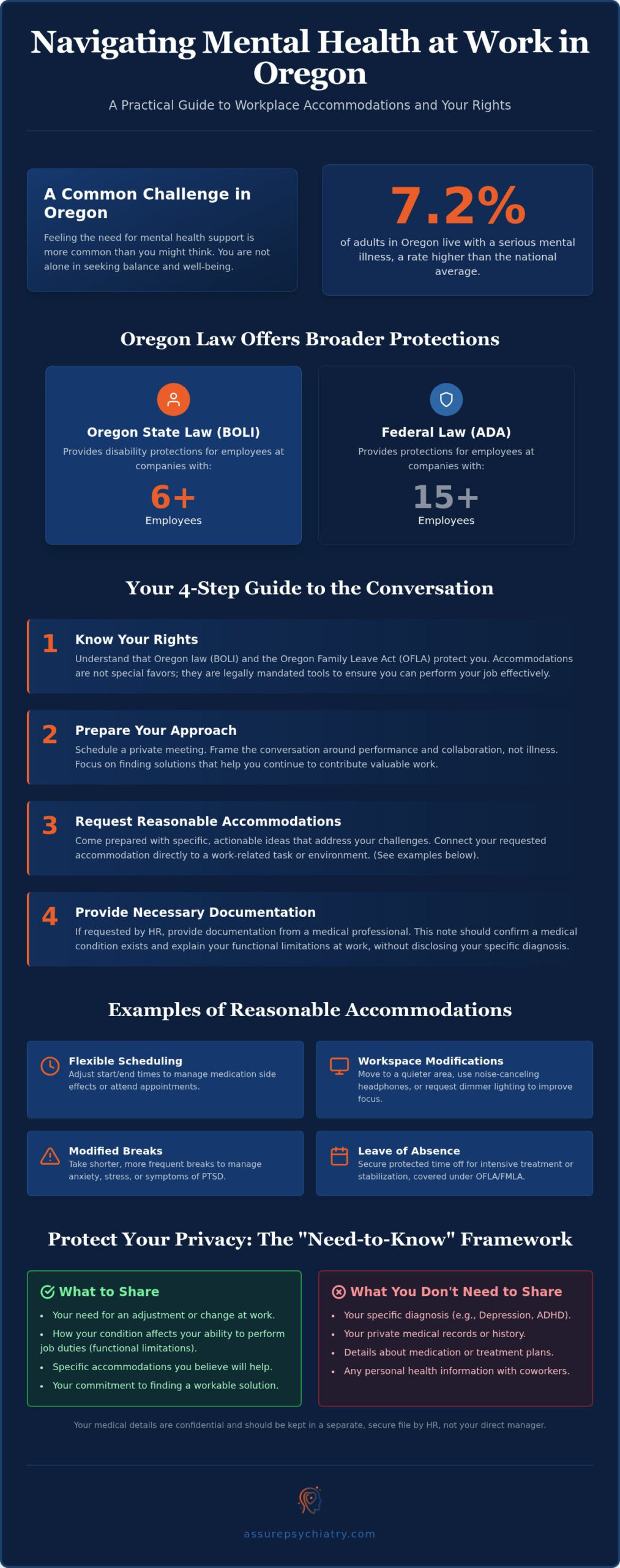
Approximately 7.2% of adults in Oregon live with a serious mental illness, a rate that sits notably higher than the national average. Despite how common these challenges are, you might still feel a deep sense of dread when considering how to tell my boss I need mental health help Oregon. It is natural to worry about professional stigma or the uncertainty of how your disclosure will be handled. You are likely looking for a way to prioritize your mental tranquility without sacrificing the career you have worked so hard to build.
We agree that your health should never be a source of professional shame. This guide provides a clear roadmap to help you advocate for yourself while staying firmly protected by state labor laws. You will discover how Oregon’s disability protections apply to smaller teams and what reasonable accommodations actually mean for your daily workflow. We provide a practical script for the conversation and explain how to secure the clinical documentation you need. You don’t have to walk this path alone; there is a way to find balance and support while remaining a valued member of your team.
Key Takeaways
- Understand how Oregon law and BOLI regulations protect your rights, even if you work for a smaller company with as few as six employees.
- Master the strategy of how to tell my boss I need mental health help Oregon by focusing on workplace performance and collaborative solutions rather than just clinical symptoms.
- Identify “reasonable accommodations” tailored to your specific needs, such as flexible scheduling or workspace adjustments for conditions like ADHD, anxiety, or depression.
- Learn why professional medical documentation should focus on your functional limitations at work rather than disclosing a specific diagnosis to maintain your privacy.
- Discover how psychiatric evaluations and medication management can provide the clinical foundation needed to secure workplace support while protecting your mental tranquility.
Know Your Rights: Mental Health Protections for Oregon Employees
Understanding your legal rights is the first step toward reclaiming your mental tranquility. Many Oregonians feel trapped by workplace psychosocial hazards, believing they must choose between their clinical well-being and their paycheck. In our state, you have powerful legal allies. While the Americans with Disabilities Act (ADA) provides a federal foundation, the Oregon Bureau of Labor and Industries (BOLI) ensures that even more local workers are shielded from discrimination and unfair treatment.
Federal vs. Oregon State Protections
The ADA protects employees at businesses with 15 or more staff members, but Oregon law goes further. In Oregon, disability protections apply to any employer with six or more employees. This is a vital distinction for those working in smaller teams or local startups. If you are wondering how to tell my boss I need mental health help Oregon, remember that state law likely has your back much sooner than federal law would. Additionally, the Oregon Family Leave Act (OFLA) often works alongside federal leave to provide job-protected time off for essential treatment when a medical professional deems it necessary.
A “reasonable accommodation” is not a special favor; it’s a tool to help you perform your job effectively. These adjustments are designed to level the playing field. Common accommodations include:
- Flexible scheduling: Adjusting start times to manage morning side effects from medication management.
- Workspace modifications: Moving to a quieter area or using noise-canceling tools to help with focus.
- Modified breaks: Taking shorter, more frequent breaks to manage symptoms of anxiety or PTSD.
- Leave of absence: Securing protected time for intensive psychiatric evaluation or stabilization.
Privacy and Confidentiality Standards
You have a right to professional boundaries that protect your dignity. You are not legally required to tell your manager your exact diagnosis, whether it is depression, ADHD, or bipolar disorder. Instead, you only need to describe your functional limitations. For instance, you might explain that you have a medical condition that requires a dimly lit workspace, without ever naming the specific illness. When you are deciding how to tell my boss I need mental health help Oregon, keep in mind that your direct supervisor does not need to see your private medical records.
Workplace privacy under Oregon law ensures that your medical details remain in a secure, separate file, protecting your personal health narrative from being shared with coworkers or unauthorized staff. While Human Resources may require “sufficient documentation” from a provider to verify your need for an accommodation, they are bound by strict confidentiality standards that keep your clinical journey private.
How to Prepare: Crafting a Professional Conversation with Your Manager
Preparation is the bridge between feeling overwhelmed and taking decisive action. When you are deciding how to tell my boss I need mental health help Oregon, the most effective approach is to reframe the narrative. Instead of viewing this as a disclosure of illness, see it as a request for performance optimization. You aren’t asking for an exception; you’re asking for the environmental adjustments that allow you to continue delivering high-value work. This mindset shift helps protect your professional confidence and sets a collaborative tone for the meeting.
Choosing the right environment for this talk is just as important as the words you choose. Avoid bringing it up during a busy team lunch or at the end of a stressful Friday. Instead, schedule a private one-on-one meeting when your manager is likely to be focused and receptive. Before you walk in, decide exactly how much you want to share using a “need-to-know” framework. Your boss needs to understand how your condition impacts your duties, but they don’t necessarily need to know your specific diagnosis. Reviewing Your Legal Rights can help you feel more secure in maintaining these boundaries.
The Solution-Oriented Script
Opening the conversation can be the hardest part. Try starting with a statement of commitment: “I value my role here and want to ensure I’m performing at my best. I’m currently managing a medical matter that requires some temporary adjustments to my workflow so I can stay productive.” This language positions you as a responsible professional. Avoid phrases like “I can’t handle the stress,” which might sound like a permanent inability to do the job. Instead, use phrases like “To maintain my focus, I’d like to discuss a quieter workspace.” A professional psychiatric evaluation can help you identify which specific adjustments will be most effective for your unique situation.
Internal Preparation and Self-Validation
It’s easy to let guilt creep in, but seeking help is actually an act of professional responsibility. You wouldn’t ignore a broken arm and expect to type at full speed; mental health is no different. Treating your needs as a standard medical requirement helps reduce the internal stigma you might feel. Before the meeting, take a moment to center yourself. Achieving a sense of mental tranquility allows you to enter the discussion with a clear head and a steady voice. When you validate your own needs first, it becomes much easier to lead your manager toward a solution that works for everyone.
Navigating Reasonable Accommodations in the Oregon Workplace
Once you’ve opened the door to the conversation, the next step is defining what you actually need to thrive. Under Oregon disability rights, an accommodation is considered “reasonable” if it doesn’t cause the employer undue hardship, which usually means significant difficulty or expense. It’s a balancing act. You aren’t asking to change the essential functions of your job, but rather the way those functions are performed. This stage is known as the “Interactive Process.” It’s a collaborative dialogue where you and your boss explore options together to find the most effective fit for your role and your health.
Examples of Workplace Adjustments
Specific adjustments depend on your unique challenges. For those managing ADHD, anxiety, or depression, small changes often lead to a significant boost in productivity. One common request is a flexible start time to accommodate medication management in Portland, as some treatments might affect sleep patterns or morning alertness. Other adjustments might include:
- Environmental shifts: Noise-canceling headphones or specialized lighting to manage sensory overload.
- Communication changes: Receiving written instructions instead of verbal ones to help with memory and focus.
- Workspace modifications: The ability to use a white noise machine or move to a desk in a lower-traffic area.
Utilizing Telehealth to Minimize Work Disruptions
Modern care makes it easier to stay consistent with treatment without missing full days of work. Utilizing telepsychiatry in Oregon allows you to attend appointments from the comfort of your home or even a private office at work. Part of your accommodation request could include access to a quiet, private space for thirty minutes to conduct these virtual sessions. This consistency is a cornerstone of long-term stability and professional success. It ensures you can maintain your treatment plan while staying fully engaged with your team’s goals.
What if your request is denied? Don’t panic. Employers must explain why a specific request is unreasonable and should ideally offer an alternative solution. If you’re struggling with how to tell my boss I need mental health help Oregon and they seem resistant, it’s helpful to stay focused on the “Interactive Process.” Ask what they can offer to help you meet your performance targets. Documentation from a provider can often turn a “no” into a productive “how can we make this work?”
The Role of Medical Documentation: Why an Evaluation is Your Best Tool
While your initial conversation with management is a brave first step, clinical documentation provides the legal weight your request needs. Employers are generally entitled to “sufficient documentation” to verify that a disability exists and that an accommodation is necessary. This isn’t about giving your boss a peek into your private life; it’s about providing a professional bridge between your medical needs and your job duties. When you are navigating how to tell my boss I need mental health help Oregon, having a formal letter from a provider transforms a personal request into a protected medical necessity.
One of the most empowering things to remember is the distinction between a diagnosis and a description of functional limitations. Your employer does not need to know you have a specific condition like PTSD or OCD. Instead, your medical documentation should focus on how the condition impacts your work. For example, a letter might state that you “require a consistent schedule to manage a medical condition” or “need a workspace with minimal sensory distractions.” This approach protects your privacy while giving your manager the specific information they need to support your productivity.
Starting with a Comprehensive Assessment
A professional psychiatric evaluation in Portland serves as the foundation for this entire process. During this initial session, your provider doesn’t just look at symptoms; they look at your life as a whole, including your specific job requirements. By understanding the “essential functions” of your role, a clinician can draft a Letter of Support that speaks directly to ADA and Oregon BOLI standards. This ensures your documentation is robust enough to withstand scrutiny while remaining focused on your goal of mental tranquility.
Continuous Care and Documentation Updates
Workplace needs often shift as your clinical journey progresses. What you need during a period of acute stress might be different from what you need six months later. For example, ongoing anxiety treatment in Portland might involve adjusting your accommodations as you develop new coping strategies. Regular follow-ups and medication management allow your provider to update your documentation in real-time, ensuring your protections stay current with your health status.
This ongoing clinical partnership is vital for the “interactive process” mentioned earlier. If your boss asks for an update on your progress or needs to re-evaluate an accommodation, having a steady relationship with a psychiatric provider makes those transitions seamless. If you are ready to secure the clinical documentation you need to protect your career, schedule a comprehensive evaluation today to begin your path toward a more supportive workplace.
Taking the Next Step: Finding Support at Assure Psychiatry
At Assure Psychiatry, we understand that determining how to tell my boss I need mental health help Oregon involves more than just understanding labor laws; it is about your human experience. Led by Dr. Olumide Aruwajoye, our practice is dedicated to providing culturally competent, empathetic care that respects your individual identity. We don’t just see a set of symptoms; we see a professional striving for excellence while navigating personal hurdles. Our goal is to act as your compassionate ally, ensuring you feel seen and heard throughout your wellness journey.
We specialize in bridging the gap between clinical health and professional stability. By offering telepsychiatry across the entire Portland metro area and the state of Oregon, we ensure that your care fits into your life, not the other way around. Whether you need assistance with medication management for ADHD or a psychiatric evaluation to support your workplace accommodations, we partner with you to create a stable foundation. We work to keep care accessible, allowing you to focus on your recovery rather than administrative barriers.
Personalized Treatment Plans
We move beyond the diagnosis to focus on what mental tranquility looks like for you. For professionals in high-stress Oregon industries, from the tech hubs in the Silicon Forest to the healthcare systems in Portland, a one-size-fits-all approach simply doesn’t work. We develop personalized treatment plans that prioritize your specific career goals and lifestyle needs. This collaborative relationship ensures you are an active participant in your treatment, empowering you to manage your health with confidence.
Booking Your Evaluation
Taking the first step is often the most difficult part of the process, but we have made scheduling as simple as possible. You can book your initial diagnostic assessment through our secure online portal. During your first virtual visit, you’ll meet with a provider who will listen to your concerns, review your history, and help you identify the functional limitations that may be impacting your work performance. This session provides the clinical clarity needed to move forward with your employer.
Finding the right words for how to tell my boss I need mental health help Oregon becomes much easier when you have a professional team standing behind you. Your peace of mind is worth the conversation, and your career deserves the support of a healthy mind. If you are ready to begin, schedule your evaluation today and let us help you navigate your professional and personal wellness with clarity and strength.
Empowering Your Professional Wellness Journey
You now have the tools to navigate workplace conversations with clarity and legal protection. By understanding Oregon’s specific BOLI regulations and the importance of clinical documentation, you can advocate for reasonable accommodations that respect your privacy. Your health is the foundation of your career success. Learning how to tell my boss I need mental health help Oregon isn’t a sign of weakness; it’s a strategic step toward long-term stability and personal peace.
Assure Psychiatry provides the expert medication management and psychiatric evaluations required to secure your workplace rights. Led by Dr. Olumide Aruwajoye, our team offers culturally competent care through convenient telepsychiatry across the state and in-person visits in Portland. We act as your compassionate ally, ensuring you feel seen and heard throughout your restorative process. Begin your journey toward mental tranquility. Schedule your evaluation with Assure Psychiatry today.
You deserve a workplace that supports your well-being. Take this next step with the confidence that your future and your health are worth the effort.
Frequently Asked Questions
Can I be fired for asking for mental health help in Oregon?
No, it is illegal for an employer to retaliate against you for requesting a reasonable accommodation. Under Oregon law and the ADA, you are protected from being fired or demoted simply because you disclosed a mental health need. As long as you can perform the essential functions of your job with or without adjustments, your request for support cannot be the basis for termination.
Do I have to tell my boss my specific diagnosis (e.g., ADHD or PTSD)?
You aren’t required to disclose your specific clinical diagnosis to your direct supervisor. You only need to explain that you have a medical condition and describe the functional limitations it creates at work. For instance, you can state that you need a quieter environment to maintain focus without naming the underlying condition. This keeps your private health journey between you and your provider.
What is a ‘reasonable accommodation’ for anxiety at work?
A reasonable accommodation for anxiety might include a modified work schedule or a quieter desk location. It could also mean having access to a private space for short sensory breaks or receiving feedback in written form rather than in high-pressure verbal meetings. These adjustments are designed to help you succeed in your role while managing your symptoms effectively and maintaining your productivity.
How do I get a doctor’s note for mental health accommodations?
You can obtain the necessary documentation by scheduling a formal psychiatric evaluation. During this visit, your provider will assess your needs and draft a letter that outlines your functional limitations and recommended accommodations. This professional support is essential when learning how to tell my boss I need mental health help Oregon, as it provides the clinical evidence your employer requires to move forward.
Does Oregon law provide more protection than the federal ADA?
Yes, Oregon state law offers broader protection because it applies to smaller businesses. While the federal ADA only covers employers with 15 or more staff members, Oregon’s disability laws apply to companies with as few as six employees. This ensure that a larger portion of the local workforce has access to legal safeguards and workplace adjustments that protect their mental tranquility and job security.
What if my boss reacts poorly to my request for help?
If your manager is unsupportive, you should document the interaction and contact your Human Resources department immediately. Oregon’s BOLI provides a clear framework for resolving these disputes, and your employer is legally obligated to engage in an interactive process with you. You don’t have to accept a flat refusal; you have the right to seek a professional resolution that protects your health.
Can I use telepsychiatry appointments as a reason for a flexible schedule?
Requesting a flexible schedule to attend telepsychiatry appointments is a common and reasonable accommodation request. Virtual care allows you to maintain consistent treatment with minimal disruption to your workday. Many employers are willing to adjust your start time or break schedule to ensure you can attend these vital sessions. This consistency helps you remain a high-performing employee while prioritizing your clinical recovery.
How do I find a psychiatrist in Portland who understands workplace issues?
Look for a provider like Dr. Olumide Aruwajoye at Assure Psychiatry who specializes in medication management and psychiatric evaluations for professionals. It’s helpful to choose a clinician who understands the intersection of clinical health and Oregon labor standards. This expertise ensures that your documentation is both clinically accurate and professionally persuasive when navigating how to tell my boss I need mental health help Oregon.
Recent Comments