

What if the hesitation you feel about leaving your current provider is actually the final barrier to the mental tranquility you deserve? It’s natural to feel anxious about switching, especially when you’re worried about medication gaps or the exhausting prospect of re-explaining your history. You might even feel a sense of guilt, but your mental health journey is a collaborative partnership that must prioritize your individual growth and comfort above all else.
We believe that finding the right clinical fit is a strategic act of self-care. This guide will help you navigate the transition with confidence, ensuring your prescriptions remain continuous and your medical records move securely. You’ll discover the essential questions to ask a new psychiatrist to determine if they truly align with your needs, covering everything from their treatment philosophy to their communication style. By following this clear roadmap, you can move toward a provider who truly hears you, allowing you to reclaim a sense of peace and stability in your care.
Key Takeaways
- Recognize that feeling dismissed or unheard is a valid reason to seek a new provider who prioritizes a collaborative therapeutic alliance.
- Avoid treatment interruptions by securing a bridge prescription from your current provider before you finalize your transition to a new office.
- Empower your first appointment by preparing specific questions to ask a new psychiatrist regarding their treatment philosophy and experience with your unique diagnosis.
- Streamline the administrative process by using a Release of Information (ROI) form to ensure your medical history moves securely and accurately between providers.
- Transition with confidence by following a structured plan that protects your medication access while moving you toward long-term mental tranquility.
Recognizing When It Is Time to Switch Psychiatrists
The bond between you and your provider is more than just a series of appointments; it’s a partnership built on trust and shared goals. Clinical research often highlights the importance of the doctor-patient relationship as a primary driver of successful treatment outcomes. If this foundation feels unstable, your path to mental tranquility may be blocked. It is completely appropriate to seek a new clinician when you feel that your current relationship has reached its natural conclusion or no longer serves your wellness journey. Your diagnosis does not define you, and you deserve a provider who sees the person behind the symptoms.
Red flags are often subtle at first. You might feel rushed during your medication management visits, or perhaps you leave feeling judged rather than validated. A provider who dismisses your concerns about side effects or ignores the nuances of your lived experience isn’t offering the collaborative care you deserve. Cultural competence is also a vital factor. If your psychiatrist lacks an understanding of your unique identity or heritage, it can create a disconnect that hinders your healing. If your symptoms, whether they relate to ADHD, depression, or anxiety, have reached a plateau despite consistent adherence to your treatment plan, a fresh clinical perspective might be the catalyst you need for progress.
Communication Barriers and Clinical Fit
True healing requires a space where you feel safe to be vulnerable. If you find yourself holding back information because you fear a dismissive response, the clinical fit is likely misaligned. There is a vital difference between a clinical disagreement, where a provider explains a medical rationale, and a fundamental lack of empathy. When a mismatch in communication styles occurs, it can stall your progress. Preparing specific questions to ask a new psychiatrist before your first meeting can help you gauge whether a new provider will truly listen to your history and respect your individual identity.
Logistical and Insurance-Driven Changes
Sometimes the decision to switch is purely practical. Insurance networks shift, or life moves you across state lines. If you are relocating within the Pacific Northwest, finding a provider licensed in both Oregon and Washington is essential for continuity. Convenience shouldn’t be overlooked as a factor in your mental health; a long commute can become a barrier to regular care. This is why many patients now seek a telepsychiatry provider in Oregon to maintain a stable, accessible connection to their care team. Identifying these logistical needs early allows you to refine your list of questions to ask a new psychiatrist during your search, ensuring your next provider offers the flexibility your lifestyle requires.
Ensuring Medication Continuity During Your Transition
The fear of losing access to your medication during a clinical transition can be a significant source of anxiety. It’s a valid concern. Stability is the foundation of mental tranquility, and any interruption in your treatment plan can disrupt the progress you’ve worked so hard to achieve. To prevent this, you must proactively manage the “medication gap.” This is the period between your last appointment with your current provider and your first psychiatric evaluation in Portland or via telepsychiatry. Since the average wait time for a new psychiatry appointment is approximately 48 days, leaving your transition to the last minute can create a risky period without clinical coverage.
The first step is transparent communication. You don’t need to feel guilty about moving to a new provider. Simply inform your current office that you’re transitioning care and need a bridge prescription to cover the intake waiting period. Framing this as a logistical necessity rather than a personal rejection helps maintain a professional partnership until your final visit. It’s also a good time to verify that your insurance remains active, as research shows that 23% of U.S. adults have delayed or skipped care due to cost concerns. Ensuring you have a 60-day supply of maintenance medication provides the safety net you need to find a provider who truly listens.
Managing Refills and Bridge Prescriptions
When you start your search for a new clinic, one of the most practical questions to ask a new psychiatrist is how quickly they can schedule a full intake. Finding a qualified professional who understands your timeline is essential for a smooth handover. If your current psychiatrist is retiring or leaving your network, your primary care physician may be able to provide a temporary refill for non-controlled maintenance medications, such as antidepressants or mood stabilizers, while you finalize your move to a new specialist. This collaborative approach ensures you never have to face a day without the support your brain requires.
Transitioning ADHD and Controlled Medications
Switching care is more complex when your treatment involves controlled substances. Most providers require a fresh diagnostic review before they can take over your ADHD treatment plan or prescribe stimulants. This isn’t a lack of trust; it’s a standard of clinical safety and regulatory compliance. You’ll need to ensure your medical records, including previous testing or prior authorizations, are transferred well before your first visit. If you’re feeling overwhelmed by the logistics, remember that Assure Psychiatry acts as a compassionate ally, helping you navigate these requirements with respect for your history and a focus on your ongoing stability.
Essential Questions to Ask a New Psychiatrist
Choosing a new provider requires looking beyond a professional title. While MDs, DOs, and Psychiatric Mental Health Nurse Practitioners (PMHNPs) all provide expert medication management, their clinical approaches often vary based on their training and philosophy. An MD or DO has a traditional medical background; a PMHNP often blends high level clinical expertise with a holistic, nursing centered perspective. Neither is inherently superior, but one might feel like a more natural partner for your specific journey toward mental tranquility. Reading between the lines of a provider’s bio can reveal their commitment to inclusive care and whether they view you as an active participant in your treatment plan.
Specialization is equally critical. If you’re managing complex PTSD or adult ADHD, you need a clinician who stays current with the latest research in those specific fields. A generalist is helpful, but a specialist understands the nuances of medication interactions and the long term trajectory of your condition. This is why preparing a list of questions to ask a new psychiatrist becomes your most powerful tool. It transforms the first appointment from a passive interview into a collaborative vetting process that prioritizes your safety and comfort.
Location also plays a strategic role in your care. While Assure Psychiatry offers in person visits in Portland, telepsychiatry has become a primary method for delivering care across Oregon and Washington. Research from 2026 indicates that over 52% of mental health patients now utilize telehealth for their appointments. This flexibility is vital for those in rural areas or those with demanding schedules. You should confirm that a provider is licensed in your specific state, as cross state regulations remain strict despite the rise of digital platforms. Preparing these specific questions to ask a new psychiatrist ensures you leave your first session with a clear path forward.
Vetting for Clinical Fit and Philosophy
Your first session is an opportunity to see if the provider’s style matches your needs. You might ask: “How do you approach medication management versus talk therapy?” While psychiatrists primarily handle medication, knowing if they value the integration of therapy helps set expectations for your partnership. Another vital question is: “What is your experience treating my specific condition?” This ensures their expertise aligns with your diagnosis. Finally, ask: “How do you handle side effects or medication adjustments between appointments?” Clear communication channels are essential for your peace of mind.
Questions about Logistics and Insurance
Practicality ensures your care remains sustainable. Start by asking: “Are you in-network with my insurance, and how are billing issues handled?” This prevents unexpected financial stress. Follow up with: “What is your availability for urgent follow up appointments?” Knowing their typical lead times helps you plan for the future. For those in the Pacific Northwest, a final essential is: “Do you offer virtual visits for patients in Washington or Oregon?” Confirming these details early protects your continuity of care and supports your long term stability.
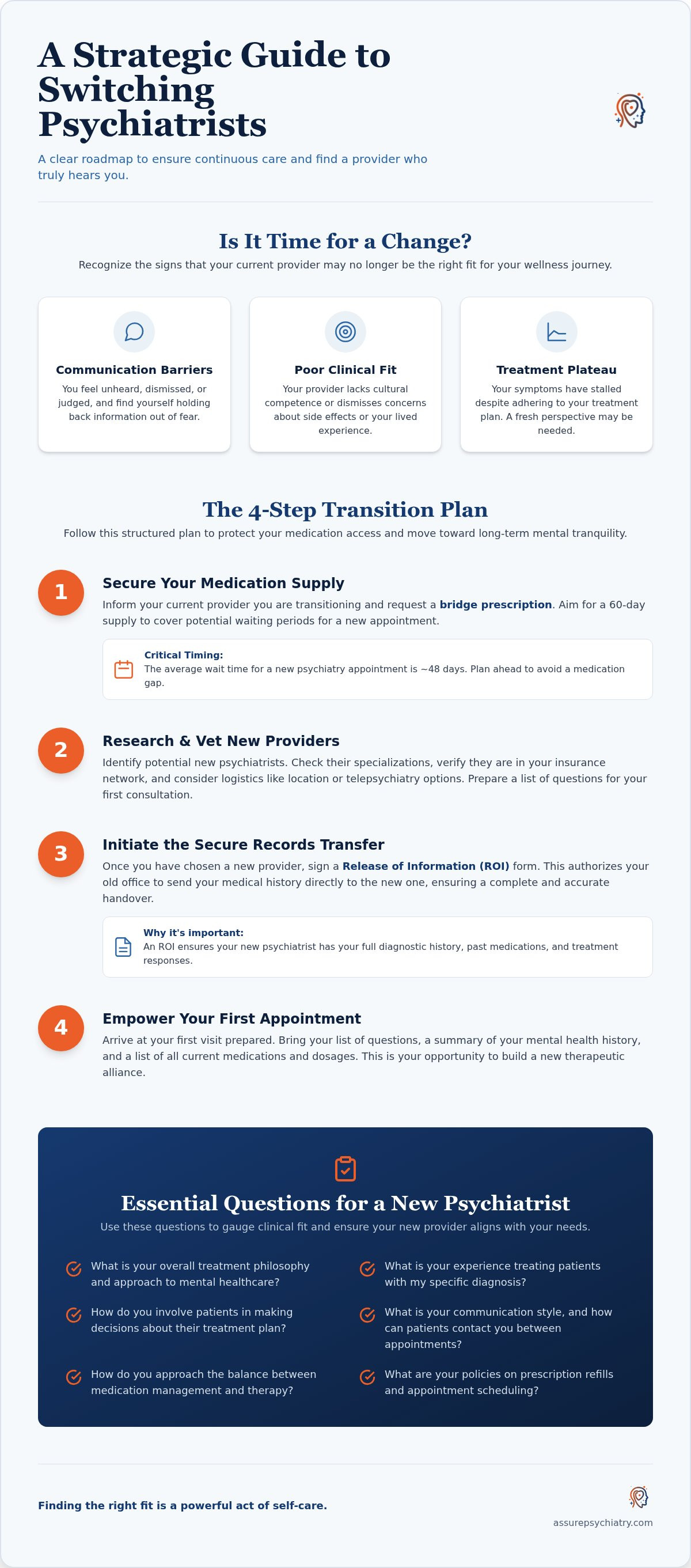
The Step-by-Step Logistics of a Smooth Handover
The administrative side of switching care often feels like the most daunting hurdle. It’s helpful to remember that you are the primary stakeholder in your health journey. Initiating a ‘breakup’ with your current office doesn’t have to be a confrontation. Most transitions can be handled through a professional message to the administrative staff or a brief note to your clinician. Your focus should remain on securing your medical records to ensure your new provider has the full context of your history. This is where the Release of Information (ROI) form becomes essential. Under HIPAA regulations, you have a right to your records, and signing this form allows your old and new clinics to communicate directly.
During this phase, you should also prepare your own ‘mental health resume.’ This document acts as a personal guide for your first medication management appointment, listing every medication you’ve tried, the dosages, and how they made you feel. Having this ready reduces the anxiety of remembering details on the spot. It also allows you to focus on the more nuanced questions to ask a new psychiatrist regarding their specific approach to your care. By taking these organized steps, you replace chaos with a structured path toward clinical stability.
Medical Records and Documentation
To build a complete clinical picture, your new provider needs your recent lab results, diagnostic notes, and past medication history. If you find your previous office is slow to release these files, don’t hesitate to follow up. Persistence ensures your safety. We recommend keeping a digital or physical copy of your records for your own files. This empowers you to be an informed participant in your treatment and ensures you always have your data ready, regardless of where you receive care. Having these documents on hand also helps you formulate better questions to ask a new psychiatrist about how they interpret your previous clinical data.
Preparing for the First Intake Session
Your first intake is a fresh start. Take a moment to summarize what has worked for you in the past and, more importantly, what hasn’t. Defining your goals for this new partnership helps your clinician tailor their approach to your specific needs. To ensure clarity during the conversation, try to write a single sentence summarizing your primary reason for switching. For example, you might say, ‘I am seeking a provider who prioritizes a collaborative approach to ADHD medication adjustments.’ This clarity helps you focus your energy on finding a clinician who aligns with your vision for mental tranquility.
If you’re ready to begin this new chapter with a team that values partnership, schedule your intake with Assure Psychiatry today.
Starting Fresh with Assure Psychiatry in Portland
Transitioning to a new provider is an invitation to redefine your wellness journey. At Assure Psychiatry, we view mental health not as a fixed destination, but as an ongoing path toward mental tranquility. Our philosophy centers on a compassionate partnership where clinical expertise meets your unique lived experience. We understand that the decision to switch was likely preceded by many questions to ask a new psychiatrist, and we’re here to provide the transparent, inclusive answers you deserve. We don’t just treat symptoms; we see the individual person behind the diagnosis.
Led by Dr. Olumide Aruwajoye, our intake process is designed to be thorough, inclusive, and entirely non-judgmental. We recognize the courage it takes to start over and re-explain your history. Whether you’re visiting our Portland office in person or utilizing telepsychiatry in Oregon or Washington, we prioritize your comfort from the very first minute. We’re deeply committed to ensuring your continuity of care, helping you bridge the gap between providers so that your medication access remains stable and your peace of mind stays intact throughout the transition.
Personalized Medication Management
We believe that your treatment plan should be as unique as your identity. This is especially true for anxiety treatment in Portland, where we tailor every intervention to fit the specific rhythm of your daily life. Our approach involves ongoing monitoring for safety and efficacy, ensuring that side-effect management is a collaborative conversation rather than a one-sided directive. You’re the expert on your own experience; we’re the guides helping you navigate the clinical path toward restorative action and long-term stability.
Next Steps Toward Peace of Mind
Taking the next step shouldn’t feel like another administrative burden. You can easily check if we accept your major insurance plan through our streamlined portal, which is designed to lower the barriers to seeking help. When booking your initial evaluation, remember to have your ‘mental health resume’ and your list of questions to ask a new psychiatrist ready. Bringing your current medication bottles and a copy of your recent lab results will ensure our first session is as productive and restorative as possible. We invite you to step into a stable environment where your voice is heard, your identity is respected, and your health is our shared priority.
Reclaiming Your Path to Mental Tranquility
Transitioning to a new provider is a significant step toward protecting your inner peace. By securing a bridge prescription and organizing your medical records, you’ve ensured that your stability remains uninterrupted. You now have the tools to vet your next clinician with confidence. Bringing your specific questions to ask a new psychiatrist to that first session allows you to find a partner who truly values your individual identity and treatment goals.
At Assure Psychiatry, we specialize in providing culturally competent and inclusive care for those managing ADHD, anxiety, and depression. We accept most major insurance plans and offer the flexibility of both in-person and virtual visits across Oregon and Washington. You deserve a therapeutic alliance built on reliability and mutual respect. If you’re ready to experience a more collaborative approach to medication management, schedule your initial evaluation with Assure Psychiatry today. Your journey toward lasting peace is a partnership we’re honored to join.
Frequently Asked Questions
Is it awkward to tell my psychiatrist I’m switching?
It is a common professional occurrence and doesn’t need to be awkward. Psychiatrists understand that clinical fit is essential for achieving mental tranquility. You can simply state that you’re moving in a different direction for your care. Most offices have a standard process for this, so you don’t need to feel guilty about prioritizing your personal wellness journey.
Will my new psychiatrist automatically continue my current medications?
While many providers aim for continuity, they’ll perform their own clinical evaluation before confirming your treatment plan. This is especially true for controlled substances. Your new provider will review your history and current symptoms to ensure your medications are safe and effective. Preparing specific questions to ask a new psychiatrist about their prescribing philosophy can help align your expectations during that first visit.
How long does it typically take to transfer medical records?
The process usually takes between 5 to 14 business days, depending on the responsiveness of your previous office. Under HIPAA, clinics must provide records in a timely manner, but administrative delays happen. We recommend requesting your files as soon as you decide to switch. Having your own digital copy can also help bridge the gap if the official transfer takes longer than expected.
Can I see two psychiatrists at the same time during a transition?
It’s generally not recommended to have two active prescribing psychiatrists simultaneously. This can lead to conflicting treatment plans and significant safety risks regarding medication interactions. Insurance companies also rarely cover two separate providers for the same service. It’s best to have a clear handover date where one provider finishes their care and the next clinician begins.
What if I can’t get an intake appointment before my meds run out?
Don’t panic if your schedules don’t perfectly align. You should ask your current psychiatrist for a 30 day bridge prescription to cover the wait time. If they’re unavailable, your primary care physician might be able to provide a temporary refill for non-controlled medications. Always communicate your timeline clearly to both offices to ensure you remain stable throughout the transition period.
Do I have to explain why I’m leaving my old psychiatrist?
You aren’t obligated to provide a detailed explanation, but a brief reason can help your new provider understand your needs. Whether it’s a change in insurance or a desire for a more collaborative partnership, sharing this context helps tailor your new care. Focusing on your goals for the future is often more productive than dwelling on the reasons you left your previous provider.
Can a new psychiatrist change my diagnosis?
Yes, a new psychiatrist may update your diagnosis after their own thorough evaluation. Psychiatry is an evolving field, and a fresh clinical perspective can sometimes uncover nuances that weren’t previously identified. This isn’t a sign of a mistake; it’s a commitment to ensuring you receive the most accurate and restorative treatment for your current mental health state.
How do I know if a new psychiatrist is a good fit after just one visit?
Trust your intuition after the first session. A good fit often feels like a partnership where you’re heard, validated, and respected. Ask yourself if the provider’s communication style made you feel safe and empowered. If you left the session with clear answers to your questions to ask a new psychiatrist and a sense of mental tranquility, you’re likely on the right path.
Recent Comments