

What if the most profound proof of your recovery isn’t a sudden burst of joy, but the quiet fact that you finally folded the laundry without feeling a crushing weight of exhaustion? When you start a new treatment, it’s natural to feel anxious about side effects or frustrated that you aren’t “back to normal” overnight. You might even catch yourself in a loop of negative self-talk, feeling like a failure because the clouds haven’t completely parted. It’s important to remember that the early signs your antidepressant is working are often incredibly subtle, appearing as tiny shifts in your daily routine rather than a total transformation.
We understand that waiting for relief can feel like an uphill battle, especially when you’re looking for a “cure” that hasn’t arrived yet. This guide will help you identify the micro-victories that prove your treatment is effectively lowering the barriers to your well-being. You’ll learn how to spot these small shifts in your energy and perspective, providing you with a clear framework to share with your psychiatrist during your next medication management appointment. By celebrating these incremental improvements, you can replace doubt with the quiet confidence that your path to mental tranquility is already unfolding.
Key Takeaways
- Understand the 4-8 week timeline for medication efficacy and why moving beyond an “all-or-nothing” mindset is essential for recognizing progress.
- Explore the science of how dopamine and neuroplasticity create subtle, positive shifts in your daily motivation and ability to build healthier habits.
- Learn to identify the specific signs your antidepressant is working based on your unique diagnosis and personal energy baseline.
- Discover how to turn your daily observations into valuable clinical data that helps your psychiatrist fine-tune your medication management plan.
- Recognize how a collaborative approach to psychiatric care transforms small, incremental wins into a foundation for lasting mental tranquility.
The Waiting Game: Why Signs Your Antidepressant Is Working Take Time
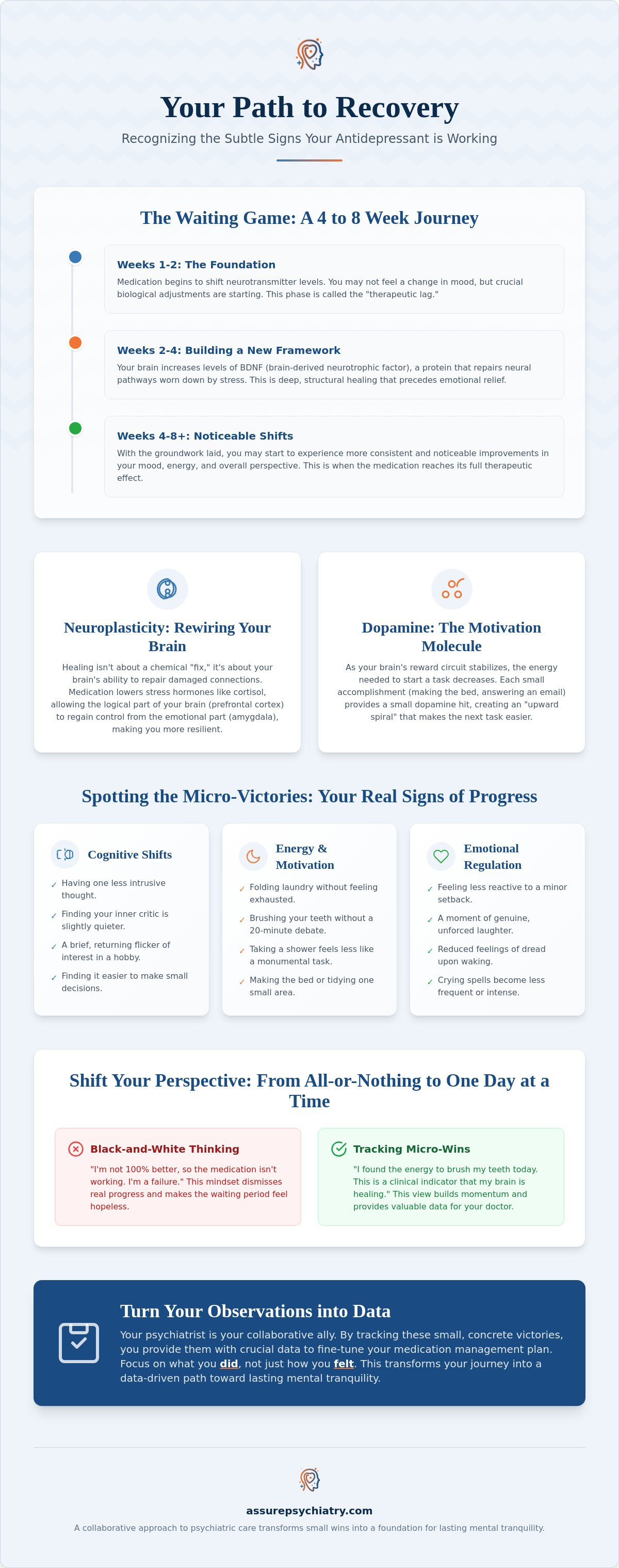
Starting a new treatment plan often feels like waiting for a storm to pass. You might find yourself checking in every hour, asking: “Do I feel better yet?” It’s a heavy burden to carry. Clinical evidence shows that most Antidepressant medications require a window of 4 to 8 weeks to reach their full therapeutic effect. This period can feel like an eternity when you’re struggling, but understanding the biological “behind-the-scenes” work can help ease the anxiety of the wait. Your brain prioritizes deep, internal stabilization before it allows your outward mood to shift. This means that even if you don’t feel “happy” yet, significant healing is likely already underway beneath the surface.
The Neurobiological Delay
Your brain is a complex landscape that doesn’t change its weather patterns instantly. While medication begins shifting neurotransmitter levels within hours or days, your emotional experience is much slower to respond. This phenomenon is known as the “therapeutic lag,” a period where the body adjusts to the medicine before the mind experiences relief. During these early weeks, the brain is busy increasing levels of brain-derived neurotrophic factor (BDNF). This protein acts like a restorative agent for your mind, slowly repairing and building new neural pathways that have been worn down by chronic stress or depression. These structural repairs are the essential groundwork that must be laid before you can feel a sustained, reliable shift in your emotional state.
Overcoming Black-and-White Thinking
Depression often distorts our perspective, forcing us into an all-or-nothing mindset. You might feel like a failure because you aren’t “cured” by week three, or you may dismiss small improvements as “not enough.” This black-and-white thinking makes it difficult to recognize the real signs your antidepressant is working. In the first 30 days, your victories are often invisible to the outside world. Perhaps you had one less intrusive thought today, or you found the energy to brush your teeth without a 20-minute mental debate. These aren’t just minor details; they are clinical indicators of progress. We encourage you to view your provider as a collaborative ally during this initial phase. Instead of waiting for a total transformation, start tracking these micro-milestones. Acknowledging that recovery is a gradual climb rather than a sudden leap helps protect your hope and builds the momentum needed for lasting mental tranquility.
The Science of Subtle Shifts: How Your Brain Signals Healing
Healing is rarely a loud, celebratory event. Instead, it’s a quiet reorganization of how your brain processes the world. While many people believe how antidepressants work is simply by “fixing” a chemical imbalance, the reality is far more dynamic. Modern treatment focuses on neuroplasticity, which is your brain’s remarkable ability to repair damaged connections and build new, healthier habits. As the medication begins to lower your baseline cortisol levels, the constant “noise” of stress begins to fade. This biological quietude allows your prefrontal cortex, the logical part of your brain, to regain control over the emotional reactivity of the amygdala. You aren’t just feeling “better”; your brain is physically becoming more resilient.
Dopamine and the Upward Spiral
We often think of dopamine as the “pleasure molecule,” but in the context of recovery, it’s actually the “motivation molecule.” When your reward circuit begins to stabilize, the energy required to start a task decreases. This creates what scientists call the “Winner Effect.” Every time you complete a small task, like making the bed or answering an email, your brain receives a tiny hit of dopamine that biologically primes you for the next success. This creates an upward spiral where one small win lowers the barrier for the next. Identifying these signs your antidepressant is working becomes easier when you recognize that your newfound “willpower” is actually your neurobiology finally having the resources it needs to function. Professional medication management is designed to help you nurture this feedback loop until these small actions feel like second nature again.
Healing the Brain’s Negative Bias
Human beings are evolutionarily wired with a negative bias. We are designed to notice threats and failures more quickly than successes because, for our ancestors, that’s what kept them alive. Depression often hijacks this survival mechanism, making it feel impossible to see progress. As your treatment takes hold, you might notice a shift in this internal narrative. You may find yourself “active savoring,” which is the conscious act of noticing a positive moment and letting it linger. This isn’t just “positive thinking”; it is your prefrontal cortex actively retraining your brain to prioritize growth over despair. One of the most reliable signs your antidepressant is working is when you realize you’ve gone a few hours without a self-critical thought. These moments of mental tranquility are the building blocks of a lasting recovery, proving that your brain is successfully moving toward a state of balance and peace.
Condition-Specific Signs Your Treatment Is Working
Recovery is a deeply personal experience, and what qualifies as a “win” depends entirely on where you started. It’s about your personal baseline. Because mental health conditions affect different neural circuits, the signs your antidepressant is working will vary based on your primary diagnosis. For instance, a person with depression might look for shifts in physical energy, while someone with anxiety might monitor their internal “noise” level. This is why a comprehensive psychiatric evaluation in Portland is so vital; it establishes your unique starting point so you and your provider can accurately measure growth. Understanding the risks of antidepressants alongside these benefits helps you stay informed and empowered as you move toward mental tranquility.
Signs in Depression and Anxiety
In depression, progress often starts with a reduction in the physical “heaviness” that makes mornings feel impossible. You might notice you’re answering a text message immediately rather than letting it sit for days, or perhaps you finally felt the desire to step outside for a short walk. For those seeking anxiety treatment in Portland, success often looks like a shorter recovery time after a trigger. Instead of a stressful event ruining your entire afternoon, you might find yourself using a grounding technique and returning to a state of calm within minutes. These are cognitive shifts where your brain begins to process threats more realistically rather than staying in a state of high alert.
Signs in ADHD and PTSD
When treating ADHD, an ADHD psychiatrist in Portland will look for improvements in task initiation and follow-through. Can you complete a five-minute chore without the usual “paralysis” of indecision? In PTSD, healing is often marked by feeling more grounded in the present moment. You might experience fewer intrusive thoughts or find that your startle response isn’t quite as sharp as it used to be. These subtle focus and safety improvements are key signs your antidepressant is working to stabilize your nervous system. By noticing these condition-specific changes, you can better communicate your progress to your care team and adjust your treatment plan for optimal results.
Turning Observations into Data: Tracking Wins for Your Psychiatrist
When you sit down for a follow-up appointment, it’s common to default to a simple “I’m doing okay.” However, your psychiatrist needs more than a general summary to provide the best care possible. Small victories aren’t just pleasant moments; they are actually clinical indicators that your neurotransmitter levels are reaching a healthier balance. By identifying these signs your antidepressant is working, you provide the “micro-data” necessary for your doctor to fine-tune your treatment. This level of detail is essential for effective medication management in Portland, as it allows for precise adjustments that prioritize your comfort and long-term stability. Vague statements can sometimes lead to stalled progress, whereas specific evidence of a “win” can signal that a dosage is exactly where it needs to be.
Low-Friction Tracking Methods
Tracking your progress shouldn’t feel like another heavy burden on your To-Do list. When executive function is low, traditional journaling often feels like an impossible task. Instead, we recommend a “Done List.” Rather than focusing on what’s left to do, write down three things you actually accomplished today, no matter how small they seem. Perhaps you answered a difficult email or simply took your medication on time. Even a one-sentence voice memo on your phone can capture a fleeting moment of clarity or a slight lift in mood. For a more visual approach, try a “Jar of Wins” where you drop a small scrap of paper for every positive shift you notice. These methods turn abstract feelings into tangible evidence that your brain is responding to treatment. They serve as a physical reminder that mental tranquility is achievable, one small step at a time.
The Collaborative Care Model
We believe in a partnership where you’re an active participant in your own wellness journey. You are the expert on your own internal experience, and your observations are the most valuable tools we have. Tracking your wins empowers you to advocate for your needs and ensures your voice is heard during every consultation. The rise of telepsychiatry in Oregon has made these data check-ins more accessible than ever, allowing you to share your progress from the comfort of your own home without the stress of a commute. When you and your provider work as allies, you can identify the signs your antidepressant is working much faster. This collaborative spirit reduces the anxiety often associated with seeking help and creates a predictable, supportive environment for your recovery.
If you’re ready to partner with a provider who values your individual journey and celebrates every victory, connect with our team at Assure Psychiatry today to begin your path to lasting peace.
Navigating Your Recovery Journey with Expert Support in Portland
Recovery isn’t a solitary climb. While you’re learning to spot the subtle signs your antidepressant is working, having a compassionate ally by your side makes the process feel far less daunting. In Portland, Assure Psychiatry offers a space where your individual identity is respected and your progress is celebrated. Dr. Olumide Aruwajoye focuses on a patient-centered approach that prioritizes your comfort above all else. You don’t have to guess if you’re getting better. You can rely on expert guidance to help you interpret the micro-victories that lead to lasting mental tranquility. Choosing a local clinic means you have access to a provider who understands the specific community standards of care and is committed to inclusive, diverse support.
What to Expect in the First 90 Days
The first 90 days of treatment are a period of profound transition. During this time, the earliest signs your antidepressant is working are often the hardest to recognize because they are so quiet. You might feel a slight shift in your energy before your mood actually lifts. Perhaps you find it easier to get out of bed, even if you don’t feel “happy” yet. Consistency is your greatest tool here. By maintaining open communication with your provider, you ensure that any side effects are managed and that your dosage is optimized for your specific neurobiology. This phase is about building a foundation of reliability and trust in your treatment plan. It’s a time to be patient with yourself and your brain as it undergoes significant structural repair.
Your Path to Mental Tranquility
Assure Psychiatry is dedicated to supporting you through every milestone, from your initial psychiatric evaluation to long-term medication management. We know that seeking help can be intimidating. That’s why we’ve designed our practice to be a stable environment where you feel seen and heard. Whether you prefer an in-person visit in Portland or the convenience of telepsychiatry across Oregon, our goal remains the same: helping you achieve a state of consistent peace. We believe that a diagnosis doesn’t define you. Instead, it’s a starting point for a collaborative partnership. Your journey is unique, and every small win counts toward the life you deserve. If you’re ready to take the next step, our team is here to guide you toward the mental tranquility you’ve been seeking. You are not just a patient; you are an active participant in a plan built for your success.
Embrace Your Progress and Reclaim Your Peace
Recovery is rarely a straight line, but every small shift in your energy or focus is a meaningful step forward. You’ve learned that the earliest signs your antidepressant is working are often found in micro-victories; these might be as simple as a slightly lighter morning or a moment of clarity during a stressful day. These aren’t just coincidences. They are clinical evidence of your brain’s incredible capacity for healing and neuroplasticity. By partnering with a provider who views these wins as vital data, you can turn your daily observations into a roadmap for lasting wellness.
Dr. Olumide Aruwajoye is here to act as your compassionate ally, offering personalized treatment plans that honor your unique milestones. Whether you visit us in person in Portland or connect through telepsychiatry across Oregon, you’ll find a stable environment focused on your restorative journey. You don’t have to navigate the complexities of medication alone. Begin your journey toward mental tranquility; schedule your psychiatric evaluation today. Your future of peace is built one small victory at a time. We’re ready to celebrate each one with you.
Frequently Asked Questions
How do I know if something is a ‘win’ worth celebrating?
Anything that feels slightly easier than it did yesterday is a win worth celebrating. If you found the energy to shower or answered a text you’ve been avoiding, your brain is demonstrating increased capacity. These micro-victories are clinical indicators that your neurobiology is responding. Don’t wait for a total mood shift to validate your progress; the small shifts are the foundation of your recovery.
What if I have a bad day and can’t find any small wins?
Bad days are a normal part of the healing process and don’t mean your treatment has stopped working. Sometimes, the “win” is simply surviving a difficult day without spiraling into old patterns of self-criticism. If you can’t find a victory today, look back at the week as a whole. Recovery is measured in trends over time rather than the perfection of a single 24-hour period.
Can medication help me notice small wins more easily?
Yes, medication can help by lowering the “noise” of anxiety or the “heaviness” of depression, allowing your prefrontal cortex to function more effectively. When your brain isn’t stuck in a survival loop, you gain the mental space to notice positive moments. This is one of the key signs your antidepressant is working; you begin to regain the cognitive ability to savor small, pleasant experiences that previously went unnoticed.
Is it normal to feel silly when celebrating small things?
It is completely normal to feel a bit awkward at first, especially if you’ve spent years being your own harshest critic. However, validating small successes is an evidence-based way to retrain your brain’s reward circuit. You aren’t being “silly”; you’re actively participating in your clinical recovery. Over time, acknowledging these wins will feel less like a chore and more like a natural part of your mental tranquility.
How often should I share these victories with my psychiatrist?
You should share these observations during every medication management appointment or follow-up consultation. Providing specific examples of improved functioning helps your psychiatrist determine if your current dosage is optimal. Instead of just saying you feel “fine,” mentioning that you’ve started a new hobby or are sleeping better provides the micro-data needed to tailor your treatment plan to your unique needs.
What if I feel side effects but no small wins yet?
It’s common to experience physical side effects before you notice emotional improvements, as the body often adjusts to medication faster than the brain. Remember that the standard timeline for efficacy is 4 to 8 weeks. If you’re struggling with side effects, stay in close contact with your provider. They can help you determine if these are temporary adjustments or if a different medication might be a better fit.
How does celebrating small wins help with ADHD specifically?
For those with ADHD, celebrating small wins helps stimulate the reward system, making it easier to initiate the next task. When you acknowledge completing a five-minute chore, you provide your brain with a biological hit of dopamine that builds momentum. Recognizing these signs your antidepressant is working or your ADHD treatment is effective helps break the cycle of task paralysis and builds long-term executive function.
Can I celebrate progress even if I still have depression symptoms?
Absolutely, because progress and symptoms often exist at the same time during the early stages of recovery. You don’t need to be symptom-free to acknowledge that things are getting better. Healing is a gradual transition where the “good” moments slowly begin to outnumber the “bad” ones. Celebrating progress while still experiencing symptoms is a powerful way to maintain hope and stay committed to your treatment plan.
Recent Comments