

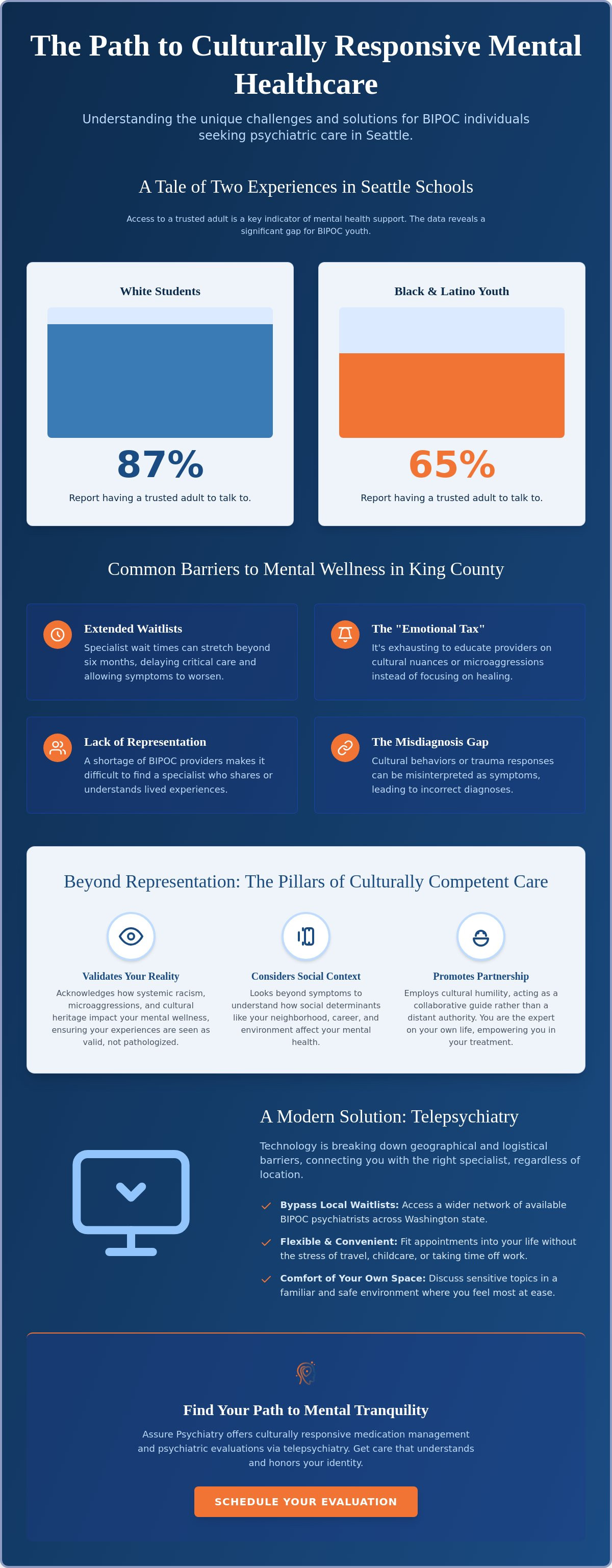
Did you know that while 87% of white students in participating Seattle schools report having a trusted adult to talk to, that number drops to just 65% for Black and Latino youth? This disparity highlights a deep-seated challenge in our local healthcare system. For many, finding a BIPOC psychiatrist Seattle residents can truly connect with feels like searching for a rare exception rather than the standard of care. You might feel exhausted by providers who lack cultural humility or overwhelmed by the stigma that sometimes surrounds psychiatric medication in your community. It is tiring to feel like you have to educate your doctor before they can even begin to help you.
We believe that your identity is a vital part of your wellness journey, not a barrier to it. This article will help you find a specialist who provides expert medication management while honoring your cultural background. You will learn how to bypass the six-month waitlists often found in King County and access care that prioritizes your peace of mind. We will preview the modern tools, such as telepsychiatry, that are helping patients achieve mental tranquility through personalized and inclusive treatment plans.
Key Takeaways
- Understand how culturally responsive care addresses systemic racism and cultural heritage to prevent misdiagnosis in marginalized communities.
- Learn why a BIPOC psychiatrist Seattle residents trust uses clinical tools specifically tailored to your unique social and cultural lived experience.
- Discover how telepsychiatry expands your options, connecting you with specialists across Washington to bypass local waitlists and busy schedules.
- Get practical steps to prepare for your first psychiatric evaluation so you feel empowered and ready to discuss your mental health goals.
- Explore how a collaborative approach to medication management can help you move beyond a diagnosis toward lasting mental tranquility.
The Importance of Finding a BIPOC Psychiatrist in Seattle’s Mental Health Landscape
BIPOC psychiatry is more than a preference. It is a clinical framework that acknowledges how systemic racism and cultural heritage directly impact your mental wellness. For many in our community, the goal isn’t just to manage a list of symptoms. It’s to achieve a lasting state of mental tranquility. This state of peace is only possible when your provider understands your starting point. In the Pacific Northwest, people of color often face unique environmental and social stressors. By 2026, the demand for inclusive care has only grown, yet the ‘misdiagnosis gap’ persists. This gap occurs when a provider misinterprets cultural behaviors or trauma responses as symptoms of a personality or mood disorder. Finding a BIPOC psychiatrist Seattle residents can trust ensures that your experiences are validated rather than pathologized.
Barriers to Care in the PNW
King County continues to face a significant shortage of specialists who identify as BIPOC. A 2025 report by King County’s Behavioral Health and Recovery Division found that language access and a lack of providers from similar backgrounds remain the biggest barriers to support. Traditional clinics often have waitlists that stretch beyond six months. During this time, untreated symptoms can worsen, affecting your work and family life. Beyond the logistics, there’s an ’emotional tax’ involved in seeking help. It’s exhausting to spend your clinical hour explaining the nuances of your culture or microaggressions to a non-competent provider. You shouldn’t have to be the teacher while you are trying to be the patient.
Why Representation Improves Clinical Outcomes
Trust is the foundation of any medical relationship. When you work with someone who shares a similar identity, the therapeutic alliance often forms much faster. You don’t have to translate your life for your doctor, which allows more time for actual healing. Research shows that patients are significantly more likely to adhere to their medication management portland or Seattle-based plans when they feel their provider truly hears them. Defining Culturally Competent Psychiatric Care involves more than just checking a box; it requires a provider who views your health through a lens of social awareness. Cultural humility in a clinical setting is the practice of ongoing self-reflection and a commitment to learning from the patient’s own expertise on their life. This collaborative approach empowers you to be an active participant in your treatment, leading to better long-term stability and health.
Beyond Representation: Defining Culturally Competent Psychiatric Care
Seeking a provider with a shared background is about more than just immediate comfort. While feeling seen is vital, true cultural competence goes much deeper into the clinical process. A skilled BIPOC psychiatrist Seattle patients work with uses the same evidence-based diagnostic tools as any other physician, but the interpretation of those results changes through a specific lens. They look at the intersection of your social environment and your symptoms. How does your neighborhood, your career path, or your history of systemic exclusion affect your sleep patterns or anxiety levels? By addressing these social determinants of health, a psychiatrist acts as a collaborative guide rather than a distant authority figure. The goal is to remind you that a diagnosis doesn’t define your identity or your future. It is merely a map to help you find your way back to mental tranquility.
Cultural Nuance in Medication Management
In the world of medication management, one size rarely fits all. Clinical research indicates that different ethnic groups can have varying metabolic responses to certain psychiatric medications. For instance, specific genetic variations can influence how enzymes break down antidepressants, meaning a standard dose might be too high or too low for your specific biology. A culturally responsive provider understands these pharmacological nuances. They also respect the role of traditional or holistic practices you may already use. Instead of dismissing these, they ask, “What does health look like in your family?” This inquiry ensures that Western medicine complements your existing values. If you are ready for a provider who respects your whole self, starting a conversation about your wellness goals can be a transformative step.
Addressing the Stigma of Diagnosis
For many in the BIPOC community, receiving a mental health “label” feels like a heavy burden. There’s often a fear that a diagnosis carries a permanent stigma or will be used to justify unfair treatment. A culturally responsive psychiatric evaluation portland or Seattle specialist focuses on restoration rather than just pathology. The evaluation is a tool for empowerment. It’s a way to name what you’re feeling so that a clear strategy for relief can be built. You’re an active participant in this process. By focusing on your potential for peace and your individual strengths, the clinical experience becomes a pathway to healing rather than a source of shame. You aren’t just a patient; you’re a person reclaiming your life.
Telepsychiatry: A Solution for BIPOC Patients in Washington
Telepsychiatry has revolutionized how we access mental health care, especially for those seeking a BIPOC psychiatrist Seattle residents can rely on for long-term support. It bridges the gap between your physical location and the specialist who truly understands your cultural baseline. Whether your provider is across the city or located elsewhere in the state, virtual care offers a direct bridge to wellness. This modern approach ensures that professional, human-centered connections aren’t limited by office walls. You can build a deep, trusting rapport with a collaborative guide from the comfort of your own home, knowing that your care meets the same high clinical standards as any in-person visit. Both Washington and telepsychiatry oregon services prioritize your safety and privacy while delivering expert medication management.
Breaking Geographic Barriers in Seattle
The “Seattle Freeze” isn’t just a social phenomenon; it often describes the difficulty of getting into a local psychiatric office. Finding a BIPOC psychiatrist Seattle patients can connect with shouldn’t be dictated by your zip code or proximity to a specific transit line. In 2022, 65% of mental health visits in Washington were conducted virtually, a rate significantly higher than the national average of 50%. This shift has empowered patients to bypass the six-month waitlists often found at traditional brick-and-mortar clinics in King County. You can now schedule essential follow-up visits for medication management without the stress of navigating I-5 traffic or the frustration of finding parking in crowded neighborhoods like Capitol Hill or First Hill. Your time is valuable, and virtual care respects that.
Privacy and Comfort in Virtual Care
For many individuals in the BIPOC community, traditional clinical environments can feel sterile or even intimidating. Discussing sensitive cultural issues, family dynamics, or the emotional toll of systemic stressors is often easier when you are in a space where you feel safe. Virtual care eliminates the “anxiety of the waiting room,” where many patients report feeling out of place or exposed. We use HIPAA-compliant technology to protect your information, ensuring your mental tranquility remains undisturbed regarding data security. This privacy allows for a more honest and open dialogue, which is essential for an accurate evaluation and a successful treatment plan. By removing the physical barriers to entry, we create a supportive environment where your healing takes center stage.
Your First Psychiatric Evaluation: A Practical Guide for BIPOC Individuals
The first step toward mental tranquility often begins with a single, brave conversation. When you prepare for your first visit with a BIPOC psychiatrist Seattle patients trust, it’s helpful to remember that this evaluation is a collaborative partnership. This is not a test you need to pass; it’s an opportunity to be seen and heard. Before the call, take a moment to reflect on your specific goals. Are you seeking relief from persistent worry, or are you looking for a more stable sleep cycle? By identifying what you want to achieve, you can better guide the discussion toward a personalized treatment plan. Whether you are seeking support for PTSD or anxiety treatment portland or Seattle specialists provide, your voice is the most important one in the room.
Self-Advocacy in the Clinical Setting
You are the expert on your own lived experience. This means the first meeting is a two-way street. While the provider is assessing your clinical needs, you are also evaluating if their approach aligns with your values. A BIPOC psychiatrist Seattle residents work with should welcome your questions. Don’t hesitate to ask direct questions to gauge their cultural humility:
- “How do you incorporate cultural identity into your diagnostic process?”
- “What is your experience working with individuals from my specific background?”
- “How do you handle differences in medication metabolism across different ethnicities?”
If you have concerns about medication side effects, bring them up early. A supportive psychiatrist will welcome this transparency and won’t label you as “non-compliant” for wanting to understand how a treatment affects your body.
What to Bring to Your First Visit
Organizing your thoughts beforehand can significantly reduce the pressure of the moment. If you’ve previously seen an adhd psychiatrist portland or Seattle specialist, try to have those records available. Creating a simple timeline of your symptoms helps ensure you don’t miss important details. Also, gather a list of your current medications and dosages, any vitamins or herbal supplements, and your insurance information. Having these basics ready allows you to focus more on the human connection and less on the logistics. Schedule your initial psychiatric evaluation today to begin your journey toward a more balanced life.
Assure Psychiatry: Culturally Responsive Care for Seattle and Beyond
Assure Psychiatry stands as a dedicated ally for those seeking inclusive and expert mental health support. We understand that finding a BIPOC psychiatrist Seattle patients can truly trust involves more than just a clinical appointment. It’s about finding a sanctuary where your identity is respected and your voice is the primary guide in your treatment. Our practice is built on the belief that a diagnosis is simply a starting point, not a label that defines your potential. We offer a supportive environment for medication management, ensuring that every step we take together is rooted in a non-judgmental partnership. If you are currently switching psychiatrists, we provide a streamlined transition to ensure your journey toward wellness remains uninterrupted and steady.
Dr. Olumide Aruwajoye’s Mission
Under the leadership of Dr. Olumide Aruwajoye, our mission is centered on social awareness and clinical excellence. Dr. Aruwajoye focuses on providing compassionate, culturally competent psychiatric evaluations that acknowledge the nuances of your lived experience. He is a firm believer that mental tranquility is an attainable goal for every individual, regardless of their history or current struggles. His expertise as a bipolar disorder specialist portland and Seattle patients can access virtually ensures that even complex conditions are managed with the highest standard of care. This commitment to restorative action helps lower the barrier for those who have previously felt misunderstood by the medical system.
The Path to Mental Tranquility
We have designed our process to be as calm and logically organized as possible. It begins with a warm invitation to share your story through a comprehensive initial evaluation. Our team is committed to seeing and hearing the person behind the diagnosis, prioritizing your comfort at every turn. How would your life change if you felt fully supported in your mental health journey? We invite you to be an active participant in your own treatment plan, working alongside a collaborative guide who values your individual identity. Finding a BIPOC psychiatrist Seattle residents can collaborate with is the first step toward reclaiming your mental tranquility. Reach out to us today to begin your personalized journey and discover the restorative power of truly inclusive, professional care.
Embracing Your Path to Mental Tranquility
Achieving mental wellness shouldn’t require you to compromise your cultural identity or wait months for an opening. We have explored how the right provider uses clinical expertise to honor your lived experience while bypassing geographic barriers through virtual care. By prioritizing a collaborative partnership, you can move beyond a diagnosis and toward a life defined by balance and stability. Finding a BIPOC psychiatrist Seattle patients can truly connect with is the essential foundation for this lasting change.
Assure Psychiatry, led by Dr. Olumide Aruwajoye, acts as your compassionate ally in this process. We specialize in culturally responsive medication management and provide seamless telepsychiatry access across both Washington and Oregon. You deserve a psychiatric evaluation that validates who you are while providing a clear, supportive path forward. It’s time to work with a team that values empowerment over paternalism and respects your unique journey.
Schedule your culturally competent psychiatric evaluation with Assure Psychiatry today. Your peace of mind is not just a clinical goal; it’s a priority we share with you every step of the way. We look forward to walking beside you on your journey to restorative health and wellness.
Frequently Asked Questions
How do I know if a psychiatrist is truly culturally competent?
A culturally competent psychiatrist demonstrates active listening and acknowledges how systemic factors impact your mental health. They won’t just treat symptoms in isolation; they’ll ask how your heritage and community values shape your wellness goals. You should feel seen as a whole person during your consultation. If the provider is open to discussing social determinants of health without you having to prompt them, it’s a strong sign of true competence.
Can a BIPOC psychiatrist in Seattle prescribe medication via telehealth?
Yes, a BIPOC psychiatrist Seattle residents consult via telehealth can prescribe medication as long as they are licensed in Washington. The standard of care for virtual visits is identical to in-person appointments. This includes conducting a thorough evaluation and establishing a professional relationship. Prescribing must follow all federal DEA and state monitoring rules to ensure your safety and clinical stability throughout the process.
Does Assure Psychiatry accept major insurance plans for Seattle residents?
Assure Psychiatry accepts most major insurance plans to help make expert care more accessible for Seattle residents. We believe that financial logistics shouldn’t stand in the way of your mental tranquility. We recommend verifying your specific coverage details when you book your initial evaluation. This transparency helps reduce the anxiety often associated with starting a new treatment plan and ensures a predictable path forward.
What is the difference between a therapist and a BIPOC psychiatrist?
The main difference is that a psychiatrist is a medical doctor who can provide medication management and diagnostic evaluations. While therapists primarily focus on long-term talk therapy, a BIPOC psychiatrist Seattle patients work with focuses on the biological aspects of mental health. They are trained to prescribe and monitor medications for complex conditions. This medical expertise is delivered through a lens of cultural humility and social awareness.
How long does a typical psychiatric evaluation take at Assure Psychiatry?
An initial psychiatric evaluation at Assure Psychiatry typically lasts between 60 and 90 minutes. This extended timeframe ensures we have enough space to discuss your medical history and cultural background without feeling rushed. We prioritize a human-centered approach that values your perspective as much as clinical data. By the end of this session, we’ll have built a collaborative treatment plan that supports your individual journey toward peace.
Is telepsychiatry as effective as in-person visits for BIPOC patients?
Telepsychiatry is often more effective for BIPOC patients because it removes the barriers of travel and clinical stigma. Many individuals report feeling safer and more open when discussing their cultural experiences from a private, familiar environment. In Washington, virtual care has seen a high adoption rate because it provides consistent access to specialists. This comfort level often leads to a stronger therapeutic alliance and more successful treatment outcomes.
Can I switch to a BIPOC psychiatrist if I am already on medication?
You can absolutely switch to a new provider even if you’re already taking medication. We’ll conduct a comprehensive review of your current prescriptions and history to ensure everything aligns with your health goals. Our team focuses on a restorative approach that respects your biological needs and cultural values. We aim to make the transition as smooth as possible so your progress remains steady and your care remains consistent.
What should I do if I feel my current psychiatrist doesn’t understand my cultural background?
If your current provider lacks cultural humility, it’s perfectly acceptable to seek a new partnership. Your mental health journey depends on a foundation of trust and validation. You shouldn’t have to spend your clinical time educating your doctor about your identity. Seeking a provider who understands the intersection of culture and psychiatry can drastically improve your results. It’s an act of self-care to find a guide who truly sees you.
Recent Comments