

Imagine standing on a busy corner in downtown Portland, the roar of the MAX train and the city’s constant hum feeling less like a backdrop and more like a threat. For many of the quarter-million veterans living in Oregon, this isn’t just urban stress; it’s the daily reality of living with trauma. You’ve likely spent years navigating systems where you feel like a number rather than a person, or perhaps you’ve struggled with medications that don’t quite hit the mark. Finding accessible PTSD treatment for veterans Portland shouldn’t feel like another battle to be fought alone.
We understand that the clinical coldness of traditional hospitals can often heighten anxiety rather than heal it. You deserve a partner who recognizes your service and validates your unique experience. This guide explores how specialized outpatient psychiatric care and precise medication management can help you transition from a state of survival into one of lasting mental tranquility. We will look at the current 2026 landscape for veteran care in Oregon, the benefits of a collaborative treatment approach, and how to establish a reliable regimen that respects your identity and your goals.
Key Takeaways
- Learn why viewing PTSD as a physiological “survival mode” rather than just a diagnosis is the first step toward reclaiming your peace.
- Discover how expert medication management can “lower the volume” on your brain’s internal alarm system and improve restorative sleep.
- Compare the benefits of personalized outpatient care versus institutional systems to find the most responsive PTSD treatment for veterans Portland has to offer.
- Understand what to expect during a psychiatric evaluation and how a non-judgmental review of your history builds a foundation for safety.
- Explore how a collaborative partnership with a culturally competent provider can help you move from constant hypervigilance to lasting mental tranquility.
Understanding PTSD in the Portland Veteran Community
Living with PTSD often feels like your internal alarm system is stuck at full volume long after the threat has passed. It is helpful to view Understanding Post-Traumatic Stress Disorder not as a personal failure or a simple diagnosis, but as a complex physiological state where your brain remains in survival mode. For the more than 250,000 veterans living in Oregon, comprising 7.4% of our adult population, this state can feel particularly isolating. You’ve been trained to be vigilant, yet when that vigilance persists in civilian life, it can prevent you from finding the mental tranquility you deserve. Does it feel like you’re always waiting for the other shoe to drop, even in the safety of your own home?
Validation is the first step toward healing. It’s entirely normal to feel “keyed up” or hyper-vigilant years after your service ended. Your brain did exactly what it was trained to do: it kept you alive. Now, the goal is to teach your nervous system that it’s safe to stand down. Finding effective PTSD treatment for veterans Portland starts with a provider who sees the person behind the service record, acknowledging that your experiences are unique and your path to peace should be too—a standard of individualized attention also found in the specialized disability support provided by Accessible Care.
Common Symptoms and Local Stressors
In a veteran context, PTSD often manifests as hyper-vigilance, profound sleep disturbances, or a sense of emotional numbness that makes it hard to connect with loved ones. Portland’s specific environment can sometimes complicate these feelings. The sudden clatter of the MAX train, the dense crowds at local events, or the constant hum of urban noise can easily trigger a nervous system that is already on edge. These local stressors can make the world feel smaller as you try to avoid triggers. Seeking care that respects your military history and your individual identity is crucial for breaking this cycle of avoidance.
Why Outpatient Care is a Vital Step
While some may require inpatient crisis stabilization during acute moments, outpatient care is where the long-term journey of wellness truly happens. It offers a stable, consistent environment to work through symptoms while maintaining your daily life and connections. A modern clinic serves as a compassionate ally, offering a blend of in-person visits and telepsychiatry to ensure support is always within reach. This flexible approach reduces the barriers to care, allowing you to focus on your recovery without the added stress of a rigid, institutional schedule. By choosing a collaborative partnership, you’re taking an active role in moving from a state of constant alert to one of lasting stability.
The Role of Medication Management in PTSD Recovery
When your brain is locked in a state of high alert, the world feels louder, sharper, and more dangerous than it actually is. Medication management isn’t about masking your personality or providing a temporary “crutch.” Instead, it’s a sophisticated way to lower the volume on your brain’s internal alarm system. By targeting the specific neurotransmitters that drive hyper-vigilance, the right medication allows your nervous system to rest. This physiological stabilization is often the missing piece in PTSD treatment for veterans Portland, providing the quiet space needed for other forms of healing to take root.
One often overlooked aspect of trauma recovery is the science of thermoregulation and its impact on sleep. Many veterans experience intense night sweats or feel physically “hot” when triggered. This isn’t just a symptom of stress; it’s a biological response. Specialized medication can help regulate these internal temperature shifts and calm the autonomic nervous system, leading to deeper, more restorative sleep. When you finally achieve consistent rest, your capacity to handle daily stressors increases exponentially. This is how we move toward true mental tranquility, addressing the body’s physical responses alongside the mind’s emotional needs.
Empowerment is the core of this process. You aren’t just a passive recipient of a prescription; you’re an active participant in a biological recalibration. Because everyone’s chemistry is different, ongoing monitoring is essential. We work together to adjust dosages and track progress, ensuring that the benefits always outweigh any side effects. The goal is to find a regimen that supports your lifestyle rather than dictating it.
Beyond the Basics: Specialized Psychiatric Care
A standard approach often fails because it misses the specific biological markers of your experience. During a thorough assessment, we look at how your symptoms overlap. Many veterans find that their struggle isn’t limited to trauma alone. Exploring Anxiety Treatment in Portland alongside PTSD care is common, as these conditions often feed into one another. By understanding the full spectrum of VA PTSD treatment options and private alternatives, you can ensure that co-occurring conditions like depression or insomnia are addressed simultaneously for a more complete recovery.
Finding the Right Balance for Your Lifestyle
We believe in a collaborative partnership where your feedback is the most important data point. Managing side effects is a priority so that you can remain fully engaged with your work and your family. Medication management is not about changing who you are, but about clearing the path for who you want to be. If you’re ready to explore how these tools can support your journey, scheduling a psychiatric consultation is a gentle first step toward reclaiming your daily life.
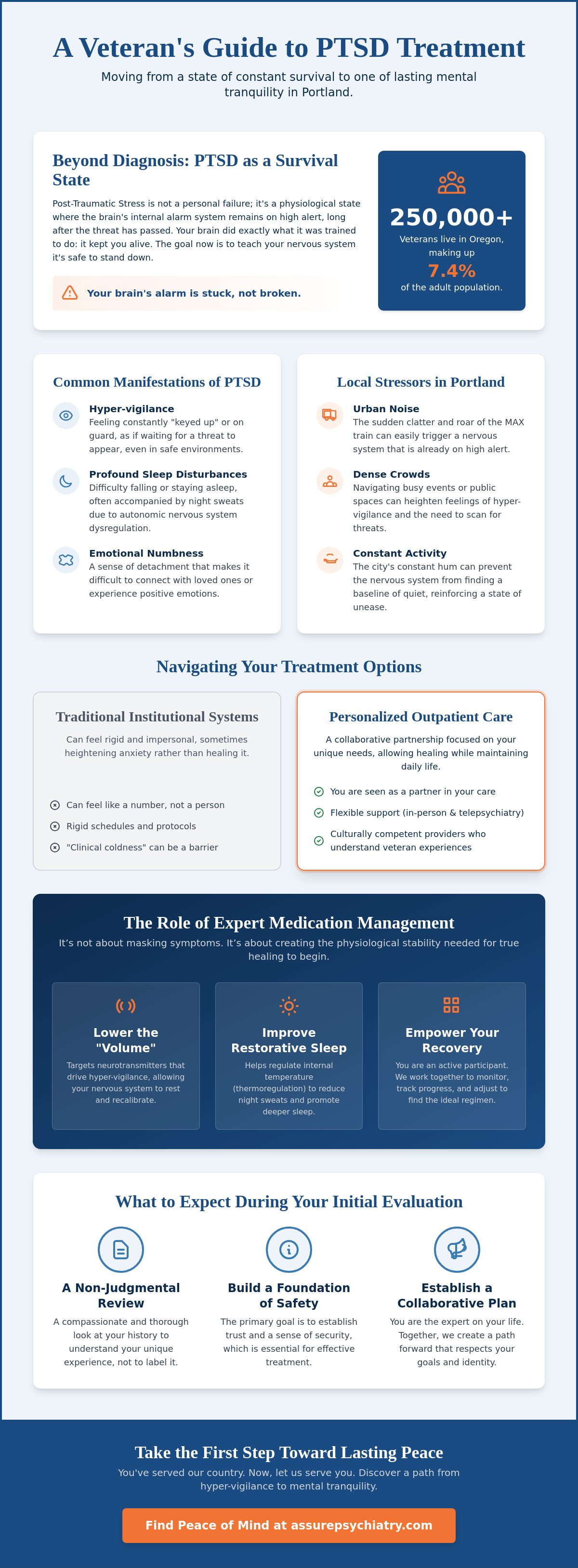
Navigating PTSD Treatment Options in Portland: VA vs. Private Practice
Choosing where to seek support is a deeply personal decision that can significantly impact your recovery timeline. While the VA is a dedicated resource for those who served, the sheer scale of such a large institution often leads to a procedural, one size fits all approach. In contrast, a private outpatient clinic offers a warm, human-centered environment where you’re treated as an individual rather than a case number. For many seeking PTSD treatment for veterans Portland, the difference lies in the atmosphere; moving away from the clinical coldness of a hospital and into a space designed for tranquility and safety can make all the difference in lowering your defenses.
Wait times are another critical factor to consider in 2026. Recent reports indicate that VA wait times for mental health specialties have continued to rise across many service sites. When you’re living in survival mode, waiting weeks or months for an initial evaluation isn’t just an inconvenience; it’s a barrier to safety. Private practices typically offer much faster access to providers, allowing you to begin your journey toward stability almost immediately. Additionally, navigating insurance is often more straightforward than people expect. Most private psychiatric clinics in Oregon now accept major plans such as Optum, Aetna, and United, and some can work with the VA Community Care program to ensure your costs are covered while you receive more personalized attention.
When to Choose an Outpatient Clinic
If you’ve ever felt like your current treatment is rushed or that you’re constantly repeating your history to new providers, it’s likely time for a more individualized approach. Outpatient clinics prioritize consistency, ensuring you see the same practitioner at every visit. This builds a foundation of trust that is essential for a thorough review of your history. Understanding the PTSD diagnostic process is a collaborative effort here, not just a series of boxes to check. This continuity is at the heart of effective Medication Management in Portland, where your provider can track subtle changes in your well being over time.
The Flexibility of Telepsychiatry
For some veterans, the thought of traveling to an office in downtown Portland can be a significant trigger. The traffic, noise, and crowds can heighten hyper-vigilance before you even step into the waiting room. Virtual care removes this barrier entirely, allowing you to connect with your provider from the safety and comfort of your own home. This flexibility ensures that your care remains consistent, even if you live outside the city center or find it difficult to leave your house on certain days. You can explore more about these options in our guide to Telepsychiatry in Oregon, which explains how we maintain high standards of care through secure, accessible technology.
What to Expect During Your Initial Psychiatric Evaluation
The first step toward reclaiming your peace isn’t about fitting you into a rigid clinical box. Instead, it’s a comprehensive diagnostic assessment designed to understand the weight you’ve been carrying and the specific ways your trauma manifests. Whether we meet in person at our clinic or through a secure virtual platform, the goal is to map out your unique history with the care it deserves. We take the time to review your medical background and previous treatments without a hint of judgment. This isn’t a performance or an interrogation; it’s a collaborative conversation aimed at lowering the barriers to PTSD treatment for veterans Portland. By knowing exactly what happens during this hour, you can approach the appointment with a sense of predictability and control.
During the evaluation, we look beyond the surface level symptoms to identify the biological patterns driving your distress. If previous medications didn’t work, we don’t view that as a failure on your part. It’s simply data that helps us refine our approach. We discuss how your symptoms impact your daily life in the Pacific Northwest, from your ability to navigate local environments to the quality of your relationships. This thoroughness ensures that the resulting treatment plan is specifically targeted toward your personal goals for tranquility and stability.
Preparing for Your Appointment
Before our meeting, it’s helpful to gather any previous medical records and a current list of medications or supplements you’re taking. This provides a baseline, but the most vital preparation involves thinking about your “mental health goals.” What does tranquility look like for you in your daily life? Perhaps it’s sleeping through the night without night sweats, or maybe it’s feeling more present and less “keyed up” during family outings. Defining these desired outcomes helps us build a plan that is meaningful to you. You can find more detail on how to prepare in our guide to Psychiatric Evaluation in Portland.
A Supportive, Non-Judgmental Environment
At Assure Psychiatry, we prioritize an environment where you feel seen and heard as a whole person, not just a set of symptoms. We emphasize cultural competence and veteran-aware care, recognizing that military service shapes your perspective and your nervous system in specific ways. Your diagnosis does not define you; it is simply a map to your recovery. We act as your compassionate ally, working alongside you to find the right balance of medication and support. If you’re ready to transition from a state of survival to one of lasting stability, schedule your initial psychiatric evaluation today to begin your partnership with a provider who understands your journey.
Finding Peace of Mind at Assure Psychiatry
At the heart of our practice is a vision established by Dr. Olumide Aruwajoye: a mission to provide psychiatric care that is as compassionate as it is clinically precise. We recognize that for those who’ve served, the journey toward wellness requires more than just a prescription; it requires a partnership based on trust and mutual respect. Our clinic is built on the “Assure” promise, a commitment to reliability, consistency, and ongoing support. We don’t just treat symptoms. We act as a collaborative guide to help you navigate the complexities of your nervous system so you can finally achieve a state of mental tranquility.
Our physical clinic is located in the heart of the community, providing a stable and quiet environment specifically designed for healing. For those who live outside the city center or prefer the comfort of their own space, we offer virtual visits across the entire state of Oregon. This dual approach ensures that high quality PTSD treatment for veterans Portland remains accessible, no matter where you’re located or what your daily challenges might be. By combining modern medical expertise with a warm, human centered approach, we help you transition from a life defined by trauma to one defined by peace.
Why Portland Veterans Choose Assure Psychiatry
Veterans often come to us because they’re tired of feeling like a number in a vast, impersonal system. They stay because they find a provider who listens, validates their experience, and includes them in every decision. Here is what sets our care apart:
- Personalized Attention: We take the time to understand your unique history and how your military service has shaped your current needs.
- Restorative Action: Our focus is on empowering you to take active steps toward recovery through expert medication management and stabilization.
- Broad Accessibility: We accept major insurance plans, including Optum, Aetna, United, Cigna, and Moda, ensuring that professional care is financially within reach.
- A Safe Haven: Whether in person or online, we maintain a non-judgmental space where your identity is respected and your safety is our priority.
Take the Next Step Toward Tranquility
You don’t have to face the overwhelming effects of trauma alone. The hyper-vigilance, the sleepless nights, and the emotional weight can be managed with the right support system. Reclaiming your daily life begins with a single, courageous step toward professional partnership. We invite you to move beyond the cycle of survival and start a new chapter focused on your well being. Peace isn’t just the absence of conflict; it’s the presence of health and stability. When you’re ready to find your path back to mental tranquility, we are here to walk alongside you. Book your initial evaluation today and experience a standard of care that honors your service and your future.
Your Journey Toward Lasting Peace
Transitioning from a state of constant survival to one of mental tranquility is a path you don’t have to walk alone. We’ve explored how specialized medication management can effectively lower the volume on your brain’s alarm system, providing the biological stability necessary for true recovery. By choosing a personalized outpatient environment over a large institutional system, you gain a partner who prioritizes your individual identity and military history. Finding the right PTSD treatment for veterans Portland is the first step in reclaiming a life defined by your goals rather than your trauma.
Dr. Olumide Aruwajoye and the team at Assure Psychiatry provide expert, veteran-aware care in a space designed for safety and validation. Whether you prefer an in-person visit at our Portland clinic or the flexibility of telepsychiatry across Oregon and Washington, we’re committed to your long-term wellness. You’ve dedicated your life to service; now it’s time to prioritize your own health and peace of mind. If you’re ready to find a reliable regimen and feel truly heard by your provider, we’re here to help. Schedule your initial psychiatric evaluation with Assure Psychiatry today. Your future of stability and tranquility is within reach.
Frequently Asked Questions
Does Assure Psychiatry accept VA insurance or community care referrals?
Assure Psychiatry accepts a variety of major private insurance plans, including Optum, Aetna, United, Cigna, and Moda. While we are a private practice, we can often work with veterans who have authorization through the VA Community Care program. It is best to contact your VA representative to confirm your eligibility for community based PTSD treatment for veterans Portland before your first visit.
How is an outpatient psychiatric evaluation different from a VA C&P exam?
A VA Compensation and Pension (C&P) exam is a forensic tool used primarily to determine a disability rating rather than to provide care. In contrast, an outpatient psychiatric evaluation at our clinic is the first step in a therapeutic partnership. We focus on understanding your history to create a restorative treatment plan that helps you achieve mental tranquility and improved daily functioning.
Can I receive PTSD medication management through telepsychiatry in Oregon?
Yes, you can receive comprehensive medication management through our secure telepsychiatry platform. Oregon regulations in 2026 require that providers hold an active state license to treat patients located here, which we maintain to ensure your safety. This virtual option allows you to receive expert care from the comfort of your home, reducing the stress of traveling into the city.
Do you provide long-term psychotherapy for veterans in addition to medication?
Assure Psychiatry specializes specifically in psychiatric evaluations and medication management. We don’t offer long-term psychotherapy or counseling services. However, we believe in a holistic approach and often work alongside your existing therapist to ensure your medication regimen provides the stability you need to make progress in your talk therapy sessions.
What should I do if I am currently in a mental health crisis?
If you are experiencing a mental health crisis or thoughts of self-harm, please call the Veterans Crisis Line by dialing 988 and pressing 1, or go to the nearest emergency room. Assure Psychiatry is an outpatient clinic and does not provide inpatient crisis stabilization or 24/7 emergency services. Your immediate safety is the highest priority during an acute crisis.
Will my PTSD treatment at a private clinic affect my VA disability benefits?
Seeking care at a private clinic generally doesn’t negatively impact your VA disability benefits. In fact, maintaining a consistent record of PTSD treatment for veterans Portland can provide valuable documentation of your ongoing efforts to manage your health. We focus on your recovery and stability, which can coexist with and even support your standing within the VA system.
How soon can I get an appointment for a PTSD evaluation in Portland?
Private practices like Assure Psychiatry typically offer much faster access to care than the traditional VA system, where wait times have been increasing throughout 2026. We often have availability for initial evaluations within a few weeks. This allows you to bypass long institutional waiting lists and begin a collaborative treatment plan aimed at stabilizing your symptoms much sooner.
What types of medications are commonly used for veteran PTSD management?
Commonly used medications include SSRIs and SNRIs, which help regulate the neurotransmitters responsible for mood and the “fight or flight” response. We also look at specific tools like prazosin to help manage trauma-related nightmares and sleep disturbances. The goal is always to find the right balance that “lowers the volume” on hyper-vigilance without dulling your personality or interfering with your daily responsibilities.
Recent Comments