

Did you know that while approximately 3 to 5 percent of adults live with Bipolar II, many spend years struggling with a misdiagnosis of unipolar depression? If you have felt the crushing weight of frequent depressive cycles or the frustration of a routine that never seems to stick, you aren’t alone. Effectively managing bipolar 2 disorder requires more than just a clinical label; it requires a compassionate partnership that respects your identity while prioritizing your safety.
It’s natural to feel hesitant about medication side effects or overwhelmed by the economic cost of care, which reached an estimated 219.1 billion dollars annually according to October 2024 reports. We believe that your diagnosis shouldn’t define who you are. This guide provides a professional framework for stability by blending expert medication management with practical lifestyle strategies. We will preview the latest 2026 clinical updates, explore new FDA-approved options like the September 2025 approval of Subvenite, and help you create a personalized plan that brings you lasting peace of mind.
Key Takeaways
- Understand why Bipolar 2 is often misidentified as clinical depression and how to recognize the distinct patterns of hypomania.
- Discover how a personalized medication management plan acts as the clinical foundation for managing bipolar 2 disorder with precision and empathy.
- Learn to build a “wellness toolbox” of daily lifestyle anchors that work alongside your treatment to maintain long-term stability.
- Identify your unique triggers and early warning signs to stop mood shifts before they escalate into significant depressive or hypomanic episodes.
- Find out how virtual telepsychiatry provides busy professionals in Oregon and Washington with convenient access to culturally competent psychiatric care.
Understanding Bipolar 2 Disorder: Beyond the “Highs” and “Lows”
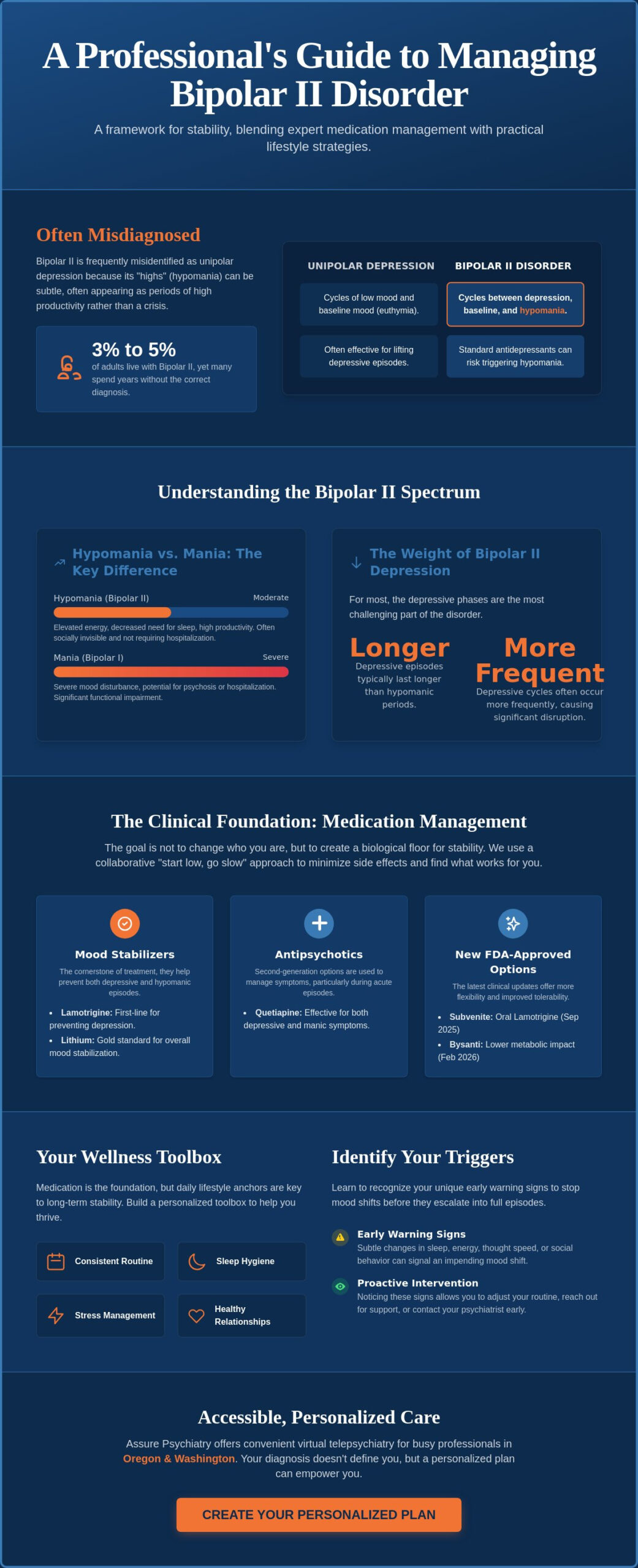
Have you ever felt like you were finally hitting your stride, only to have the ground disappear beneath you a week later? For many, the journey toward managing bipolar 2 disorder begins with years of confusion. Statistics from 2025 indicate that Bipolar II affects approximately 3 to 5 percent of the population, yet it’s frequently misdiagnosed as standard clinical depression. This happens because the “highs” of Bipolar 2 don’t always look like a medical emergency. Instead, they often masquerade as bursts of high energy or sudden spikes in productivity.
Validation is the first step toward healing. It’s common to feel a sense of grief when a period of high functioning suddenly evaporates into a depressive crash. You aren’t “lazy” or “failing” when the energy leaves; you’re experiencing a biological shift. By Understanding Bipolar II Disorder, we can see that these cycles are part of a manageable condition rather than a reflection of your character. A diagnosis is simply a roadmap for treatment; it doesn’t define your worth or your future potential.
Hypomania vs. Mania: Spotting the Difference
The primary feature that distinguishes Bipolar 2 from Bipolar 1 is hypomania. While full mania can lead to hospitalization or psychosis, hypomania is often socially invisible. You might notice a decreased need for sleep, racing thoughts, or an intense drive to complete new projects. Friends might simply think you’re “on your game” or particularly motivated. However, this state is still disruptive because it’s often followed by an equal and opposite reaction in your mood. Identifying these subtle shifts is crucial for managing bipolar 2 disorder effectively before the cycle shifts downward.
The Weight of Bipolar 2 Depression
While the world focuses on the “highs,” those living with Bipolar 2 know that the depressive phases are often the most grueling. These episodes typically last longer and occur more frequently than the hypomanic periods. You might experience a heavy lethargy that makes even small tasks feel impossible, paired with a persistent cognitive fog that clouds your decision making. Modern clinical guidelines from 2026 emphasize that these depressive cycles require specific interventions, as standard antidepressants can sometimes trigger a switch into hypomania. Bipolar 2 exists as a complex spectrum disorder that requires a nuanced psychiatric evaluation to distinguish it from other mood conditions. Because symptoms like racing thoughts, restlessness, and difficulty concentrating can appear in multiple diagnoses, understanding the key differences between bipolar disorder vs ADHD is an important part of arriving at an accurate clinical picture.
The Clinical Foundation: Medication Management for Stability
Stability isn’t found in a single pill bottle; it’s cultivated through a consistent, professional partnership. Many patients fear that psychiatric medication will “change who they are,” but the goal of managing bipolar 2 disorder is actually to help you feel more like yourself. We view medication management as a collaborative journey where your voice is the most important part of the conversation. By working together, we can find the right balance of psychotropic medications that protect you from depressive crashes and hypomanic spikes without muting your personality. For those whose mood symptoms are intertwined with past experiences, working with a trauma informed psychiatrist in Portland can ensure that your full history is honored as part of this collaborative process.
We adhere to a “start low, go slow” philosophy. This approach is designed to minimize the fear of side effects by allowing your body to adjust gradually to new treatments. It’s also vital to ensure your care is culturally competent. Your background, lifestyle, and individual values influence how you respond to treatment, and a “one size fits all” prescription often misses these critical nuances. Medication provides the biological floor upon which you can begin Developing Your Wellness Toolbox for daily life.
Commonly Prescribed Medications for Bipolar 2
Current clinical standards for 2026 emphasize a mix of mood stabilizers and second-generation antipsychotics. For many, Lamotrigine is a first-line choice for preventing depressive episodes; notably, the FDA approved Subvenite, an oral suspension of lamotrigine, on September 17, 2025, offering more flexibility in dosing. Lithium remains a gold standard for mood stabilization, though it requires regular blood level monitoring to ensure safety and precision. Quetiapine and newer options like Bysanti, approved in February 2026, focus on better tolerability with a lower metabolic impact. We prioritize monitoring your metabolic health, such as blood pressure and weight, to ensure your physical wellness keeps pace with your mental health.
The Value of Regular Psychiatric Follow-ups
Brief follow-up appointments are about much more than just a refill. These sessions allow your provider to fine-tune your dosage based on your real-world experiences. Even when you feel stable, “checking in” is vital for long-term safety. It allows us to catch subtle mood shifts before they become full-blown episodes, providing the quiet strength and reliability you need to maintain your routine. If you’re looking for a partner in this process, exploring the benefits of ongoing medication management can be the first step toward lasting peace of mind. Consistency is the key to preventing the “yo-yo” effect often seen in untreated cycles.
Developing Your “Wellness Toolbox” for Daily Management
Think of medication as the biological floor of your stability. While it provides the necessary foundation, lifestyle “anchors” act as the walls that protect your daily peace of mind. We believe that managing bipolar 2 disorder is an empowering process where you aren’t just a passive recipient of care, but an active architect of your own wellness. Many of our patients in Portland and across the Pacific Northwest are high-achieving creatives and professionals who worry that a structured routine might stifle their spark. In reality, a consistent routine protects your creativity by preventing the burnout and cognitive fog that follow a depressive crash.
These tools are designed to give you agency. By identifying what keeps you grounded, you can work more effectively with your psychiatric provider to adjust your care plan in real time. This collaborative approach ensures that your treatment remains as dynamic as your life, providing a sense of order and predictability even when external stressors arise.
Step 1: Mastering Your Sleep-Wake Cycle
Sleep is your barometer. There is a profound biological link between your circadian rhythms and mood regulation; even a minor disruption can trigger a shift toward hypomania or depression. Clinical research updated in 2026 highlights that consistent wake times are more critical for Bipolar 2 stability than total hours slept. You can support your medication’s effectiveness by practicing “dark therapy,” which involves reducing blue light exposure two hours before bed to signal your brain to wind down. Because sleep changes are often the very first sign of an impending episode, mastering this cycle is your most powerful early intervention tool.
Step 2: Mood Tracking and Symptom Awareness
Data-driven care is the shortest path to peace of mind. Whether you prefer a digital app or a simple paper journal, tracking your daily mood, sleep quality, and potential triggers provides invaluable insights for your next medication management visit. Instead of trying to remember how you felt three weeks ago, you can show your PMHNP exactly how your body responded to a specific dosage or a stressful week at work. This level of detail allows for surgical precision in your treatment, ensuring we make adjustments based on facts rather than guesswork. Using these tools doesn’t just track your disorder; it documents your resilience and your journey toward lasting stability.
Navigating Triggers and Early Warning Signs
Triggers aren’t just minor inconveniences; they’re environmental keys that can unlock significant mood shifts. For high-functioning professionals in fast-paced cities like Seattle or Portland, managing bipolar 2 disorder often involves negotiating high-pressure deadlines, frequent travel, and the relentless “always-on” culture. Identifying your “prodromal” symptoms-those subtle, early signals that a shift is beginning-is essential for staying ahead of the curve. It’s the difference between being caught in a storm and seeing the clouds gather in time to find shelter.
A proactive approach means developing a deep awareness of how your environment interacts with your biology. When you know your triggers, you can implement stress reduction techniques before your system becomes overwhelmed. This isn’t about avoiding life; it’s about building a resilient framework that allows you to engage with your career and relationships with total confidence.
Identifying Your Personal Red Flags
How do you tell the difference between a genuinely good day and the start of a hypomanic episode? Healthy happiness is usually responsive to your environment and allows for natural rest. Hypomania, however, feels like a motor that won’t turn off. You might notice you’re talking faster than usual or that your ideas are coming so quickly you can’t write them down. Similarly, normal sadness allows for moments of light, while bipolar depression feels like a physical weight or a heavy, immovable fog that doesn’t lift even when good things happen.
Common triggers to monitor include:
- Excessive caffeine intake, which can mimic or trigger hypomanic jitters.
- High-stress projects that require “crunch time” or missed sleep.
- Travel across time zones that disrupts the circadian rhythms we discussed earlier.
- Interpersonal conflicts that cause lingering emotional distress.
Creating a Collaborative Action Plan
A crisis plan is most effective when it’s written during a period of stability. We encourage you to involve trusted family members or friends in this process. Because they aren’t experiencing the internal shift, they can often spot your red flags before you’re aware of them. Your plan should include clear “if-then” scenarios. For example, if you experience more than 48 hours of significantly reduced sleep, the plan might involve an immediate call to your psychiatric provider for a precision medication adjustment.
For residents in Washington and Oregon, telepsychiatry has become a vital tool for fast-access care. You don’t have to navigate traffic or wait weeks for a traditional office visit when you’re feeling a shift. A virtual check-in allows for a timely psychiatric evaluation and a collaborative decision on the next steps for your medication management. If you’re ready to build a proactive safety net for your mental health, you can schedule a psychiatric evaluation to start your stability journey today.
Personalized Bipolar 2 Care in Portland and Beyond
Finding a partner you can trust is the final piece of the stability puzzle. At Assure Psychiatry, we specialize in managing bipolar 2 disorder for residents across Oregon and Washington. We know that the journey to a correct diagnosis can be long and exhausting. Our team is here to lend a helping hand, offering a space where you feel seen as an individual rather than just a set of symptoms. By combining high-level clinical expertise with a warm, human-centered approach, we help you achieve the consistency needed to move forward with confidence.
Our commitment to culturally competent care means we respect your unique identity and background. We understand that mental health isn’t one-size-fits-all. Whether you’re navigating the tech industry in Seattle or a creative career in Portland, your care plan will reflect your specific reality. This partnership is built on empowerment; we invite you to be an active participant in every decision regarding your treatment plan. This collaborative spirit ensures that your treatment aligns with your personal goals and lifestyle.
Telepsychiatry: Expert Care from the Comfort of Home
Modern mental healthcare shouldn’t be a source of extra stress. Our virtual telepsychiatry services ensure that busy professionals can access top-tier medication management without the need for a long commute. These sessions maintain the exact same clinical standard as a traditional office visit, providing a safe and private environment for your psychiatric evaluation. This accessibility is particularly vital for patients in rural Oregon or those with demanding schedules in Washington who need reliable, consistent follow-ups to maintain their peace of mind. If you’re ready to take the next step, you can Schedule your initial psychiatric evaluation with Assure Psychiatry today.
Why a Specialized Bipolar 2 Evaluation Matters
Precision is everything when it comes to mood disorders. Because Bipolar 2 is so frequently mistaken for standard depression, a specialized evaluation is necessary to untangle the nuances of your history. Our PMHNP-BC providers focus on diagnostic accuracy from the very first meeting, looking past the surface to understand your unique cycles. We also believe in the power of collaboration. While we focus on medication management, we’re happy to coordinate with your existing therapist to ensure your treatment is cohesive and comprehensive. This integrated approach allows us to provide a stable environment where you can find lasting peace of mind. We’re here to support you every step of the way on your path to wellness.
Embracing a Future of Balance and Reliability
You’ve explored how managing bipolar 2 disorder is a journey that combines clinical precision with personal empowerment. From understanding the subtle shifts of hypomania to mastering your circadian rhythms, every tool we’ve discussed is designed to return the control of your life to your hands. With the economic cost of bipolar disorder reaching 219.1 billion dollars annually in the U.S. as of October 2024, finding an expert partner is a vital investment in your long-term stability.
We specialize in medication management for complex conditions, offering culturally competent care that respects your unique identity. Our telehealth services across Oregon and Washington ensure that professional support is accessible from the comfort of your own home. You don’t have to navigate these cycles alone. We are here to provide the quiet strength and clinical expertise you need to thrive in your career and relationships.
Let us help you find stability-Schedule your psychiatric evaluation at Assure Psychiatry today.
Peace of mind allows for positive mental health, and we’re ready to lend a helping hand every step of the way.
Frequently Asked Questions
Is Bipolar 2 less serious than Bipolar 1?
Bipolar 2 is not a “milder” version of the disorder; it is a different clinical presentation with its own severe challenges. While it lacks the full-blown mania seen in Bipolar 1, individuals with Bipolar 2 often spend significantly more time in debilitating depressive states. These long-lasting depressive episodes can be just as disruptive to your career and personal life, requiring a dedicated and professional approach to treatment.
Can I manage Bipolar 2 disorder without medication?
Clinical guidelines consistently prioritize medication as the essential biological foundation for stability. While the lifestyle “anchors” we discussed are vital, managing bipolar 2 disorder effectively usually requires mood stabilizers or second-generation antipsychotics to prevent the brain’s chemistry from spiraling. Relying solely on lifestyle changes often leads to more frequent relapses and an increased risk of severe depressive crashes over time.
How long does it take for Bipolar 2 medications to start working?
Most psychotropic medications used for mood stabilization take between two and six weeks to reach their full therapeutic effect. You might notice improvements in sleep or energy levels within the first few days, but the stabilization of your overall mood takes more time. We monitor your progress closely during this period to ensure the dosage is precise and side effects remain minimal.
What is the difference between hypomania and just being in a good mood?
Hypomania is a clinical state that feels like an internal motor is running too fast, while a good mood is typically a balanced response to positive life events. Hypomania persists even when things go wrong and is often marked by a decreased need for sleep and racing thoughts. Crucially, a hypomanic episode is almost always followed by a period of intense depression, which does not happen with normal happiness.
Does Assure Psychiatry accept insurance for Bipolar 2 treatment in Oregon?
We partner with various insurance providers to ensure our culturally competent care is accessible to as many individuals as possible. Because health plan requirements can be complex, we recommend reaching out to our team to verify your specific coverage for psychiatric evaluations and medication management. We aim to lower the barrier to care so you can focus entirely on your healing journey.
How often do I need medication management appointments for Bipolar 2?
Appointment frequency depends on your current level of stability, but we usually meet every two to four weeks when starting or adjusting a plan. Once you achieve a state of consistency and peace of mind, we may transition to check-ins every three months. These regular visits are essential for monitoring your physical health and catching subtle mood shifts before they escalate into a crisis.
Can Bipolar 2 be cured, or is it a lifelong condition?
Bipolar 2 is currently managed as a lifelong condition, but it is remarkably treatable with the right partnership. Most people lead highly successful and fulfilling lives by staying consistent with their treatment plans. Stability isn’t about finding a permanent “cure” but about mastering the tools that keep your mood within a healthy, manageable range every day.
What happens during a first psychiatric evaluation for Bipolar 2?
Your initial 60-minute evaluation is a thorough and empathetic deep dive into your mental health history and personal goals. We will discuss your past experiences with mood shifts, family history, and any medications you have tried previously. This collaborative session is designed to ensure an accurate diagnosis, which is the first step toward a treatment plan that truly respects your individual identity. If you’ve previously been evaluated for attention or focus concerns, it may also be helpful to review how bipolar disorder vs ADHD symptoms overlap and differ, as this distinction can meaningfully shape your treatment path.
Recent Comments