

Finding a same-week psychiatrist appointment in Seattle depends on current openings, insurance, and the type of care you need. There is no single wait time for the whole city. At a first visit, expect to discuss what has been troubling you, your health history, and what you hope to get from care. The goal is to understand your needs and consider an appropriate next step, not reduce you to a diagnosis.
It’s understandable to want clarity before booking, especially when symptoms affect daily life. This guide explains what a first psychiatric appointment may cover, which concerns psychiatrists treat, how insurance can shape your options, and what affects the likelihood of finding an appointment this week in Seattle.
You’ll also learn how evaluations and medication management fit into psychiatric care, and what to consider when seeking support soon. Knowing what to expect can make the first step feel more manageable and help you prepare to discuss what matters most.
Key Takeaways
- A first psychiatric appointment is a chance to discuss your concerns, health history, and care goals so the clinician can understand what support may fit.
- Psychiatrists treat a range of concerns, including anxiety, depression, ADHD, PTSD, and other mental health conditions.
- Insurance coverage and in-network status can affect your options; understanding your plan can help you prepare for scheduling.
- Appointment timing depends on current openings and scheduling factors, so learn practical ways to look for care within the week.
- If you face an immediate safety threat or medical emergency, call 911, as instructed by the Federal Communications Commission.
Conditions treated
Psychiatrists assess mental health concerns and consider how symptoms affect daily life, relationships, work, and sleep. Common areas of care include anxiety, depression, ADHD, bipolar disorder, obsessive-compulsive disorder (OCD), post-traumatic stress disorder (PTSD), and insomnia. At a first appointment, the psychiatrist asks what you’re experiencing, when it began, and what support you’re seeking. For example, difficulty concentrating may lead to questions about attention, mood, sleep, and stress rather than an immediate conclusion about ADHD.
Care for mood and anxiety concerns starts with a fuller picture than one symptom or difficult day. The psychiatrist may ask about changes in mood, worries, energy, sleep, and situations that make symptoms better or worse. Sharing a recent example, such as persistent worry disrupting work, can make the conversation more specific. Anxiety Treatment and Bipolar Disorder Treatment address different concerns, so describing mood patterns and their effects can help guide an individualized evaluation.
Depression can affect motivation, concentration, sleep, and interest in usual activities. During an evaluation, describe the changes you’ve noticed, how they affect your routine, and what you’ve already tried. A psychiatrist may consider depression alongside other factors in your history, rather than treating one symptom as the whole picture. Depression Treatment can include discussing care goals and reviewing possible next steps together. If you’re unsure how to explain what has changed, write down one or two examples before your visit.
ADHD diagnosis and treatment involve looking at a pattern of difficulties, not just one recent lapse in focus. Bring examples from work, school, or home, and describe how long these challenges have affected daily tasks. The psychiatrist can use your history and evaluation to understand whether ADHD treatment may be appropriate. You can also ask how symptoms may overlap with anxiety, depression, or sleep difficulties. This context helps shape a plan around your needs, priorities, and daily responsibilities.
Personalized planning connects the evaluation to practical goals. You might want to manage anxious thoughts, improve sleep, or make work tasks easier to complete. Discuss which concern feels most urgent, any previous mental health care, and what progress would look like for you. Follow-up sessions can provide opportunities to review how a plan is working and discuss changes with your psychiatrist. Treatment options may include care for OCD, PTSD, or insomnia, depending on the concerns discussed. If you face an immediate safety threat or medical emergency, call 911, as instructed by the Federal Communications Commission.
Insurance coverage and in-network providers
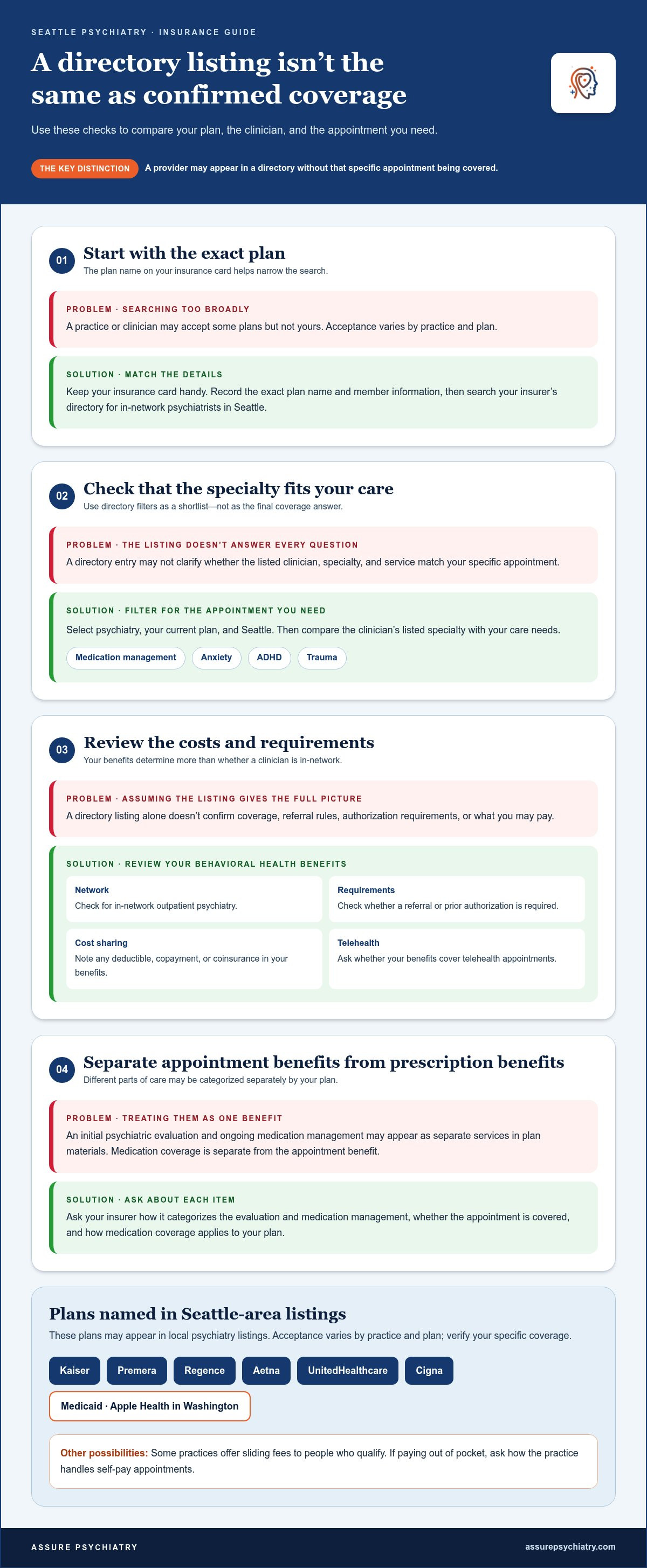
Insurance can affect which psychiatry appointments fit your budget and scheduling needs. Compare your plan’s behavioral health benefits with the care you’re seeking.
Provider Specialty and Insurance Filters
Start with your insurer’s provider directory and select psychiatry, your current plan, and Seattle. Then narrow the results by concerns such as medication management, anxiety, ADHD, or trauma. If you’re seeking medication, look for clinicians whose listed specialty matches that need. Directory filters can help create a shortlist, but they don’t explain every detail of coverage.
Accepted Insurance Plans
Seattle-area psychiatry listings may include plans such as Kaiser, Premera, Regence, Aetna, UnitedHealthcare, and Cigna. Medicaid, also called Apple Health in Washington, is accepted by some practices. Acceptance varies by practice and plan, so a directory listing alone doesn’t confirm that a specific appointment is covered. Keep your insurer’s plan name and member information handy.
Before scheduling, review the mental health section of your insurance benefits. Check for in-network outpatient psychiatry and whether your plan requires a referral or prior authorization. Note any deductible, copayment, or coinsurance listed in your benefits. These terms affect what you may pay, while network status determines whether a clinician participates in your plan. For example, a clinician listed for a different plan may not be in-network for your coverage.
Next, compare the directory entry with the appointment you need. An initial psychiatric evaluation and ongoing medication management may appear as separate services in plan materials. Ask your insurer how it categorizes each service and whether your benefits cover telehealth appointments. If you’re seeking medication for anxiety or another concern, check medication coverage too. The appointment benefit and prescription benefit are separate parts of a plan.
For a practical review, gather your insurance card and follow these steps:
- Record the exact plan name shown on your card.
- Search the insurer directory for in-network psychiatrists in Seattle.
- Compare listed specialties with your care needs and appointment type.
- Review referral, authorization, and cost-sharing terms in your benefits.
Some Washington practices accept Medicaid or Apple Health, Premera, Regence, and other private plans; some offer sliding fees to people who qualify. Eligibility rules vary. If you’re paying out of pocket, ask how the practice handles self-pay appointments before booking. Don’t assume an insurance directory listing explains those terms. Understanding your coverage can make scheduling easier and help you plan for ongoing care.
If your next step involves discussing medication as part of psychiatric care, explore psychiatric medication management as one option for ongoing support.
Seattle psychiatrist listings and appointment availability
Some Seattle-area practices let patients request psychiatric care directly, without a referral. Telepsychiatry is available to patients in Washington, and one provider reports seeing new patients within a week.
Online Calendar Availability
An online calendar may show whether a clinician has openings for a particular appointment type. If a clinician’s name or availability doesn’t appear, the practice indicates that the clinician has no current openings and the practice is full. Try filtering by appointment type and telehealth or in-person format. Then review the dates and times that fit your schedule.
Seattle had about 372 licensed psychiatrists as of September 2026, but a directory listing doesn’t mean each clinician is accepting new patients. Listings can help you identify clinicians, specialties, and appointment formats; a booking calendar gives a more direct view of open times. Search by Seattle location and the care you need, then compare the calendar with your own scheduling constraints.
New-Patient Appointments
New-patient openings may differ from follow-up slots because an initial visit includes a psychiatric evaluation. One provider reports seeing new patients within a week. As you search, distinguish calendar options for new patients from those for returning patients. If you’re seeking care for anxiety, depression, or another concern, note whether the listing describes the clinician’s relevant focus.
Start with your essential criteria: Seattle access, in-person or remote visits, and the concerns you want to discuss. Then open each matching calendar and look for a new-patient appointment. If no suitable time appears, broaden the days you can attend or consider telehealth. Keep a short note of the clinician, appointment type, and opening so you can compare options without repeating your search.
Same-Week Appointments
A same-week opening depends on the appointments currently listed, the visit type, and whether you can attend at the available time. Check the calendar for the coming days and include telehealth if it works for you. Openings vary between clinicians, so searching by specialty alone may miss someone with a timely appointment and relevant experience.
For a same-week psychiatrist appointment in Seattle, look specifically for new-patient slots rather than general calendar availability. A provider serving Washington may offer telepsychiatry, while another listing may show in-person appointments. Compare the earliest available date with your needs and schedule. If your thoughts or symptoms are becoming harder to manage, note the changes you want to discuss during the visit.
Before booking, prepare a brief summary of your main concern, when it began, and how it affects daily life. For example, mention whether anxiety disrupts your sleep or depression makes routine tasks difficult. This can help you make the most of an initial appointment, online or in person. Appointment access and the type of visit shown on a calendar are separate details, so review both before choosing a time.
Average time to see a provider
There isn’t one average wait time that describes every Seattle psychiatry appointment. Seattle had about 372 licensed psychiatrists as of September 2026, but that count doesn’t show how many accept new patients or have open appointments. A clinician’s schedule, the visit type, insurance, and your availability all affect how soon you can be seen. One provider reports seeing new patients within a week, illustrating that prompt appointments can be available.
First, distinguish an initial evaluation from follow-up care. A first visit gives the psychiatrist time to understand your symptoms, history, and treatment goals. Follow-up appointments may focus on medication management and how you’re responding to care. For example, someone seeking an initial evaluation for bipolar symptoms may need a different appointment type from a returning patient discussing an existing medication plan.
Your scheduling flexibility can affect which options you find. Search across the days you can attend instead of focusing on one preferred time. If telehealth works for you, include virtual visits alongside in-person appointments. Patients available at different times of day may see more calendar options than those limited to one time. Keep your preferred format and availability clear as you compare openings.
Insurance and appointment type can also affect your search. A psychiatrist who accepts your plan may have a different schedule from a clinician outside its network. Look for new-patient appointments, not just general availability, and filter for the psychiatric care you need. If medication management is your priority, make sure the appointment suits that purpose. A broad search across mental health concerns may return different results from a search focused on bipolar care.
To make the time before your visit more useful, prepare a short note before booking. Include when symptoms began, what has changed, and how the situation affects sleep, work, or relationships. Add current medications and questions you want to raise. For example, note whether a recent mood change followed a medication adjustment. These details can help organize your thoughts for the first conversation without requiring you to recall everything under pressure.
For a same-week appointment, compare current openings with your schedule, visit type, and insurance. If the earliest slot doesn’t work, adjust one search factor at a time, such as considering telehealth or another available day. The right timing is the first appointment you can attend that also matches the care you’re seeking. A clear plan can make the next step in your mental health journey easier to manage.
Same-week psychiatry scheduling
Finding psychiatric care within the same week starts with a focused search and flexible scheduling. Check new-patient openings first, then consider telehealth and in-person appointments serving Washington. One Seattle-area provider reports seeing new patients within a week, showing that a short wait may be possible. Compare current appointment types with your needs and availability to decide on your next step.
Start by identifying the type of appointment you need. An initial psychiatric evaluation gives a provider time to understand your symptoms, health history, and goals. It also helps the clinician assess what care may fit before discussing treatment options. If you want a same-week psychiatrist appointment in Seattle, search for openings specifically marked for new patients. A follow-up slot may not provide the time or format needed for a first evaluation.
Next, broaden the times you can attend. Search across the days you’re available and include telehealth if it suits your situation. Telepsychiatry appointments are offered to patients in Washington, so virtual care is another option to consider. For example, if no in-person opening fits your work schedule, a remote appointment may be a practical alternative. Keep your location and preferred visit format in mind as you review options.
Prepare a brief summary before your visit so you can focus the conversation on what matters. Note when symptoms began, how they affect daily activities, and any current medications. Include the main question you hope to address, such as whether anxiety is disrupting sleep or mood changes are affecting work. These details help the provider understand your circumstances without requiring you to organize every thought during the appointment.
A psychiatric evaluation supports assessment; a diagnosis isn’t based solely on booking a prompt appointment. Psychiatric providers may prescribe medication when clinically appropriate after a comprehensive evaluation. Prescription arrangements also matter if medication management is part of your care: for U.S. residents receiving medication management, prescriptions are sent to Washington State pharmacies. Sending prescriptions to pharmacies in other U.S. states is handled case by case.
Choose the earliest appointment that fits your care needs, schedule, and visit format. A passionate clinician should listen carefully, explain the evaluation process, and discuss next steps in clear language. If you’re ready to move from searching to a clinical conversation, explore next steps for psychiatric care.
Assure Psychiatry: Medication Management
Assure Psychiatry offers psychiatric evaluations and medication management for people seeking support with mental health concerns. An evaluation helps clarify symptoms and care goals, while medication management provides an opportunity to discuss treatment and follow-up needs. The practice also offers ADHD Treatment and Anxiety Treatment for concerns that may prompt someone to seek psychiatric care. If you’re looking for ongoing medication-related care, these services may be a relevant next step. Contact Assure Psychiatry to discuss a psychiatric evaluation or medication management.
Take the Next Step Toward Steadier Support
Finding a same-week psychiatrist appointment in Seattle can be the beginning of a more manageable path forward. Before your visit, consider what you most want help with, what has felt difficult lately, and what you hope might change. You don’t need perfect words or a complete explanation. A few honest notes can help start a useful conversation.
Assure Psychiatry offers Psychiatric Evaluation, Medication Management, and ADHD Treatment. These services support people seeking an assessment or help addressing ADHD-related concerns and medication needs. Care is collaborative and shaped around the concerns you bring and the goals you want to work toward.
If you’re ready to explore whether this care fits your needs, contact Assure Psychiatry to discuss appointments. Taking one step is enough to begin. You deserve to be heard, and support can help you move toward greater mental tranquility.
Frequently Asked Questions
What Happens at My First Psychiatric Appointment?
Your first psychiatric appointment is a clinical conversation and evaluation, not a test you need to pass. The psychiatrist asks what prompted your visit, about your symptoms, health and medication history, and what you’d like help changing. You can correct assumptions and ask how recommendations relate to daily concerns. For example, if focus problems happen mainly after poor sleep, mention that context. The clinician uses your perspective to discuss possible next steps.
What if I do not see The therapist or Psychiatrist I am looking for on the online calendar?
If a clinician’s name or availability isn’t shown on an online calendar, the practice indicates that the clinician has no current openings and the practice is full. A missing listing doesn’t mean you’ve overlooked a bookable time. Review the visible clinicians and appointment options, and consider whether a different visit format or schedule works. Also distinguish your care needs: psychiatrists provide psychiatric evaluations and medication care, while therapists provide therapy.
DO YOU HAVE LOW-FEE OR SLIDING SCALE OPTIONS?
Assure Psychiatry offers discounted cash rates for uninsured patients, rather than sliding-scale fees. The practice provides care tailored to patients seeking a same-week psychiatrist appointment Seattle residents can rely on. If you’re comparing affordability, distinguish a discounted self-pay rate from an income-based sliding fee. These are different payment arrangements, and understanding the difference can help you plan for care.
How can I find a Seattle Psychiatrist who takes my insurance?
Search your insurer’s directory using your exact plan name and psychiatry as the specialty, then compare the results with Seattle listings. Plans named by some Seattle-area practices include Kaiser, Premera, Regence, Aetna, UnitedHealthcare, and Cigna; some also accept Medicaid or Apple Health. Before booking, ask your insurer whether the psychiatrist is in-network under your specific plan and how it processes an initial evaluation.
What is the cost of a psychiatric appointment in Seattle without insurance?
Self-pay costs vary by appointment and are provided after a quote request. Factors include whether you need an initial psychiatric evaluation or a follow-up, the visit’s scope, and whether ongoing care includes medication management. Ask for the self-pay quote and what the appointment covers before booking. This gives you a clearer basis for planning than relying on a fee for a different type of visit.
How can I find and book a same-week psychiatrist appointment in Seattle?
To find a same-week psychiatrist appointment in Seattle, search for new-patient openings and include telehealth if it suits your needs. Compare the appointment type, clinician’s focus, and times you can attend. Once you find a suitable slot, follow the calendar’s booking steps and have your insurance details ready. If the available times conflict with work or caregiving, broaden the days or visit formats you can consider.
What information should I prepare for a first psychiatric appointment?
Bring your insurance card, a current medication list, and relevant records from previous mental health care, if available. Include medication names, doses, and any concerns you’ve noticed, such as unusual tiredness after a change. It may also help to note the name of your primary care clinician or other members of your healthcare team. These details give the psychiatrist useful context for the evaluation.
What are the wait times for urgent psychiatric care in Seattle?
Urgent-care waits depend on the type of service and how quickly a person needs assessment; a routine outpatient calendar doesn’t measure emergency access. For an immediate safety threat or medical emergency, call 911, as instructed by the Federal Communications Commission. The 988 Suicide & Crisis Lifeline is available 24/7 across the United States, according to the Substance Abuse and Mental Health Services Administration.
Recent Comments