

Virtual psychiatry can make care easier to access, but an appointment may not be available from every location. In general, the clinician must be authorized to treat patients in the state where you are physically located during the visit. When looking for a Washington state certified telepsychiatry provider, focus on whether the clinician is authorized to practice in Washington, not where you log in from.
It’s understandable to want care that fits around school, work, or family responsibilities, and a video appointment can offer a more convenient way to talk with a psychiatric provider. This guide explains who may access virtual psychiatry in Washington, how location and licensure affect an appointment, and which concerns may be addressed, including anxiety, depression, ADHD, and PTSD.
You will also learn what to expect from a virtual psychiatric evaluation and medication management visit, how telehealth differs from other remote communication, and when virtual care may not be the right fit. Clear information can help adults, teens, and students consider their options and take a confident next step.
Key Takeaways
- Your location during the appointment matters: telepsychiatry clinicians need authorization to treat patients physically located in Washington.
- Learn how virtual psychiatric visits work and what they can include, from evaluation to medication management.
- Explore how care may address anxiety, depression, ADHD, and PTSD, and what to discuss during an evaluation.
- Understand why a practitioner-patient relationship, patient history, and evaluation matter, even when care begins remotely.
- See how to tell whether medication management or a psychiatric evaluation may be a useful next step for your needs.
Virtual mental health appointments
Washington telehealth connects patients with care remotely, while telemedicine refers to clinical care using real-time, interactive audio and video. Understanding how appointments work can help you prepare for an evaluation, ongoing care, and practical details that affect access.
Appointment Availability
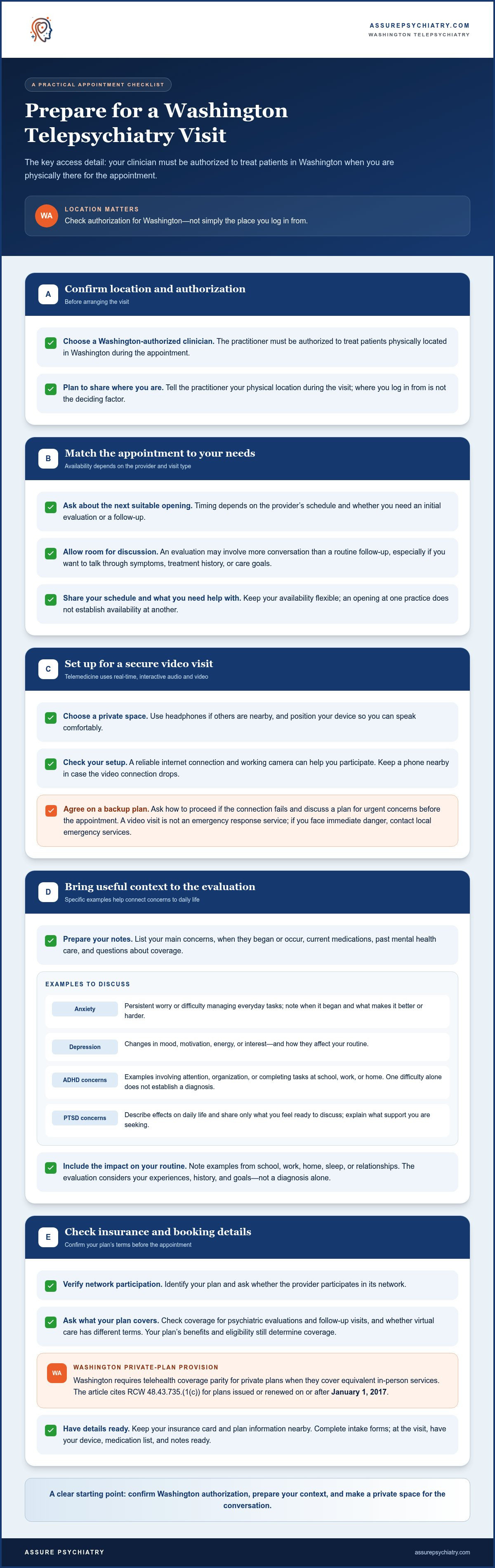
Appointment availability depends on the provider’s schedule, the type of appointment, and whether you need an initial evaluation or a follow-up. Ask about the next suitable opening and whether the format fits your needs. An evaluation may involve more discussion than a routine follow-up, so consider whether you need time to talk about symptoms, treatment history, or care goals. If you have a preferred appointment time, keep your schedule flexible.
Before booking, note your availability and what you would like help with. Sharing this context can help the scheduling team match the appointment to your needs. Availability varies, so an opening at one practice does not establish when another provider can see you.
Secure Video Visits
Washington telemedicine uses real-time, interactive audio and video for clinical care. Choose a private room, use headphones if others are nearby, and position your device so you can speak comfortably. A reliable internet connection and working camera can help you take part in the conversation. Keep a phone nearby in case the video connection drops.
Ask how the visit will proceed if the connection fails, and agree on a plan for urgent concerns before the appointment. A video visit is not an emergency response service. If you face immediate danger, contact local emergency services. Providers protect privacy through their clinical practices, and choosing a private setting helps reduce the chance of being overheard.
Insurance Acceptance
To find a Washington-authorized telepsychiatry provider who accepts your insurance, identify your plan and confirm whether the provider participates in its network. Ask whether psychiatric evaluations and follow-up visits are covered, and whether your plan applies different terms to virtual care. Washington requires telehealth coverage parity for private plans when they cover equivalent in-person services, but your plan’s benefits and eligibility still determine coverage.
Washington State Legislature states that Washington law provides a private health-plan telehealth reimbursement provision under RCW 48.43.735.(1(c)) for plans issued or renewed on or after January 1, 2017. Keep your insurance card and plan details nearby when arranging care, so you can discuss coverage before the appointment.
Booking an Appointment
First, choose a provider authorized to treat patients located in Washington, then request an appointment and share basic scheduling and insurance details. Complete any intake forms and prepare a list of symptoms, medications, past care, and questions. This information helps the practitioner understand your history and guide the psychiatric evaluation.
At the appointment time, join from a private space with your device, medication list, and notes ready. Tell the practitioner where you are physically located and what you hope to address. A clear opening conversation gives you both a shared starting point for care.
Conditions treated, including anxiety, depression, ADHD, and PTSD
Telepsychiatry can help Washington residents discuss a range of mental health concerns with a psychiatric practitioner. Anxiety, depression, ADHD, and PTSD can affect concentration, sleep, relationships, school, or work in different ways. An evaluation considers these experiences alongside your history and goals, rather than reducing care to a diagnosis alone.
Anxiety and depression
Anxiety can involve persistent worry or difficulty managing everyday tasks. Depression may affect mood, motivation, energy, or interest in activities. During an evaluation, describe when changes began, how they affect your routine, and what makes them better or harder. For example, a student might explain how worry disrupts studying, while an adult may discuss changes at work or in sleep.
Specific examples help a practitioner understand your concerns and consider an appropriate care plan. Anxiety and depression treatment may include psychiatric care, with follow-up focused on changes in symptoms and daily functioning. Mental health care is collaborative: share what matters most to you and ask how each proposed step relates to your goals.
ADHD and PTSD
ADHD concerns can involve attention, organization, or completing tasks at school, work, or home. Bring specific examples, such as losing track of assignments or struggling to plan a workday, along with relevant treatment history. A practitioner considers this context during an assessment. One difficulty on its own does not establish a diagnosis.
PTSD-related concerns may be connected to a distressing experience and changes in daily life. If you are discussing trauma, describe only the effects you feel ready to share and explain what support you are seeking. The conversation should respect your comfort and priorities. Treatment planning depends on the evaluation and your individual needs.
What an evaluation can clarify
A psychiatric evaluation can help organize next steps. Before your appointment, write down your main concerns, when they occur, current medications, past mental health care, and questions about coverage. For example, note whether concentration problems happen at school and home, or whether low mood affects work and relationships. These details give the practitioner a fuller picture than a symptom label alone.
After discussing your history and goals, you can talk through possible care options and follow-up. Psychiatric services may include evaluation and medication management; they are distinct from long-term therapy. If anxiety or depression is affecting your routine, explore how a psychiatric evaluation can help clarify your care needs.
Washington physician licensure for telemedicine
A clinician’s authority to treat you depends on where you are physically located during the appointment. Consider Washington authorization, professional scope, telemedicine experience, and whether the practitioner’s approach fits your needs, such as an evaluation for anxiety.
Physician Licensing
For telemedicine, your location matters, not the location of the practitioner’s office. A provider licensed in another state generally cannot treat you while you are physically in Washington without Washington authorization. Washington telemedicine practitioners must establish a practitioner-patient relationship, take an appropriate history, and evaluate you before providing care, including prescribing.
Beginning January 1, 2021, Washington health care professionals who offer telemedicine services must complete telemedicine training, except allopathic and osteopathic physicians, according to Washington State Legislature. Washington’s Engrossed Substitute Senate Bill 5481 was passed in the 2024 legislative session and established uniform telehealth standards across regulated professions, according to Washington State Legislature.
These requirements clarify what to compare: the practitioner’s Washington authorization, professional scope, evaluation process, and follow-up plan. Washington telemedicine practitioners are held to the same standard of care as in-person practitioners. A video appointment still requires an appropriate history and clinical assessment before treatment decisions.
Statewide Patient Coverage
Telepsychiatry can serve patients in different Washington communities when the practitioner is authorized to treat people located in the state and the service is within their professional scope. Your physical location during each appointment remains important, including if you travel outside Washington between visits.
Washington defines telehealth to include synchronous or asynchronous telecommunications used for assessment, diagnosis, consultation, treatment, and monitoring. However, email, text messaging, instant messaging, and fax are not considered telehealth unless a statute authorizes their use. A message to a practitioner does not replace a follow-up visit when clinical care requires one.
When comparing providers, consider whether their telemedicine appointments can address your concern, how they arrange follow-up, and whether their approach to care is clear to you. If prescriptions are part of the discussion, Washington law allows licensed psychiatric providers to prescribe through telehealth when clinical and monitoring conditions are met. Evaluation and ongoing monitoring remain part of responsible care.
Washington has joined the Interstate Medical Licensure Compact, which offers an expedited licensing pathway for out-of-state medical professionals seeking state licenses. The pathway does not remove the need for Washington authorization to treat a patient located in Washington. Before booking, identify where you will be during the visit and ask about the practitioner’s license and the appointment format.
Which telepsychiatry providers serve patients throughout Washington state?
Telepsychiatry can reach patients across Washington without requiring a practitioner’s office in every town. The key is whether the practitioner is authorized to treat someone physically located in Washington and whether the service is within their professional scope.
A provider serving patients statewide delivers care remotely, rather than promising a local office in every community. For example, someone in a rural area may attend a video appointment with a practitioner based elsewhere, provided the practitioner is legally authorized to treat Washington patients and the appointment suits the clinical need.
Use these steps to assess whether a provider can serve your location:
- Confirm the practitioner is authorized to practice in Washington.
- Explain where you’ll be physically located during appointments.
- Ask whether your concern can be addressed through the provider’s telehealth format.
- Discuss how clinical follow-up is handled if you travel outside Washington.
Washington’s definition of telehealth includes telecommunications used for assessment, diagnosis, consultation, treatment, and monitoring. This scope matters for telepsychiatry because an appointment may involve an evaluation, treatment planning, or continued monitoring. Statewide reach does not mean every service is appropriate by video; the clinical purpose and the practitioner’s scope still guide care.
The Interstate Medical Licensure Compact provides an expedited licensing pathway for out-of-state medical professionals seeking licenses in Washington. Compact membership can help a physician pursue state licensure, but it does not itself authorize treatment of a Washington patient. What matters for your appointment is the practitioner’s Washington authorization.
Compare more than geographic reach. Consider whether the practitioner’s specialty and appointment type fit your concern, how the evaluation works, and what follow-up may involve. For instance, someone seeking help with anxiety may want to understand how the practitioner assesses symptoms and discusses treatment options. Clear explanations can help you feel prepared to participate in decisions about care.
Telemedicine practitioners in Washington are held to the same standard of care as practitioners providing traditional in-person care. A remote format does not remove the need for an appropriate clinical relationship, history, or evaluation. If your needs call for care beyond the practitioner’s scope or the video format, that is a clinical consideration, not a question of the provider’s mailing address.
Assess a Washington state certified telepsychiatry provider by its authority to practice in Washington, not by whether its office is nearby. Before booking, consider your location during the visit, the service you need, and how the practitioner’s telehealth approach supports ongoing care.
Does Washington require an initial in-person visit before telepsychiatry?
Washington does not require every telepsychiatry patient to have an initial in-person visit. Practitioners must establish a practitioner-patient relationship, take an appropriate history, and evaluate the patient before providing care, including prescriptions. These steps can happen remotely when the clinician can assess the patient appropriately.
The distinction is between an in-person requirement and a clinical evaluation. During a video appointment, a practitioner can discuss symptoms, medical and treatment history, and care goals. For example, someone seeking help with anxiety can describe how symptoms affect daily life and answer follow-up questions during a remote evaluation. The practitioner uses that information to guide care.
Some situations may call for an in-person appointment, depending on the assessment needed. If you are seeking testing, whether an in-person session is necessary is determined during the screening call. Share the reason for testing and any relevant history during screening so the next step reflects the type of assessment involved.
Audio-only care has a distinct rule. Washington extended the required prior in-person or real-time interactive visit interval for audio-only telemedicine from 2 years to 3 years under Senate Bill 5821 (2024). This concerns audio-only telemedicine, not a blanket requirement that every new telepsychiatry patient attend an office first. Video and audio-only appointments shouldn’t be treated as interchangeable when considering this rule.
Before booking, identify the appointment format and prepare a concise history. Include when the concern began, how it affects your routine, current medications, and previous care. If you are asking about prescriptions, Washington practitioners must evaluate patients before prescribing. A list of questions can help you explain what you hope to address and understand the reasoning behind the proposed next steps.
Telemedicine practitioners are held to the same standard of care as in-person practitioners. Remote care still requires an appropriate assessment, not simply a video connection or exchange of messages. Washington does not consider email, texts, instant messages, or fax telehealth unless authorized by statute. A message to a practitioner also does not replace a follow-up visit when clinical care requires one.
If you’re ready to discuss your concerns and history with a psychiatric practitioner, schedule a psychiatric evaluation as a next step toward understanding your care options.
Assure Psychiatry: Medication Management
Assure Psychiatry provides medication management as part of ongoing psychiatric care. A psychiatric evaluation can help clarify concerns and inform next steps, including ADHD or anxiety treatment. Medication decisions take your symptoms, history, and treatment goals into account, so you can participate in conversations about your care.
If you are exploring virtual psychiatry and seeking an evaluation or medication management, Assure Psychiatry can help you consider your next steps. Bring questions about your symptoms, previous care, and goals to the conversation. Visit assurepsychiatry.com to learn more about Assure Psychiatry’s care.
Choose a next step that feels manageable
You do not need to have every answer before your first conversation about seeking support. As you look for a Washington state certified telepsychiatry provider, consider what you want help with, what questions you have, and what would make care more accessible. These reflections can help you begin a focused conversation about your needs.
Assure Psychiatry provides psychiatric evaluations, medication management, and ADHD treatment. These services offer a place to discuss concerns, share relevant treatment history, and explore appropriate next steps with a psychiatric provider. Your experiences matter, and your goals can help shape the conversation.
If you’re ready to explore care, contact Assure Psychiatry today. A thoughtful first step can help you move toward support with greater clarity and confidence.
Frequently Asked Questions
Can I do a Telehealth appointment from anywhere?
No. For a clinical appointment, your physical location matters: the practitioner must be authorized to treat patients in the state where you are located during the visit. If you travel, tell the practitioner which state you will be in before the appointment. For example, a clinician authorized in Washington may not automatically be authorized to treat you while you are visiting another state.
Can You Legally Get Psychiatric Prescriptions Online in Washington?
Yes, psychiatric prescriptions can be issued through telehealth in Washington when the practitioner evaluates you, establishes a diagnosis, monitors your care, and follows applicable regulations. A prescription issued online has the same legal validity as one issued in person. However, not every appointment results in a prescription. The practitioner considers your history, symptoms, clinical needs, and the safety of the proposed treatment.
How are Telehealth sessions conducted?
Clinical telemedicine appointments in Washington use real-time, interactive audio and video. Before joining, find a private place, check your camera and sound, and keep relevant notes or medication information nearby. For example, write down when a symptom started and how it affects your routine. If the connection drops, follow the practitioner’s agreed plan for reconnecting or continuing the visit.
How do I verify a Washington state telepsychiatry provider’s license and credentials?
Ask for the practitioner’s full name, professional credential, and Washington license information, then compare those details with Washington’s licensing records. Check that the profession matches the care being offered, such as psychiatric assessment or medication prescribing. You can also ask who will conduct the appointment and what their role is. These steps help distinguish a licensed clinician from a service platform or scheduler.
What licenses must psychiatrists and psychiatric nurse practitioners hold to practice telehealth in Washington?
Practitioners must be authorized to practice their profession in Washington when treating a patient located there. A psychiatrist practices as a physician, while a psychiatric nurse practitioner practices under nursing credentials and professional scope. Credentials therefore differ by role. Ask for the clinician’s name and credential, then confirm Washington authorization for that profession before arranging care.
What are Washington’s rules for prescribing controlled substances through telepsychiatry?
Washington permits online prescribing of controlled substances, including ADHD medications, when a licensed practitioner evaluates the patient, establishes a diagnosis, monitors care, and follows applicable regulations. A video appointment alone does not establish that prescribing is appropriate. Before making treatment decisions, the practitioner considers your clinical history, symptoms, and ongoing monitoring needs. Bring an accurate medication history to the evaluation and discuss questions about follow-up.
Recent Comments