

You sit down in the chair, your provider asks how your month has been, and despite a week of sleepless nights, the only word that comes out is “fine.” It’s a common frustration. Research on the “Peak-End” rule shows we often over-index the last 48 hours of our experience, leaving the rest of the month a blur. It’s incredibly difficult to distinguish between a temporary medication side effect and a genuine mood shift when you’re living through it. You want to be an active partner in your wellness journey, but the pressure of a short window can make your mind go blank.
This guide will show you how tracking mood for my psychiatrist appointment can bridge the gap between your daily emotions and actionable clinical data. By using tools like a 7-day sprint, you can ensure your next visit leads to more accurate medication adjustments and a treatment plan that truly reflects your needs. We’ll explore how to record your energy and sleep patterns to help your provider validate your progress and guide you toward lasting mental tranquility. You’ll learn to turn subjective feelings into the objective insights your clinician needs to help you feel your best.
Key Takeaways
- Learn why tracking mood for my psychiatrist appointment helps overcome the “recency bias” that often makes us forget how we felt weeks ago.
- Compare the benefits of digital apps and traditional journals to find a method that respects your privacy and fits your daily lifestyle.
- Move beyond simple emotions by recording the “Core Four,” which include mood, sleep, energy, and side effects, to provide a clearer clinical picture.
- Use the 7-day pre-appointment sprint to condense your data into the three most important trends for a more focused consultation.
- Discover how sharing your personal insights helps your provider tailor medication management to your unique path toward mental tranquility.
Why Tracking Your Mood is Essential for Your Psychiatrist Appointment
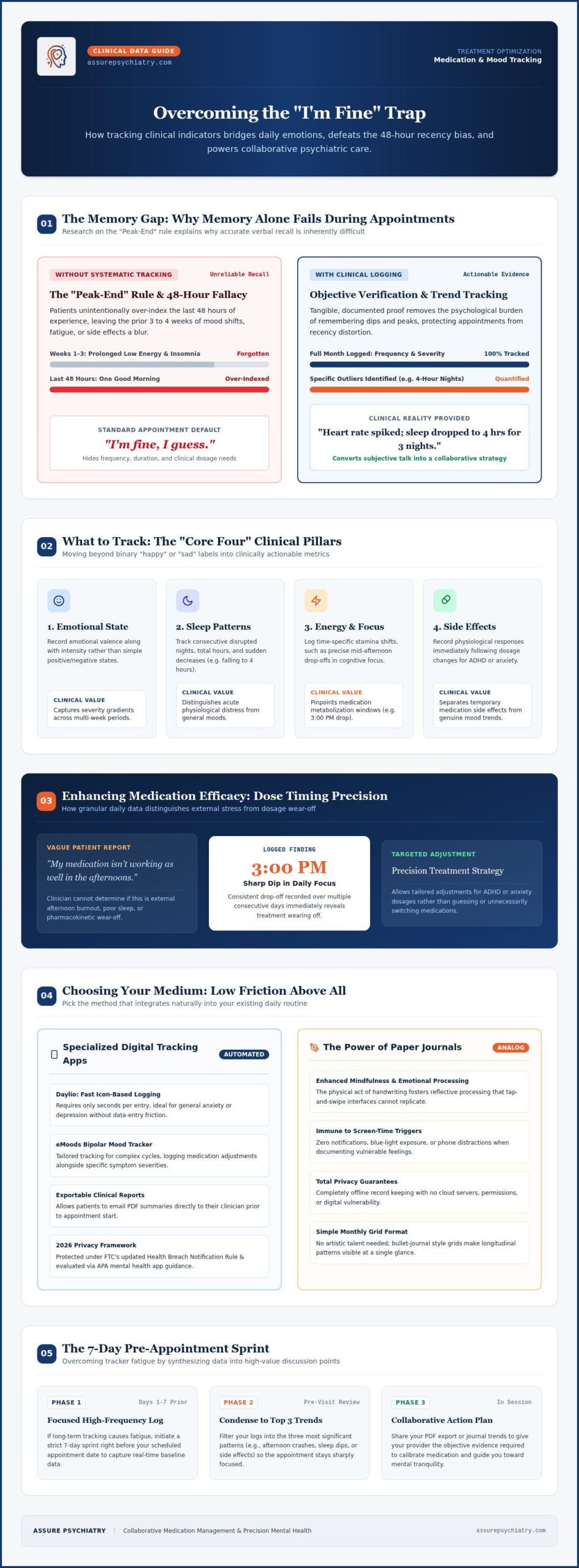
Clinical mood tracking is the consistent recording of your emotional states and physiological symptoms over time. It’s a vital tool for anyone preparing for a follow-up visit. When you’re tracking mood for my psychiatrist appointment, you’re building a dataset that protects you from recency bias. This bias often limits our memory to the most recent 48 hours, which can lead to inaccurate reporting during a short check-in. If you had a good morning today but three weeks of low energy before that, your provider might miss the bigger picture without a log.
Documenting your journey provides a form of validation that memory cannot match. It offers tangible proof for your feelings, helping you feel seen and heard rather than just diagnosed. In our practice, we see how this data supports precise medication management in Portland. It transforms a subjective conversation into a collaborative strategy session where you and your provider work as partners to find the most effective path forward.
Overcoming the ‘I’m Fine’ Trap
Many patients default to saying “I’m fine” because summarizing a month of complex emotions in a few minutes feels overwhelming. It’s a common response to the pressure of a clinical setting. However, “fine” is an inadequate description of your mental health. Data replaces these vague generalities with specific metrics regarding frequency and intensity. Instead of saying you’ve been anxious, you can show that your heart rate increased and your sleep dropped to four hours for three nights. There’s a profound psychological relief in having a written record. You don’t have to carry the burden of remembering every dip and peak; the record does that work for you.
Enhancing Medication Efficacy
Tracking is particularly useful when fine-tuning your treatment plan. If you’ve recently had a dosage change for ADHD or anxiety, a daily log helps identify exactly when a medication might be wearing off. For instance, you might notice a sharp dip in focus at 3:00 PM every day. This level of detail allows for much more accurate adjustments than a general memory of it not working in the afternoon. It also helps you and your provider distinguish between a single bad day caused by external stress and a clinical trend that suggests a need for a different approach. This clarity is a fundamental step toward achieving lasting mental tranquility.
Choosing Your Method: Digital Apps vs. Traditional Mood Journals
Deciding how to log your daily experiences is a deeply personal choice. The most effective tool is the one that feels like a supportive partner rather than a chore. When you’re tracking mood for my psychiatrist appointment, your primary goal is finding a method with the lowest friction. If a complex app feels overwhelming, you likely won’t use it. If a paper journal feels too slow, it might end up forgotten in a drawer. Consistency is the foundation of clinical data, so pick the medium that fits naturally into your existing routine.
The Rise of Specialized Mood Tracking Apps
Digital tools offer unparalleled convenience and sophisticated data visualization. For those managing general anxiety or depression, Daylio uses a quick, icon-based system that takes seconds to update. If you’re managing more complex cycles, eMoods Bipolar Mood Tracker offers specific logs for medication changes and symptom severity. These platforms often include automated reminders, which are essential for overcoming tracker fatigue and ensuring you have a complete record to share with your provider.
Data privacy is a significant consideration in 2026. Following the FTC’s updated Health Breach Notification Rule, users now have better protection against unauthorized data sharing. To help you navigate these options, the American Psychiatric Association’s mental health app guidance offers a clinical framework for evaluating which apps are safe and useful. Look for exportable features. Being able to email a PDF report to your provider before your session allows for a much more efficient review of your progress.
The Power of the Pen: Why Paper Still Works
Despite the convenience of technology, many people find that the act of handwriting fosters deeper emotional processing and mindfulness. Paper journals are immune to screen-time triggers and offer a sense of total privacy. You don’t need to be an artist to maintain an analog log; a simple bullet journal style with a monthly grid works perfectly for most people who want to record their state of mind without digital distractions.
If you prefer the analog route, consider creating a physical health folder for your in-person visits in Portland. This folder acts as a central hub for your daily logs, pharmacy printouts, and notes on medication side effects. This organized approach ensures you feel heard and validated when you sit down with your provider. If you’re looking for a collaborative guide to help interpret these patterns, exploring options for ADHD treatment or medication management can provide the professional perspective needed for mental tranquility.
What to Track: Moving Beyond Just ‘Happy’ or ‘Sad’
Effective tracking requires looking at your health through a wider lens than just raw emotion. While “happy” and “sad” are starting points, they don’t capture the full clinical picture required for a productive visit. When you’re tracking mood for my psychiatrist appointment, you should focus on the “Core Four”: Mood, Sleep, Energy, and Side Effects. By using a 1-10 scale for intensity, you transform vague feelings into objective data. For instance, an “anxiety level 8” provides much more clarity than simply saying you felt nervous.
It’s equally important to record what happened before a mood shift. Triggers like a stressful meeting, high caffeine intake, or hormonal changes can explain sudden fluctuations. However, don’t forget to track your “wins.” Recording moments of resilience or peace ensures a balanced view of your progress. This comprehensive approach, often called mood charting for psychiatric evaluation, helps your provider see the nuances of your daily life.
The Sleep-Mood Connection
Sleep is often the first domino to fall before a mood shift. Tracking both hours and quality is essential for your wellness. If you notice you’re only sleeping four hours but feel highly energetic, it could signal a manic episode. Excessive sleep might indicate worsening depression. Consistent sleep patterns are a cornerstone of effective medication management in Portland, as they help your provider determine if your treatment supports a healthy circadian rhythm.
Identifying Medication Side Effects
One of the biggest challenges in psychiatry is distinguishing between symptoms of a condition and the effects of a medicine. Are you restless because of anxiety, or is it a side effect of a new medication? By tracking the timing of your doses relative to physical sensations like nausea or jitters, you provide the evidence needed to solve this puzzle. This is critical during a psychiatric evaluation in Portland. Even minor issues are worth mentioning; they might be the key to adjusting your plan for better mental tranquility.
Clinical overlap can be confusing. For example, the restlessness of ADHD can look identical to the agitation of anxiety. Tracking specific triggers helps your provider untangle these threads. Does the restlessness happen during quiet tasks or when you’re worried about the future? Having this data makes tracking mood for my psychiatrist appointment an act of self-empowerment. It ensures your diagnosis doesn’t define you, but instead informs a care plan that respects your individual identity.
The 7-Day Pre-Appointment Sprint: Organizing Your Data
Entering your appointment with a thick stack of logs or a month’s worth of digital entries can feel daunting. While capturing daily data is vital, trying to review every single entry during a short follow-up is often counterproductive. This is where the 7-day sprint becomes essential. By focusing your preparation on the week leading up to your visit, you can distill your experiences into a clear narrative. Organizing your findings when tracking mood for my psychiatrist appointment ensures that the most relevant information takes center stage, allowing for a more focused and effective session.
To make your data actionable, apply the “Top 3” Rule. Identify the three most significant trends or challenges you’ve faced since your last visit. Perhaps your anxiety peaks on Sunday evenings, or your energy crashes every afternoon at 2:00 PM. Highlighting these specific patterns prevents the conversation from getting lost in generalities. It also helps you prepare targeted questions for your provider. Instead of asking “Is this working?”, you can ask if a dosage adjustment could address a specific “wearing off” period you’ve documented. This level of preparation empowers you to be an active participant in your treatment plan.
Step 1: Look for the ‘Why’ in the Patterns
Spend a few minutes looking for the story behind the numbers. Are your low moods tied to specific days of the week or times of day? You might notice that your mental state shifts based on your physical health, such as a lack of exercise or changes in your diet. Summarize these observations into one-sentence “trend statements.” For example, you might write: “I notice my focus improves significantly on mornings when I have a high-protein breakfast” or “My irritability increases when I sleep fewer than six hours.” These concise summaries act as a roadmap for your provider, helping them navigate your data quickly and accurately during your visit.
Step 2: Practical Logistics for the Visit
Technical preparation is just as important as emotional preparation when tracking mood for my psychiatrist appointment. If you use a digital tracker, check the “PDF Export” function at least 24 hours before your appointment. This ensures you aren’t fumbling with technology during your session. If you’re utilizing telepsychiatry in Oregon, having these reports ready to screen-share or email can save valuable time. Sync your tracker with your pharmacy refill dates to see if mood shifts correlate with the start of a new bottle. Finally, write down one primary goal for the visit. Whether it’s “reduce morning jitters” or “improve sleep quality,” having a clear objective anchors the session in your desire for mental tranquility.
If you’re looking for a collaborative guide who values your insights, explore our options for telepsychiatry in Oregon to start your journey toward mental tranquility.
Collaborative Care: How Assure Psychiatry Uses Your Data
At Assure Psychiatry, we believe your journey is a partnership. Dr. Olumide Aruwajoye’s philosophy centers on the idea of providers acting as collaborative guides. We aren’t here to simply hand down a diagnosis; we’re here to help you navigate the complexities of your mental health with compassion and expertise. When you’re tracking mood for my psychiatrist appointment, you’re providing the compass for that journey. This data allows us to see beyond the clinical snapshot of a single visit and understand the actual rhythm of your daily life.
We integrate this patient-reported data directly into our ADHD treatment and medication management protocols. It ensures that every adjustment we make is rooted in evidence from your actual lived experience. This commitment to evidence-based care is how we help you achieve mental tranquility. Your logs aren’t just a record of symptoms; they’re a tool for empowerment that ensures your voice remains the most important one in the room. A diagnosis doesn’t define you, but your data helps us refine the support you deserve.
Personalized Treatment Plans in Portland
Using your logs helps us avoid the common pitfalls of over-medicating or under-treating. By seeing the nuances of your energy levels and your specific triggers, we can titrate medications with greater precision. This objective data is also incredibly valuable when navigating insurance hurdles or prior authorizations. It provides a clear clinical justification for why a specific treatment is necessary for your wellness. We use your records to advocate for the care you need.
Our approach is grounded in culturally competent care. We recognize that your unique life triggers are influenced by your identity and environment. By reviewing your patterns together, we can identify how external stressors interact with your internal state. This collaborative review ensures that your treatment plan respects who you are as an individual. It’s about finding a path forward that feels restorative and safe.
Your Path to Mental Tranquility
Taking the first step toward a more organized wellness journey can feel like a significant move. Whether you’re ready to schedule an initial psychiatric evaluation or a follow-up in our Portland office, we’re here to support you. You can reach out to our team to find a time that works for your schedule, whether you prefer an in-person visit or a virtual consultation. We aim to lower the barrier for those seeking help by providing a stable, predictable environment for care.
Remember, we are your ally. Your data helps us help you better, but it’s only one part of the story. It provides the clarity needed to refine your care and move you closer to a state of peace. Your commitment to tracking mood for my psychiatrist appointment is an investment in your own health. We’re honored to walk this path alongside you, providing the consistent and reliable support you need to thrive.
Empowering Your Journey toward Mental Tranquility
Transforming your daily experiences into clinical data is a powerful act of self-advocacy. You’ve learned how to move beyond generic descriptions by tracking the “Core Four” and how to use a 7-day sprint to identify meaningful trends. By organizing your insights, you ensure that tracking mood for my psychiatrist appointment becomes a bridge to more accurate medication management and deeper validation. You don’t have to carry the burden of memory alone; your logs tell the story for you.
At Assure Psychiatry, we view these records as the foundation for a restorative partnership. Led by Dr. Olumide Aruwajoye, our team provides compassionate, culturally competent care that respects your unique identity. We offer both in-person visits in Portland and telehealth options for those in Oregon and Washington. We’re dedicated to being your collaborative guide as you navigate your wellness journey. Our goal is to provide a stable, supportive environment where you can find genuine peace.
You deserve to feel truly seen and heard throughout your treatment. With the right tools and a supportive ally, finding lasting peace is within your reach. We look forward to walking this path with you.
Frequently Asked Questions
What if I forget to track my mood for a few days?
Don’t worry if you miss a few entries; perfection isn’t required for clinical utility. Just pick back up where you left off today. It’s better to leave a gap than to try and “backfill” from memory, which is often influenced by how you feel right now. Your provider is looking for overall trends and cycles rather than a perfect daily record.
Do psychiatrists actually want to see my mood tracking app?
Most modern providers welcome this data because it offers objective evidence that complements your verbal report. It makes your medication management visit much more efficient. Instead of handing over your phone, use the app’s export feature to send a PDF report. This allows your clinician to review your visual trends quickly and include them in your medical record.
How long should I track my mood before my first appointment?
While any amount of data is helpful, a two-week log is ideal for an initial psychiatric evaluation. If you’re short on time, even a 7-day sprint provides a high-density snapshot of your circadian rhythms and daily shifts. This window gives your provider a solid foundation to begin building your personalized treatment plan and identifying your unique life triggers.
Is it better to track my mood in the morning or at night?
Tracking at night is usually most effective because it lets you reflect on the entire day’s events, sleep quality, and medication effects. Some patients prefer a quick check-in at both times to capture “morning dread” versus “evening fatigue.” The best time is simply the one that has the lowest friction for your schedule and ensures you’ll stay consistent.
Can mood tracking help with an ADHD diagnosis?
Absolutely. Tracking mood for my psychiatrist appointment helps differentiate ADHD from anxiety or bipolar disorder. By logging your focus levels, impulsivity, and emotional regulation alongside your mood, you provide the specific patterns needed for an accurate diagnosis. It highlights how your symptoms fluctuate throughout the day, which is essential for tailoring your ADHD treatment plan for mental tranquility.
What should I do if my mood tracker shows I’m getting worse?
If your logs show a consistent downward trend, contact your provider’s office to see if you can move your appointment up. While tracking is a great tool for wellness, it doesn’t replace professional crisis intervention. Your data serves as an early warning system. It helps your provider adjust your medication management plan sooner to prevent a more significant episode from developing.
Are there free mood tracking apps that are HIPAA compliant?
Many free apps like “How We Feel” offer strong privacy, but most consumer apps aren’t strictly HIPAA compliant because they aren’t “covered entities.” Under the FTC’s 2024 Health Breach Notification Rule, these apps must notify you of unauthorized data disclosures. For total privacy, a paper journal or a local-storage-only app is your safest option for keeping your data secure.
How do I explain my mood tracking data to my doctor if I’m nervous?
Focus on your “Top 3” trends instead of every single detail. You can start by saying, “I’ve noticed my energy crashes every afternoon,” or “I’m sleeping better but still feel restless.” Let the data be the bridge for the conversation. Tracking mood for my psychiatrist appointment is a collaborative tool. Your provider is your ally, and they want to validate your experience.
Recent Comments