

What if the medication your doctor prescribed for PTSD isn’t meant to silence you, but to finally let you breathe? That’s a reframe worth sitting with, especially if you’ve spent months white-knuckling through flashbacks, lying awake after another night terror, or scanning every room you walk into out of sheer exhaustion. If that sounds familiar, you’re not alone, and you’re not broken.
Seeking medication management for PTSD in Portland comes with its own frustrations. Long wait times at large health systems, the feeling that you’re just a chart number, the quiet worry that nothing will actually help. Those concerns are valid. And they deserve a real answer.
Here’s the truth: effective PTSD medication management isn’t about numbing your experience. It’s about gently recalibrating your nervous system so it stops treating everyday life like an emergency. When that foundation is in place, healing becomes possible in ways that once felt out of reach. In this article, you’ll learn how psychiatric medication works for PTSD, what a thoughtful evaluation looks like, and how to find a Portland provider who treats you as a whole person, not just a diagnosis.
Key Takeaways
- PTSD isn’t just a psychological wound — it’s a biological one, and understanding how trauma keeps your brain’s alarm system stuck in overdrive is the first step toward finding real relief.
- Specialized medication management for PTSD in Portland goes beyond writing a prescription; it’s an ongoing, collaborative partnership designed to recalibrate your nervous system and restore a sense of safety in daily life.
- FDA-approved medications like SSRIs, SNRIs, and Prazosin each target different aspects of PTSD — from mood dysregulation to the adrenaline-fueled hypervigilance that makes rest feel impossible.
- Medication alone isn’t always the full answer — discover why combining psychiatric medication with therapy is widely considered the gold standard for PTSD recovery, and what that means for your care path.
- Assure Psychiatry offers culturally competent, insurance-accessible psychiatric care in Portland, guided by a provider who sees the whole person behind the diagnosis.
Understanding PTSD and the Role of Medication Management in Portland
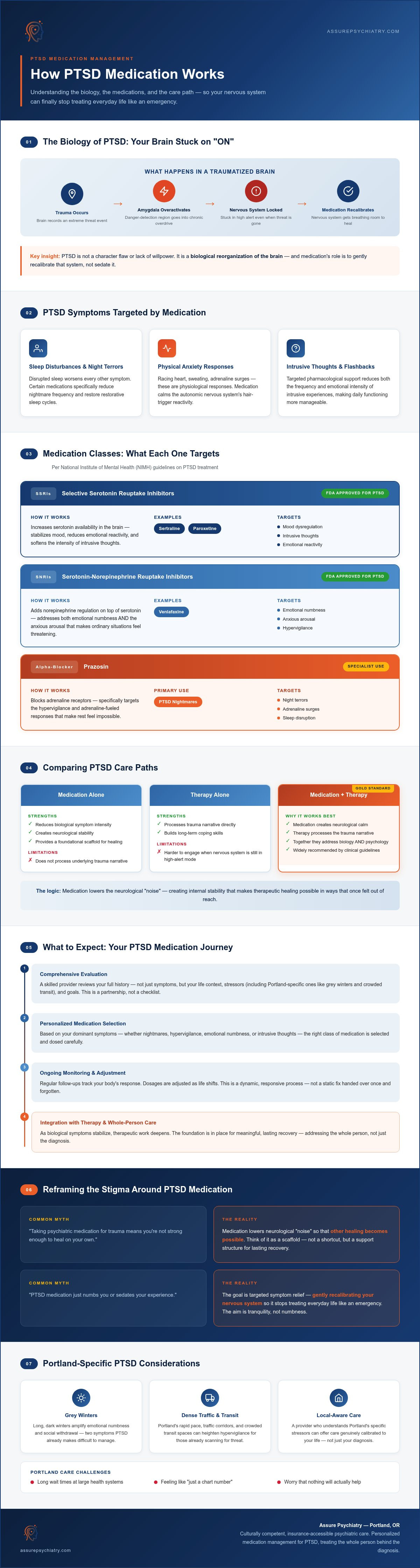
Post-traumatic stress disorder is far more than a psychological response to a difficult event. It’s a biological reorganization of the brain. After trauma, the amygdala, the region responsible for detecting danger, can become chronically overactivated. Your nervous system essentially gets locked into a state of high alert, even when the original threat is long gone. That’s not a character flaw or a sign of weakness. It’s your brain doing exactly what it was designed to do, just stuck in the “on” position when it should have powered down.
This is precisely why medication management for PTSD in Portland isn’t a one-size-fits-all prescription handed over at the end of a rushed appointment. Done well, it’s a personalized, ongoing clinical partnership. A skilled psychiatric provider monitors how your body responds to treatment over time, adjusts dosages when life shifts, and keeps the bigger picture of your well-being in focus. The goal isn’t chemical sedation. It’s targeted symptom relief that gives your nervous system enough breathing room to actually heal.
Portland’s environment adds its own layer of complexity. Long, grey winters can amplify emotional numbness and social withdrawal, two symptoms that PTSD already makes difficult to manage. The city’s rapid pace, dense traffic corridors, and crowded transit spaces can heighten hypervigilance for those who are already scanning for threat. These aren’t trivial details. A provider who understands local stressors can offer care that’s genuinely calibrated to your life, not just your diagnosis.
Why Medication Is a Tool, Not a Crutch
There’s a persistent stigma around taking psychiatric medication for trauma, the quiet worry that needing it means you’re not strong enough to heal on your own. That framing gets it backwards. Medication lowers the neurological “noise” of symptoms like hypervigilance and intrusive thoughts, creating the internal stability that makes other healing possible. Think of it less like a shortcut and more like a scaffold. Thoughtful medication management in Portland supports long-term stability precisely because it’s treated as a dynamic, responsive process, not a static fix.
Common PTSD Symptoms Targeted by Medication
Effective psychiatric care for PTSD addresses symptoms across multiple domains:
- Sleep disturbances and night terrors: Disrupted sleep compounds every other symptom. Certain medications specifically reduce nightmare frequency and help restore restorative sleep cycles.
- Physical anxiety responses: Racing heart, sweating, and sudden surges of adrenaline are physiological, not imagined. Medication can calm the autonomic nervous system’s hair-trigger reactivity.
- Intrusive thoughts and flashbacks: Targeted pharmacological support can reduce both the frequency and emotional intensity of these experiences, making daily functioning genuinely more manageable.
The aim isn’t silence. It’s tranquility, earned through precise, compassionate care.
How Psychiatric Medications Regulate the PTSD Nervous System
Not all PTSD symptoms respond to the same treatment. That’s not a flaw in the system; it’s simply the reality of how trauma reshapes the brain across multiple pathways simultaneously. Understanding which medications target which mechanisms is what separates reactive prescribing from genuinely thoughtful medication management for PTSD in Portland. According to the National Institute of Mental Health guidelines on PTSD treatment, two classes of antidepressants, SSRIs and SNRIs, are the only FDA-approved medications for PTSD, and for good reason.
SSRIs like sertraline and paroxetine work by increasing serotonin availability in the brain, which helps stabilize mood, reduce emotional reactivity, and soften the intensity of intrusive thoughts. SNRIs, such as venlafaxine, add norepinephrine regulation to the equation, addressing both emotional numbness and the anxious arousal that makes ordinary situations feel threatening. These aren’t sedatives. They’re recalibration tools, gradually shifting the brain’s baseline away from chronic threat response and toward something closer to equilibrium.
But mood regulation is only part of the picture. For many people with PTSD, the most debilitating symptoms are physical: the racing heart at 2 a.m., the cold sweat triggered by a car backfiring, the nightmares that make sleep feel dangerous. This is where Alpha-1 blockers like Prazosin enter the conversation. Originally developed to treat hypertension, Prazosin works by blocking the norepinephrine receptors that fuel the body’s adrenaline-driven alarm response. In practice, this means fewer nightmares and a measurable reduction in the physiological intensity of hypervigilance. It’s a mechanism most general practitioners never mention, and it can be genuinely life-changing for the right patient.
When breakthrough symptoms persist despite first-line treatment, mood stabilizers or targeted anti-anxiety agents may be introduced carefully and temporarily. The emphasis is always on precision, not volume.
The Science of Hypervigilance
When the amygdala stays locked in threat-detection mode, the nervous system can’t distinguish between genuine danger and a crowded grocery store. Medication helps interrupt that feedback loop, creating enough neurological calm for the brain to begin relearning safety. This capacity for change is called neuroplasticity, the brain’s ability to form new pathways in response to new experiences, and it’s the biological foundation of lasting trauma recovery.
Managing Side Effects with a Professional Ally
Starting any psychiatric medication follows a principle that experienced providers know well: start low and go slow. Small initial doses allow your body to adjust gradually, and your feedback at every appointment shapes what comes next. If something feels off, that information matters. It’s not a complaint; it’s clinical data. At Assure Psychiatry, patient comfort isn’t an afterthought to a rigid protocol. It’s the protocol. If you’re ready to explore what a collaborative, responsive approach to care looks like, connecting with a psychiatric provider who listens is a meaningful first step.
Comparing Care Paths: Medication, Therapy, and Integrated Support
Here’s a question worth asking honestly: is medication enough on its own, or is therapy enough on its own? For most people living with PTSD, the answer to both is no. The National Institute of Mental Health overview of PTSD consistently points to a combined approach as the most effective framework for recovery. Medication stabilizes the neurological terrain. Therapy reshapes how the brain processes and integrates the traumatic experience. These two paths don’t compete; they complete each other.
What medication does exceptionally well is lower the threshold of emotional flooding. When someone is in acute distress, flashbacks can feel so overwhelming that talking about the underlying trauma becomes re-traumatizing rather than healing. Psychiatric medication reduces that intensity enough that trauma-focused therapy, such as EMDR or CPT, can actually take hold. Think of it this way: medication quiets the alarm long enough for the deeper work to begin.
It’s worth being transparent about what Assure Psychiatry offers and what it doesn’t. Long-term psychotherapy isn’t part of their clinical scope. What they specialize in is precise, responsive medication management for PTSD in Portland, paired with thorough psychiatric evaluations. That clarity of focus isn’t a limitation; it’s a strength. Knowing exactly what kind of specialist you’re working with allows you to build a care team with clear roles rather than a single provider stretched too thin.
When to Prioritize Medication Management
Some symptoms make therapy genuinely inaccessible at first. If you’re not sleeping, can’t concentrate at work, or feel emotionally numb to the point of disconnection, your nervous system isn’t ready to process trauma narratively. Medication creates the physiological stability that makes engagement with therapy possible. When “just talking about it” hasn’t moved the needle, that’s often a signal that the biological dimension of PTSD needs direct attention first.
The Collaborative Care Model in Oregon
Assure Psychiatry functions as the medical specialist within your broader wellness circle. If you already have a therapist or primary care doctor, Dr. Aruwajoye can work alongside them, handling the pharmacological dimension of your care while your other providers focus on what they do best. Nobody duplicates effort. Everyone stays in their lane.
For patients across Oregon, telepsychiatry in Oregon makes this coordination genuinely practical. Medication check-ins, dosage adjustments, and communication with your care team can happen remotely, without disrupting your schedule or requiring long commutes. Starting with a psychiatric evaluation in Portland gives you a clear clinical picture of which path, medication, integrated support, or both, fits where you are right now.
What to Expect During Your PTSD Medication Journey
Starting psychiatric care can feel like stepping into the unknown, especially when you’re already running on empty. Knowing what actually happens, step by step, removes a lot of that uncertainty. Medication management for PTSD in Portland at Assure Psychiatry isn’t a single appointment and a prescription. It’s a structured, evolving process built around you.
The Initial Evaluation: A Safe Space for Your Story
The first appointment is a conversation, not an interrogation. While the science of physiological response is often utilized in forensic or investigative contexts by professionals like Morgan Polygraph, your psychiatric evaluation is focused on using that understanding for healing and support. Dr. Aruwajoye takes time to understand your full picture: your medical history, your trauma history, the current stressors that shape your daily life, and the symptoms that are making things hardest right now. You are not your diagnosis. The goal of this evaluation isn’t to assign a label and move on; it’s to understand who you are well enough to chart a path forward that actually fits your life. That distinction matters.
Follow-up Care: The Key to Long-term Peace
After an initial prescription is in place, the real work of fine-tuning begins. Early check-ins allow your provider to assess how your body is responding, catch any unwanted side effects before they become entrenched problems, and make dosage adjustments based on your lived experience rather than a textbook average. Your feedback at each visit isn’t a formality. It’s the clinical data that drives every decision.
Over time, follow-up appointments shift in focus. The early phase is about tolerability and initial symptom relief. Later visits track deeper progress: Are you sleeping more consistently? Has the emotional flooding between triggers lessened? Are you able to engage with therapy or daily life in ways that felt impossible before? These aren’t abstract questions. They’re the markers of genuine recovery.
Life also changes. A job transition, a relationship shift, a new season of grief can all alter how your nervous system responds to treatment. Ongoing medication management for PTSD in Portland accounts for that reality. Dosages may be adjusted. Medications may be added, swapped, or eventually tapered as stability deepens. Nothing is set in stone, because you aren’t.
- Initial evaluation: Comprehensive diagnostic assessment covering trauma history, medical background, and current life context.
- Collaborative planning: Goal-setting focused on your definition of tranquility, not a generic treatment checklist.
- Early check-ins: Monitoring tolerability, side effects, and first signs of symptom relief.
- Ongoing follow-ups: Tracking functional progress and adjusting the plan as your life evolves.
- Maintenance phase: Sustaining stability while gradually shifting care toward long-term wellness.
If you’re ready to begin that first conversation, schedule a psychiatric evaluation with Assure Psychiatry and take the first step toward a care plan built around you.
Finding Tranquility with Assure Psychiatry in Portland
Behind every effective psychiatric practice is a provider who genuinely believes that healing is possible for every person who walks through the door. At Assure Psychiatry, that provider is Dr. Olumide Aruwajoye, a psychiatrist whose approach to care is built on a straightforward conviction: you are far more than your symptoms. His mission isn’t to manage a diagnosis indefinitely. It’s to walk alongside you as your nervous system finds its way back to something that actually feels like peace.
What sets Assure Psychiatry apart in the Portland psychiatric landscape isn’t just clinical expertise. It’s the deliberate commitment to culturally competent, inclusive care. Trauma doesn’t look the same across every background, every community, or every lived experience. A provider who recognizes that, and who actively works to meet patients where they are, creates a fundamentally different kind of clinical relationship. One where you don’t have to translate yourself before the real conversation can begin.
Compassionate Care in the Heart of Portland
The Portland office offers a stable, welcoming environment for patients who prefer in-person visits, and that consistency matters more than it might seem. For someone living with PTSD, predictability in a care setting isn’t a small thing. It’s part of the foundation that makes trust possible. Assure Psychiatry accepts most major insurance plans, which directly addresses one of the most common barriers to specialized psychiatric care in a market where many providers operate on a cash-only basis. Accessible, insurance-supported medication management for PTSD in Portland shouldn’t be a luxury. Here, it isn’t.
For patients across Oregon and Washington who can’t easily reach a Portland office, telepsychiatry brings the same quality of care directly to wherever you are. Virtual appointments remove the logistical friction that often delays people from seeking help in the first place.
Starting Your Journey Today
Taking the first step doesn’t require certainty. It just requires a willingness to show up. Whether you’re dealing with PTSD, or you’re also navigating anxiety and want to explore anxiety treatment in Portland as part of a broader care plan, Assure Psychiatry is equipped to meet you there.
Scheduling your first appointment is straightforward. You don’t need to have everything figured out before you reach out. That’s what the evaluation is for. Dr. Aruwajoye will help clarify the picture, answer your questions honestly, and build a path forward that reflects your life, not a generic protocol.
Tranquility isn’t a distant outcome reserved for other people. It’s a realistic destination, reached one thoughtful step at a time. Connect with Assure Psychiatry today and begin the conversation that could change everything.
Your Path to Tranquility Starts Here
Living with PTSD doesn’t have to mean living in survival mode. As this article has explored, medication management for PTSD in Portland works best when it’s precise, collaborative, and built around your whole life, not just your symptoms. The right medication can quiet the neurological noise that keeps your nervous system stuck in overdrive. Paired with therapy and ongoing follow-up care, it creates the foundation that real recovery is built on.
You don’t need to have everything figured out before reaching out. You just need to take one step. Assure Psychiatry offers compassionate, culturally competent psychiatric care with both in-person and telehealth options across Oregon and Washington. Most major insurance plans are accepted, which means specialized care doesn’t have to come with an impossible price tag.
Healing isn’t reserved for other people. It’s available to you, and it starts with a single conversation. Schedule your PTSD consultation with Assure Psychiatry and let someone who genuinely listens help you find your way forward.
Frequently Asked Questions About Medication Management for PTSD in Portland
Is medication for PTSD permanent?
No, PTSD medication isn’t automatically a lifelong commitment. Many people use psychiatric medication for a defined period, typically one to two years, while their nervous system stabilizes and they build resilience through therapy or other support. The timeline depends entirely on your individual response, symptom severity, and life circumstances. Some patients taper off medication gradually once they reach sustained stability; others find that longer-term use best supports their quality of life.
That decision is never made unilaterally. At Assure Psychiatry, tapering or discontinuing medication is a collaborative conversation guided by your clinical progress, not a fixed schedule. Nothing about your care plan is set in stone.
How long does it take for PTSD medications to start working?
SSRIs and SNRIs, the first-line medications for PTSD, typically take four to eight weeks to produce noticeable symptom relief. Some patients notice subtle improvements in sleep or emotional reactivity within the first two weeks, while full therapeutic effects often emerge closer to the six to eight week mark. This gradual timeline reflects how these medications work: they recalibrate neurological pathways over time rather than producing immediate sedation.
Prazosin, used specifically for nightmares and hypervigilance, can produce more rapid results for some patients. Your provider will set realistic expectations at your first appointment so you know exactly what to watch for and when.
Can I do medication management for PTSD via telehealth in Oregon?
Yes. Assure Psychiatry offers telepsychiatry across Oregon and Washington, which means medication management for PTSD in Portland and beyond is fully accessible via virtual appointments. Initial evaluations, follow-up check-ins, and dosage adjustments can all happen remotely without requiring you to commute or rearrange your schedule around an in-person visit.
For people whose PTSD symptoms include hypervigilance in public spaces or crowded transit environments, telehealth isn’t just a convenience. It’s often a genuinely more comfortable and accessible care setting. The quality of clinical attention remains the same regardless of format.
Will PTSD medication change my personality?
This is one of the most common concerns patients raise, and it deserves a direct answer: no, well-managed PTSD medication shouldn’t flatten your personality or make you feel like a different person. The goal is to reduce the neurological interference of chronic threat response, not to suppress who you are. Most patients describe feeling more like themselves, not less, once the constant noise of hypervigilance and intrusive thoughts quiets down.
If a medication does produce unwanted emotional blunting or a sense of disconnection, that’s important clinical information. It means the current approach needs adjusting, and your provider will respond accordingly. You’re not expected to simply tolerate side effects that feel wrong.
What if I have other conditions like ADHD or depression alongside PTSD?
Co-occurring conditions are common, not exceptional. PTSD frequently overlaps with depression, anxiety, and ADHD, and each combination requires a thoughtful, sequenced approach to medication. For individuals navigating the intersection of trauma and substance use, specialized evaluations—such as a DUI assessment Wichita KS from Recovery Unlimited Inc—can be an essential step in addressing legal requirements alongside clinical recovery. Assure Psychiatry offers treatment for ADHD, depression, anxiety, and PTSD, which means your provider can see the full picture rather than treating each diagnosis in isolation. Certain medications address more than one condition simultaneously, which can actually simplify rather than complicate your care.
The initial psychiatric evaluation is specifically designed to surface these overlapping patterns. Understanding the full clinical picture from the start leads to a more precise, effective treatment plan than addressing each condition separately over time.
Does Assure Psychiatry accept insurance for PTSD medication management?
Yes. Assure Psychiatry accepts most major insurance plans, which directly addresses one of the most significant barriers to specialized psychiatric care in Portland. Many psychiatrists in the area operate on a cash-only basis, making consistent, high-quality medication management genuinely inaccessible for a large portion of the population. Assure Psychiatry’s insurance accessibility is a deliberate part of their practice model, not an afterthought.
It’s worth confirming your specific plan’s coverage before your first appointment, as accepted plans can vary. Reaching out to the practice directly is the most reliable way to verify your benefits before scheduling.
What is the difference between a psychiatrist and a therapist for PTSD?
A psychiatrist is a medical doctor who specializes in diagnosing mental health conditions and prescribing medication. A therapist, such as a licensed counselor or psychologist, focuses on talk-based treatments like EMDR or cognitive processing therapy. Both play important roles in PTSD recovery, but they serve different functions. Psychiatrists manage the biological dimension of trauma; therapists address the psychological and narrative dimensions.
Assure Psychiatry’s scope is psychiatric evaluation and medication management, not long-term psychotherapy. If you already work with a therapist, Dr. Aruwajoye can coordinate with them directly, handling the pharmacological side of your care while your therapist focuses on the deeper processing work. Clear roles make for stronger outcomes.
Can medication help with PTSD-related nightmares?
Yes, and this is one area where psychiatric medication can produce particularly meaningful relief. Prazosin, an alpha-1 blocker, is specifically used to reduce nightmare frequency and intensity by blocking the norepinephrine receptors that drive the brain’s adrenaline response during sleep. For patients whose nights are dominated by vivid, distressing dreams, this can be genuinely life-changing, because better sleep affects every other symptom during waking hours.
SSRIs and SNRIs may also reduce nightmare frequency as part of their broader effect on emotional reactivity. Your provider will assess which approach fits your specific symptom profile rather than applying a generic protocol.
Recent Comments