

You’ve spent another night watching the clock’s numbers change, feeling the weight of tomorrow’s fatigue before the sun even rises. It’s exhausting to live with the constant anxiety of whether tonight will be the night you finally rest, or another cycle of tossing and turning. You might worry that seeking help means relying on a pill forever, but you deserve more than a temporary fix. Professional medication management for insomnia Seattle offers a path that prioritizes your safety and long term health while addressing the fear of dependency.
I understand that chronic insomnia is rarely just a sleep problem. It’s often a signal of underlying mental disharmony that requires a compassionate, expert partnership to resolve. In this article, you’ll discover how specialized psychiatric care can help you reclaim your nights and your daytime energy. We’ll preview a journey toward a clear diagnosis and a sustainable, long term sleep plan. By focusing on restorative action and personalized care, we can work together to restore your mental tranquility and improve your overall quality of life. You don’t have to face the darkness alone; a clearer path to rest is within reach.
Key Takeaways
- Learn why a specialized psychiatric evaluation is crucial for identifying the complex mental and physical factors driving your chronic insomnia.
- Discover how personalized medication management for insomnia Seattle provides a safe, monitored path toward reclaiming your nights without long-term dependency.
- Find out how telepsychiatry removes the barriers to care, offering a convenient way to meet with your provider from anywhere in Washington.
- Understand the philosophy of using modern sleep treatments as a bridge to restore your natural rhythm and mental tranquility.
- See how a collaborative partnership with a psychiatrist ensures your treatment plan is tailored to your unique identity and lifestyle.
Finding a Psychiatrist for Insomnia in Seattle: When Sleep Becomes a Crisis
Seattle’s unique environment, with its high-stress professional landscape and seasonal light shifts, creates a perfect storm for sleep disruption. Many residents find that the long, grey winters make it particularly difficult to maintain a consistent circadian rhythm. While you might initially turn to a primary care provider for help, their focus is often broad and time-limited. A psychiatrist, however, specializes in the complex intersection of brain chemistry, lifestyle, and emotional health. When you reach the point where melatonin or other over-the-counter aids no longer provide relief, professional intervention becomes necessary. This is where specialized medication management for insomnia Seattle becomes a vital tool in your journey toward recovery.
Gaining a thorough understanding of insomnia involves looking at your whole life, not just your bedtime routine. We examine how your work stress, your personal history, and your environment interact to keep your mind in a state of high alert. It’s about more than just receiving a prescription; it’s about establishing a collaborative partnership with a guide who understands the science of rest. By moving beyond surface-level fixes, we can address the crisis of sleeplessness at its source and help you rediscover the quiet strength that comes with a good night’s rest.
The Emotional Toll of Sleeplessness
The experience of failing to sleep night after night is deeply isolating and physically draining. You’re left alone with your thoughts while the rest of the city rests. This often leads to the “3:00 AM calculation,” where you look at the clock and realize that if you fall asleep this very second, you only have four hours left before your alarm. Then three. Then two. This mental pressure creates a state of hyperarousal that makes sleep nearly impossible to achieve. The frustration is valid and real. You’re trying your best to do something that should be natural, yet it feels like a failing grade every morning. This cycle doesn’t just make you tired; it erodes your mental tranquility and leaves you vulnerable to a persistent loop of anxiety and low moods.
Insomnia as a Symptom vs. a Primary Disorder
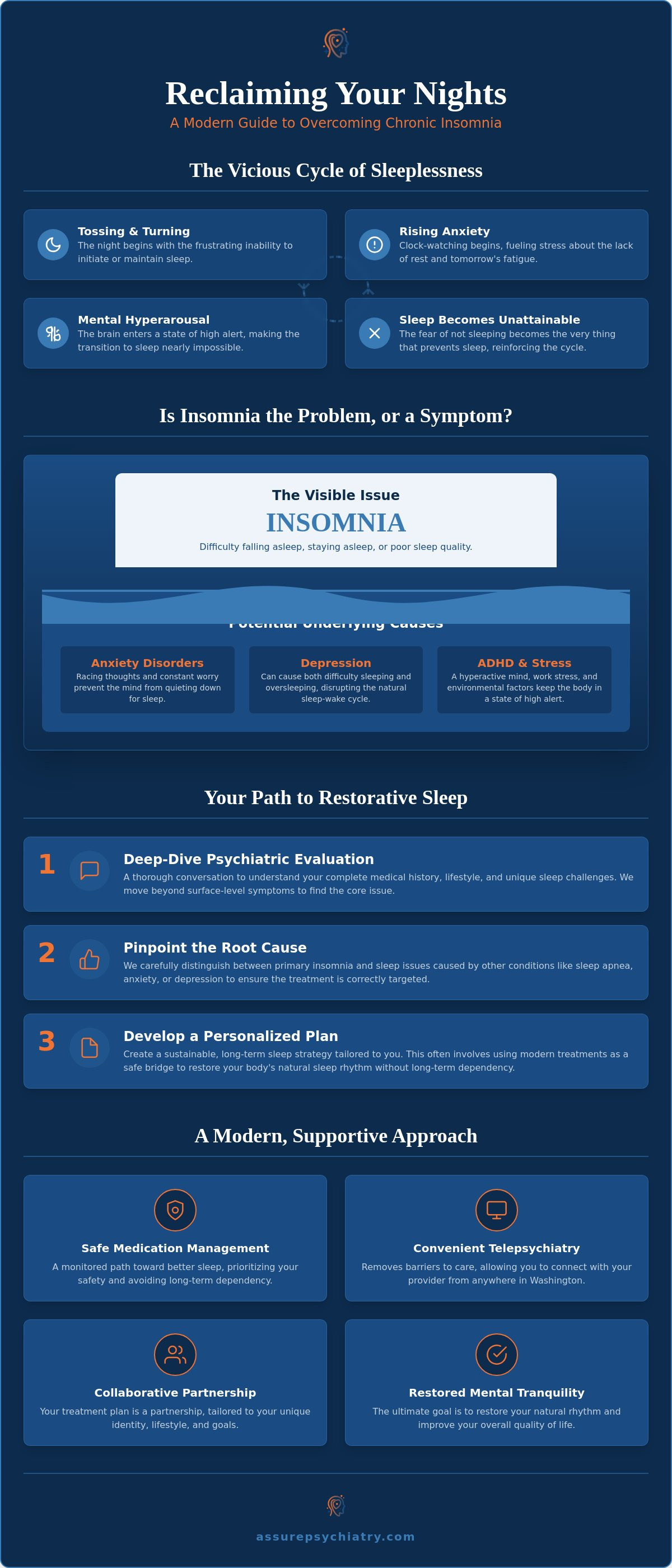
Is your insomnia the core problem, or is it a messenger for something else? In many cases, sleep issues are secondary to other underlying conditions like ADHD, anxiety, or depression. These conditions create neurological loops where the mind simply cannot quiet itself enough to transition into sleep. For instance, the anxiety you feel about not sleeping can actually cause the very insomnia you fear. Identifying these loops early is a cornerstone of effective treatment.
Insomnia Disorder is clinically defined as a persistent difficulty with sleep initiation, duration, or quality that occurs despite adequate opportunity for sleep and results in significant daytime impairment. Distinguishing between a primary disorder and a symptom is the first step toward a sustainable sleep plan. By choosing targeted medication management for insomnia Seattle, we can address these complex loops directly and help you find the lasting peace you’ve been missing.
The Role of a Specialized Psychiatric Evaluation for Sleep
Your journey toward better rest begins with a conversation that values your history as much as your symptoms. During your initial psychiatric evaluation, we move beyond the surface to understand why your sleep has become a source of stress. While it’s tempting to focus solely on the hours spent awake, we look at your full medical and psychiatric history to rule out other physical causes that might mimic insomnia. For instance, we carefully distinguish between primary insomnia and conditions like sleep apnea or restless leg syndrome. These physical ailments require different clinical approaches, and misdiagnosing them can lead to years of frustration. You’re the expert on your own lived experience, and my role is to act as a collaborative guide in interpreting those signals.
By reviewing various insomnia treatment options, we can determine if your sleeplessness is a standalone issue or part of a larger clinical picture. This thoroughness is the foundation of effective medication management for insomnia Seattle, ensuring that any intervention we choose is grounded in a deep understanding of your unique biology. We don’t just want to mask the problem; we want to solve it. This initial step is about validation and safety, ensuring you feel seen and heard before we ever discuss a treatment path.
Uncovering Comorbidities: ADHD, Anxiety, and PTSD
Sleep doesn’t exist in a vacuum. For many, untreated ADHD manifests as a racing brain that refuses to power down at night, making the transition to rest feel like a battle. Similarly, the hypervigilance associated with PTSD can make sleep maintenance nearly impossible, as the body remains on high alert for perceived threats even in a safe environment. In these cases, treating the underlying anxiety or trauma is often the key to unlocking better sleep. We don’t just treat the “insomnia” label; we treat the person living with these complex, overlapping challenges. A specialized approach to medication management for insomnia Seattle means we aren’t just looking for a quick fix, but a sustainable solution that addresses the root cause.
Formulating a Personalized Treatment Plan
Once we have a clear picture, we create a roadmap that respects your individual identity and lifestyle. Our goal is restorative sleep, not just the temporary unconsciousness that some generic aids provide. We want you to wake up feeling refreshed and capable of meeting the demands of your day. This evaluation naturally transitions into ongoing medication management, where we monitor your progress and adjust your plan as your sleep improves. It’s a dynamic process that evolves with you. If you feel ready to explore how a tailored approach can help, reaching out for a professional consultation is the next step toward reclaiming your nights.
Modern Medication Management for Insomnia: Beyond the Prescription
Rest isn’t a luxury; it’s a physiological requirement. When we approach medication management for insomnia Seattle, we view prescriptions as a temporary bridge that helps you cross from a state of hyperarousal back to your natural baseline. The goal isn’t to create a permanent crutch, but to provide the stability your brain needs to relearn how to rest. Many patients worry that starting a medication means they’ll never sleep without it again. In reality, a well-managed plan uses the lowest effective dose for the shortest necessary time, always with the ultimate aim of restoring your independent sleep cycle.
A comprehensive look at pharmacotherapy for insomnia shows that modern medicine has moved far beyond simple sedatives. Today, we utilize sophisticated options like orexin receptor antagonists, which target the chemical signals that keep you awake, or melatonin agonists that help regulate your internal clock. My role is to monitor how these tools interact with your unique biology. We track your progress closely, adjusting dosages and checking for side effects to ensure your safety remains the top priority. This ongoing dialogue is what distinguishes true medication management for insomnia Seattle from a generic, one size fits all prescription.
Addressing the Fear of Dependency
It’s natural to feel hesitant about sleep aids if you’ve heard stories of addiction or “sleepwalking” episodes. Contemporary psychiatry has made significant strides in developing non-habit-forming options that don’t carry the same risks as older generations of sedatives. We focus on medications that support the brain’s natural architecture rather than simply knocking you out. As your sleep stabilizes and your mental tranquility returns, we’ll work together on a gradual tapering plan. This ensures your transition back to natural sleep is smooth, supported, and entirely under your control. You’re never alone in this process; I act as your collaborative guide every step of the way.
Integrating Behavioral Strategies
Medication is most effective when it’s part of a larger, holistic strategy. Your circadian rhythm is sensitive to your environment, and living in an urban center like Seattle presents unique challenges. Between the light pollution of the city and the high-pressure tech culture, your biological clock can easily fall out of sync. We’ll discuss practical ways to create a sleep sanctuary in your home, even amidst the noise of a busy neighborhood. This might include:
- Optimizing your light exposure to match the Pacific Northwest’s seasonal shifts.
- Establishing a wind-down ritual that signals safety to your nervous system.
- Managing caffeine and screen time to protect your brain’s natural melatonin production.
By combining clinical expertise with these behavioral shifts, we create a sustainable path to rest that lasts long after the medication has served its purpose.
Navigating Insomnia Treatment in Seattle: The Telepsychiatry Advantage
When you’re already exhausted from lack of sleep, the last thing you need is the stress of a long commute. Fighting traffic on I-5 or hunting for expensive parking in South Lake Union can turn a helpful appointment into a source of frustration. This is why telepsychiatry in Washington has become such a transformative tool for those seeking help. Virtual visits allow you to access expert care from the comfort and safety of your own home, where you can speak freely in a space where you already feel secure. It’s a more human centered way to approach mental health, prioritizing your comfort over clinical convenience.
Utilizing secure, HIPAA compliant technology, we can conduct a full psychiatric evaluation and handle ongoing medication management for insomnia Seattle without requiring you to leave your living room. This digital approach doesn’t sacrifice the quality of care; instead, it lowers the barrier to entry for those who feel overwhelmed by the logistics of traditional office visits. It’s about meeting you where you are, both emotionally and geographically. By removing these hurdles, we can focus entirely on your restorative journey and the recovery of your natural sleep patterns.
Consistency and Accessibility
Maintaining treatment momentum is easier when care fits into your life rather than disrupting it. Seattle’s fast paced professional environment often leaves little room for mid day appointments that require hours of travel. Virtual follow ups are much more convenient, allowing us to monitor your progress and adjust your plan with minimal disruption to your work schedule. This flexibility ensures that we can maintain the consistency needed for long term success. Our practice is also committed to providing culturally competent care that respects the diverse identities within our Seattle community, ensuring every patient feels seen and validated throughout their experience.
What You Need for Your First Virtual Visit
Preparing for your first session is simple and straightforward. You’ll need a reliable internet connection and a device with a camera and microphone, such as a laptop, tablet, or smartphone. It’s helpful to choose a quiet, private space where you won’t be interrupted, allowing you to focus on our conversation and your own mental tranquility. To verify your insurance coverage for telepsychiatry, you can contact your provider directly or check your benefits portal to confirm that virtual mental health services are included in your plan. If you’re ready to start your journey toward better rest from the comfort of your home, schedule your virtual consultation today.
Restoring Mental Tranquility with Assure Psychiatry
At Assure Psychiatry, we believe that a diagnosis is just one part of your story; it doesn’t define who you are as an individual. Our approach to medication management for insomnia Seattle is built on a foundation of mutual respect and ongoing support. We understand that when you reach out for help, you aren’t just looking for a prescription. You’re looking for a stable environment where you can find rest and a sense of order. By focusing on your unique needs and identity, we move beyond the clinical data to see the person behind the symptoms. This commitment to seeing you as a whole person ensures that your treatment plan is both scientifically grounded and emotionally intelligent.
Achieving better sleep is often the vital first step toward total mental tranquility. When your nights are no longer a source of dread, you gain the emotional capacity to engage fully with your work, your family, and your passions. We promise consistency and reliability throughout your experience, acting as a collaborative guide rather than a paternalistic authority. This partnership empowers you to be an active participant in your own wellness journey, ensuring that every step we take together brings you closer to the peace you deserve. Your health and your peace are inextricably linked, and we are here to support both.
A Compassionate Ally in Your Care
Dr. Olumide Aruwajoye leads our practice with an approach that prioritizes empathy alongside clinical expertise. He understands the complex loops between sleep, anxiety, and other mental health challenges, providing a safe space for you to share your experience without fear of judgment. Our practice values diversity and maintains inclusive care standards, ensuring that every resident of Washington feels seen and heard. Patients often report that the most restorative part of their journey is the validation they feel during our sessions. By blending high level medical knowledge with a lexicon of care, we create a restorative environment where you can feel secure in your path to recovery.
Take the First Step Toward Peace of Mind
The process of seeking mental health support can often feel overwhelming, but we strive to lower that barrier through a warm, human centered process. Scheduling your initial diagnostic assessment is a low pressure way to begin exploring your options for medication management for insomnia Seattle. We accept most major insurance plans for Washington residents, making professional psychiatric care more accessible than ever. Reducing the anxiety of that first appointment is our priority, as we guide you through a predictable and calm consultation. Your journey to restorative sleep begins with a single conversation. Reach out today to discover how we can work together to restore your nights and your mental tranquility.
Reclaiming Your Nights and Your Peace of Mind
The path from restless nights to mental tranquility is a journey you don’t have to walk alone. By recognizing that insomnia is often a signal of deeper disharmony, you can shift from frustration to restorative action. We’ve explored how a specialized evaluation uncovers the root causes of sleeplessness and how modern medication management for insomnia Seattle serves as a safe bridge to long term stability. You now know that expert care is accessible from your own home, removing the stress of the city’s traffic and allowing you to focus entirely on your wellness.
Assure Psychiatry is committed to providing culturally competent and inclusive care for all Washington residents. We accept most major insurance plans to ensure that professional support remains within reach. Every night of rest you reclaim is a victory for your overall quality of life. It’s time to move toward a future where sleep is a source of strength rather than a source of anxiety. Begin your journey to restorative sleep; schedule your psychiatric evaluation today. You deserve to wake up feeling refreshed and ready for the day ahead.
Frequently Asked Questions
Do I need a referral to see a psychiatrist for insomnia in Seattle?
In most cases, you don’t need a formal referral to begin care with a psychiatrist, although you should always check with your specific insurance provider’s requirements first. Assure Psychiatry welcomes patients who are ready to take the first step toward better sleep on their own. We prioritize making the intake process as simple and supportive as possible so you can focus on your recovery rather than navigating complex bureaucratic hurdles or long waitlists.
Will my insurance cover telepsychiatry visits for sleep disorders?
Yes, most major insurance plans in Washington cover virtual mental health visits the same way they cover in-person appointments. Our practice accepts most major insurance providers, ensuring that expert care for sleep disorders remains accessible and affordable for our community. We recommend verifying your specific telehealth benefits through your insurance portal or by contacting your provider directly to confirm your coverage details and any applicable co-pays for virtual care.
What is the difference between a sleep study and a psychiatric evaluation?
A sleep study focuses on physical signals like breathing and heart rate to detect conditions like sleep apnea, while a psychiatric evaluation explores the emotional and neurological factors behind your insomnia. While a sleep study looks at what your body is doing during the night, we look at how your brain chemistry, stress levels, and history are impacting your ability to rest. Both are valuable, but we focus on the mental tranquility needed for sleep.
Can a psychiatrist help if my insomnia is caused by ADHD or anxiety?
Absolutely, as a psychiatrist is uniquely equipped to treat the complex loops where ADHD or anxiety fuel persistent sleeplessness. When your brain is racing due to untreated executive function issues or persistent worry, generic sleep hygiene often isn’t enough to induce rest. We address the underlying mental health condition directly, which often resolves the sleep disturbance by calming the nervous system and restoring your natural biological rhythm over time.
How long does it typically take to see improvements in sleep with medication management?
Many patients experience an improvement in their sleep quality within the first week, although long term stabilization through medication management for insomnia Seattle typically takes several weeks of careful monitoring. Our goal is to find the right balance that supports your rest without leaving you groggy the next day. We adjust your plan based on your feedback to ensure the results are sustainable, safe, and truly restorative for your mind.
Are the sleep medications prescribed by a psychiatrist habit-forming?
While some older sedatives carry risks, many modern sleep medications are non habit forming and designed to support the brain’s natural architecture rather than forcing unconsciousness. We prioritize safety and use the latest clinical guidelines to select options that carry a lower risk of dependency. By acting as your collaborative guide, I ensure that any medication we use is monitored closely to protect your health and your long term well being.
What happens if I want to stop taking sleep medication in the future?
We approach medication as a temporary bridge to stability, and we’ll work together on a personalized tapering plan whenever you feel ready to stop. Professional medication management for insomnia Seattle ensures that you never have to navigate this transition alone or feel unsafe. We monitor your sleep quality during the process to ensure your natural rhythms are strong enough to maintain your mental tranquility without the extra support.
How do I know if my insomnia is chronic enough for a psychiatrist?
If your lack of sleep is affecting your daytime performance, mood, or overall quality of life, it’s chronic enough to seek professional help. You don’t need to reach a point of total crisis before you deserve support. If you’ve tried over the counter aids without success or if your sleep is tied to persistent feelings of anxiety or depression, a psychiatric evaluation can provide the clarity and restorative plan you need to recover.
Recent Comments