

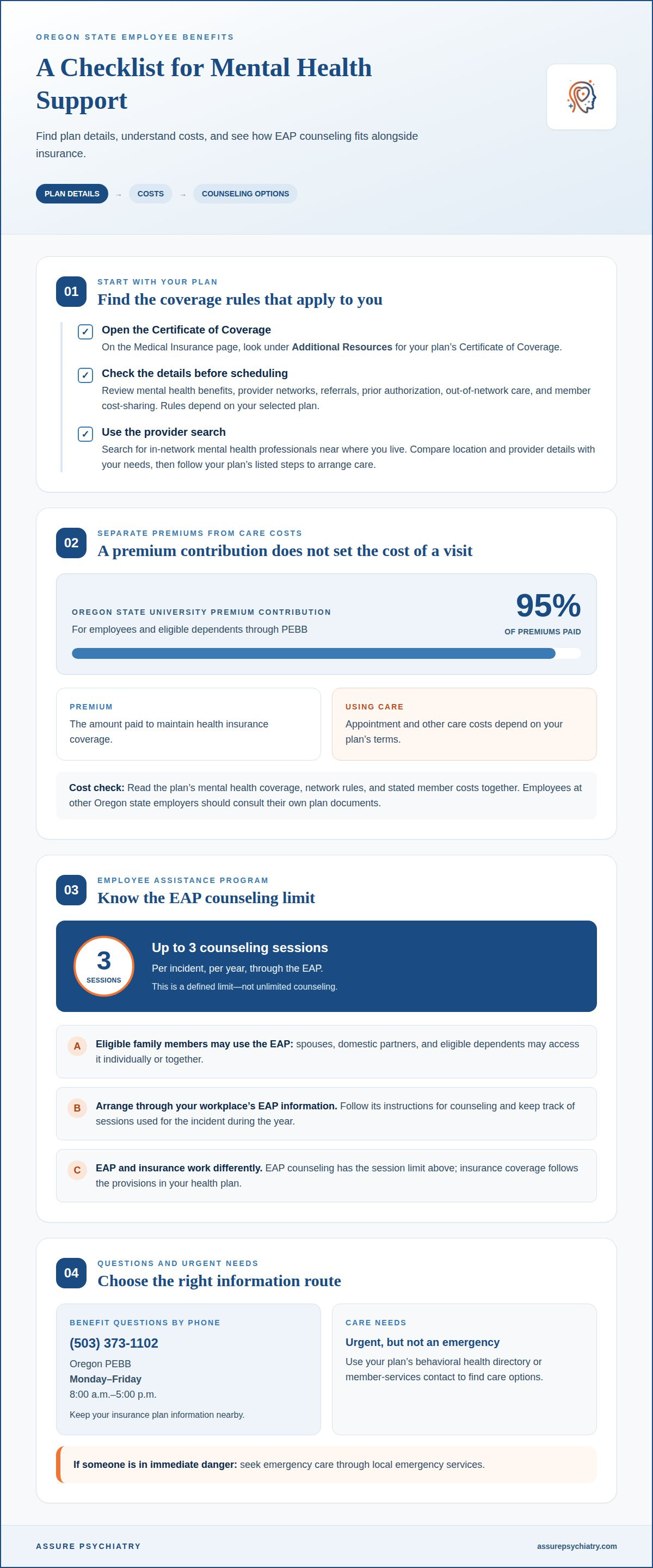
Oregon state employees have more than one route to mental health support. Oregon state employees’ mental health benefits can include counseling through their insurance plan and the Employee Assistance Program (EAP), which provides up to three counseling sessions per incident per year. The State of Oregon benefits package also includes healthcare, retirement plans, and paid time off.
It’s understandable to want clear answers before reaching out: Which services are covered, what might you pay, and how do counseling sessions work? The details depend on your plan and the support you’re seeking. Knowing where to find coverage information can make the next step feel more manageable.
This guide explains how Oregon state employees can access mental health services, find their plan’s coverage details, and understand how EAP counseling fits alongside insurance benefits. It also clarifies how premium contributions work for Oregon State University employees, helping distinguish insurance costs from the cost of using a service. With these basics in view, you can make a more informed choice about the support that feels right for you.
Key Takeaways
- Find plan-specific mental health coverage in your insurance plan’s Certificate of Coverage on the Medical Insurance page under Additional Resources.
- For help by phone, Oregon PEBB is available Monday through Friday, 8:00 a.m. to 5:00 p.m., at (503) 373-1102.
- Oregon State University pays 95% of premiums for employees and eligible dependents, which can help clarify the difference between premiums and care costs.
- Eligible spouses, domestic partners, and dependents may access the Employee Assistance Program individually or together.
Accessing services online or by phone
Oregon state employees can start finding mental health care through their health plan’s provider search and coverage documents. For enrollment or benefit questions, Oregon PEBB provides a phone contact during weekday business hours.
In-Network Provider Search
An in-network provider is a mental health professional included in an insurance plan’s preferred provider network. Use your plan’s provider search to look for mental health professionals in the area where you live. Your insurance plan can help you find a preferred provider nearby. Compare the directory’s location and provider details with your needs, then use the plan’s listed steps to arrange care. This search is a practical starting point for eligible employees looking to understand their options.
Referrals and Prior Authorization
A referral is a recommendation or approval for care, while prior authorization is approval from the plan before certain services. Referral, authorization, and out-of-network rules depend on your selected insurance plan. Review its Certificate of Coverage for the requirements, including how it handles out-of-network care. Certificates are posted on the Medical Insurance page under Additional Resources, giving you a plan-specific reference before scheduling.
For online details, open the Medical Insurance page and find Additional Resources. Read your plan’s Certificate of Coverage, focusing on mental health benefits, provider networks, referrals, authorization, and out-of-network care. These sections clarify which steps apply and where to direct follow-up questions.
For phone assistance, contact the Oregon Public Employees’ Benefit Board (PEBB) at (503) 373-1102. PEBB operates Monday through Friday from 8:00 a.m. to 5:00 p.m. Keep your insurance plan information nearby so you can explain which coverage you’re asking about and note the next step provided.
For urgent but non-emergency concerns, use your plan’s behavioral health directory or member-services contact to find care options. If someone is in immediate danger, seek emergency care through local emergency services. Your plan documents explain how mental health care is handled under your specific benefits.
Costs and premium-free coverage
A premium is the amount paid to maintain health insurance coverage. For Oregon State University employees, Oregon State University pays 95% of premiums for employees and eligible dependents through the Public Employees Benefits Board (PEBB). This contribution lowers the premium burden, but it does not mean every service is free.
Premium contributions and care costs are separate parts of health coverage. A premium keeps the plan active, while costs for appointments or other care depend on the plan’s terms. For example, an employee may have a large share of the premium covered and still need to review how the plan handles mental health visits. The 95% figure describes the premium contribution, not the cost of each counseling appointment or other service.
To understand potential expenses, start with your medical plan’s Certificate of Coverage. Find the mental health section and review its rules for covered services, provider networks, and member cost-sharing. Compare these terms with the care you expect to use. Depending on the plan, an in-network visit may be handled differently from out-of-network care.
Oregon State University employees receive medical, dental, and vision benefits through PEBB. Reviewing the package can help distinguish the employer-paid premium share from costs associated with using care. Employees at other Oregon state employers should consult their own plan documents, since coverage and cost-sharing depend on the specific plan. The Certificate of Coverage is the practical reference for comparison.
Before scheduling mental health care, identify the service you’re considering and check how your plan classifies it. Review the relevant coverage terms, network rules, and stated member costs together. This helps you understand what the premium contribution covers and what expenses may arise when you use benefits.
Counseling sessions
An Employee Assistance Program (EAP) is an employee benefit that provides access to counseling. Oregon state employees can access up to three counseling sessions per incident, per year through the EAP. This benefit gives employees a defined starting point for discussing a concern with a counselor.
A session is one appointment with a counselor, while an incident is the concern connected with a request for support. The EAP allowance is capped at three sessions per incident in a year. It is not a promise of unlimited counseling, so keep the incident-based limit in mind when planning support.
Eligible family members can also use the EAP. An employee’s spouse or domestic partner and eligible dependents may access it individually or together. For example, a dependent may seek support independently, or eligible family members may participate together. EAP access can therefore extend beyond an employee’s individual appointments.
To use the benefit, start with the EAP information provided through your workplace. Follow its instructions for arranging counseling and describe the concern you want help with. Keep track of the sessions used for that incident during the year, especially if you’re considering ongoing care.
The EAP is one route to counseling, while an insurance plan may cover other mental health services under its own terms. These benefits do not work identically: the EAP has a stated session limit, and insurance coverage follows the plan’s provisions. If you’re deciding how to continue after EAP sessions, identify the care you need and review your plan’s mental health coverage. For example, distinguish EAP counseling from appointments billed through health insurance.
Use the EAP as a first step when counseling sessions feel suited to your concern. If your needs change, consider your separate insurance benefit and its coverage rules as you plan what to do next.
Oregon state employee benefits overview
Oregon state employee mental health benefits are part of a broader package that includes healthcare, retirement, and paid time off. Mental health coverage is specific to each plan, so its Certificate of Coverage is the key document for understanding available services.
Therapy, Psychiatry, and Counseling Coverage
A Certificate of Coverage explains the benefits and conditions of a particular medical plan. To find out how your plan covers therapy, psychiatry, or counseling, consult the certificate for your selected plan. It describes mental health coverage and the applicable terms, rather than relying on a general summary of state benefits.
Coverage can differ among plans because each certificate sets its own terms. Compare the mental health sections for covered services, provider networks, and applicable approval or cost-sharing rules. This side-by-side review helps clarify how each plan handles the care you’re considering.
Included Mental Health Benefits
Mental health benefits are plan provisions describing access to behavioral and psychiatric care. Oregon state employee mental health benefits are outlined in the Certificates of Coverage posted on the Medical Insurance page under Additional Resources. Use your certificate to understand how the plan treats services such as counseling or psychiatric care.
The State of Oregon benefits package includes healthcare, PERS retirement plans, and paid time off. For mental health coverage, focus on your healthcare plan’s terms rather than assuming all benefits work alike. Read the relevant sections together to understand covered care, network requirements, and how to use the plan.
Benefits for Dependents
Dependent mental health benefits are coverage or support available to eligible family members through an employee’s benefits. An employee’s spouse or domestic partner and eligible dependents may access the Employee Assistance Program (EAP), individually or together. Family members can use this route to EAP support without requiring the employee to attend each session.
To understand a dependent’s insurance coverage, locate their plan information and review its Certificate of Coverage. Check the mental health provisions and the plan’s definition of eligible dependents. For EAP counseling, follow the workplace EAP instructions; for health-plan services, follow the member’s plan terms. Keeping these routes distinct helps families identify a suitable benefit.
Assure Psychiatry: Medication Management
Assure Psychiatry offers Medication Management and Psychiatric Evaluation for people seeking support beyond their employee benefits. If concerns such as ADHD or anxiety are affecting daily life, a psychiatric evaluation can help clarify symptoms and inform care planning. Medication management provides ongoing support around psychiatric medication as part of treatment.
Assure Psychiatry provides outpatient psychiatric care in Portland, Oregon, and virtual telepsychiatry for patients who fulfill specific criteria for remote appointments. These services may be a next step if you’re seeking psychiatric care alongside counseling or insurance benefits. Your health plan’s coverage terms are separate, so review them when considering payment.
If you’d like to explore a psychiatric evaluation or medication management, contact Assure Psychiatry to discuss your next step.
Take a thoughtful next step toward support
Understanding Oregon state employee mental health benefits can help you plan, but choosing what support feels right is personal. If you’re considering psychiatric care, think about the concerns you want to address and the clinical guidance you’re seeking. Bring those priorities into a conversation about next steps.
Assure Psychiatry offers Psychiatric Evaluation, Medication Management, and ADHD Treatment. These services may suit you if you’re seeking an evaluation, support managing psychiatric medication, or care related to ADHD. Insurance benefits and treatment decisions are separate considerations, so move forward at a pace that feels comfortable.
Taking one informed step can make the path ahead feel clearer. Contact Assure Psychiatry to explore whether its psychiatric services fit your needs.
Frequently Asked Questions
What are the copays, deductibles, and out-of-pocket costs for mental health care?
Copays, deductibles, and out-of-pocket costs depend on your medical plan. A copay is a set amount for a covered service, while a deductible is what you pay toward eligible care before certain coverage applies. Review your plan’s mental health and cost-sharing terms before scheduling. The Certificate of Coverage explains how the plan handles these costs.
Does Oregon state employee insurance cover teletherapy and virtual mental health care?
Virtual mental health coverage depends on your medical plan’s terms and the service you receive. Review its telehealth provisions and provider network details to understand how virtual appointments are handled. Counseling professionals serving someone physically present in Oregon must be licensed by Oregon. The video format alone does not determine how your plan covers or processes an appointment.
Are employee assistance program counseling sessions available to Oregon state employees?
Yes. Oregon state employees can access EAP counseling, with the session allowance separate from insurance coverage. This distinction matters when planning continued support: an EAP appointment and a visit billed through a medical plan are different benefit routes. Eligible spouses, domestic partners, and dependents can also access the EAP, individually or together, according to the program’s eligibility rules.
How does coverage work for mental health prescriptions and psychiatric medication?
Prescription coverage is determined by your health plan’s medication terms, while medication management is a clinical service. Review your plan’s prescription benefit information for its coverage rules and any requirements for a particular medicine. A medication-management appointment and the prescription itself may fall under separate benefits. Keeping this distinction in mind can help you plan questions about care and medication coverage.
Recent Comments