

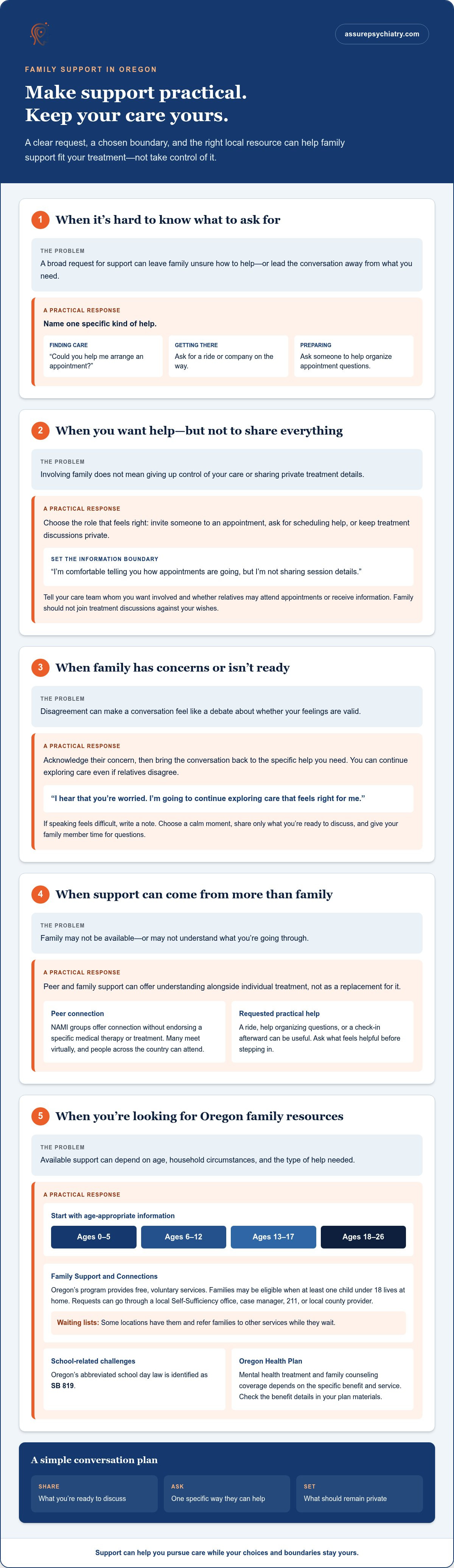
Family support starts with a clear conversation about what would help you feel supported in treatment. If you’re figuring out how to get family to support my mental health treatment in Oregon, name one practical way they can help, explain what you’re comfortable sharing, and invite them to learn alongside you.
It can feel vulnerable to involve family in something so personal, especially when you’re unsure how they’ll respond. You can set boundaries and choose how much to share. Support does not mean giving up control of your care.
This article offers ways to start the conversation, connect family members with mental health resources, and consider peer support. It also explains what you can do if relatives aren’t ready to be involved, so you can keep moving toward care and support that feel right for you.
Key Takeaways
- Match family support to the person’s age and situation, and explore Oregon resources that may help families connect with care.
- Use peer and family support as a source of understanding alongside, not as a replacement for, individual treatment.
- Plan a calm, direct conversation by identifying what you want to share, what help you need, and where your boundaries are.
- Learn how psychiatric evaluation and medication management can support treatment when you’re ready to discuss your care with a professional.
Connecting families with mental health treatment
Start by identifying the support you need: finding care, getting to an appointment, or discussing school challenges. In Oregon, available resources can depend on age, household circumstances, and the type of support needed.
Family Participation and Consent
If you want family involved in your treatment, decide what role feels right. You could invite someone to an appointment, ask for help scheduling, or keep treatment discussions private. Tell your care team whom you want involved and what information you’re comfortable sharing. Family support should reflect your choices and boundaries.
Family members should not join treatment discussions against your wishes. Tell your care team your preferences about consent, including whether relatives may attend appointments or receive information.
Discussing Treatment Needs with Family
Choose a calm moment and make one clear request, such as, “Could you help me arrange an appointment?” Share only what you’re ready to discuss, then give your family member time to ask questions. If they have concerns, steer the conversation toward practical support rather than debating whether your feelings are valid. A written note can help if speaking feels difficult.
For children and young adults, age-based resources cover ages 0-5, 6-12, 13-17, and 18-26. This can help families start with information suited to a child’s or young person’s stage of life. For school-related challenges, Oregon’s abbreviated school day law is identified as SB 819, according to the Oregon Legislative Assembly.
To explore low-cost family support, consider Oregon’s Family Support and Connections program. It provides free, voluntary services, and families may be eligible when at least one child under 18 lives at home. Requests can go through a local Self-Sufficiency office, case manager, 211, or local county provider. Some locations have waiting lists, with referrals to other services while families wait.
Oregon Health Plan coverage for mental health treatment and family counseling depends on the specific benefit and service. Review each benefit in your plan materials. OHP enrollment may also be relevant to eligibility for Family Support and Connections when a family is not enrolled in active Child Welfare services.
Family and peer support
Support can be practical, such as help with appointment logistics, or simply listening without judgment. Family members and peer groups can offer different kinds of connection while you pursue care.
Supporting Someone Starting Care
Ask what kind of help would feel useful before stepping in. You could offer a ride, help organize questions for an appointment, or check in afterward without pressing for private details. Make your support consistent and specific. “Would you like company on the way there?” offers a choice and makes it easier to accept help.
Family members can support someone starting therapy or psychiatric care by listening, respecting their decisions, and offering requested practical help. NAMI support groups do not endorse a specific medical therapy or treatment, so they can offer connection without directing someone toward a particular care choice.
Setting Boundaries with Family
If you’re asking how to get family to support my mental health treatment in Oregon, start by defining the help you want. Explain what you’re willing to discuss and what should stay private. For example, you could say, “I’m comfortable telling you how appointments are going, but I’m not sharing session details.” Calmly repeat your boundary if the conversation shifts.
You decide whether relatives take part in treatment discussions. You might welcome help with transportation but prefer to keep appointment conversations private. Clear boundaries can make support feel more manageable.
Responding to Family Opposition
If relatives discourage treatment, acknowledge their concerns without letting disagreement dictate your next step. You might say, “I hear that you’re worried. I’m going to continue exploring care that feels right for me.” If you’re still wondering how to get family to support my mental health treatment in Oregon, explain the specific help you need. You can seek care even if they disagree.
NAMI groups offer another way to connect. Many meet virtually, and people across the country can attend. Peer experiences may help you feel understood, but another person’s path does not determine yours.
When you want professional help considering care options, psychiatric evaluation and treatment can be a next step to explore.
Mental illness and recovery
Millions of people in the United States experience mental health conditions each year. Mental illness is a medical condition that can affect thinking, feelings, mood, relationships, and daily functioning. These experiences vary and do not define a person’s identity. Someone may struggle to concentrate at work, while another finds relationships or everyday routines harder to manage.
Recovery from serious mental illness is possible and, for many people living with mental illness today, probable. Recovery does not have to mean every challenge disappears. It might mean recognizing what helps, reconnecting with meaningful activities, or finding steadier ways to handle difficult days. Consider what progress would look like in your daily life. A personal answer can help family members understand your goals.
Family support can make those goals easier to discuss, though relatives may understand progress differently. One person might focus on returning to work; another may value a calmer morning routine. Share the outcome that matters to you, then name one supportive action. For instance, ask a relative to check in after a demanding day rather than expecting them to know what you need.
Before talking with family, try writing down one challenge, one thing that helped, and one request. “I’ve been finding meals difficult; sitting together at dinner would help” gives someone a concrete way to respond. This can also keep the conversation focused on your experience rather than broad assumptions about mental illness or recovery.
Progress can look different across parts of life. You might feel more connected to friends while still struggling with household tasks. Naming both experiences can help relatives avoid treating one difficult moment as proof that nothing is changing. If family members ask how to help, explain which actions feel supportive and which add pressure. A specific example can make the difference clear.
Keep track of your own progress, too. Note a meaningful change, such as attending a planned activity or asking for help sooner. These examples can help you describe your experience to family without making them responsible for judging your recovery. Your goals remain yours. Loved ones can support them by listening, respecting your choices, and noticing what you say matters.
How can I talk to my family about needing mental health treatment?
Choose a family member who tends to listen calmly, then decide what you want them to understand. You can share that you need care without explaining every personal detail.
Before talking, write a few notes to keep the conversation focused. Include what you’ve noticed, what you’re considering, and the response you hope for. You might want a relative to listen first instead of immediately offering advice. Choose a private setting where you can leave if the discussion becomes overwhelming.
- Start with your purpose. Say, “I want to tell you why I’m considering mental health care.”
- Describe your experience. Use a concrete example, such as trouble sleeping or difficulty managing everyday responsibilities.
- Make a specific request. Ask them to listen, help you think through next steps, or give you space to decide.
- Pause when needed. Suggest returning to the conversation later if emotions rise or you need time to gather your thoughts.
A family member may respond with surprise, questions, or uncertainty. Give them time to process, while keeping the conversation focused on what you need. If they make assumptions, you can say, “I’m still learning what support looks like for me.” You do not have to resolve every disagreement in one conversation.
Decide in advance what information you want to keep private. You could talk about seeking care without sharing appointment details. If speaking feels difficult, write a message and ask for a calm time to talk. A trusted friend can help you rehearse your main points before you share them with family.
For a next step toward care, explore treatment options at a pace that feels manageable.
Assure Psychiatry: Medication Management
Assure Psychiatry offers Medication Management and Psychiatric Evaluation for people seeking professional guidance with their care. If concerns such as anxiety or attention difficulties affect daily life, an evaluation can help clarify what you’re experiencing and inform next steps. Medication management offers a way to discuss treatment over time and how it fits your needs.
You can involve family in your care only to the extent you choose. For example, you might ask a relative to help remember questions for an appointment while keeping personal details private. Treatment decisions remain centered on your needs, not on persuading family members to agree. Assure Psychiatry also provides Anxiety Treatment and ADHD Treatment for people seeking support with those concerns.
To explore care, contact Assure Psychiatry or visit assurepsychiatry.com.
Take the Next Step at Your Own Pace
Family support can be meaningful, but your care is your decision. If you’re thinking about how to get family to support my mental health treatment in Oregon, consider what you want from your next conversation: understanding, practical help, or room to make your own choices. You can move forward even if relatives need time to understand.
For professional guidance, Assure Psychiatry offers Medication Management, Psychiatric Evaluation, and ADHD Treatment. These services provide an opportunity to discuss concerns and consider care options that fit your needs. You can choose whether to share that process with family and which details to keep private.
When you’re ready to explore care, contact Assure Psychiatry. Your next step can be a small one, taken with care and confidence.
Recent Comments