

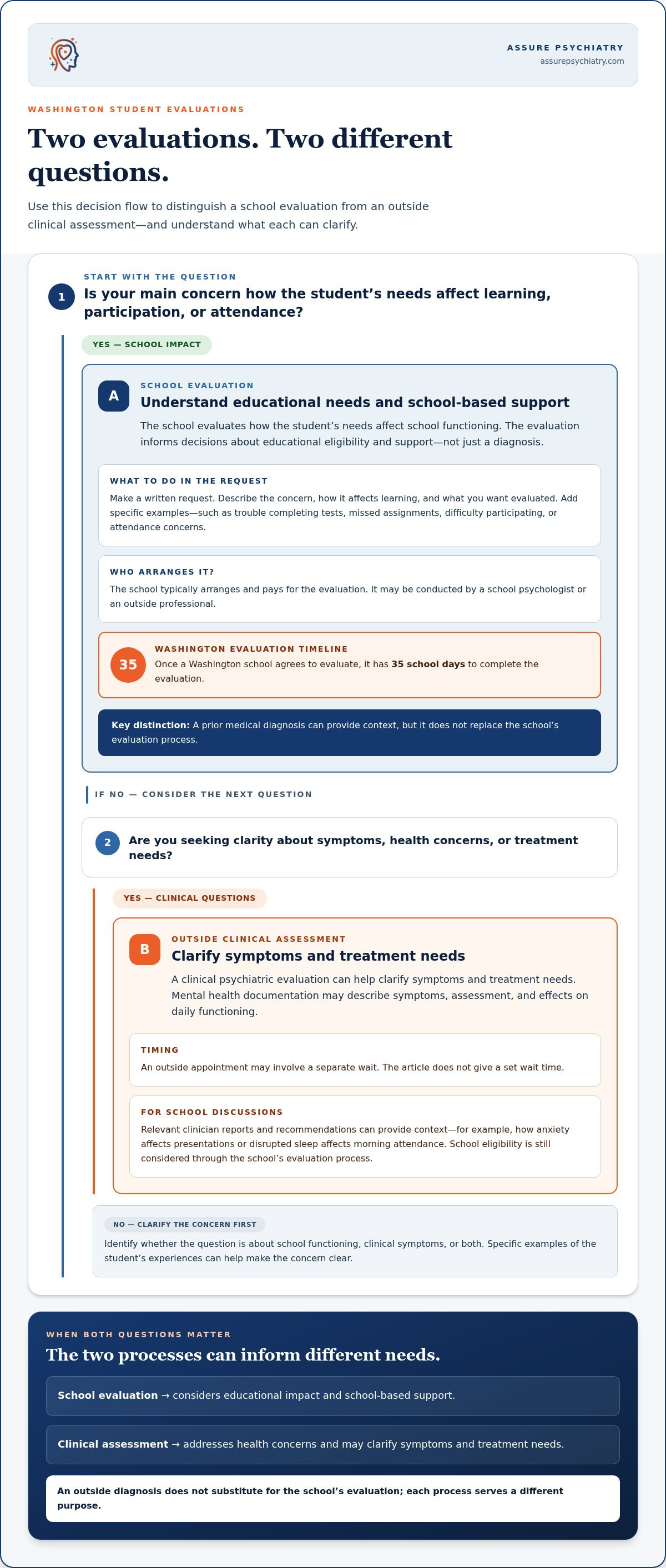
A school evaluation and an outside assessment follow different timelines. Once a Washington school agrees to evaluate a student, it has 35 school days to complete the evaluation, according to the Washington Office of Superintendent of Public Instruction. An outside appointment may involve a separate wait, and a medical diagnosis doesn’t replace the school’s evaluation process.
It’s understandable to want clear answers when mental health concerns affect a student’s learning, especially when you’re also trying to understand fees and possible financial help. The process can feel overwhelming, but identifying the kind of evaluation you need is a practical place to start.
This guide explains how school evaluations differ from outside clinical assessments, what to know about waitlists and costs, and how federal protections may support students with mental health concerns. It also describes how a psychiatric evaluation can clarify symptoms and treatment needs, helping you approach next steps with greater confidence.
Key Takeaways
- Learn how classroom challenges may lead to school supports, and how Washington’s rules address absences related to mental or behavioral health.
- Understand why a school evaluation and an outside medical diagnosis serve different purposes, and what to prepare when requesting an evaluation.
- See what can shape appointment timing and assessment fees, plus how to think through financial support options.
- Explore how Section 504 and IDEA may protect a student’s access to appropriate public education and accommodations.
- Find out when a psychiatric evaluation or medication management may help address mental health concerns affecting daily life and school.
Learning disabilities and classroom challenges
A learning disability affects how a student acquires, processes, or uses information. A classroom challenge is a difficulty that interferes with learning, participation, attendance, or schoolwork. For example, anxiety may make presentations or crowded classrooms difficult, while depression can disrupt concentration and completing assignments. These concerns deserve attention, but one difficulty alone doesn’t establish a disability or determine which school supports are appropriate.
An Individualized Education Program, or IEP, is a written plan for eligible students receiving special education and related services. The school team considers how a student’s needs affect educational progress, then identifies appropriate instruction and support. An IEP may include resource-room time, psychological counseling, or extra time on tests. For a student who struggles to finish timed exams, extra time could address a specific barrier without defining the student by a diagnosis.
Related services are supports that help a student benefit from special education. Washington Administrative Code WAC 392-172A-01155 lists related services that might be included in a student’s IEP. The team connects supports to the student’s individual needs and school participation. Families can describe patterns they observe, such as missed assignments after periods of distress, difficulty returning after absences, or trouble focusing during particular classes.
Attendance concerns can also signal that school feels difficult or unmanageable. Washington Administrative Code WAC 392-401-020 sets state requirements for excusing absences related to mental or behavioral health, according to the Washington State Legislature. Washington enacted HB 1834 in 2022 to require schools to excuse absences related to mental or behavioral health. Excused absences and classroom accommodations address different needs, so one does not automatically replace the other.
Truancy rules make it useful to address attendance patterns early. Under Washington’s Becca Bill, schools must file truancy petitions if a student age 17 or younger misses 7 days of school in a month or 15 days in a year without a documented excuse. A student is truant when absent without a valid excuse. Keep a record of attendance concerns and communications, and share relevant context with the school.
- Describe the barrier: Note whether the concern involves tests, transitions, attendance, concentration, or completing assignments.
- Give a specific example: Explain what happened, when it occurred, and how it affected school participation.
- Ask for a team discussion: Share the examples with school staff and discuss whether evaluation or supports may address the educational impact.
In August 2022, OSPI issued guidance that IEP services should begin at the start of the school year and continue uninterrupted unless the team makes a student-centered decision to change delivery. If a student’s needs shift, families can document the change and discuss it with the IEP team. Specific examples help the team consider supports that match the student’s learning and classroom circumstances.
School evaluations and outside medical diagnoses
A school evaluation examines how a student’s needs affect learning and whether school-based support is appropriate. An outside clinical assessment addresses health concerns, but it doesn’t replace the school’s separate evaluation.
School Evaluations
A school evaluation is an assessment arranged through the school to understand a student’s educational needs. The school typically arranges and pays for the evaluation, which may be conducted by a school psychologist or an outside professional. When a Washington school agrees to evaluate a student, it has 35 school days to complete the evaluation, according to the Washington Office of Superintendent of Public Instruction. The team considers the student’s school functioning, not just a diagnosis.
For example, difficulty attending class may be related to anxiety, while incomplete work may reflect trouble concentrating. Describe specific effects on learning, participation, and attendance. A written request clarifies what the family wants evaluated and gives the school a clear record of the concern. The school evaluation informs decisions about educational eligibility and support.
Mental Health Documentation
Mental health documentation describes a student’s symptoms, assessment, and how concerns affect daily functioning. For school accommodations in Washington, useful records may include an outside clinician’s diagnosis, notes about observed difficulties, and recommendations related to school activities. For example, documentation might explain how anxiety affects presentations or disrupted sleep affects morning attendance.
There isn’t one outside document that automatically establishes a student’s eligibility for school services. A prior medical diagnosis can provide context, but it doesn’t replace the school’s evaluation process. Organize relevant reports and write down examples of school impact, such as missed assignments or difficulty participating in class. A clinical psychiatric evaluation can help clarify symptoms and treatment needs, while the school separately evaluates educational needs.
Requesting Evaluations and Accommodations
A written request is a parent’s or caregiver’s formal way to ask the school to evaluate a student or discuss accommodations. Describe the concern, explain how it affects learning, and ask the school to assess the student’s needs. Include specific examples, such as repeated difficulty completing tests or absences related to mental health concerns.
Send the request to school staff responsible for evaluation discussions, and keep copies of the letter and replies. Attach relevant documentation if available, while stating clearly what you want the school to consider. To request accommodations, explain the barrier and the practical support that could help, such as a quieter testing setting. Because the school evaluation is separate from an outside diagnosis, share records as context, not as a substitute.
Assessment appointments and duration
An assessment appointment is a clinical meeting to understand symptoms, concerns, and their effects on daily life. If school is affected, explain the specific difficulty and what questions the family hopes the assessment will answer.
Waitlists and Scheduling
A waitlist is a queue of people waiting for an appointment with an assessment provider. Scheduling depends on provider availability, the type of assessment, and whether it requires additional meetings or record review. These factors affect the time between requesting an appointment and beginning the assessment.
When arranging a mental health assessment for school accommodations in Washington, explain how school functioning relates to the concern. For example, describe difficulty concentrating in class, anxiety about presentations, or distress affecting attendance. This context helps the provider understand the appointment’s purpose. Keep school meetings and relevant deadlines on your calendar, and share them when scheduling.
What Happens During an Appointment
A clinical assessment gathers information about symptoms, history, and functioning to support diagnostic understanding. The provider may ask the student and caregiver about current concerns, when they began, and how they affect home, school, and relationships. A student might describe feeling overwhelmed by tests, while a caregiver may note changes in sleep or attendance.
Use specific examples rather than broad labels. Saying “My child is anxious” gives less context than explaining that the student avoids oral presentations or leaves class when distressed. The discussion may also cover previous evaluations, treatment history, medications, and family observations. Bring available records and a concise list of concerns so important details aren’t missed.
What Shapes the Appointment Length
Appointment length is the time set aside for assessment activities and discussion. The assessment’s scope, the complexity of the concerns, and the history to review all affect how much time the process requires. A focused discussion of one concern differs from an evaluation exploring several symptoms and their effects across settings.
Some assessments involve more than one meeting, particularly when the provider needs additional history or time to review records. Don’t assume one appointment will answer every question. Ask how the process is organized and what to bring, such as school observations, previous reports, or a list of current concerns. These details help make each meeting purposeful.
After the Assessment
Follow-up is when the provider discusses findings and possible next steps with the family. The conversation may clarify symptoms, identify areas for treatment, or explain what additional information could help. A diagnosis can inform care, but the school makes educational decisions through its own process.
Before leaving the final meeting, note recommendations and ask for explanations of unfamiliar terms. If the family plans to share findings with school staff, identify relevant records and consider the student’s privacy. For a mental health assessment for school accommodations in Washington, organize the assessment summary and examples of school challenges to guide conversations about support.
Assessment fees and financial need
An assessment fee is the amount charged for a private clinical evaluation. Costs depend on the assessment’s scope, the time needed to review records, and whether written findings or follow-up are included. For a private assessment, the price depends on the case and is provided after a quote request. Factors include the assessment’s scope, record review, and follow-up needs.
School and clinical evaluations have different funding paths. The school arranges and pays for a school evaluation, while an outside assessment may involve family expenses. Before scheduling privately, clarify what the appointment includes and whether the report will address the family’s questions. A brief clinical consultation and a detailed diagnostic assessment, for example, may involve different work.
Understanding Potential Costs
The total expense reflects the work involved, not just the time spent talking. Reviewing records, gathering history from caregivers, assessing several concerns, and preparing written findings can affect the scope. Ask for a written explanation of what the quoted fee covers, including whether follow-up discussion is included.
Insurance benefits may affect what a family pays, depending on the plan and service. Review the plan’s behavioral health benefits and any out-of-network rules before booking. Note the representative’s explanation, the date of the call, and any documents requested. These records can help families compare expected expenses with their budget.
Planning for Financial Need
Financial need means assessment expenses compete with a family’s other essential costs. Start by identifying the question the assessment needs to answer, such as whether symptoms affect school participation or whether treatment planning is needed. This focus can help the family discuss an appropriately scoped evaluation rather than paying for work unrelated to the concern.
Families can also consider whether a school evaluation addresses their educational question. It is distinct from a private clinical assessment and examines school needs through the school’s process. If the main goal is a school evaluation, submit a written request rather than assuming an outside assessment is required. If clinical clarification is also needed, keep those goals separate when planning expenses.
Keeping Costs Manageable
A simple preparation list can make fee discussions more specific. Gather existing reports, write down the main concerns, and note which questions need answers. For example, a caregiver may want to know whether difficulty concentrating calls for clinical follow-up or a school-based assessment. Sharing relevant records can help clarify the work being requested.
Before committing, ask for the scope, fee, payment timing, and any separate charges in writing. If the expense isn’t manageable, explain the financial constraint and ask what lower-cost option may address the immediate educational question. Comparing a school evaluation with a private clinical assessment helps families direct limited funds toward the need they want addressed.
Federal protections for students with mental health concerns
Section 504 and the Individuals with Disabilities Education Act (IDEA) are federal protections for students with disabilities, including students with mental health concerns. A student may qualify for support when mental health needs affect learning, but the school must evaluate the student under the relevant process.
For an IEP or Section 504 plan in Washington, eligibility depends on the student’s needs and how a disability affects access to education. Section 504 covers a physical or mental impairment that substantially limits a major life activity; IDEA may apply when a student qualifies for special education. A diagnosis alone doesn’t determine which plan is appropriate.
Section 504 and IDEA
Section 504 of the Rehabilitation Act of 1973 protects students whose impairments substantially limit a major life activity and entitles eligible students to a free appropriate public education. A Section 504 plan generally keeps the student in the classroom while setting accommodations agreed upon by the parent and school team. For example, a plan might address how a student accesses classroom instruction during periods of significant anxiety.
IDEA is another federal protection for children with disabilities, including children with mental health concerns. Parents can request a school evaluation under IDEA when they believe mental health issues interfere with learning. An IEP may provide special education and related services, while a Section 504 plan typically focuses on accommodations. The appropriate route depends on the student’s educational needs.
School Decisions and Protections
Free appropriate public education, or FAPE, means an educational program reasonably calculated to support progress appropriate to the child’s circumstances. The U.S. Supreme Court described that standard in its 2017 ruling. School teams should connect decisions to the student’s individual circumstances, such as difficulty attending class or completing assignments during periods of distress.
Parents may appeal school decisions they disagree with or when they believe needed services aren’t being provided. If a student with a disability is removed from their regular placement for 10 or more days because of behavior, a manifestation determination meeting is required. This meeting considers whether the behavior relates to the student’s disability and supports appropriate next steps.
Finding Washington Resources
Washington families can begin with their school district’s special education or Section 504 contact and the Washington Office of Superintendent of Public Instruction (OSPI). Ask the district for its evaluation procedures, relevant forms, and the staff member responsible for the student’s plan. Keep copies of written requests, responses, evaluations, and meeting notes.
The U.S. Department of Education’s Office for Civil Rights issued guidance in July 2022 about supporting students with disabilities and avoiding discriminatory discipline under Section 504. Families can use that guidance to frame questions about school responses to behavioral health needs. OSPI’s August 2022 IEP guidance also addresses services continuing at the school-year start unless the team makes a student-centered decision to change delivery.
Assure Psychiatry: Medication Management
Assure Psychiatry provides psychiatric evaluations and medication management for people seeking help with mental health concerns that may affect school and daily life. A psychiatric evaluation can clarify symptoms, while medication management supports ongoing treatment. The clinic also provides ADHD and anxiety treatment.
These clinical services address health and treatment needs; they don’t replace a school’s evaluation or determine eligibility for accommodations. Families can use clinical insight alongside school documentation when considering what support may help a student. If you’re exploring treatment for ADHD, anxiety, or another mental health concern, contact Assure Psychiatry to learn more.
Take the Next Step Toward Support
Let the student’s experience guide the next conversation. Ask what feels hardest during the school day and what might make one moment more manageable. This perspective can help families keep care focused on the young person, not just paperwork or labels.
Planning a mental health assessment for school accommodations in Washington can be part of a broader effort to understand symptoms and support wellbeing. Assure Psychiatry provides psychiatric evaluations, medication management, and ADHD treatment. These services address clinical concerns alongside the separate school process for educational support.
Choose a next step that fits your family’s needs, whether that means organizing questions for a clinician or discussing treatment options. Contact Assure Psychiatry to learn about psychiatric care. With thoughtful support and the student’s voice included, families can move forward with greater clarity and care.
Frequently Asked Questions
Is there a waiting list for assessment?
There isn’t one statewide waitlist for mental health assessments in Washington. School evaluation scheduling and private clinical appointments are separate processes, each shaped by provider availability and the assessment needed. If school concerns are urgent, submit a written evaluation request while organizing relevant examples and records. The school process can then move forward independently of an outside appointment.
Need an accommodation?
If a mental health concern makes school participation harder, write to the school and describe the barrier. For example, explain that anxiety makes oral presentations difficult or that symptoms interfere with classwork. Ask the school to discuss an evaluation and possible support. Include practical examples, and keep copies of your request and the school’s response for future conversations.
What is the difference between an IEP and a 504 plan for mental health conditions?
An IEP is a special education plan for a student who qualifies under IDEA, while a Section 504 plan provides accommodations for an eligible student with a disability. An IEP may include specialized instruction and related services; a 504 plan generally changes how a student accesses classroom learning. For instance, the team might consider testing accommodations when a condition substantially affects participation or performance.
Can a private therapist or psychologist provide documentation for school accommodations in Washington?
Yes. A private clinician can provide records describing a student’s assessment, diagnosis, symptoms, and functional needs. For example, a report could explain how panic symptoms affect attendance or concentration. Families can share relevant documentation with the school team, but an outside report doesn’t determine school eligibility or replace the school’s evaluation. The school considers it alongside its own assessment of educational needs.
How long does the school evaluation and accommodation process take in Washington?
After a Washington school agrees to evaluate a student, it has 35 school days to complete the evaluation, according to the Washington Office of Superintendent of Public Instruction. That deadline covers the evaluation, not every discussion or decision about accommodations. Families can track the request date, school replies, evaluation activities, and meeting dates to understand where the process stands and what follow-up remains.
Are school evaluations for mental health accommodations free in Washington?
The school typically arranges and pays for school evaluations, so families don’t pay a private assessment fee for that evaluation. An outside clinical assessment is separate and may involve family costs. If the school is evaluating educational needs, start with a written request and keep a copy. Ask the school to explain its evaluation process and how findings inform support decisions.
What accommodations can Washington schools provide for anxiety, depression, ADHD, or other mental health conditions?
Supports depend on the student’s educational needs and eligibility. An IEP may include resource-room time, psychological counseling, or extra time for tests. A Section 504 plan can set classroom accommodations agreed upon by the parent and school team. A student who struggles with timed exams, for example, may need a support addressing that barrier. Share concrete examples so the team can consider relevant options.
What are parents’ rights if a Washington school denies an evaluation or accommodations?
Parents may appeal school decisions they disagree with or when they believe a student isn’t receiving needed services. Keep the school’s decision, your written request, and related correspondence together. Ask the district to explain its reasoning and identify its procedures for challenging the decision. If the concern involves disability-related discrimination, Section 504 protections may also be relevant. Clear records help families describe the issue during follow-up.
Recent Comments