

What if finding the right psychiatric support starts not with a diagnosis, but with feeling heard? If you’ve searched “find a psychiatrist near me Portland,” you may still be wondering whether a psychiatrist is the right fit, what an evaluation involves, or whether you’ll feel reduced to a label. Those questions are understandable. Psychiatric care should make room for your experiences, concerns, and goals.
A psychiatric evaluation can explore concerns such as anxiety, depression, ADHD, mood changes, or sleep difficulties and help determine whether medication management may be appropriate. It’s a clinical assessment, not a definition of who you are. You can ask questions and take part in decisions about your care.
This guide explains what psychiatric care may address, how to prepare for an initial evaluation, and what to consider when choosing between insurance, private pay, in-person visits, and virtual care. Assure Psychiatry is an outpatient practice in Portland, Oregon, offering personalized, culturally competent evaluations and medication management in person and through virtual visits. Knowing what to expect can make the first step clearer and more manageable.
Key Takeaways
- A psychiatrist can evaluate mental health concerns and discuss whether medication management may be part of a personalized care plan.
- An initial evaluation reviews your symptoms, health history, and mental health needs to help guide next steps.
- In-person and virtual visits have different practical considerations. Your preferences, privacy, and circumstances can help you choose a format.
- Before your appointment, note when symptoms began, how they affect daily life, and what questions you want answered.
- If you’re searching “find a psychiatrist near me Portland,” Assure Psychiatry offers evaluations, medication management, and in-person and virtual care options.
Finding a Psychiatrist Near Me in Portland: When Psychiatric Care May Help
Looking for mental health support can bring up questions: Is a psychiatrist the right person to see? What if you feel judged or reduced to a diagnosis? You deserve care that takes your experiences seriously. If you’re searching “find a psychiatrist near me Portland,” start by considering what you want help understanding, whether that’s a new concern, a change in symptoms, or questions about medication.
A psychiatrist is a medical professional who evaluates mental health concerns and may manage medication as part of care. The field of psychiatry focuses on understanding, assessing, and treating mental health conditions. An evaluation is a conversation and clinical assessment to better understand your needs, not a label that defines you.
An evaluation helps clarify what may be going on; medication management supports ongoing review of medication as part of a care plan. An evaluation can inform next steps. Follow-up care gives you and your clinician a chance to discuss how the plan is working and whether changes may be appropriate.
What concerns can a Portland psychiatrist help evaluate?
You might consider an evaluation when emotional or behavioral changes persist, feel difficult to manage, or interfere with daily life, relationships, work, or sleep. You don’t need to know the cause before seeking guidance. A clinician can explore the concern with you, including how long it has been happening and what effect it has on your routine.
- Attention, organization, or focus challenges that raise questions about ADHD
- Ongoing worry, fear, or tension associated with anxiety concerns
- Low mood, loss of interest, or changes in energy that may relate to depression
- Distressing experiences or reactions that prompt questions about PTSD
- Significant shifts in mood that lead you to ask about bipolar disorder
- Repeated unwanted thoughts or behaviors that raise concerns about OCD
- Sleep difficulties or insomnia that affect your well-being
These experiences can have different causes, and a symptom by itself doesn’t establish a diagnosis. An evaluation considers your circumstances and mental health needs. At Assure Psychiatry, evaluations help clarify concerns and inform a personalized treatment plan, with you involved in decisions about your care.
How is psychiatric care different from therapy or primary care?
Psychiatric care centers on medical evaluation of mental health concerns and may include medication management. Psychotherapy is a distinct form of support focused on therapeutic conversations and strategies. Primary care addresses general health needs. These services have different purposes, and seeking psychiatric care doesn’t mean other forms of support are unimportant.
As you consider a next step, think about what you want help with: a clinical assessment, guidance about medication, or another kind of support. Assure Psychiatry is a Portland outpatient practice offering psychiatric evaluations and medication management. Naming your questions and priorities can help you start a focused conversation without needing to have everything figured out first.
What Psychiatric Evaluations and Medication Management in Portland Involve
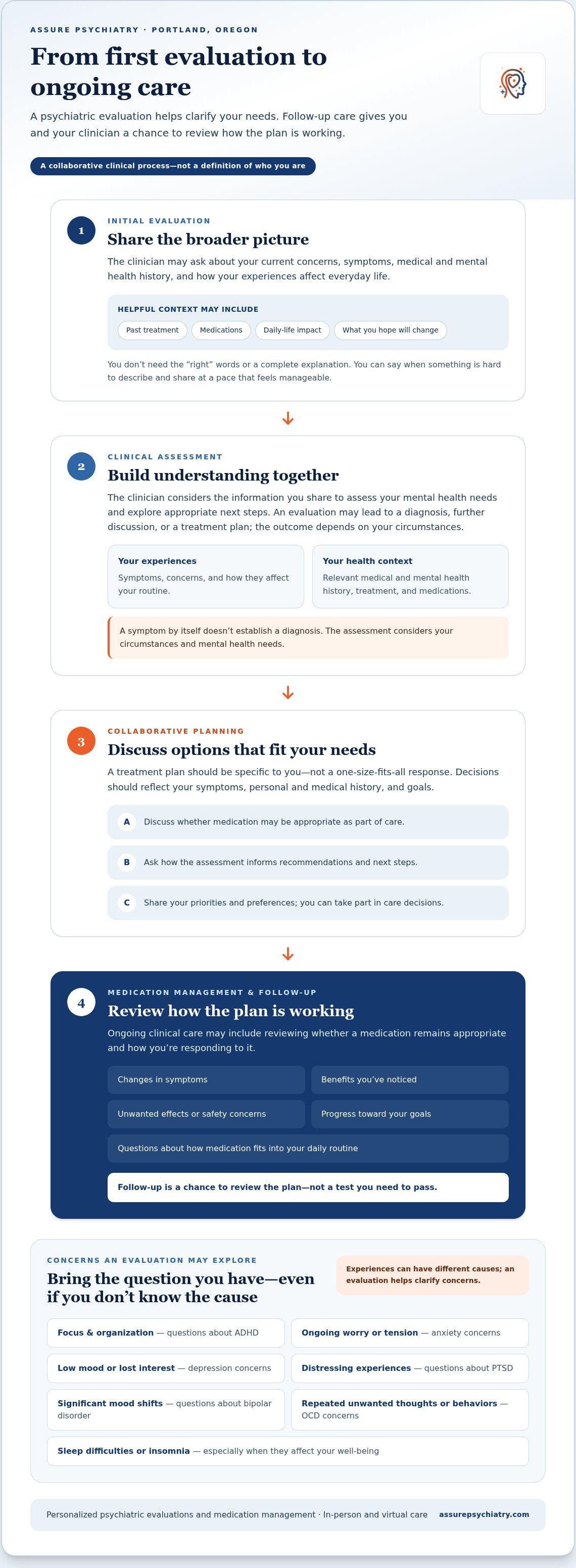
An initial psychiatric evaluation looks at the broader picture, not just one difficult day or symptom. The clinician may ask about your medical and mental health history, current concerns, symptoms, and how those experiences affect everyday life. Relevant past treatment, medications, and other context can help the clinician understand your needs.
You don’t have to arrive with the right words or a complete explanation. If something is hard to describe, say so. Bring questions, explain what you hope will change, and share information at a pace that feels manageable. The purpose is to build understanding together, not to judge your choices or reduce you to a diagnosis.
What happens during an initial psychiatric evaluation?
The clinician uses what you share to assess your mental health needs and consider appropriate next steps. The American Psychiatric Association’s overview of psychiatry describes the field’s medical focus on mental health. An evaluation may lead to a diagnosis, further discussion, or a treatment plan. The outcome depends on your individual circumstances. You can ask how the assessment informs recommendations and explain what matters most to you.
A treatment plan should be collaborative and specific to you, rather than a one-size-fits-all response. Treatment decisions should reflect your symptoms, personal and medical history, and goals. That may mean discussing medication, reviewing other relevant factors, or considering what further support would be useful. Understanding the options and expressing your preferences can help shape a plan that feels relevant to your needs.
What is medication management, and what does follow-up address?
Medication management is ongoing clinical care focused on whether a medication remains appropriate and how you’re responding to it. Follow-up appointments offer space to discuss changes in symptoms, benefits you’ve noticed, unwanted effects, safety concerns, and progress toward your goals. You can also raise questions about how a medication fits into your daily routine. A follow-up is a chance to review the plan, not a test you need to pass.
Medication choices and adjustments depend on an individual clinical assessment. A clinician may consider your response alongside your history, current needs, and concerns before discussing next steps. Don’t change or stop prescribed medication on your own. Bring questions or concerns to the clinician managing your care so you can discuss them together.
If you’re looking up “find a psychiatrist near me Portland,” understanding follow-up can help you know what to expect beyond the first evaluation. Assure Psychiatry provides outpatient psychiatric evaluations and medication management in Portland, with in-person and virtual care options. Read the medication management guide for more detail on ongoing care, or visit Assure Psychiatry in Portland.
Portland Psychiatrist: In-Person or Virtual Visits?
Choosing a visit format is part of finding care that fits your life. Some people prefer being in the same room as their clinician; others value meeting remotely. If you’re searching “find a psychiatrist near me Portland,” location is only one part of the decision. Comfort, privacy, transportation, and access to a reliable internet connection can also matter.
Assure Psychiatry offers in-person visits in Portland, Oregon, and virtual telepsychiatry. Neither format is automatically the right fit for everyone or every situation. The choice can depend on your comfort, the appointment, and your clinical needs. For readers comparing options in Portland or Seattle, Washington, it’s useful to distinguish Assure Psychiatry’s Portland office from its virtual care for patients in Oregon.
When might an in-person Portland visit feel like the better fit?
Meeting face to face may feel more natural if you prefer an in-person conversation or find it easier to focus in a dedicated clinical setting. Consider how travel to the Portland office fits into your routine, whether an office setting feels comfortable, and what privacy means for you. These preferences can help guide your decision.
What should I consider about virtual psychiatric visits in Oregon?
Virtual visits let you meet with a clinician remotely when that format suits your needs. They may avoid travel to an office, but you’ll want a private space where you can speak comfortably and a reliable internet connection. Clinical suitability is individual, so virtual care isn’t necessarily appropriate for every person or circumstance.
A simple comparison can help you think through the trade-offs:
- Setting: In-person care means meeting at the Portland office; virtual care takes place remotely.
- Convenience: An in-person visit involves getting to the office, while a virtual visit may avoid that trip.
- Personal comfort: Consider whether you feel more at ease speaking face to face or from a private space of your own.
- Practical needs: Think about transportation, privacy, internet access, and how each format fits into your routine.
It can help to consider where you’re most likely to feel present and able to talk openly. Someone with a private room and steady internet may appreciate remote care, while someone who prefers an office setting may feel more comfortable in person. These are examples, not rules.
Assure Psychiatry provides in-person Portland visits and virtual telepsychiatry for patients in Oregon. To learn more about remote psychiatric care in Oregon, explore this Oregon telepsychiatry guide. Your preferences and clinical needs can help shape the conversation about which format may work for you.
How to Prepare for Your First Portland Psychiatry Appointment
A little preparation can make a first appointment feel more manageable, but you don’t need a perfect timeline or a complete explanation of everything you’ve experienced. A psychiatric evaluation generally reviews your health and treatment history, current symptoms, and mental health needs to help inform next steps. You can learn more about the process in this psychiatric evaluation guide.
What information can help the psychiatrist understand your concerns?
Brief notes can help you remember what you want to discuss, especially if it feels difficult to recall details in the moment. Include patterns, changes, and effects on daily life. If readily available, bring relevant health history and a current medication list. These are useful prompts, not homework you have to finish before beginning.
- Note your main concerns. Write down what has been troubling you or what prompted you to seek an evaluation.
- Describe symptoms and patterns. Record what you’ve noticed, when it began, whether it changes over time, and anything that seems to affect it.
- Consider daily impact. Note how your concerns may affect sleep, focus, relationships, work, school, or routines.
- Gather relevant health details. If convenient, note past or current treatments and any medical history you think may matter.
- List current medications. Include names and, if you have the information, doses and how you take them. Don’t worry if you can’t gather every detail.
- Write down questions. A short list can help you make space for what matters most during the conversation.
Your notes don’t need to tell a complete story. A few words, such as “sleep changed,” “harder to focus,” or “started after a major life change,” can give you a place to begin. If you’re trying to find a psychiatrist near me Portland, remember that you don’t need to know what diagnosis or treatment you need before seeking an evaluation.
What questions can you bring to a first appointment?
Questions can help you understand the process and take an active role in decisions. Choose the ones most relevant to you, and add your own.
- How will the evaluation help clarify my concerns and inform care options?
- What might follow-up care involve, and how will we review progress?
- If medication is discussed, what potential benefits, risks, or side effects should I understand?
- How would medication response and safety be monitored?
- How can my preferences and concerns shape the treatment plan?
You can ask for an explanation in everyday language or say when a recommendation raises questions. A thoughtful appointment leaves room for your perspective; you don’t have to agree to a plan before you understand it. Explore psychiatric care with Assure Psychiatry.
Start Your Psychiatric Care with Assure Psychiatry in Portland
Choosing to seek support is a meaningful step, and you don’t need every answer before you begin. Assure Psychiatry is a Portland, Oregon, outpatient practice offering psychiatric evaluations and medication management, with in-person visits and virtual telepsychiatry. The practice provides personalized, culturally competent care and involves patients in decisions about treatment.
Assure Psychiatry accepts most major insurance plans and offers private-pay appointments. Coverage and out-of-pocket costs depend on your plan and circumstances. Review your benefits for behavioral health coverage, copays, deductibles, and any referral requirements. To prepare, identify the concern you most want to discuss and consider whether an in-person or virtual visit better fits your preferences.
Which concerns can Assure Psychiatry help address?
Assure Psychiatry offers evaluation and treatment related to ADHD, anxiety, bipolar disorder, depression, OCD, PTSD, and sleep concerns, including insomnia. These concerns can affect people in different ways, so a symptom alone doesn’t determine a diagnosis or dictate a particular treatment. A psychiatric evaluation helps clarify your needs and inform an individualized plan based on your experiences, history, and goals.
If attention, organization, or focus difficulties are prompting questions about ADHD, learn more in this ADHD psychiatrist guide for Portland. Whatever brings you to care, your concerns deserve to be heard in context. A diagnosis, if made, is one part of understanding your needs, not a definition of who you are.
What is a simple next step toward care?
Keep it manageable. Choose one concern you want to raise, such as persistent worry, changes in mood, attention challenges, or disrupted sleep. Then consider which visit format feels more comfortable and note any questions you’d like answered. You can gather relevant health information or a medication list if it’s readily available, but you don’t need a polished account to start a conversation.
Your preferences belong in the discussion. You can ask how an evaluation informs care and what follow-up may involve. Assure Psychiatry’s approach is personalized and culturally competent, with plans shaped around each patient rather than a one-size-fits-all template.
If you’ve been searching “find a psychiatrist near me Portland,” take the next step at your own pace. Review the practice’s care information and consider whether an evaluation or medication management fits what you’re looking for. Explore care with Assure Psychiatry.
Take the Next Step at Your Own Pace
You don’t have to map out your entire care journey today. A useful next step can be as small as deciding what you want help understanding or writing down one question. You can begin without knowing what a diagnosis might be or which treatment, if any, will feel right.
If you searched “find a psychiatrist near me Portland,” let that search be a starting point, not a demand to have everything figured out. Notice what matters to you: feeling listened to, understanding your options, or finding a way to talk about concerns that have been hard to carry alone. Your voice and preferences belong in the process.
When you feel ready, take the next step toward personalized psychiatric care in Portland. Begin by learning about Assure Psychiatry’s evaluations and medication management, available in person in Portland and virtually in Oregon.
Frequently Asked Questions
Is seeing a psychiatrist different from seeing a therapist?
Yes. A psychiatrist is a medical professional who evaluates mental health concerns and may manage medication, while a therapist generally focuses on psychotherapy. Depending on your needs, these forms of support serve different purposes and may complement one another. Assure Psychiatry provides psychiatric evaluations and medication management. Thinking about whether you want a medical assessment, therapeutic conversations, or both can help you describe the support you’re seeking.
Can I see a psychiatrist online in Oregon?
Yes. Assure Psychiatry offers virtual telepsychiatry as well as in-person visits at its Portland office. Remote appointments may suit some people’s routines, while others feel more comfortable meeting face to face. The appropriate format depends on individual needs and circumstances. For practical details about virtual mental health care in Oregon, explore the Oregon telepsychiatry guide.
Does insurance cover a psychiatrist appointment in Portland?
Coverage depends on your insurance plan, the service, and your benefits. Assure Psychiatry accepts most major insurance plans and also offers private-pay appointments, but a particular visit or treatment may not be covered under every policy. Review your plan documents or member portal for behavioral health benefits, copays, deductibles, and referral rules.
Do I need a referral to see a psychiatrist in Portland?
It depends on your insurance plan and circumstances. Some plans allow you to schedule directly, while others may require a referral or authorization. Review your plan documents for its requirements and make a note of any questions about the process. You can also prepare a brief summary of your main concerns to help you explain what brings you to an evaluation.
What should I bring to a psychiatric evaluation?
If readily available, bring a current medication list and relevant medical or mental health history. A brief note about when concerns began, what has changed, and how daily routines are affected may also help you explain what’s happening. You don’t need to prepare a perfect account or remember every detail. For example, noting that sleep or concentration changed around a particular period gives you a useful starting point.
Will a psychiatrist prescribe medication at the first appointment?
Not necessarily. The initial visit may focus on understanding your concerns, reviewing relevant history, and assessing your needs. Medication is discussed when the clinician’s evaluation indicates it may be appropriate, and decisions should include consideration of potential benefits and risks. You can ask what options are being considered and how follow-up would work. An appointment alone, or one symptom, doesn’t determine a diagnosis or mean a prescription will be made.
What should I do if I am in a mental health crisis?
If you or someone else may be in immediate danger, call 911 or go to the nearest emergency department. In the United States, call or text 988 to reach the Suicide & Crisis Lifeline. A routine outpatient psychiatry appointment isn’t a substitute for emergency help. If you can, tell someone you trust what’s happening and ask them to stay with you or help you reach immediate support.
Recent Comments