

What makes a telepsychiatry option a good fit? Convenience matters, but so do your benefits, privacy needs, and care goals. If you’re considering telepsychiatry for Washington state employees, it helps to understand what your plan covers, where you can attend a visit, and what kind of care you need.
Virtual psychiatric care can make appointments easier to fit around work and home life, but the details matter. Your health plan affects which services are covered and what you may pay. Your privacy depends partly on finding a comfortable place to talk, and your physical location can affect whether a clinician is eligible to provide care there.
This guide covers what to review in employee health benefits, how virtual visits compare with in-person care and employer resources, and what to expect from an evaluation and follow-up medication management. An individualized psychiatric evaluation can help clarify your needs and shape a treatment plan. Follow-up visits can review medication effectiveness and side effects. Understanding coverage, privacy, and clinical fit can help you choose a next step.
Key Takeaways
- Review behavioral health coverage and telehealth benefits separately. Use a checklist to understand what your employee plan may cover.
- For telepsychiatry for Washington state employees, PEBB or SEBB enrollment alone doesn’t guarantee coverage for a particular clinician or visit.
- Compare virtual and in-person appointments based on travel, technology, privacy, and setting, as well as clinical fit.
- Plan for privacy before, during, and after a visit, especially if you’re joining from a shared home or workplace.
- A psychiatric evaluation can clarify care needs, while follow-up medication management supports ongoing treatment planning.
What telepsychiatry means for Washington state employees seeking psychiatric care
Telepsychiatry is psychiatric care delivered through a virtual appointment, typically by video. It’s one type of telehealth, the broader term for healthcare provided remotely. A virtual psychiatric visit may include assessment, diagnosis, treatment planning, and medication management. It is different from ongoing psychotherapy, which generally involves regular sessions focused on therapeutic support. For a general overview of the field, see What is Telepsychiatry?
For telepsychiatry for Washington state employees, the video format is only one part of the decision. Consider what the appointment includes, what your benefits cover, and whether the clinician can provide care where you’ll be during the visit. You need to be physically present in a state where the clinician is authorized to practice at the time of your appointment.
What can a virtual psychiatric appointment include?
An initial psychiatric evaluation can include a review of your medical history, symptoms, and relevant life circumstances. You and the clinician can discuss what you want help with and work together on a treatment plan. The purpose is to understand your needs, not reduce your experience to a label. An appointment doesn’t guarantee a particular diagnosis, prescription, or outcome.
Medication management visits serve a different purpose from an initial evaluation. Follow-ups can review how medication is working, any side effects, and your progress toward treatment goals. The clinician can discuss possible next steps with you. Not every concern or situation is suited to virtual care, so clinical judgment is part of deciding what approach fits.
Why Washington employee status matters when comparing care
“Washington state employee” can refer to public employees, school employees, retirees, and other workers, whose benefits may differ. Public employees and school employees may encounter the PEBB and SEBB programs, respectively. The Washington State Health Care Authority (HCA) is a starting point for program information, but enrollment alone doesn’t establish coverage for a particular clinician or visit.
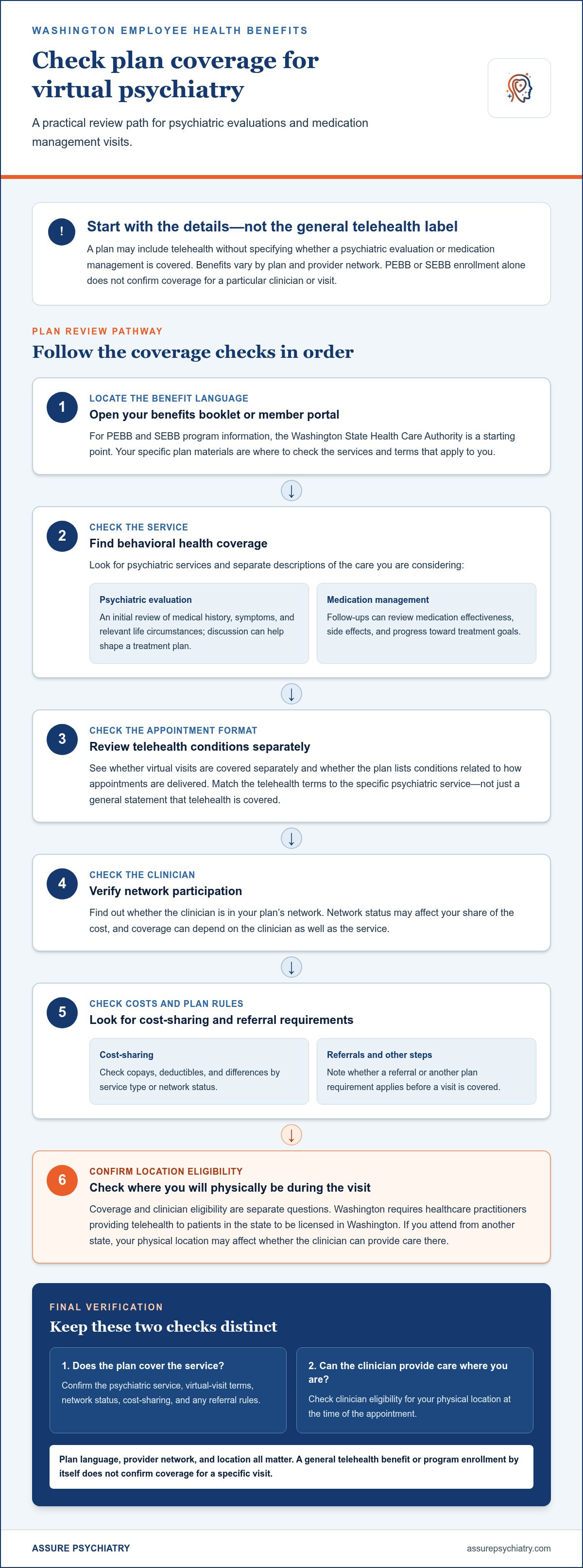
Keep two questions separate: does your plan cover the service, and can the clinician provide care where you’ll be during the appointment? Washington requires healthcare practitioners providing telehealth to patients in the state to be licensed in Washington. If you travel or attend from another state, your physical location may affect eligibility. Reviewing both benefits and location requirements can help you compare options, whether you’re in Seattle or elsewhere in Washington.
How Washington employee health benefits may apply to telepsychiatry
A plan that includes telehealth doesn’t necessarily spell out whether a psychiatric evaluation or medication management visit is covered. Benefits can vary by plan and provider network, so review the details for the care you’re considering. For public employees and school employees, the Washington State Health Care Authority is a starting point for PEBB and SEBB information. Program enrollment does not guarantee that a specific clinician or appointment is covered.
What should employees check in PEBB, SEBB, or other plan materials?
Use your plan’s benefits booklet or member portal to find the relevant terms. This checklist can help you review the details:
- Find behavioral health coverage. Look for psychiatric services and separate descriptions of evaluations and medication management.
- Review telehealth benefits. Check whether virtual visits are covered separately and whether there are conditions related to how appointments are delivered.
- Check network participation. See whether the clinician is in your plan’s network, since network status may affect your share of the cost.
- Understand cost-sharing. Look for copays, deductibles, and differences by service type or network status.
- Look for referral rules. Note whether your plan requires a referral or other steps before a visit is covered.
Telehealth coverage depends on the individual plan and provider network. A general telehealth benefit may describe how virtual care is delivered without specifying whether psychiatric evaluations and medication management are included. Review the benefit language for both the service and the appointment format, and note any terms you need clarified by your plan.
Does employee insurance automatically cover virtual psychiatry?
No single assumption applies to every employee. Benefits may differ across PEBB, SEBB, and other employer plans, and people enrolled in the same program may have different plan options. Coverage for a virtual appointment can also depend on the clinician’s network status and whether the visit meets plan requirements. Don’t treat a general statement that “telehealth is covered” as confirmation that a particular psychiatric service is covered.
Along with reviewing benefits, plan for the practical details of attending remotely. The U.S. Department of Health and Human Services offers guidance on how to prepare for a confidential telepsychiatry appointment, including privacy during a video visit. To learn about psychiatric care in Portland, you can also explore Assure Psychiatry’s care options.
Telepsychiatry versus in-person psychiatric care: what fits your needs?
Choosing between virtual and in-person psychiatric care is about more than convenience. Telepsychiatry for Washington state employees may make it easier to attend from home or another private place. An in-person visit may better suit certain assessments or circumstances. The best format depends on your needs and the clinician’s judgment.
| Factor | Virtual appointment | In-person appointment |
|---|---|---|
| Access and travel | Can reduce travel and make it easier to fit a visit around work, depending on your schedule and location. | Requires getting to the clinic, but may suit people who prefer meeting face to face. |
| Privacy | You choose a suitable location, but need a space where you can speak without being overheard. | A private clinical setting may feel more comfortable if home or work isn’t a confidential place to talk. |
| Technology | Requires a working device, reliable internet, and a quiet place for the appointment. | Doesn’t depend on your internet connection or video setup. |
| Appointment setting | May offer flexibility around where you attend, subject to the clinician’s eligibility to provide care in your location. | Takes place at the clinic, where the clinician can meet with you directly. |
When might virtual appointments feel more practical?
If travel adds strain to your day, a virtual visit removes the need to travel to the appointment, though it won’t necessarily save time or make scheduling easier. You might join from home or another appropriate location where you can talk privately. Before booking, consider whether your device, internet connection, and surroundings will support a focused conversation.
When might in-person or additional support be important?
Some concerns may call for an in-person assessment or a different level of care. Your clinician can help determine whether virtual care is appropriate for your situation. Convenience alone shouldn’t determine the format. Employer assistance resources, such as an employee assistance program, may offer support or help connect you to care, but they aren’t the same as a psychiatric evaluation or medication management.
Telepsychiatry isn’t an emergency or crisis-response service. If you or someone else may be in immediate danger, seek emergency help. In the United States, call or text 988 for crisis support. The goal is a setting that supports an honest conversation and a clinically sound plan, whether virtual or in person.
How to prepare for a confidential telepsychiatry appointment around work
Preparing ahead can help you focus on care instead of your surroundings or technology. Privacy deserves special attention if you’re joining between work responsibilities or from a shared home. No setting can guarantee absolute confidentiality, but choosing a private space and following the platform’s instructions can make the conversation more comfortable.
How can you protect privacy during a virtual visit?
Choose a private room where coworkers, family members, or roommates are unlikely to overhear. Headphones can add privacy when practical, but they don’t replace a quiet setting. If you can’t speak freely at work, choose another appropriate location rather than taking a sensitive appointment where others may listen in.
- Before: Set aside time in your calendar, find a private location, and use a secure internet connection. Avoid public Wi-Fi for a sensitive appointment when possible.
- During: Follow the telehealth platform’s instructions, silence notifications, and let the clinician know if your surroundings change or your privacy is limited.
- After: Review follow-up instructions and note questions or next steps while they’re fresh.
What should you have ready for an initial evaluation?
You don’t need a perfect account of everything you’ve experienced. A few notes can help you explain what’s been going on and what you hope to address. Allow time to test your device and connection before the appointment, and leave time afterward to review the plan instead of rushing straight back into work.
- List current medications, how you take them, and relevant medical history.
- Briefly describe your symptoms, when you noticed them, and how they affect daily life, including work, sleep, or relationships.
- Write down past treatment experiences, questions, goals, and concerns you want to discuss.
- Keep benefit information nearby if you have questions about coverage for the visit or follow-up care.
For follow-up visits, note changes since your last appointment, including medication benefits, side effects, and progress toward your goals. If you have concerns about privacy, technology, or what to expect, raise them with the clinician so you can work through them together.
Ask your clinician how to handle urgent concerns between appointments and identify appropriate local emergency resources. A scheduled telepsychiatry visit isn’t a crisis-response service. If you or someone else may be in immediate danger, contact emergency services or use an appropriate crisis resource.
Preparing for a virtual appointment can help you have a more focused conversation. Explore virtual psychiatric care options with Assure Psychiatry.
Finding a telepsychiatry care path with Assure Psychiatry
Assure Psychiatry is a Portland-based outpatient practice offering psychiatric evaluations, medication management, and virtual telepsychiatry. The practice provides compassionate, culturally competent, personalized care, with space for you to describe what you’re experiencing and take part in treatment decisions. For telepsychiatry for Washington state employees, access also depends on whether the clinician can provide care based on your physical location and whether your plan covers the visit.
What can you expect from an initial psychiatric evaluation?
An evaluation is a starting point for understanding your concerns, not a promise of a particular diagnosis or treatment. The clinician reviews relevant medical history and symptoms, discusses how they affect daily life, and explores your goals and questions. Together, you can consider appropriate care and develop an individualized treatment plan. Notes about symptoms, medications, and past treatment can help you make the most of the conversation.
For more background before an appointment, Assure Psychiatry’s guide to psychiatric evaluation in Portland can help you understand what an evaluation may involve.
How does medication management support ongoing care?
If medication is part of your care plan, follow-up visits provide an opportunity to review how it’s working, discuss side effects, and consider your progress. Treatment decisions are collaborative. Your experience matters, and any adjustments are guided by clinical assessment rather than a one-size-fits-all approach. The timing and plan for follow-up depend on your individual needs.
Assure Psychiatry’s guide to medication management in Portland offers more context on how ongoing visits can support treatment planning. Virtual care can make it easier to connect with the practice, but it isn’t right for every situation. Your care needs, the clinician’s judgment, your physical location, and your benefits all help determine a suitable path.
You don’t need to have every answer before taking a first step. A thoughtful evaluation can help clarify what you’re experiencing and what options may be worth considering. Explore virtual psychiatric care with Assure Psychiatry when you’re ready to learn more.
Choose a thoughtful next step for your mental health
Choosing telepsychiatry for Washington state employees means looking beyond convenience. Review your plan’s behavioral health and telehealth benefits, including network participation and cost-sharing. Consider whether you can speak privately and use the technology comfortably. Your physical location and the clinician’s eligibility to provide care there can also affect access.
A psychiatric evaluation can clarify your concerns through a review of medical history, symptoms, and treatment goals. If medication management is part of your care plan, follow-up visits can review effectiveness, side effects, and progress. Decisions are shaped collaboratively around your needs. Virtual care may be useful, but the right format depends on clinical fit, not convenience alone.
Assure Psychiatry provides compassionate, culturally competent outpatient psychiatric care, including personalized evaluations and medication management. Explore virtual psychiatric care with Assure Psychiatry to learn more about taking the next step.
Frequently Asked Questions
Is telepsychiatry available to Washington state employees?
Telepsychiatry for Washington state employees may be an option if the clinician is authorized to provide care where you’re physically located during the appointment. If you’re joining from Seattle or elsewhere in Washington, your location matters, even when the practice is based in Portland, Oregon. Your plan’s behavioral health benefits, provider network, and coverage rules also affect access. The virtual format alone doesn’t determine whether a visit is covered, so review current plan materials and follow the practice’s appointment instructions.
Does PEBB or SEBB cover telepsychiatry?
PEBB or SEBB coverage depends on your current plan and the details of the visit. Check plan documents for behavioral health and telehealth benefits, network participation, visit types, cost-sharing, and referral requirements. Don’t assume that every virtual psychiatric evaluation or medication management appointment is covered. The Washington State Health Care Authority is an official starting point for PEBB and SEBB information and links to plan resources, which can help you locate documents relevant to your enrollment.
Can I attend a telepsychiatry appointment during my workday?
You may be able to plan a virtual appointment around work, but set aside enough uninterrupted time to speak openly and complete the visit. A private room, reliable internet connection, and headphones can help, particularly if you work in a shared office or attend from home with others nearby. Avoid joining from a place where coworkers can overhear sensitive details. Consider your workplace policies and leave time to review follow-up instructions after the appointment.
Is telepsychiatry as effective as an in-person psychiatric appointment?
The best format depends on your needs, clinical circumstances, and the clinician’s judgment. A virtual appointment may be a practical way to connect for some people, while other situations may call for an in-person assessment or additional support. Neither format is automatically right for everyone. Share your symptoms, preferences, and concerns about access or privacy with the clinician so the care format can be considered as part of an individualized plan.
What happens during a telepsychiatry evaluation?
An initial evaluation commonly includes a conversation about your symptoms, medical and treatment history, current medications, and goals for care. The clinician uses this information to understand your needs and discuss possible next steps. An evaluation doesn’t guarantee a specific diagnosis or prescription. Beforehand, you might write down questions and note how symptoms affect daily life, such as sleep, relationships, or work. Ask for clarification if any part of the process is unclear.
Can a telepsychiatrist prescribe medication?
A telepsychiatrist may prescribe medication when it’s appropriate following an assessment and consistent with applicable professional and legal requirements. A virtual visit doesn’t guarantee a prescription. If medication is part of your care plan, follow-up appointments can review its effectiveness, side effects, and your progress, with next steps guided by clinical assessment. Sharing your current medication list and relevant medical history can help the clinician consider important context during the evaluation.
Recent Comments