

Trust with a mental health provider doesn’t have to come from instant chemistry. It can take shape in small moments: a thoughtful question, a clear explanation, or a provider who takes your concern seriously. If you’re searching for “building trust with your mental health provider Seattle,” you may be wondering whether you’ll be judged, dismissed, or seen only through a diagnosis.
You don’t have to share everything at once or agree with every recommendation to build a respectful working relationship. You deserve to understand how your information is handled, take part in decisions about care, and raise questions about treatment, medication, or communication without feeling brushed aside.
This guide offers practical ways to express your needs, talk through concerns, and notice whether trust is growing. You’ll also learn how to address a difficult moment in the relationship and recognize when a mismatch needs attention. The goal isn’t instant certainty. It’s collaborative care where you feel heard, respected, and included.
Key Takeaways
- Building trust with your mental health provider Seattle readers seek begins with feeling respected, informed, and included, not agreeing with every recommendation.
- Prepare questions and share your goals at a pace that feels manageable to make care conversations more collaborative.
- Early uncertainty can be normal. Repeated dismissiveness, unclear explanations, or ignored preferences may signal a concern worth raising.
- Clarify next steps during appointments, then reflect on whether you felt heard and understand the plan.
- Psychiatric evaluations and medication follow-ups can support personalized care by making room to discuss your history, goals, treatment response, side effects, and changing needs.
Building trust with a mental health provider in Seattle starts with feeling heard
Trust isn’t the same as agreeing with every recommendation or feeling completely at ease from the first appointment. It means being treated with respect, understanding the information you’re given, and having a real part in decisions about your care. For people searching “building trust with your mental health provider Seattle,” that distinction can make getting started feel more manageable.
Sharing personal concerns may feel vulnerable, especially if past care left you feeling judged, rushed, or misunderstood. You can choose what to discuss and how much to share at a time. Trust often develops through consistent interactions: a provider listens, explains their thinking, responds to questions, and follows through on agreed next steps.
Trust in mental health care grows when you feel safe enough to speak honestly, clear about your options, and included in decisions about what comes next.
What does trust with a mental health provider look like?
Look for actions you can observe. Does the provider listen without interrupting, reflect what they’ve heard, and explain clinical terms in language you understand? Is there room to ask why a recommendation was made or to talk about what matters most to you?
You’re allowed to disagree, ask for more information, or say that a plan doesn’t feel right. That doesn’t make you difficult. It gives the provider a chance to understand your perspective and discuss options. Feeling comfortable can grow over time, but trust doesn’t require instant chemistry, immediate agreement, or symptoms to improve right away.
What can make seeking care in Seattle feel vulnerable?
People may have concerns about stigma, privacy, cultural understanding, or how a past experience will affect a new conversation. Those worries aren’t universal, but they’re valid if they’re part of your experience. You don’t have to explain everything at once to deserve respectful care.
Consider what being understood would look like for you. It might mean having your identity and cultural background treated with care, being asked rather than having assumptions made, or receiving a clear explanation of how information is handled. Naming a preference can give the conversation a useful starting point, and you can revisit it as the relationship develops.
If knowing what to expect from an initial appointment would help, read this guide to a psychiatric evaluation. A clearer picture of the conversation may help you identify what you want your provider to understand.
How communication and shared decisions build trust during mental health care
Trust is easier to assess when a conversation becomes a two-way exchange. A short note before an appointment can help you remember what matters, especially if a topic feels hard to raise. Write down your main concerns, what you hope will change, symptoms you’ve noticed, and questions about possible next steps. A few prompts are enough to keep the conversation focused.
How can I prepare to speak openly with my provider?
Start with the concern that feels most important. If you’re unsure how to begin, try: “There’s something I’ve hesitated to bring up because of a past care experience. Can we talk about it at a pace that feels manageable?” You can ask for a plain-language explanation, request clarification, or say you’d like time to think before deciding. Preparation can support the conversation, but you’re not responsible for making it go perfectly.
Before the appointment ends, summarize what you understood and ask what happens next. If anything remains unclear, say so. These quick checks can prevent assumptions from turning into frustration and help you and your provider leave with a shared understanding of the plan.
How do shared decisions support trust in psychiatric care?
Shared decision-making brings clinical guidance together with your goals, concerns, and preferences. When discussing a medication, for example, you can ask about its intended benefits, possible risks, alternatives, and what to monitor. Your provider can explain the clinical considerations, while you share what outcomes matter to you and what concerns you have. A collaborative plan makes room for both perspectives.
Follow-up conversations help you describe how a medication is working in daily life. You might report that a symptom has improved, describe a side effect, or explain that a change in your routine has affected your needs. Medication management includes discussing effectiveness and side effects over time. Don’t start, stop, or change a medication on your own. Bring concerns to your provider so you can discuss an appropriate next step together.
Clear explanations and meaningful patient participation turn treatment decisions into a collaboration, giving trust room to grow. If you’re searching for “building trust with your mental health provider Seattle,” look for conversations where your questions and priorities shape the discussion, not just the plan’s final details.
For more context on ongoing medication care, read this medication management guide. You can also learn about psychiatric evaluations and medication management at Assure Psychiatry.
Does trust require instant chemistry? How to assess fit in Seattle
No. Trust doesn’t have to arrive fully formed in the first appointment, and a session can feel awkward even when care is respectful. You may be discussing personal topics, learning how the provider communicates, or deciding what feels safe to share. Rather than expecting instant chemistry, notice whether the relationship becomes clearer and more collaborative over time.
What is the difference between early discomfort and a mismatch?
Early uncertainty may ease as you become familiar with the process. A mismatch is worth exploring when concerns repeat: you’re regularly interrupted, feel shamed for asking questions, receive explanations you can’t understand, or find that your preferences are left out of decisions. These observations aren’t a scorecard or a diagnosis of either person. They can help you reflect on how care feels and functions.
One disagreement doesn’t automatically mean the relationship can’t work. The provider’s response can offer useful information: do they listen to your concern, explain their reasoning, and consider what matters to you? A respectful conversation may help repair a difficult moment. If the same concern continues without acknowledgment or change, the pattern may deserve closer attention.
How can I raise a concern without escalating tension?
Describe one specific moment, its effect on you, and what would help next time. For example: “When I was interrupted while explaining that concern, I felt unsure whether I’d been understood. Could we make space for me to finish before we discuss options?” This keeps the focus on your experience and invites a direct response.
If a recommendation feels unclear, try asking, “Could you explain how you reached that recommendation and what other options we could consider?” You can also ask for more time to process information or a clearer summary of next steps. You don’t have to resolve every concern in one conversation.
As you consider building trust with your mental health provider Seattle, reflect on more than whether each visit feels comfortable. Ask yourself: Can I raise a concern? Do I understand the responses? Is there an effort to address a difficult moment? Your answers may change as you gain experience with the relationship.
If you’ve raised an unresolved concern and are considering a change, this guide to switching psychiatrists offers context for thinking through next steps while keeping continuity of care in view.
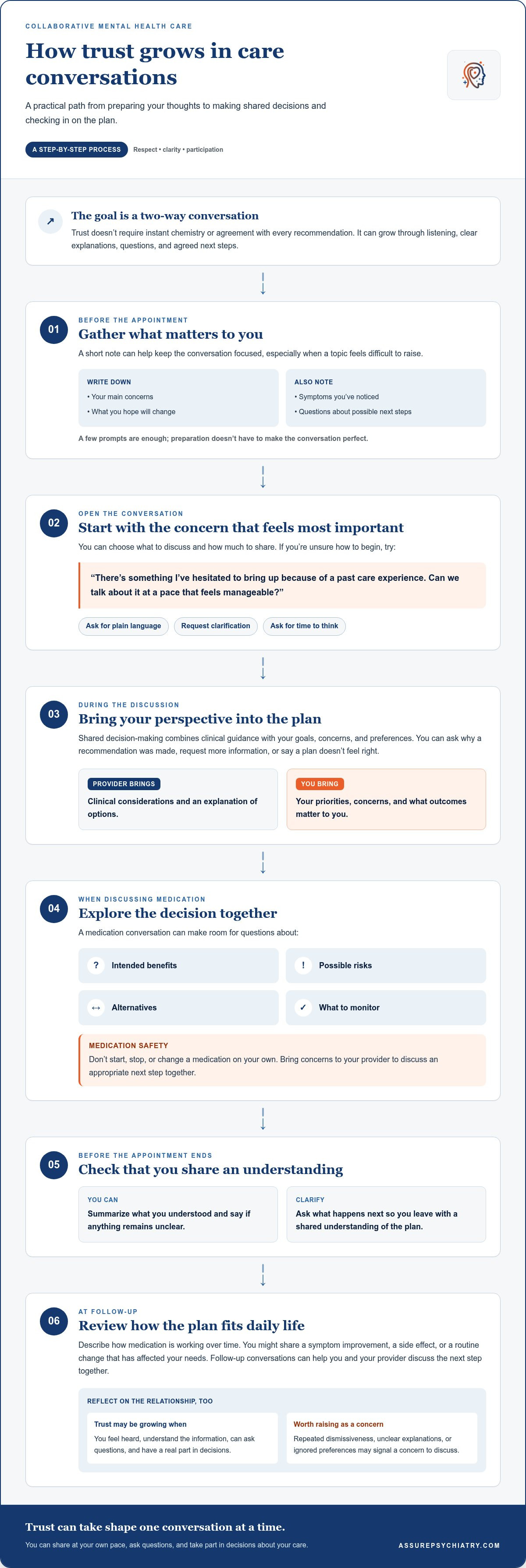
Practical steps to build trust with your mental health provider
Trust can grow through a series of small, useful conversations. You don’t need to arrive with a complete story or disclose everything at the first appointment. Try this flexible sequence:
- Name your goal: Identify the main change or concern you’d like help with.
- Prepare a few questions: Note symptoms, relevant history, or anything you want clarified.
- Share at your own pace: Say when a subject feels difficult and ask to return to it later.
- Clarify next steps: Before the appointment ends, summarize what you understood and what happens next.
- Reflect afterward: Notice what felt helpful, what remains unclear, and what you want to discuss next time.
Use the steps that suit you. They’re prompts, not a test. If you’re searching for “building trust with your mental health provider Seattle,” preparation can focus the conversation without pressuring you to share everything at once.
What should I bring up at an early appointment?
Start with your main concern, what you’d like to be different, relevant history, and the questions you most want answered. If identity, culture, or communication preferences affect how understood you feel, you can mention those too. A simple opening might be, “This is hard for me to discuss, so I may need to take it slowly.” You can also ask about practical expectations, such as appointment format, how to communicate between visits, and what follow-up generally involves.
For virtual care, your location during the appointment matters. Clinicians must meet applicable licensing and practice requirements where the patient is located. If you’re in Seattle or elsewhere in Washington, keep this in mind when considering virtual care. Portland-area patients can also consider whether in-person visits or virtual appointments in Oregon better fit their needs.
How can I tell whether trust is growing between visits?
After an appointment, jot down whether your questions were answered, whether the next steps made sense, and what you’d like to revisit. If you’re discussing treatment, a brief record of concerns or effects can make follow-up conversations more specific. You don’t need a detailed journal. A few notes can help you explain what you’ve noticed.
Trust may show up first as clearer communication, more confidence asking questions, or a better understanding of the plan. Symptom improvement can take time, so it isn’t the only way to assess whether care is becoming more collaborative.
If you’re exploring psychiatric evaluation or medication management, you can learn about care with Assure Psychiatry.
How collaborative psychiatric care can support trust and mental wellness
Psychiatric care can feel more collaborative when an evaluation makes room for your experiences, not just a list of symptoms. A provider may explore what you’ve noticed, relevant history, and what you hope will change. Together, those details can inform a personalized treatment plan. Understanding how the plan connects to your goals can help you feel included rather than reduced to a diagnosis.
What does trust-centered psychiatric care involve?
Trust shows up in practical behaviors: listening closely, explaining clinical reasoning in clear language, and building a plan around the individual. You should have space to ask what a recommendation is intended to address and share what matters to you. Clinical expertise guides care, while your knowledge of daily life, priorities, and preferences helps shape decisions.
Medication management is an ongoing conversation, not a one-time decision. Follow-up discussions can cover what seems to be helping, side effects or other concerns, and whether your needs have changed. Sharing those observations gives your provider useful information for reviewing the plan with you. Medication isn’t the right choice for every person or every concern, and no particular outcome can be promised.
For people researching building trust with your mental health provider Seattle, collaboration means being able to ask questions and have your perspective considered throughout care. It doesn’t mean you must feel certain at every step. It means there’s room to discuss uncertainty and understand the options before moving forward.
How can I take a comfortable next step toward care?
Before exploring care, write down what you want help with and the questions you’d like answered. You might note which symptoms are most disruptive, what you hope treatment could support, or what has felt difficult in past care. A few prompts can make an initial conversation easier without requiring you to have every answer ready.
If you’re considering virtual care in Oregon, this Oregon telepsychiatry guide offers more information. Assure Psychiatry is a Portland-based outpatient practice offering psychiatric evaluations and medication management, with in-person visits in Portland and virtual telepsychiatry services. For readers in Seattle and Washington, the location of the patient during a virtual appointment is an important consideration because licensing and practice requirements can vary by location. If you’re exploring care in Portland, you can explore Assure Psychiatry’s psychiatric care and next steps.
Take the next step at a pace that feels right
Trust doesn’t depend on instant chemistry. It can grow as you feel heard, receive clear explanations, and take part in decisions about your care. You can share sensitive details gradually, ask questions, and notice whether concerns are met with respect. If you’re researching “building trust with your mental health provider Seattle,” steady communication and repair after a difficult moment may matter more than a perfect first appointment.
Collaborative psychiatric care brings your goals and lived experience into clinical conversations. At Assure Psychiatry, psychiatric evaluations inform personalized treatment plans, while medication management includes follow-up discussions about effectiveness and side effects. The Portland-based practice describes its care as compassionate and culturally competent, with in-person visits in Portland and virtual telepsychiatry services.
If you’re exploring psychiatric care in Portland, take a next step by exploring Assure Psychiatry’s psychiatric care. You deserve care that makes room for your questions and helps you move forward one conversation at a time.
Frequently Asked Questions
How long does it take to build trust with a mental health provider?
There’s no universal timeline for building trust with a mental health provider. Some people feel comfortable early, while others need several conversations before trust begins to develop. Notice whether your provider listens, explains recommendations clearly, respects your pace, and follows through on agreed next steps. If something would help you feel safer or more understood, bring it up. It’s reasonable to reflect on how care feels as the relationship develops.
What are signs that I can trust my mental health provider?
Trust may be growing if you feel listened to, can ask questions without being shamed, and understand the reasons behind recommendations. Your provider should make room for your goals and preferences, explain next steps, and respond respectfully when you raise concerns. Trust doesn’t require agreement about everything or comfort in every moment. For people researching “building trust with your mental health provider Seattle,” consistent respect, clarity, and collaboration are more useful signs than instant chemistry.
Can I disagree with my psychiatrist and still have a good relationship?
Yes. Disagreement can be part of collaborative psychiatric care. You might say, “Could you explain how this recommendation fits my goals?” or “I’m concerned about this option. Can we discuss alternatives?” A respectful conversation doesn’t require either person to pretend there’s no disagreement. Notice whether your concern is taken seriously and whether the discussion leaves you with a clearer understanding of the options and next step.
What should I do if I do not feel heard by my provider?
If it feels safe, describe a specific moment and explain what would have helped. For example, you could say, “I left unsure about the plan. Could we go over the next steps again?” Notice whether your provider listens and whether communication changes. If the same concern continues without repair, consider what you need from care and what next steps could support continuity, especially if you’re receiving medication management.
Is everything I tell a mental health provider confidential?
Mental health providers generally treat patient information as private, but confidentiality can have legal or safety-related limits that depend on the situation and jurisdiction. Ask your provider to explain their privacy practices and when information may need to be shared. If a topic feels difficult to disclose, you can first ask what privacy rules apply, then decide what you feel comfortable discussing. Avoid assuming that every circumstance is handled the same way.
How can I build trust with a mental health provider through telehealth?
Trust can develop over video when expectations are clear and you can speak comfortably. Choose a private space if possible, and tell your provider if technology or privacy makes it harder to talk. Ask how follow-up works and how to raise questions between appointments. If you’re in Seattle or elsewhere in Washington, remember that clinicians must meet applicable requirements where you’re located during an appointment. Assure Psychiatry is based in Portland, Oregon, and offers virtual telepsychiatry services.
What happens if trust does not improve with my mental health provider?
If it feels appropriate, start by explaining what has been difficult and what would make care more collaborative. A direct conversation may clarify the concern or create an opportunity to repair it. If the pattern continues, it may be reasonable to consider a different fit. If you decide to change providers, think through continuity of care, including how to manage ongoing treatment or medication follow-up during the transition.
Recent Comments