

What if the most effective environment for healing from trauma wasn’t a clinical office, but the very place where you already feel most secure? For those managing the heavy weight of trauma, the simple act of leaving the house can feel like an insurmountable challenge. You might find that triggers make traveling to appointments feel unsafe, which is why specialized telehealth PTSD treatment Washington offers such a vital lifeline. It’s understandable to feel overwhelmed when your symptoms make the outside world feel unpredictable, but your home can become a sanctuary for healing.
You deserve a path to recovery that respects your need for safety and consistency. This article shows how virtual psychiatric care in 2026 provides a compassionate, evidence-based way to reclaim your mental tranquility. By connecting with a professional from your own living room, you can access vital medication management and evaluations without the stress of a commute. We will explore how this virtual approach helps reduce flashbacks and builds a stable, supportive relationship with a provider who views you as a partner in your own wellness journey.
Key Takeaways
- Learn how telehealth PTSD treatment Washington offers a secure way to access specialized psychiatric care from the safety of your own home.
- Understand the process of virtual psychiatric evaluations and how providers accurately assess trauma symptoms like hypervigilance through video sessions.
- Discover why your personal environment serves as a powerful clinical tool, helping you engage more deeply in treatment without the stress of a commute.
- Get practical steps for starting your journey, including how to verify insurance coverage and prepare for your first appointment in Washington.
- Explore how a collaborative relationship with a psychiatric provider can help you reclaim mental tranquility through consistent medication management.
Understanding Telehealth PTSD Treatment Washington
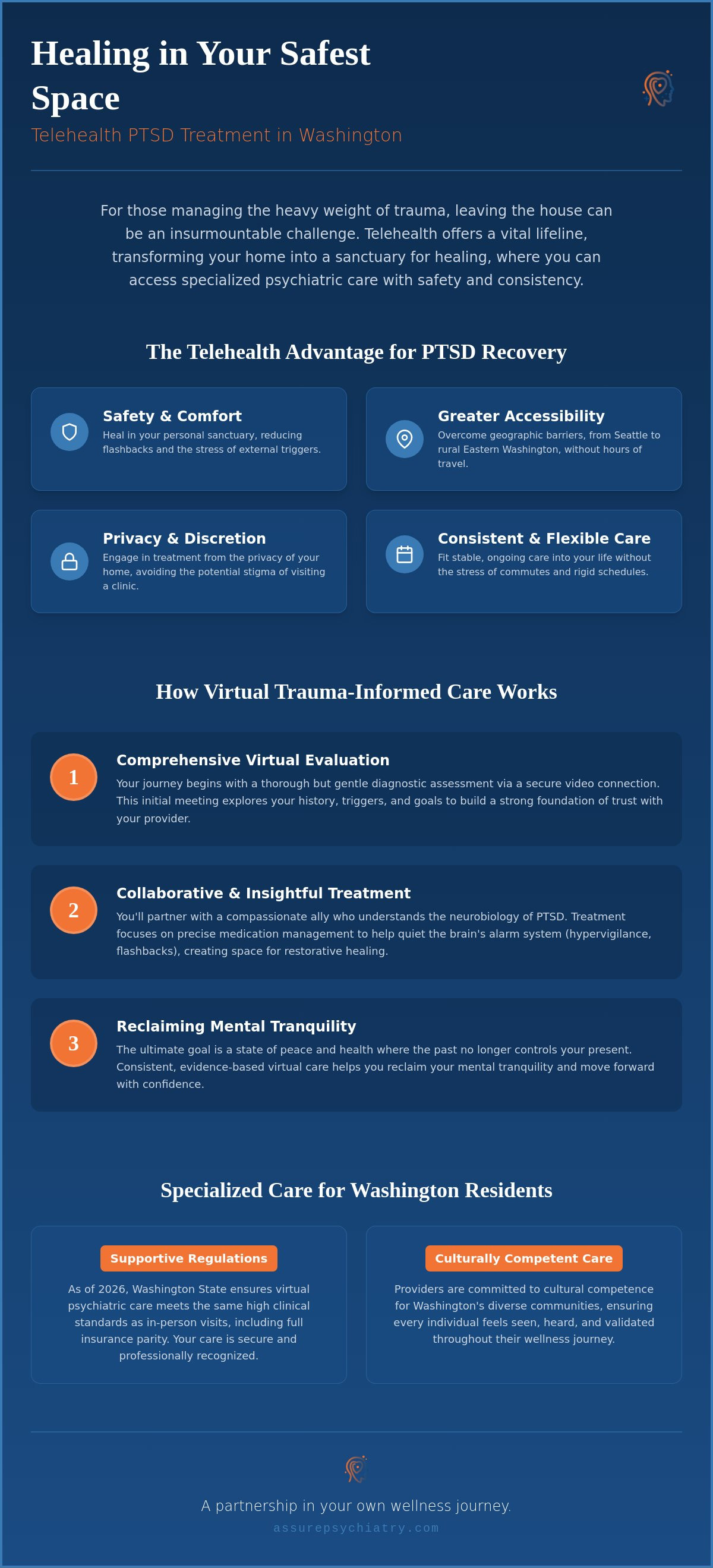
Telepsychiatry is more than a digital convenience; it’s a secure bridge to healing. By using a HIPAA-compliant video connection, patients can engage in comprehensive psychiatric evaluations and ongoing medication management without leaving their comfort zone. For those seeking telehealth PTSD treatment Washington provides a unique regulatory environment in 2026 that ensures these virtual visits are treated with the same clinical rigor and insurance parity as in-person appointments. This means your care is backed by the same professional standards you would find in a traditional office, but delivered where you feel most secure.
Washington residents often face a unique set of challenges. From the fast-paced urban stressors of Seattle to the geographic isolation found in rural Eastern Washington, the environment can play a significant role in how trauma is experienced and processed. The 2026 updates to the Washington State Health Care Authority’s policies have made accessing this care even more predictable. Mental tranquility is the primary goal of this approach. It is a state of being where peace and health intersect, allowing you to move through your day without being constantly pulled back by the weight of past experiences.
What is Virtual Trauma-Informed Care?
Trauma-informed care in a digital setting means your provider prioritizes your sense of safety from the very first click. It involves a deep recognition that your physical environment affects your ability to share your story. Research into Internet-based treatments for trauma shows that virtual platforms are highly effective when handled with clinical expertise and empathy. Providers focus on creating a non-judgmental space where your identity is respected and your diagnosis does not define you. In Washington’s diverse communities, this also requires a commitment to cultural competence, ensuring that every individual feels seen, heard, and validated during their telehealth PTSD treatment Washington sessions.
Why Washington Residents are Choosing Telehealth
Why are so many people in the Pacific Northwest moving toward virtual care? The reasons are as varied as our landscape. For many, the ability to overcome geographic barriers is the biggest factor. You shouldn’t have to drive hours across a mountain pass just to speak with a specialist. Telehealth also addresses the heavy burden of stigma. Walking into a mental health clinic can feel exposing; however, a virtual visit happens in the privacy of your own home. This flexibility is essential for those with demanding work schedules, limited mobility, or intense anxiety that makes leaving the house feel impossible. It allows for a stable, ongoing relationship with a provider that fits into the reality of your daily life.
The Role of Telepsychiatry in Trauma Recovery
Recovery from trauma is a deeply personal process that requires a collaborative partnership between you and your provider. When you engage in telehealth PTSD treatment Washington, you aren’t just talking to a screen; you’re connecting with a compassionate ally who understands the neurobiological roots of your distress. PTSD often keeps the brain’s alarm system in a state of constant activation. This leads to hypervigilance, where you’re always scanning for danger, or flashbacks that pull you back into the past. In a virtual setting, a skilled psychiatric provider observes these physiological cues. They notice subtle changes in your breathing or the tension in your posture. These observations, combined with your shared history, allow for a precise assessment of your clinical needs.
Understanding the “why” behind your symptoms can be incredibly validating. Trauma physically changes how the brain processes fear and memory, often making it difficult to feel safe even in peaceful environments. Telemental health for PTSD has proven to be an effective tool for addressing these biological shifts. Medication isn’t a “fix-all,” but it acts as a vital stabilizer. It helps quiet the overactive amygdala, giving your prefrontal cortex the space it needs to engage in restorative action. This collaborative approach ensures you’re an active participant in your care rather than just a passive recipient of a diagnosis.
Psychiatric Evaluation: Your First Step
Your journey begins with a comprehensive diagnostic assessment. During this initial meeting, your provider explores your medical history, current triggers, and the specific ways PTSD impacts your daily life. It’s a thorough but gentle inquiry designed to build a foundation of trust. This virtual evaluation ensures that your treatment plan is tailored to your unique identity and experiences. For a deeper look at what this entails, you can read our psychiatric evaluation guide. This step is essential for establishing the baseline for your mental tranquility.
Medication Management for PTSD
Medication management is a vital component of trauma recovery for many Washington residents. Standard treatments often include SSRIs or SNRIs, which help regulate the neurotransmitters responsible for mood and anxiety. These medications can lower the “volume” of your symptoms, making it easier to manage the challenges of your day-to-day life. Consistency is key to this process. Recurring follow-up appointments allow us to monitor how you’re feeling and adjust dosages as needed. This ongoing support is essential for maintaining the stability required to reach long-term health. If you’re ready to start, consider how professional psychiatric support can help you reclaim your peace of mind.
Benefits of Virtual vs. In-Person PTSD Care
Choosing between virtual and in-person care isn’t just a matter of saving time on the I-5 corridor. For many, a traditional clinical office can feel sterile, exposing, or even triggering. The simple act of sitting in a crowded waiting room can spike hypervigilance, making it difficult to open up once the session actually begins. By opting for telehealth PTSD treatment Washington residents can bypass these external stressors entirely. This shift in environment often leads to a significant reduction in “no-show” rates, as the anxiety associated with travel and public spaces no longer stands between a patient and their provider.
It’s also important to distinguish specialized psychiatric care from general “talk therapy” platforms. While many apps offer basic counseling, trauma recovery often requires the high-level clinical authority that only a dedicated psychiatric practice can provide. We focus on the intersection of biological symptoms and restorative action. This means your care is overseen by professionals who can manage complex medication regimens and conduct deep psychiatric evaluations, all while respecting the safety of your personal boundaries.
Maintaining Stability at Home
Your home is your most established safe space. When you engage in a session from a familiar chair, your nervous system is less likely to enter a “fight or flight” state. This stability allows you to process difficult emotions more effectively. You have immediate access to your own support systems, whether that’s a pet resting at your feet or a weighted blanket nearby. This comfort isn’t just a luxury; it’s a clinical tool that helps keep you grounded. For those who also spend time across the border, our telepsychiatry in Oregon guide offers additional perspective on how we maintain this standard of care throughout the Pacific Northwest.
Addressing the Clinical Efficacy Objection
Is virtual care as effective as meeting in person? The data suggests a resounding yes. Numerous studies have confirmed that telepsychiatry is highly effective for managing PTSD, particularly when it involves rigorous medication management and specialized trauma protocols. Leading publications often highlight online trauma therapy services as a gold standard for modern accessibility. At Assure Psychiatry, we maintain these high standards by using secure, high-definition video that allows us to monitor clinical cues with precision. This ensures that the quality of your telehealth PTSD treatment Washington remains uncompromised, providing a reliable path to mental tranquility without the barriers of a traditional office visit.
How to Start Your Telehealth Journey in Washington
Beginning a journey toward mental tranquility shouldn’t feel like another source of stress. When you’re ready to explore telehealth PTSD treatment Washington, the process is designed to be as seamless and supportive as possible. You don’t need to have everything figured out before your first call. Our role is to act as a collaborative guide, helping you move from a state of overwhelm to one of organized, restorative action. This first step is often the most courageous one, and we’re here to ensure you feel seen and heard from the very beginning.
Creating a personal sanctuary for your sessions is a practical way to reclaim your peace. You’ll want a private, quiet room where you can speak freely without the fear of being overheard. A stable internet connection and a device with a camera are the only technical tools required. Many patients find that having a glass of water, a comfortable chair, or a notebook nearby helps them stay grounded during the conversation. This setup allows you to focus entirely on your healing without the distractions of a traditional clinical environment.
Preparing for Your Initial Evaluation
Think of your first evaluation as a conversation rather than a formal test. It’s helpful to gather any previous medical records or a list of past treatments, but don’t let a lack of paperwork stop you from reaching out. Your primary goal is to identify what mental tranquility looks like for you. Are you hoping to reduce the frequency of flashbacks? Do you want to feel less on edge in public spaces? Defining these personal outcomes helps us tailor your care plan from day one. We’ll work together to ensure your treatment aligns with your unique identity and goals.
Navigating Insurance and Costs
One of the most common concerns is whether virtual care is covered by insurance. In 2026, Washington state law (RCW 48.43.735) continues to mandate payment parity for telehealth services. This means health insurers must reimburse providers the same amount for a telehealth visit as they would for an equivalent in-person session. This protection applies to private insurance and Washington Apple Health (Medicaid). When you contact us, we can help you verify your specific benefits so there are no surprises. Understanding the difference between a comprehensive initial evaluation and shorter follow-up medication management sessions helps you recognize the long-term value of this investment in your health. If you’re ready to take that first step, you can schedule your psychiatric evaluation with our compassionate team today.
Restoring Tranquility with Assure Psychiatry
Assure Psychiatry stands as a compassionate ally in Washington’s mental health landscape, offering more than just medical services. We provide a sanctuary of quiet strength and professional expertise for those who have felt lost in the wake of trauma. Our commitment to telehealth PTSD treatment Washington is rooted in the belief that every individual deserves a path to healing that respects their unique identity and history. We prioritize culturally competent and inclusive care, ensuring that Washington’s diverse communities find a safe, non-judgmental space to share their stories and seek restorative action. By combining high-level clinical credentials with human-centered empathy, we help you bridge the gap between where you are now and the mental tranquility you deserve.
We act as a collaborative guide on your journey, which means we value your input and your lived experience as much as our own medical knowledge. A diagnosis does not define you; it’s simply a tool we use together to build a more peaceful future. By choosing a provider that understands the local landscape of the Pacific Northwest, you gain a partner who is invested in your long-term wellness. Our approach is designed to lower the barriers to care, making it possible for you to find consistency and reliability in your treatment without the stress of navigating a traditional clinical setting.
Personalized Treatment Plans
We avoid the “one-size-fits-all” approach that is often found in larger, national mental health platforms. Every treatment plan at Assure Psychiatry is a living document, shaped by your feedback and your specific progress. This level of personalization is essential for trauma recovery, where triggers and needs can shift over time. You are an active participant in your own recovery, not just a passive recipient of care. Our medication management guide offers a closer look at how we integrate clinical precision with your personal goals. We provide the medical framework, but you lead the way toward your own restorative health.
Take the First Step Toward Peace
If you have been hesitant to seek help, please know that your feelings are valid and heard. It’s natural to feel a sense of uncertainty when addressing past trauma, but you don’t have to carry the weight of hypervigilance or flashbacks alone. We promise to provide consistent, reliable support throughout every stage of your telehealth PTSD treatment Washington experience. The path to mental tranquility begins with a single, low-pressure conversation in an environment where you feel most secure. When you are ready to reclaim your peace of mind and move toward a life defined by stability, our team is here to help you take that first restorative step. We invite you to schedule your virtual evaluation and begin your journey toward lasting peace today.
Embrace Your Path to Restored Peace
Reclaiming your mental tranquility is a journey that requires both patience and the right clinical support. Throughout this guide, we’ve seen how telehealth PTSD treatment Washington provides a secure, non-judgmental bridge to recovery. By choosing virtual care, you’re opting for a treatment model that respects your need for a safe space while ensuring you receive expert psychiatric evaluations and medication management. You don’t have to navigate trauma triggers or travel anxiety alone when professional help is available right from your own living room.
Assure Psychiatry is here to act as your collaborative guide, offering culturally competent care that values your individual identity. We accept major insurance plans and specialize in the precise medication management needed to help reduce flashbacks and hypervigilance. You deserve a life that isn’t defined by your past experiences. When you’re ready to take a restorative step forward, we’re ready to listen and support you every step of the way. It’s time to prioritize your wellness and find the stability you’ve been seeking.
Schedule Your Virtual PTSD Evaluation with Assure Psychiatry today and start your journey toward lasting peace.
Frequently Asked Questions
Is telehealth PTSD treatment as effective as in-person visits?
Yes, telehealth PTSD treatment Washington is clinically proven to be as effective as traditional in-person sessions. Numerous studies have demonstrated that virtual platforms allow for the same high-quality diagnostic assessment and medication management as physical offices. For many trauma survivors, the added comfort of being in a safe space at home can actually enhance the effectiveness of the treatment by lowering immediate anxiety levels during difficult conversations.
Can a telepsychiatrist prescribe medication for PTSD in Washington?
Yes, licensed telepsychiatrists in Washington can prescribe medications as part of a comprehensive treatment plan. During your virtual psychiatric evaluation, your provider will determine if medication is appropriate for managing symptoms like hypervigilance or insomnia. Our focus is on ongoing medication management to ensure your treatment remains stable and effective, with prescriptions sent electronically to your local pharmacy for your convenience. Additionally, for those considering supplemental options for symptom relief, you can check out CMed to connect with a trusted medical cannabis evaluator online.
What insurance plans does Assure Psychiatry accept for Washington residents?
Assure Psychiatry accepts most major insurance plans for residents across Washington. Because state law mandates payment parity, your telehealth visits are typically covered at the same rate as an in-person appointment. We recommend contacting our team to verify your specific coverage details, as we work with a wide range of networks to make specialized psychiatric care accessible and affordable for our patients.
Do I need a specific diagnosis to start telehealth for PTSD?
You don’t need a pre-existing diagnosis to begin your journey with us. The first step is a comprehensive psychiatric evaluation where we’ll explore your history and current symptoms together. This assessment helps us determine if you meet the clinical criteria for PTSD or if another condition is impacting your mental tranquility. We focus on understanding your unique experience rather than just applying a label.
How do I ensure my privacy during a virtual psychiatric session?
Privacy is maintained through the use of secure, HIPAA-compliant video platforms that encrypt every session. To protect your confidentiality at home, we recommend finding a quiet, private room where you won’t be interrupted or overheard. Using headphones can also add an extra layer of privacy, ensuring that the conversation between you and your provider remains completely confidential and secure.
What happens if I have a crisis between telehealth appointments?
If you experience a mental health crisis between scheduled appointments, it’s vital to utilize emergency resources like the 988 Suicide & Crisis Lifeline or visit your nearest emergency room. While we provide ongoing medication management and psychiatric support, we don’t offer inpatient crisis stabilization. We’ll work with you during your sessions to develop a safety plan and ensure you have the necessary resources for immediate help.
Can I switch from in-person to telehealth care if I move within Washington?
Yes, you can easily maintain your care as long as you remain within Washington state. One of the primary benefits of telepsychiatry is its portability; whether you move from Seattle to Spokane or to a rural area, your relationship with your provider stays consistent. This continuity of care is vital for trauma recovery, allowing you to sustain your progress without the disruption of finding a new psychiatric team.
How long does a typical telepsychiatry session for PTSD last?
An initial psychiatric evaluation typically lasts between 45 and 60 minutes to allow for a thorough assessment of your history and goals. Follow-up appointments for medication management are generally shorter, often ranging from 15 to 30 minutes. These recurring visits focus on monitoring the efficacy of your treatment and making any necessary adjustments to support your ongoing path toward mental tranquility.
Recent Comments