

Out-of-network psychiatrist costs in Portland depend on the visit fee and your insurance plan’s out-of-network benefits. You’ll generally pay the full fee at the appointment, then submit the required documents to seek reimbursement. The amount your plan may repay depends on your coverage.
It’s understandable to want a clear answer to “Do you accept insurance?” With out-of-network care, whether a practice bills your plan directly is separate from whether your plan reimburses you. This guide explains how to estimate the total cost, how benefits and deductibles affect your share, and how self-pay and reimbursement work. It also explains Good Faith Estimates, which can help you understand expected charges before a scheduled appointment. Knowing what to ask can make the financial side easier to navigate as you consider psychiatric care.
Key Takeaways
- Understand how your plan’s out-of-network benefits, deductible, and reimbursement rules can shape what you pay.
- Learn how paying upfront and using a superbill may help you seek reimbursement from your insurer.
- Know when a written Good Faith Estimate is due and how it can help you understand expected charges.
- See how psychiatric evaluations and medication-management visits differ, so you can better anticipate the type of care you need.
Does insurance cover therapy, prescriptions and other behavioral health services?
Insurance may help pay for therapy, psychiatric evaluations, and medication management, but coverage depends on your plan. For out-of-network care, benefits and your share of the cost can differ from in-network visits.
Out-of-Network Coverage
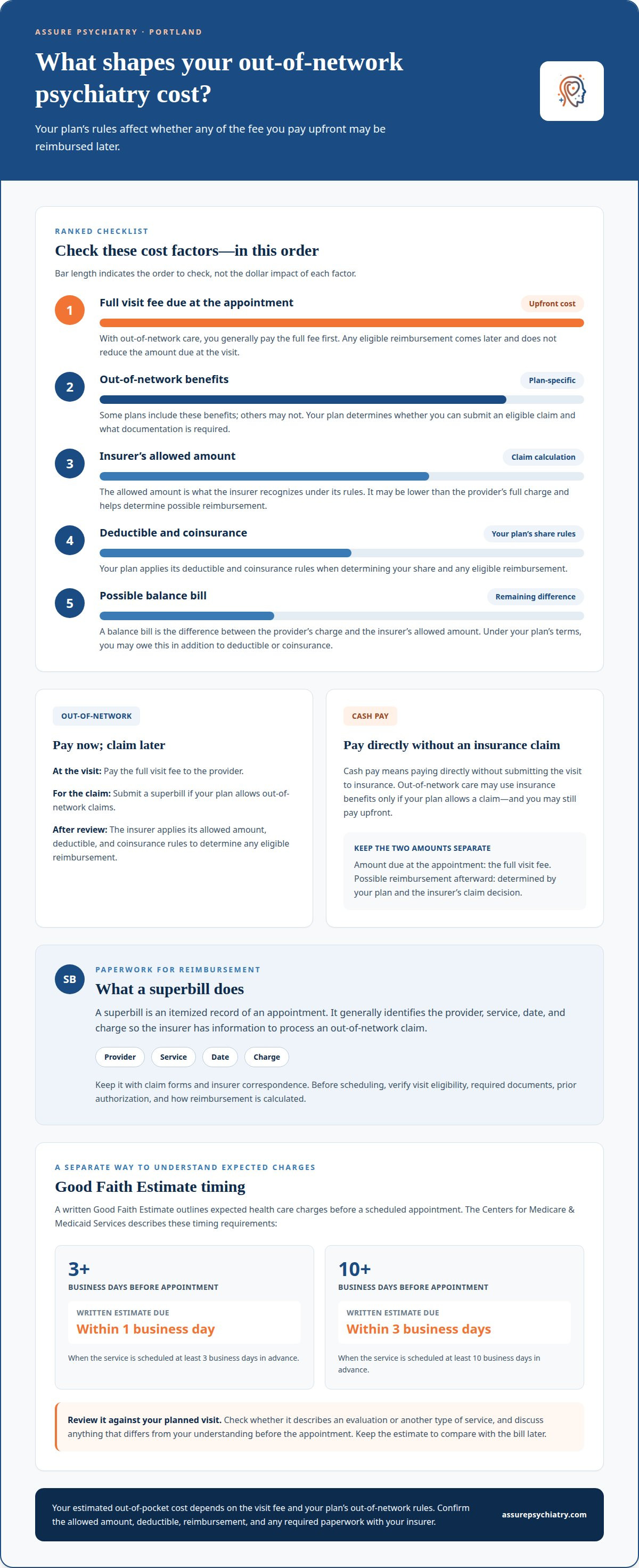
Some insurance plans include out-of-network behavioral health benefits; others may not. The insurer applies your plan’s deductible, coinsurance, and allowed amount to determine possible reimbursement. Before a visit, ask whether psychiatric evaluations and medication management are covered, whether prior authorization applies, and what documentation supports a claim. The U.S. Department of Labor explains that the Mental Health Parity and Addiction Equity Act of 2008 requires insurance companies to provide mental health coverage comparable to physical health coverage. Parity does not mean every service is covered.
Psychiatrist Visit Costs With Insurance
Your cost for a psychiatrist visit depends on whether the provider is in network, whether you’ve met your deductible, and how your plan calculates coinsurance. In-network visits may involve a copayment or deductible. For out-of-network visits, you may need to pay the full fee upfront and seek reimbursement afterward. The amount you ultimately pay depends on the visit and your plan. Ask your insurer what it considers the allowed amount, what share it reimburses, and whether the deductible applies. These details help you estimate your out-of-pocket costs.
Payment Categories
Insurance categories can include in-network care, out-of-network care, and private-pay care. In-network providers follow the plan’s contracted payment terms. With out-of-network care, you may pay the provider directly and submit a claim, depending on plan rules. Private-pay care means paying without using insurance benefits. Coverage also varies by service: individual therapy, psychiatric evaluations, and medication management may be covered, while family or group therapy depends on the plan. Couples therapy is often not covered, so distinguish it from family therapy when discussing benefits.
Balance Billing and Allowed Amounts
A balance bill is the difference between a provider’s charge and the amount an insurer recognizes as the allowed amount. For out-of-network care, Oregon patients may owe this difference under their plan’s terms, in addition to any deductible or coinsurance. The allowed amount may be lower than the provider’s full charge, and the insurer calculates reimbursement according to its rules. Ask how your plan defines the allowed amount, applies the deductible, and handles any remaining balance. This can clarify how out-of-network psychiatrist costs in Portland may affect your budget.
Cash pay and out-of-network care with superbills
Cash pay and out-of-network care both involve paying outside an insurer’s in-network billing arrangement, but they use insurance differently. In Portland, patients using out-of-network benefits generally pay the full visit fee at the appointment. If their plan allows it, they can then submit a superbill to seek reimbursement. Reimbursement comes later, so it does not reduce the amount due at the visit.
A superbill is an itemized document recording key details about a health care appointment. It generally identifies the provider, service, date, and charge, giving the insurer information to process an out-of-network claim. Keep it with any claim forms and insurer correspondence. The insurer applies your plan’s out-of-network rules, including the deductible, coinsurance, and allowed amount, to determine any eligible reimbursement.
Before scheduling, review your plan’s out-of-network mental health benefits and claim process. Ask the insurer whether psychiatric visits are eligible, what documentation it requires, whether prior authorization applies, and how reimbursement is calculated. This helps distinguish a plan that may reimburse part of a visit from one without out-of-network benefits. General behavioral health coverage alone does not explain what your plan will reimburse for a specific appointment.
For a practical estimate, separate the amount due at the appointment from any possible reimbursement afterward. The first is the full visit fee; the second depends on your plan’s rules and the insurer’s claim decision. Budget for reimbursement as a separate step, not as a discount at checkout. If your plan requires specific paperwork, submitting a complete claim with the superbill can help the insurer review it.
Cash pay means paying directly without submitting the visit to insurance. Out-of-network care uses insurance benefits only if your plan allows a claim, and you may still need to pay upfront. Comparing these options helps you plan for the immediate cost and any later reimbursement.
Good Faith Estimates
A Good Faith Estimate provides a written view of expected health care charges before a scheduled appointment. For a psychiatric evaluation, it can help you understand the planned service and discuss costs before care begins. Keep the estimate with your appointment records so you can compare it with the bill later. It can also support a clear conversation about the services included.
The Centers for Medicare & Medicaid Services says a Good Faith Estimate must be provided in writing within 1 business day when a healthcare service is scheduled at least 3 business days in advance. When a healthcare service is scheduled at least 10 business days in advance, the Centers for Medicare & Medicaid Services says the written estimate must be provided within 3 business days. These timelines depend on how far ahead the appointment is scheduled.
Read the estimate carefully when you receive it. Match the named service to the appointment you plan to attend, and note whether it describes an evaluation or another type of visit. If the estimate differs from your understanding, discuss the details before the appointment. A written estimate makes planned charges easier to follow, but it does not replace understanding which services are included.
After receiving a bill, compare its charges with the Good Faith Estimate from that provider or facility. According to the Centers for Medicare & Medicaid Services, a patient can dispute a bill when it is at least $400 more than the Good Faith Estimate from that provider or facility. Keep the estimate, bill, and related appointment documents together. This makes it easier to identify the difference and explain which charges you are disputing.
A practical sequence is simple: save the estimate, attend the scheduled appointment, then review the bill against the written amount. If a bill crosses the $400 threshold, use the dispute process described by the Centers for Medicare & Medicaid Services. Keep copies of the documents and notes from any discussion. This organized record can help you track the estimate, the delivered care, and the amount billed.
Oregon self-pay psychiatry and medication management costs
Self-pay psychiatry means paying directly for care rather than using insurance benefits. In Oregon, the total depends on the type and structure of the visit, including whether it is an evaluation or ongoing medication management. These appointments serve different purposes: an evaluation reviews symptoms, history, and treatment needs, while follow-up visits focus on progress and medication decisions.
Medication-management follow-ups with a psychiatrist are typically 30 minutes. That appointment time can help patients understand what a follow-up involves, but it does not establish the session charge. The cost is shaped by the service provided and the clinician’s fee structure. Patients seeking continuing care can consider how often visits may be needed and how those appointments fit their budget.
Self-pay and out-of-network payment also differ in how insurance is used. With self-pay, you pay directly and do not submit the visit through insurance. With out-of-network benefits, you may pay upfront and seek reimbursement under your plan. The deductible, coinsurance, allowed amount, and claim requirements all affect potential reimbursement. A superbill can document the visit for a claim, but it does not guarantee that the insurer will pay.
Are sliding-scale psychiatrists or lower-cost psychiatric services available in Portland? Some practices may offer sliding-scale arrangements, but eligibility and payment terms vary. To compare options, look at the type of care you need, such as an evaluation or follow-up, and whether your plan offers out-of-network reimbursement.
For a clearer estimate, identify the visit type, expected appointment length, and payment method before scheduling. Ask what the estimate includes and whether follow-up care is billed separately. These details help patients plan for the full course of care rather than focusing only on the first appointment. If medication decisions are part of your care, explore medication management options as a next step toward a treatment plan that fits your needs.
Assure Psychiatry
When you’re ready to discuss psychiatric care, Assure Psychiatry provides psychiatric evaluations and medication management in Portland. The clinic treats conditions including ADHD and anxiety. An evaluation offers time to discuss your concerns and care needs as part of a thoughtful treatment conversation.
Assure Psychiatry offers outpatient care in Portland, with in-person visits and virtual telepsychiatry. If you’re weighing out-of-network expenses, understanding your insurance benefits can help you plan how to pay for care. The clinic’s focus is compassionate, culturally competent support, with an approach that respects your individual needs.
If you’re seeking a psychiatric evaluation or ongoing medication management, contact Assure Psychiatry to discuss the next step in care.
Take a thoughtful next step toward care
Choosing care is not only a financial decision. It also means finding an approach that feels workable and respectful of your needs. Once you understand how your plan handles out-of-network care, you can make a more informed decision about seeking support. The details behind out-of-network psychiatrist costs in Portland matter, as does feeling comfortable discussing your concerns and goals.
Assure Psychiatry offers psychiatric evaluations and medication management for people seeking help with ADHD or other mental health concerns. You can take the next step at your own pace and start a conversation about what support may fit your needs. Clear communication can make care feel more manageable, even when insurance details are complicated.
Contact Assure Psychiatry to discuss your care needs and explore a way forward. Seeking support is a meaningful step toward greater balance and peace of mind.
Frequently Asked Questions
Do you accept insurance?
Assure Psychiatry accepts most major insurance plans, but your specific plan determines whether a visit is covered and what you may owe. Before scheduling, contact your insurer to ask about benefits for psychiatric evaluations and medication management. Have the practice name and appointment type ready when you call. This helps you get plan-specific information rather than relying on general coverage descriptions.
How do I use my out-of-network benefits?
Ask your insurance company whether your plan includes out-of-network psychiatric benefits and what documents it requires for a claim. If you pay directly for a visit, keep the receipt and any superbill provided, then submit them with the insurer’s claim form. Confirm whether the claim requires a diagnosis code or prior authorization. Your plan determines how eligible claims are processed.
How much does a psychiatrist cost?
There isn’t one fixed psychiatrist fee for every patient or appointment. The amount depends on the service and appointment structure, while your insurance benefits can affect your share. For a useful estimate, identify whether you need an initial evaluation or follow-up care, then consider whether you’ll pay privately or use insurance. This gives you a clearer basis for budgeting.
What is the typical out-of-network psychiatrist fee per session in Portland, Oregon?
Out-of-network psychiatrist fees in Portland vary by provider and appointment type, so one typical fee may not reflect your expected cost. Your payment at the visit may differ from your eventual expense if your plan reimburses part of an eligible claim. For example, your deductible may affect reimbursement even when your plan includes out-of-network benefits. Budget for the amount due at the appointment rather than assuming reimbursement.
How much do psychiatrists in Portland charge for an initial evaluation versus follow-up visits?
Initial evaluations and follow-up visits serve different purposes, so their charges may differ. An evaluation focuses on your history, symptoms, and care needs; a follow-up may focus on progress and medication decisions. Ask which type of visit is planned and what it includes. If medication management is part of follow-up care, clarify whether that appointment is billed separately from the initial evaluation.
Does Oregon health insurance cover out-of-network psychiatrist visits, and how does reimbursement work?
Oregon insurance plans may cover out-of-network psychiatric visits, but eligibility and reimbursement depend on the individual plan. Ask your insurer whether the service is eligible, how to submit a claim, and what documents are required. After a visit, submit the required materials and keep copies of the insurer’s decision. Any reimbursement follows the plan’s terms and may be less than your full payment.
Recent Comments