

Culturally responsive psychiatric care starts with listening to how your identity and life experiences shape your well-being. A psychiatrist that understands cultural differences in Portland should make room for your values, community, and personal history, rather than treating a diagnosis as the whole story. Care can also take into account experiences related to being LGBTQ+, autistic, or a military veteran.
It’s reasonable to want a clinician who takes your concerns seriously without making assumptions about your background. This article explains what culturally responsive psychiatric care can look like, what to consider when choosing a provider, and how psychiatric evaluations and medication management may fit into care. You’ll also learn how in-person and virtual appointments can support different needs, so you can approach the next step with a clearer idea of what matters to you.
Key Takeaways
- Look for a clinician who listens to how your identity, values, and lived experiences shape your mental health needs.
- Compare provider specialties with the concerns you want help addressing, such as anxiety, depression, trauma, or ADHD.
- Understand how psychiatric evaluation and medication management differ from psychotherapy when deciding what kind of support you need.
- Explore how Assure Psychiatry’s evaluations and medication management may support care for ADHD or anxiety.
Care for people from diverse backgrounds, including LGBTQ+ patients, autistic people, and military veterans
In Portland, consider how a psychiatrist discusses race, ethnicity, and cultural identity. A psychiatrist that understands cultural differences in Portland will invite your perspective and consider it during an assessment, rather than relying on assumptions.
Culturally Sensitive Psychiatric Care
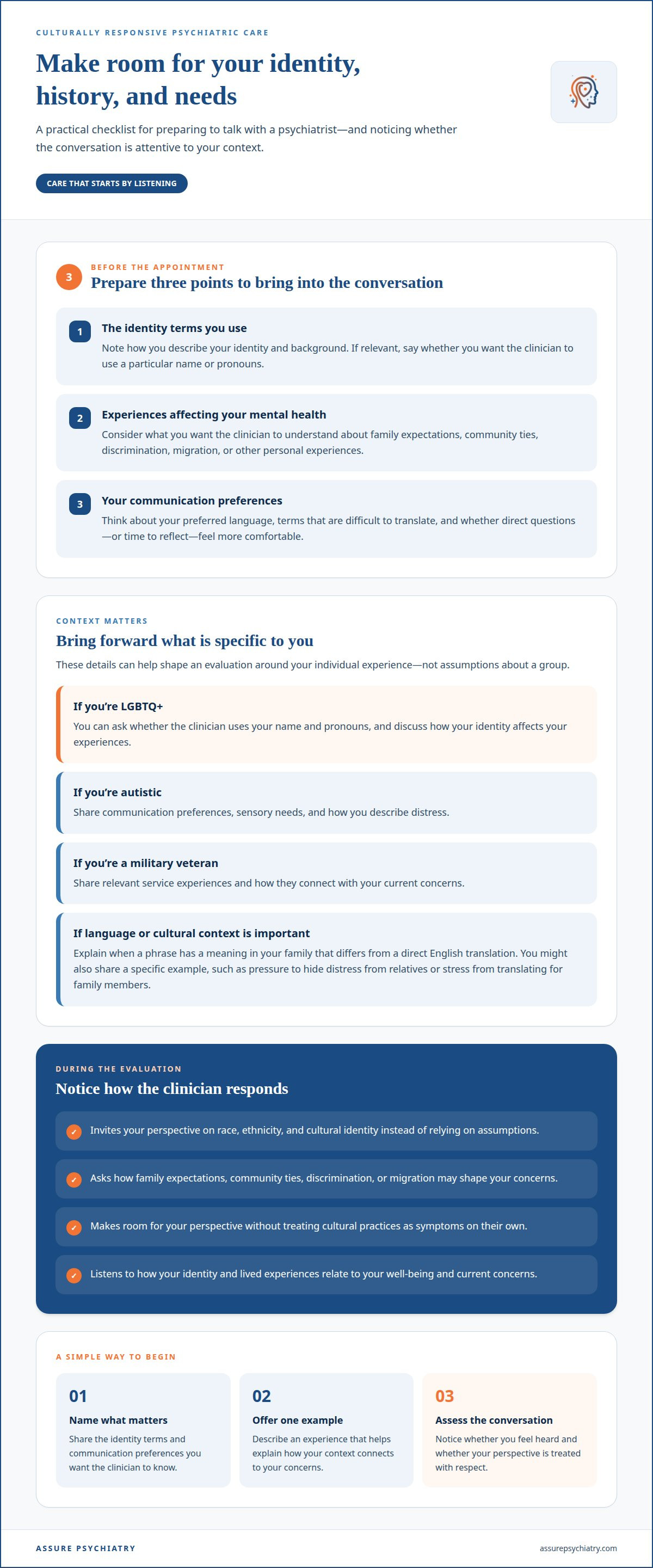
For LGBTQ+ patients, ask whether the clinician uses your name and pronouns and respects how your identity affects your experiences. If you’re autistic, discuss communication preferences, sensory needs, and how you describe distress. If you’re a military veteran, share relevant service experiences and how they connect with your current concerns. These examples help shape an evaluation around your individual context, not stereotypes about a group.
Language Options for Care
Choose the language in which you can most comfortably describe your emotions, symptoms, and personal history. For example, a phrase used in your family may carry a different meaning than its direct English translation. Before an evaluation, note your preferred language and any terms that feel difficult to translate. Clear communication can help keep important context in the conversation.
Care for Race, Ethnicity, and Cultural Identity
A clinician’s approach is more informative than a broad promise of cultural competence. During an evaluation, notice whether the psychiatrist asks how family expectations, community ties, discrimination, or migration shape your concerns. You might share a specific example, such as pressure to hide distress from relatives. A thoughtful discussion makes room for your perspective and avoids treating cultural practices as symptoms on their own.
Before your first appointment, prepare three points: the identity terms you use, experiences affecting your mental health, and your communication preferences. For example, note whether direct questions feel comfortable or whether you need time to reflect. These details provide a practical starting point and help you assess whether the conversation feels respectful and attentive.
Provider specialties and mental health conditions
Match a provider’s clinical focus with the concerns you want to address. In Portland’s 97217 directory listings, 89% of psychiatrists prioritize anxiety, 86% depression, and 82% trauma and PTSD. Those figures can help you understand common specialties, but your own needs and preferred approach should guide the fit.
For immigrant, refugee, and first-generation patients, relevant experience includes understanding how migration, family expectations, language, and cultural adjustment can affect mental health. Ask how the psychiatrist takes those experiences into account during an evaluation. A specific example, such as stress from translating for family members, can help explain what you want the clinician to understand.
Age range matters, too. A provider may focus on adults, adolescents, or a broader age group, so look for a clear match for the person seeking care. Consider whether the provider treats concerns such as anxiety, depression, or trauma. If you’re unsure how your symptoms fit, describe how they affect sleep, work, school, or relationships.
Provider demographics and experience offer additional context, not a substitute for clinical fit. Among 97217 directory listings, 76% of providers are female, 16% are male, and 8% are non-binary. Listed psychiatrists average 13 years in practice. These details can inform your preferences, while a provider’s listening style and relevant experience remain important.
To verify credentials, compare the psychiatrist’s name and stated credential with the official Oregon licensing authority’s lookup. Then ask how they work with patients whose cultural backgrounds differ from their own. Specific answers about assessment, communication, and treatment planning offer more insight than a general claim of cultural competence.
If you’re considering care, learn about culturally responsive support and consider whether an evaluation could help clarify your needs.
Psychiatrists and psychiatric nurse practitioners in Portland, Oregon
Portland listings include both psychiatrists and psychiatric mental health nurse practitioners (PMHNPs). Psychology Today lists more than 20 psychiatrists in ZIP code 97217. Compare each listing’s credentials, areas of focus, appointment format, and cultural experience instead of treating titles as interchangeable.
Insurance participation can narrow your options. In 97217 directory listings, 85% of psychiatrists accept BlueCross and BlueShield, 77% accept Aetna, and 73% accept Moda Health. For Oregon Health Plan, use the directory for your specific plan and Portland area to identify in-network psychiatric providers. Coverage and network participation are tied to the individual plan.
PMHNPs are another type of psychiatric provider to consider. For example, Kristen Helms is listed as a psychiatric mental health nurse practitioner in Oregon and 1.02 miles away in Portland. A listing gives you a starting point, but your priorities matter too: consider whether you want in-person or virtual appointments, and whether the provider’s experience aligns with your needs.
Use a focused comparison process. First, identify the credentials and specialty that fit the care you’re seeking. Next, compare the provider’s approach with what matters to you, such as discussing family or cultural context without assumptions. Then review location, appointment format, and insurance participation. These practical details can help you choose care that fits your needs and everyday circumstances.
Before scheduling, prepare questions about how an evaluation works and what you want to discuss. For instance, explain how stress affects your sleep or concentration, then ask how that information informs the assessment. A psychiatric evaluation can bring symptoms and personal history together into a clearer clinical picture. Choose a provider whose communication helps you share that context comfortably.
Kristen Helms is a psychiatric mental health nurse practitioner in Oregon who has been practicing since 2024. That detail can help you frame questions about her professional background, but it does not by itself show whether her approach or appointment options fit your needs. Ask how she handles the concerns you want to discuss, what the first appointment involves, and whether her care can be coordinated with other support you use.
Psychotherapy and medication management
Psychotherapy and medication management are different forms of mental health care. Psychotherapy focuses on conversations and therapeutic approaches, while medication management involves reviewing medication as part of psychiatric care. Understanding the distinction helps you describe the support you’re seeking, such as discussing ongoing stress or reviewing how a current medication fits your needs.
After an introductory session, psychiatry appointments may last 15-20 minutes and focus largely on medication management. A shorter appointment can still cover important updates, including changes in sleep, mood, concentration, or daily routines. Bring a concise example, such as trouble concentrating at work, so the conversation has a clear starting point.
Medication decisions should take into account your symptoms, health history, current medications, and personal priorities. Cultural context can matter, too. Family beliefs may shape how you view medication, for example, or past experiences may affect how comfortable you feel discussing it. Sharing these concerns makes the conversation more specific to your circumstances.
To prepare for a medication review, write down the medications you take, any changes you’ve noticed, and questions you want answered. Include a practical detail, such as whether a symptom affects school, work, or relationships. This can organize the discussion and clarify what you’d like the clinician to consider. Don’t change or stop a prescribed medication without discussing it with the prescribing clinician.
Psychiatric care can include an evaluation to understand your concerns and medication management when that approach fits your needs. If you’re looking for support reviewing medication as part of psychiatric care, explore medication management as a possible next step.
Psychiatrists often spend upwards of 12 years completing bachelor’s, medical doctorate, and residency training. When discussing medication management, you can use that appointment to explain what you hope to address and ask how your concerns will be considered. If a recommendation feels unclear, ask for an explanation in terms that make sense to you, and share any priorities that could affect your decision.
You can also note what you want to understand, such as how a proposed approach relates to your concerns or which questions remain unanswered. Being direct about uncertainty can help keep the discussion focused on what matters to you.
Assure Psychiatry: Medication Management
Assure Psychiatry offers psychiatric evaluations and medication management for people seeking support with mental health concerns. An evaluation can help clarify symptoms and inform a care plan. Medication management offers a setting to review treatment and discuss questions as they arise.
If anxiety or ADHD symptoms are affecting your daily routine, for example, share what you’ve noticed and what matters to you in care. Your background and preferences belong in the conversation, helping you take an active role in treatment decisions. An evaluation may be a useful starting point if you want to better understand your concerns; medication management may fit if you’re seeking support with psychiatric medication.
Contact Assure Psychiatry to discuss whether a psychiatric evaluation or medication management is a useful next step for you.
Take a Thoughtful Next Step Toward Care
Choosing a psychiatrist that understands cultural differences in Portland can begin with a simple question: what would help you feel heard during care? Notice whether you can speak openly about your concerns, priorities, and the experiences shaping your well-being. You deserve to take an active role in decisions about your mental health.
Assure Psychiatry offers psychiatric evaluations, medication management, and ADHD treatment to patients in Oregon. An evaluation may be a helpful starting point when you want to discuss symptoms and understand possible next steps. Medication management supports conversations about psychiatric medication as part of care.
If you’re ready to explore whether these services fit what you’re seeking, contact Assure Psychiatry. Taking a first step can feel meaningful, and you can move forward at a pace that feels right for you.
Frequently Asked Questions
How to find a culturally responsive psychiatrist in Portland, Oregon?
Start with Portland provider profiles and look for specific descriptions of inclusive care rather than relying on labels alone. Note whether a clinician discusses adapting communication, considering family or community context, and respecting identity. Prepare a brief example of what you want understood, such as how workplace expectations affect your stress. In the first conversation, notice whether the clinician listens and responds thoughtfully.
What questions should I ask a psychiatrist about cultural understanding before booking?
Ask questions that invite concrete answers: “How do you include a patient’s cultural background in an evaluation?” and “How do you respond if my family’s beliefs differ from your recommendations?” You can also ask how the psychiatrist approaches identity-related stress or communication preferences. Share an example that matters to you, then consider whether the response feels respectful, curious, and specific to your situation.
Portland community clinics and directories for culturally specific mental health care
Psychology Today lists more than 20 psychiatrists in Portland’s 97217 ZIP code. Compare providers’ cultural experience and ask how they consider family, community, language, and identity during evaluation.
Recent Comments