

A move, a new role, a loss, or a change in family life can affect sleep, concentration, relationships, and daily responsibilities. Feeling unsettled during a major change doesn’t automatically mean something is wrong, but persistent or disruptive symptoms may deserve closer attention. If you’re weighing what you’re experiencing, psychiatric help for life transitions Oregon can offer a place to discuss the change and its effects with a clinician.
It makes sense to want clarity without having every difficult feeling turned into a diagnosis. A psychiatric evaluation considers symptoms alongside life events, personal history, and health context. It can help clarify what may be contributing to distress and what kinds of care could fit. Medication management may be discussed when clinically appropriate, but it isn’t an automatic outcome of an evaluation.
This article explains when a life transition may be affecting your mental health, what an evaluation and follow-up can involve, and how to prepare for a conversation. Assure Psychiatry offers in-person care in Portland and virtual psychiatric care in Oregon. If you’re comparing care in Portland with options in Seattle, Washington, remember that virtual appointments with Assure Psychiatry are for patients located in Oregon during the visit.
Key Takeaways
- A major life change can bring mixed emotions and disrupt routines without automatically meaning you have a mental health condition.
- An evaluation can put symptoms in context by considering your history, health, timing, and how the change affects daily life.
- Psychiatric evaluation, medication follow-up, and self-directed coping practices serve different support needs.
- Prepare for a psychiatric conversation by noting what changed, when symptoms began, how they affect you, and what you hope will improve.
- Explore psychiatric help for life transitions Oregon through in-person care in Portland or virtual telepsychiatry for patients in Oregon.
Psychiatric Help for Life Transitions in Oregon: When Change Starts Affecting Wellbeing
A major change can bring relief and excitement, grief and uncertainty, or several feelings that seem to contradict one another. You might welcome a new job and still miss the structure of the old one. You might look forward to retirement while feeling unsettled about how your days will change. Mixed emotions don’t mean you’re responding incorrectly; they can be part of making sense of change.
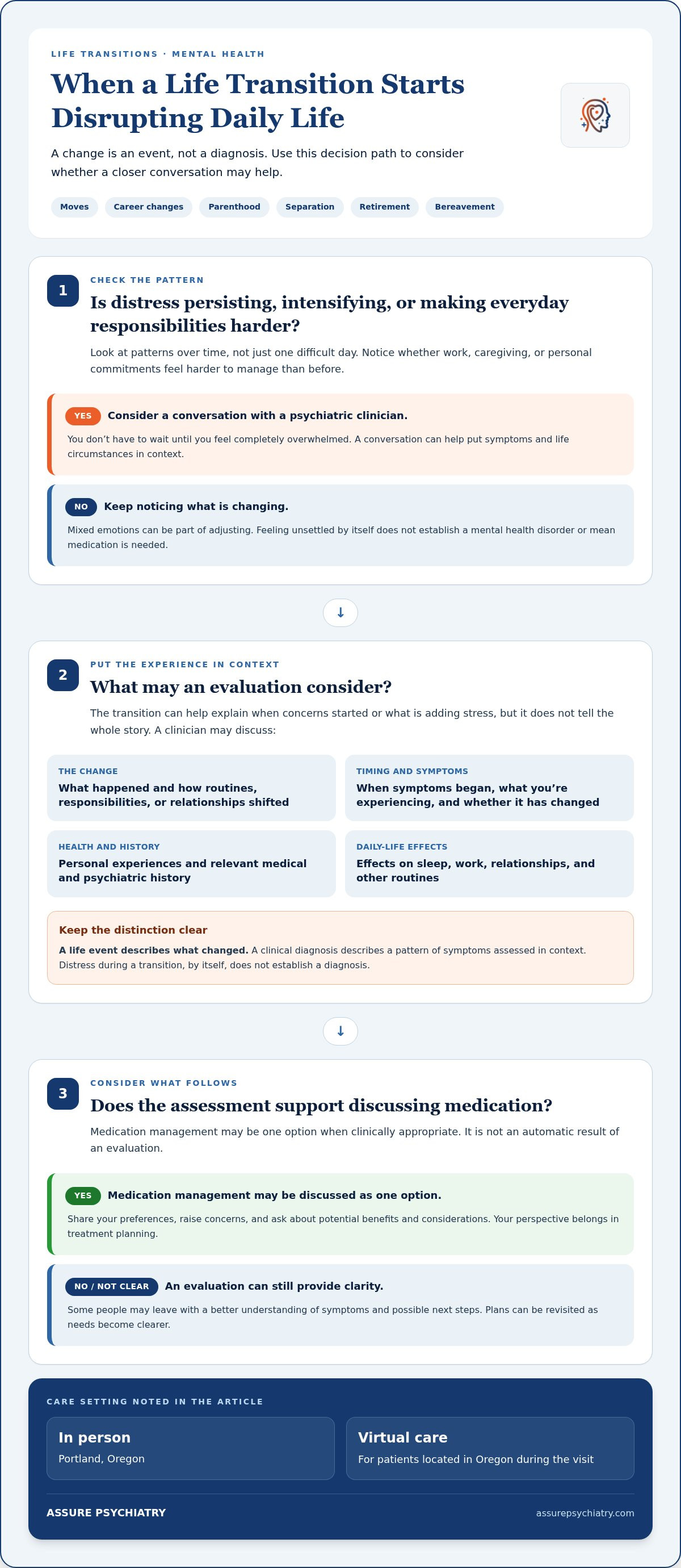
A life transition is a significant change that can reshape routines, responsibilities, relationships, or a sense of identity. The transition itself is an event, not a diagnosis. A life event describes what has changed; a clinical diagnosis describes a pattern of symptoms assessed in context. Feeling distressed during a transition, by itself, doesn’t establish that you have a mental health disorder or need medication.
Context still matters. If distress persists, intensifies, or begins to interfere with everyday life, a conversation with a psychiatric clinician may help clarify what’s going on. Psychiatric help for life transitions Oregon can start with understanding how symptoms relate to the change, rather than assuming that the transition explains everything.
Which life changes can affect mental health?
Relocation, a career change, becoming a parent, separation, retirement, and bereavement can all reshape daily life. A move may mean rebuilding social connections; a new caregiving role can leave less time for rest; retirement may alter routines and a familiar sense of purpose. Even a positive transition can take adjustment and effort.
Changes in responsibilities and disrupted routines can add strain, especially when several changes overlap. There’s no universal emotional response to any one event. People bring different histories, resources, relationships, and expectations to the same transition, so comparing your response with someone else’s may not tell you whether your experience needs attention.
When does adjustment deserve a closer conversation?
Consider seeking clinical guidance if distress isn’t easing, is becoming more intense, or is making ordinary responsibilities harder to manage. You might notice changes in sleep, concentration, mood, or tension in relationships. These observations don’t diagnose a condition, but they can help you describe what’s different and decide whether an assessment would be useful.
Pay attention to patterns as well as individual feelings. Are difficult days becoming more frequent? Is it harder to meet work, caregiving, or personal commitments than before? You don’t need to wait until you feel completely overwhelmed to raise these concerns. A psychiatric conversation can put symptoms and life circumstances in context and help identify possible next steps.
How Psychiatric Evaluation Can Put Life-Transition Symptoms in Context
A psychiatric evaluation can help make sense of symptoms that seem connected to a major change, without assuming the change tells the whole story. A clinician considers what you’re experiencing alongside when it began, your personal and medical history, relevant health context, and how daily life has been affected. That broader view can help clarify what may need attention and whether the experience could be part of an adjustment process.
Life-event context informs a clinical assessment, but it doesn’t replace one. The transition may help explain when concerns started or what is adding stress. An assessment also considers the symptoms themselves and the broader picture of your health and functioning. The purpose is to understand your needs and discuss possible next steps, not to assign a label automatically.
For people searching “psychiatric help for life transitions Oregon,” an evaluation offers a structured conversation when it’s hard to tell what’s contributing to distress. It can also establish what to keep track of over time, particularly if symptoms change or begin affecting daily responsibilities in new ways.
What may a psychiatric evaluation discuss?
You may talk through what changed, when symptoms appeared, whether they’ve shifted, and how they affect sleep, work, relationships, or other routines. The clinician may also ask about previous experiences and medical and psychiatric history. These details provide a fuller picture than the transition alone. This guide to psychiatric evaluation explains what a first conversation may involve.
Does psychiatric care always mean medication?
No. An evaluation doesn’t make medication automatic, and medication isn’t the right choice for everyone. If your symptoms and the clinical assessment support it, medication management may be discussed as one option. You can share your preferences, raise concerns, and ask about potential benefits and considerations. Your perspective belongs in the treatment-planning conversation.
A treatment plan should reflect the person, not just a list of symptoms. A clinician can explain the reasoning behind options and consider how they relate to your concerns and goals. Some people may benefit from medication follow-up; others may leave an evaluation with more clarity about their symptoms and possible next steps. Plans can be revisited as your needs become clearer.
To learn about evaluation and medication management at Assure Psychiatry, explore psychiatric care in Oregon. An informed conversation can help you consider what support fits, without requiring you to arrive with a diagnosis or a decision already made.
Life-Transition Distress: How to Think Through Support Options
The most useful support depends on what you need help with now. You might want a clearer understanding of symptoms, a conversation about whether medication could help, or practical ways to steady daily routines. These options serve different purposes, and more than one may be relevant. Coping practices can support day-to-day wellbeing, but they shouldn’t replace assessment when distress persists or disrupts everyday functioning.
Use this comparison as a starting point, not a ranking. Consider what you want help understanding, how symptoms are affecting you, and whether you want to discuss possible treatment with a clinician.
| Option | Main purpose | What it may help with |
|---|---|---|
| Psychiatric evaluation | Understand symptoms and possible contributing factors | Reviewing symptom patterns, health and psychiatric history, and effects on daily life |
| Medication follow-up | Review an individualized medication plan, when appropriate | Discussing response, concerns, and whether a treatment plan needs adjustment |
| Self-directed coping practices | Support day-to-day steadiness | Trying routines such as regular sleep and meals, brief grounding practices, or breaking tasks into manageable steps |
Self-directed practices may bring structure to an unsettled period, but they don’t determine why symptoms are happening. If you’re unsure what’s driving a change in mood or focus, or the strain is making work, relationships, or basic responsibilities harder, a professional assessment can help clarify what support may fit. Psychiatric help for life transitions Oregon can include an evaluation without presuming that medication is necessary.
When could a psychiatric assessment be useful?
An assessment may be useful if distress is worsening, symptoms could have several explanations, or daily tasks feel harder to manage. A clinician can consider anxiety, depression, ADHD, PTSD, or other concerns when relevant, rather than attributing every change to the transition. If anxiety is part of what you’re experiencing, this guide to anxiety treatment offers related information.
How can Oregon telepsychiatry fit into care?
Virtual appointments offer an alternative to traveling to an office for patients located in Oregon during the appointment. In-person visits at Assure Psychiatry’s Portland office may suit people who prefer meeting face to face; telepsychiatry may be more practical if you prefer a remote visit. For either format, consider where you’ll feel comfortable speaking and how the appointment fits into your routine. People searching from Seattle, Washington, should distinguish Oregon telepsychiatry from care available where they are physically located. Learn more about telepsychiatry in Oregon to understand the virtual-care format.
How to Prepare for a Psychiatric Conversation About a Life Change
You don’t need a perfect explanation of what you’re feeling to have a useful psychiatric conversation. A few notes can help you describe what changed and what you’d like help understanding. Use them as a guide for discussion, not a test you have to pass.
Try this four-step outline. A few words for each step may be enough:
- Name the change. Describe the life event or shift in responsibilities as you understand it.
- Track symptoms. Note what you’ve noticed and when it began. Include whether it’s eased, stayed similar, or become more intense.
- Note daily effects. Record how your concerns affect routines, work, relationships, or tasks that usually feel manageable.
- Identify your goals. Consider what you hope to understand or change, such as sleeping more steadily or feeling more focused during the day.
If you have a list of medications or relevant health-history information, bring it or keep it accessible for a virtual appointment. You can also jot down questions as they occur to you. For psychiatric help for life transitions Oregon, these notes can give the conversation a starting point. You don’t need to arrive with a diagnosis, a complete timeline, or every detail worked out.
What details can help explain what has changed?
Consider noting changes in mood, sleep, concentration, energy, and everyday routines. Specific examples are often easier to discuss than broad summaries: “I’m waking earlier than usual” or “I lose track of tasks by afternoon.” You might also note what feels hardest and anything that has helped so far. Share what you feel comfortable discussing, and ask why a detail matters if you’re unsure.
A simple timeline can help you notice patterns. Record roughly when the concern began and whether it shifted alongside changes in your schedule, responsibilities, or relationships. Incomplete notes are fine. Your recollection and questions are still useful, and a clinician can help explore what feels unclear.
What questions can patients bring to the appointment?
Questions can help you take part in decisions. You might ask:
- What could an evaluation help clarify about what I’m experiencing?
- How will you explain recommendations and the reasons behind them?
- If medication is being considered, what benefits and possible side effects should I understand?
- What would follow-up involve, and how would we review whether a plan is helping?
It’s okay to state your preferences, name concerns, or ask for an explanation in plain language. If you’d like to discuss how an evaluation may help clarify your concerns, connect with Assure Psychiatry.
Finding Psychiatric Help for Life Transitions in Oregon
A change in circumstances can make it difficult to tell what’s temporary strain and what deserves more attention. A psychiatric evaluation can help organize that uncertainty by reviewing symptoms, health and psychiatric history, and effects on daily life. At Assure Psychiatry, care includes psychiatric evaluations and, when clinically appropriate, individualized medication management. The aim is to understand your needs and discuss options, not to assume that every difficult transition requires a diagnosis or medication.
People seeking psychiatric help for life transitions Oregon can access Assure Psychiatry through in-person appointments at its Portland office or virtual telepsychiatry for patients in Oregon. A virtual visit may suit your circumstances if you prefer to meet remotely; an in-person appointment offers a face-to-face setting. The practice provides compassionate, culturally competent care and accepts most major insurance plans. If you’re in Seattle, Washington, keep in mind that Assure Psychiatry’s virtual care is for patients located in Oregon during the appointment.
What can ongoing medication management address?
If medication is part of your plan, follow-up appointments provide time to discuss how you’re responding, any side effects or concerns, and whether adjustments may be appropriate. The purpose is to review treatment in light of your experience and clinical needs, rather than assume everyone needs the same pattern of care. You can raise questions and share changes you’ve noticed between visits. This Portland medication management guide explains more about this kind of follow-up.
What is a manageable first step toward care?
Start by considering what would feel most useful: an evaluation to better understand symptoms, or a conversation about concerns you’re already tracking. You don’t need to settle every question beforehand. Bringing a few notes about what has changed, what feels difficult, and what you hope to improve can help focus the discussion. You can share preferences, ask questions, and request clear explanations as care options are considered.
It’s reasonable to take this one step at a time. Seeking an evaluation doesn’t commit you to a particular treatment; it creates space to discuss your situation and consider what feels appropriate with a clinician. If you’re ready to explore psychiatric care in Oregon, learn more about care with Assure Psychiatry.
Take One Steady Step Toward Support
You don’t have to know exactly what’s wrong, or have every next step mapped out, before asking for support. It can be enough to notice that something feels different and that you’d like help making sense of it. A life transition may take time to settle, and seeking guidance doesn’t mean you’ve failed to manage it on your own.
Considering psychiatric help for life transitions Oregon can create space to discuss your concerns and decide what feels useful now. Bring questions, uncertainties, and preferences into the conversation. The aim is a clearer understanding of what might help you feel more grounded, not a forced quick answer.
If you’re ready to take a next step, schedule a conversation with Assure Psychiatry about psychiatric evaluation or medication management in Portland or through virtual care in Oregon.
Frequently Asked Questions
Can a life transition cause anxiety or depression?
A major change can contribute to anxiety or low mood, or make existing symptoms more noticeable, but the event alone doesn’t establish a diagnosis. For example, a move may bring practical pressures and distance from familiar support, while a promotion may add responsibilities. If feelings persist or interfere with daily life, a clinician can consider their timing and your symptoms alongside your broader health history.
How do I know if I need psychiatric help during a major life change?
Consider an assessment if distress is worsening, you’re unsure what’s causing it, or it’s making everyday responsibilities difficult to manage. Keep track of what feels different and how it affects work, relationships, or routines. Seeking psychiatric help for life transitions Oregon doesn’t mean you’ve decided you have a disorder; an evaluation can help clarify whether symptoms warrant attention and what options may fit.
Does seeing a psychiatrist mean I will have to take medication?
No. An appointment doesn’t obligate you to take medication, and medication isn’t appropriate for everyone. A psychiatrist may discuss medication management if your symptoms and assessment suggest it could be useful. You can talk through your preferences, concerns, and questions before making decisions. If medication is considered, ask about possible benefits, side effects, and how you and your clinician would review your response.
Can I access telepsychiatry for mental health care in Oregon?
Yes. Assure Psychiatry offers virtual telepsychiatry for patients in Oregon, as well as in-person visits at its Portland office. A remote appointment may suit you if you prefer to meet from a private space, while an office visit may be preferable face to face. For virtual care, plan to be located in Oregon during your appointment and choose a setting where you can speak comfortably.
What happens during a psychiatric evaluation for transition-related symptoms?
A psychiatric evaluation typically includes discussion of your concerns, symptom history, and relevant medical and psychiatric background. You can describe what prompted you to seek care and how symptoms affect daily activities. The clinician uses this information to understand your needs and discuss possible recommendations. You don’t need to arrive with a diagnosis; it may help to bring a medication list or notes about symptoms you’ve noticed.
Can psychiatric care help with a move, career change, or relationship change?
Psychiatric care can assess emotional or behavioral symptoms that arise during a move, career change, or relationship change. The focus is on understanding concerns such as anxiety, low mood, sleep disruption, or difficulty concentrating, and considering an appropriate care plan. The life event provides useful context; care isn’t a judgment about whether your reaction is right or wrong. Medication management may be discussed when clinically appropriate.
Does insurance cover psychiatric evaluations in Oregon?
Coverage depends on your plan, benefits, and the details of the service. Assure Psychiatry accepts most major insurance plans, but that doesn’t guarantee every plan covers every evaluation or that your out-of-pocket costs will be the same. Review your plan’s behavioral health benefits, including any deductible, copay, or referral requirements. Your insurer’s member resources can explain your individual coverage.
Recent Comments