

What if explaining my mental health condition to my partner doesn’t mean telling them everything at once? If you’re worried they’ll judge you, misunderstand what a diagnosis means, or treat you differently, that hesitation makes sense. You can be honest without sharing every detail before you’re ready. One conversation doesn’t have to settle everything.
Talking about symptoms or treatment can feel especially vulnerable when you’re unsure how they might affect your relationship. It’s also okay to want support while setting limits on what you’re ready to discuss. A paced conversation gives you room to explain what matters, hear your partner’s questions, and decide what to share next.
This guide offers practical ways to prepare for a calm, clear conversation, choose a time and level of detail that feel right, and ask for useful support while protecting your boundaries. You’ll also find ways to explain what helps during difficult moments and how a psychiatric clinician can help you understand your diagnosis or prepare treatment questions.
Key Takeaways
- Identify what you hope your partner will understand before deciding how much to share.
- When explaining my mental health condition to my partner, I can use everyday language to describe my experience, its impact, and a specific need.
- Sharing a diagnosis doesn’t mean disclosing private records, trauma details, or every treatment decision.
- Plan the setting, boundaries, and a pause ahead of time, then ask for support in clear, practical terms.
- Notice over time whether your partner listens, respects your limits, and follows through on agreed support.
Explaining a Mental Health Condition to Your Partner Starts With Your Own Goals
It’s understandable to feel unsure about what to say, how much to share, or whether this is the right moment. There’s no single correct time to disclose a mental health condition. You can choose what feels useful and safe for you, and your decision doesn’t have to be all-or-nothing. A diagnosis can describe health experiences and guide treatment, but it doesn’t define your character, your values, or the whole of who you are.
Before planning the conversation, consider what you hope will be different afterward. Do you want to feel understood, explain why you need a certain kind of support, or give your partner context for something they’ve noticed? Knowing your aim can help keep the discussion focused. An interpersonal relationship is shaped by communication and mutual understanding, but you’re not responsible for controlling exactly how another person responds.
Decide what you want your partner to understand
Separate your main message from details you’d rather keep private. You might want your partner to know that anxiety affects your sleep without discussing every symptom or treatment decision. Or you may want to explain that depression can make plans feel difficult, then ask for patience rather than advice. Consider whether your immediate goal is to share information, receive emotional support, or ask for a practical adjustment.
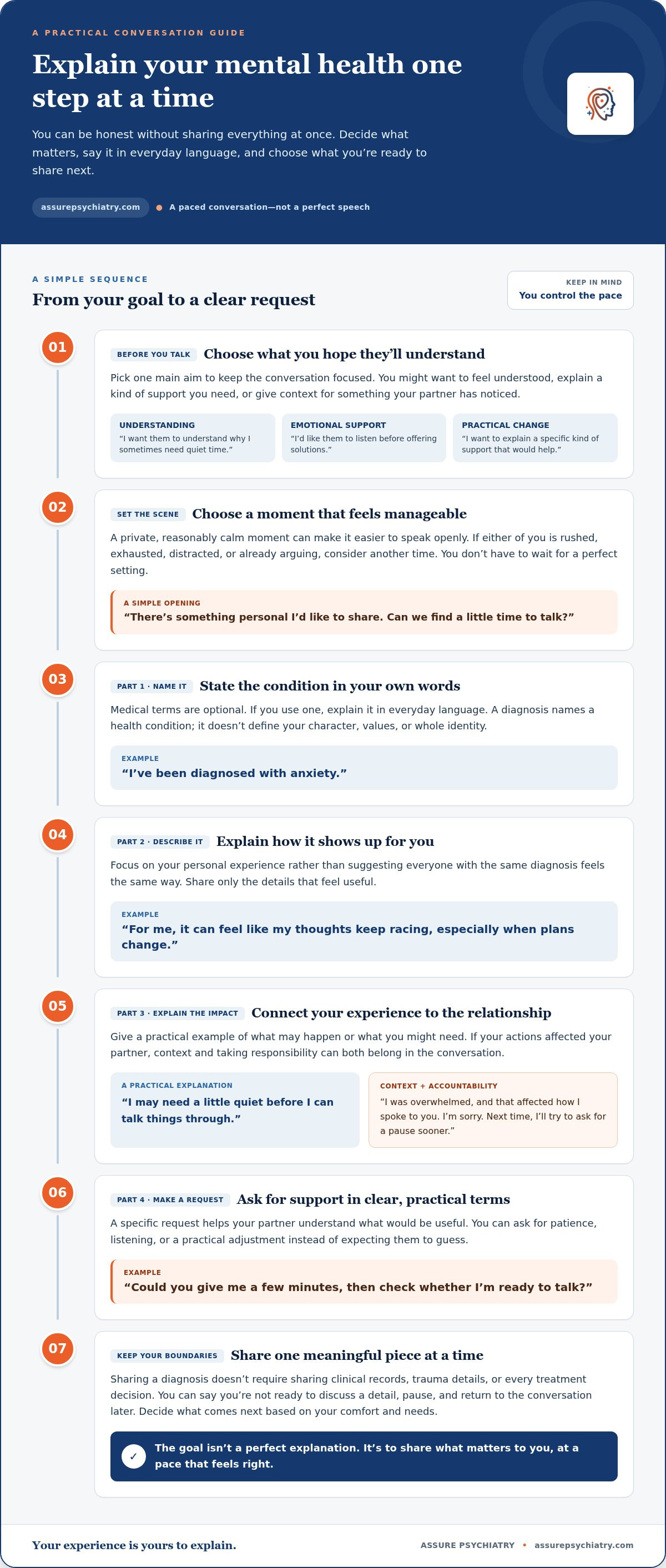
Write down one hoped-for outcome before you talk: “I want them to understand why I sometimes need quiet time,” or “I’d like them to listen before offering solutions.” This can help you stay focused if the conversation becomes emotional. The goal isn’t to deliver a perfect explanation. It’s to share what matters to you.
Choose a time and setting that feel manageable
A private, reasonably calm moment can make it easier to speak openly, but you don’t need to wait for an ideal setting. If either of you is rushed, exhausted, distracted, or already arguing, consider choosing another time when you can focus. You could start by saying, “There’s something personal I’d like to share. Can we find a little time to talk?”
A short opening is enough. You can explain that you’re not ready to discuss every detail and suggest returning to the conversation later. Disclosure is a choice, and you control its pace. You can share one meaningful piece at a time and decide what comes next based on your comfort and needs.
How to Explain Your Mental Health Condition in Clear, Everyday Language
You don’t need to give a lecture or find perfect words. A simple structure can help your partner understand what you’re experiencing and what might help. Try four parts: name the condition, describe how it affects you personally, explain any impact on the relationship, and make a clear request.
- Name it: “I’ve been diagnosed with anxiety.”
- Describe your experience: “For me, it can feel like my thoughts keep racing, especially when plans change.”
- Explain the impact: “I may need a little quiet before I can talk things through.”
- Make a request: “Could you give me a few minutes, then check whether I’m ready to talk?”
Use only the parts that fit. Symptoms can provide context for how you act, but they don’t erase the impact of your actions. If you snapped during a stressful moment, you might say, “I was overwhelmed, and that affected how I spoke to you. I’m sorry. Next time, I’ll try to ask for a pause sooner.” Understanding the context and taking responsibility can both be part of an honest conversation.
Use a simple explanation without turning it into a lecture
An adaptable opening could be, “I want to share something about my mental health.” Describe what the condition looks like for you rather than implying that everyone with the same diagnosis has the same experience. Medical terms are optional. If you use one, explain it in everyday language. Mental Health America also offers guidance on how to talk to your partner about mental health.
A diagnosis names a health condition; your personal experience describes how it shows up in your life. That distinction can keep the conversation centered on you as a whole person, not just a label.
Explain how symptoms or treatment may affect the relationship
Give practical examples: “When I’m anxious, I sometimes need a few minutes of quiet,” or “My sleep has been difficult, so I may have less energy in the evening.” If treatment is relevant, share only what feels comfortable. You might say that you’re working with a clinician or monitoring how a treatment affects you without discussing private clinical details.
If you’d like help understanding a diagnosis or preparing questions about treatment, this guide to psychiatric evaluations explains what to expect. A psychiatric evaluation can also help you make sense of your own experience and identify treatment needs.
Sharing, Privacy, and Handling Common Concerns
Being honest with your partner doesn’t mean giving them access to every part of your mental health history. You can share a diagnosis without sharing clinical records, trauma details, or every treatment decision. Disclosure is a personal choice, not a test of love, and it can’t replace professional care. Sharing may help your partner understand a need or make sense of something they’ve noticed. It may also leave you feeling exposed or prompt questions you’re not ready to answer. You can weigh these possibilities without assuming how your partner will respond.
Set boundaries around questions and personal details
Decide which topics you’re comfortable discussing now and which you’d rather keep private. You might say, “I can talk about how this affects me, but not every detail today,” or, “I’m not ready to discuss that part. I may come back to it later.” You can pause, decline a question, or continue another time. Privacy is a boundary around personal information; it doesn’t automatically mean you’re being dishonest.
If you’re still working out what a diagnosis means, you don’t need to sound certain. Try: “I’m still learning what this means for me, so I may not have an answer to every question.” As your partner works on learning to be supportive of your partner, they may need time to take in what you’ve shared. You can invite respectful questions while keeping control of how much you explain.
Respond to misunderstanding without escalating the conversation
If your partner misunderstands, calmly correct the point and explain how their words affect you. For example: “I know you may not mean it this way, but calling this ‘just stress’ makes me feel dismissed. What I’m describing is affecting my daily life.” This can clarify what you need without turning the exchange into a debate about whether your experience is real.
If the conversation becomes overwhelming or hostile, it’s okay to stop: “I want to continue, but I need a break now.” You don’t have to decide the future of the relationship in that moment. Notice what happened, give yourself room to process, and consider whether a calmer follow-up feels safe. If questions about your diagnosis or treatment are weighing on you, an individual psychiatric evaluation can provide clinical guidance apart from the conversation with your partner.
Plan the Conversation and Ask for Support That Is Actually Helpful
A little preparation can make a vulnerable conversation feel more manageable. You don’t need a script for every possible response, but deciding what you want to say and what support would help can keep the discussion grounded. Before you begin, consider:
- Choose the setting: Find a private moment when you both have room to focus.
- Identify your core message: What do you most want your partner to understand?
- Decide your boundaries: Which details are you ready to share, and which are off-limits for now?
- Plan a pause: Choose a simple way to take a break if either of you feels overwhelmed.
Use a flexible conversation outline
Start with why the conversation matters to you: “I want to share this because I care about helping you understand what’s been going on.” Offer only the context your partner needs, along with one or two personal examples. You might finish with a clear request: “Could you listen first, then ask me questions about what I’ve shared?”
You can agree to revisit the conversation after you’ve both had time to process. A follow-up might be as simple as, “Can we check in about this tomorrow?” That gives your partner space to reflect and gives you time to consider what you want to add or clarify. Explaining my mental health condition to my partner can be an ongoing exchange, not a single conversation that must cover everything.
Agree on practical support without making your partner responsible for care
Specific, manageable requests are easier to understand than “I need you to support me.” You could ask for patience when you need time to regroup, a reminder you’ve agreed on, or a listening ear when you say you don’t want advice. Make the request collaborative: “Would you be comfortable checking in with me after work on days I’m having a harder time?” Your partner can offer care, but shouldn’t be expected to diagnose you, monitor symptoms, or manage treatment.
Your treatment decisions remain yours to make with your care team. If you’re unsure what to ask about medication follow-up, this medication management guide can help you prepare. A psychiatric clinician can provide individual support with treatment questions, while your partner can offer the everyday support you’ve discussed.
For individual guidance on treatment planning or medication questions, learn about psychiatric care with Assure Psychiatry.
After You Tell Your Partner: Give the Conversation Room to Continue
Your partner may need time to absorb what you’ve shared, and you may find new words for your experience as time passes. Understanding can grow over more than one conversation. Rather than judging the entire exchange by an immediate response, notice what happens next: Does your partner listen, respect the limits you set, and follow through on the support you agreed to try?
Those actions offer useful information, but you don’t have to reach a final conclusion about the relationship right away. Reflect on what felt reassuring, what felt difficult, and what you’d like to clarify. Your needs may shift as symptoms, treatment, or circumstances change. It’s okay to revisit an earlier request and say, “What we tried helped, but I need something different now.”
Make space for questions while keeping control of your story
Let your partner know that respectful questions are welcome, while making clear that you can choose what to answer. “I can explain how this affects me, but I’m not ready to discuss that detail” keeps the conversation open without giving up your privacy. If sharing trusted information about your condition would help, you can offer it, but you don’t have to become your partner’s only source of education.
You may not know exactly how symptoms or treatment will change, or what support you’ll need in the future. It’s honest to say, “I’m still figuring that out, and I’ll tell you if something changes.” You can make plans together while leaving room for uncertainty.
Find individual clinical support when you need help understanding your condition
Questions that come up after disclosure may be about your diagnosis, symptoms, or treatment rather than the relationship itself. A psychiatric evaluation can assess a mental health concern and inform an individual treatment plan. Medication management follow-up can focus on medication effectiveness and side effects. These clinical services are different from couples counseling or long-term psychotherapy, and they don’t require your partner to take on a care role.
Assure Psychiatry offers in-person care in Portland and virtual telepsychiatry. For readers in Portland, Oregon, and Seattle, Washington, these steps can help prepare for a conversation, while individual clinical support can help with questions about symptoms or treatment. Explore psychiatric care with Assure Psychiatry.
Take the Next Step at a Pace That Feels Right
Explaining my mental health condition to my partner can begin with one clear message, a personal example, and a request for support. You can choose what to share, set limits on private details, and let understanding grow through follow-up conversations. Your diagnosis is part of your health story, not the whole of who you are.
If questions about symptoms or treatment make it harder to find your words, individual clinical support may help. Assure Psychiatry provides psychiatric evaluations and treatment planning, along with medication management follow-up. Care is available in person in Portland and through virtual telepsychiatry. Explore personalized psychiatric care with Assure Psychiatry when you’re ready.
You don’t need to have every answer before you begin. A thoughtful conversation can start small, and you can keep deciding what feels right, one step at a time.
Frequently Asked Questions
How do I explain my mental health condition to my partner?
Start with the main thing you want your partner to understand, then explain how the condition affects you personally and what would help. For example: “I’ve been dealing with anxiety. Sometimes I need a little time to settle before I can talk. It helps if you listen first.” Use your own words, share only relevant details, and remember you can continue the conversation later.
Should I tell my partner about my mental health diagnosis?
Whether to share a diagnosis is your choice, and there’s no single right time. Consider what you hope disclosure will help with, such as explaining a need or giving context to something affecting your relationship. You can also share how you’re feeling without naming a diagnosis. If you want help understanding a diagnosis, a psychiatric evaluation can provide individual clinical support, including in-person care in Portland, Oregon.
What if my partner does not understand my mental health condition?
Try clarifying your experience in everyday language and explaining what their response brings up for you. You might say, “I know this is new to you, but calling it ‘just stress’ makes me feel dismissed.” Invite respectful questions, but you don’t have to keep explaining if the conversation becomes overwhelming or hostile. Take a pause and consider what you want to do next after you’ve had time to process.
How much should I tell my partner about my mental health?
Share enough to communicate what matters to you, while keeping details you’re not ready to discuss private. You can explain symptoms, their impact, or a practical need without sharing clinical records, trauma details, or every treatment decision. Try setting a limit clearly: “I can talk about how this affects me, but I’m not ready to discuss the details today.” You can decide later whether to share more.
Can I explain my mental health condition without sharing my diagnosis?
Yes. You can describe what you experience and what support would help without naming a diagnosis. For instance, you could say, “I’ve been feeling overwhelmed and sometimes need quiet before I can talk.” You’re also allowed to say you’re still figuring things out. If understanding symptoms or treatment questions would help, Assure Psychiatry offers psychiatric evaluations and medication management, with in-person Portland visits and virtual telepsychiatry.
What should I do if I feel overwhelmed while telling my partner?
Pause the conversation and give yourself time to regroup. You can say, “I want to keep talking, but I need a break. Can we come back to this later?” If possible, agree on a time to continue so the pause feels clear rather than abrupt. You don’t need to answer every question in one sitting, and you can reach out to someone you trust for support afterward.
Recent Comments