

What if the right psychiatric provider isn’t the one who shares your healthcare background, but the one who listens carefully and respects what you need? If you’re considering psychiatric care for healthcare workers Portland has to offer, you may be wondering whether your concerns warrant an evaluation, how the clinic handles privacy, or whether appointments can fit around demanding shifts. You don’t have to wait until you’re in crisis to ask about support.
A good fit starts with your needs, not assumptions about your job. Outpatient psychiatric care may include an evaluation and, when appropriate, medication management. It is not a substitute for long-term psychotherapy, primary care, or inpatient crisis stabilization. Knowing what a provider does and does not offer can help you choose the kind of support to explore.
This article explains what an evaluation and follow-up care may involve, and offers questions to ask Portland providers about clinical approach, privacy, scheduling, appointment format, and insurance. It also outlines practical ways to compare options without pressure. A useful first step can be as simple as asking questions and deciding whether the conversation feels right for you.
Key Takeaways
- Consider an evaluation if symptoms or concerns are affecting your well-being, even if you’re unsure whether they warrant psychiatric care.
- Learn what outpatient psychiatric care may include and how it differs from psychotherapy, primary care, and crisis services.
- When comparing psychiatric care for healthcare workers Portland providers offer, ask about appointment formats, insurance, communication policies, and how your work context will be considered.
- Prepare for a first appointment by clarifying your goals, gathering relevant information, and checking scheduling and privacy details with the clinic.
- Explore whether Assure Psychiatry’s in-person or virtual evaluations and medication management may fit your needs. Confirm current availability and insurance participation directly.
Psychiatric Care for Healthcare Workers in Portland: When Is It Worth Exploring?
Healthcare work can involve rotating shifts, high-stakes decisions, and regular exposure to distress. These experiences may shape how you feel, but they don’t automatically mean you have a mental health condition. Work-related strain is useful context for an individual clinical assessment, not a diagnosis by itself.
Outpatient psychiatric care generally begins with an evaluation and a discussion of possible next steps with a qualified psychiatric clinician. Your symptoms, goals, personal and medical history, and preferences all inform that conversation. Your job title alone does not determine whether care is appropriate or what it should involve. Consider psychiatric care for healthcare workers Portland in terms of individual fit, rather than assumptions about what healthcare workers experience.
How work context can inform a psychiatric evaluation
Details about your work can help a clinician understand when concerns arise and how they affect daily life. You might describe changing shifts, responsibility for others’ safety, or repeated exposure to distressing situations. If relevant, compassion fatigue is a concept associated with repeated exposure to others’ suffering, but it is not a diagnosis by itself.
Describe changes in your own words. For example, are you sleeping differently, feeling unlike yourself, finding it harder to focus, or struggling with usual responsibilities? You don’t need to arrive with a label or a polished explanation. Healthcare workers’ experiences vary, so no single symptom pattern or treatment approach applies to everyone.
When outpatient care may be a reasonable next step
An evaluation may be worth considering if concerns persist, interfere with daily functioning, or leave you wanting professional guidance. You don’t need to be certain that something is “serious enough” before asking questions. An initial conversation can help clarify what you’re experiencing and what options may fit. It does not guarantee a diagnosis or prescription.
To prepare, note what has changed, when you noticed it, and what you hope to understand. You can also share what matters to you in care, including preferences or concerns about treatment. A useful evaluation makes room for your perspective, not just your work demands.
If you or someone else is in immediate danger, contact emergency services. For urgent emotional distress or suicidal thoughts, call or text the 988 Suicide & Crisis Lifeline in the United States.
What Psychiatric Care in Portland Can, and Cannot, Include
Outpatient psychiatric care can help you understand symptoms and consider possible treatment options. An initial evaluation is a conversation with a psychiatric clinician about what you’re experiencing, relevant health history, and what you hope to address. The clinician may discuss next steps, but an evaluation does not guarantee a particular diagnosis or prescription.
The CDC’s information on healthcare worker mental health provides broader context for why these concerns deserve attention. Your care should still be guided by your circumstances, not by general trends or assumptions about your profession.
What to expect from an initial psychiatric evaluation
A little preparation can make it easier to explain what’s been going on. Consider noting when symptoms began, how they have changed, relevant personal or medical history, current medications, and questions you want answered. You don’t need to organize everything perfectly. The clinician gathers information, learns what matters to you, and discusses possible next steps with you.
An evaluation helps clarify what may be happening; medication follow-up monitors a medication plan; psychotherapy focuses on therapeutic conversation and other approaches. These forms of care serve different needs. Ask a provider which services they offer and whether those services match what you’re seeking.
Medication management and the limits of outpatient psychiatry
Medication management involves follow-up discussions about how a medication is working, any side effects, and whether the plan should be continued or reassessed. Medication is not automatic. A clinician should discuss possible options with you, taking your history, concerns, preferences, and response to treatment into account.
For more detail about follow-up care, look for the guide Medication Management in Portland. It may help you prepare questions about monitoring and treatment decisions.
Outpatient psychiatry is distinct from long-term psychotherapy, primary care, and inpatient crisis stabilization. A psychiatric clinician may discuss concerns relevant to your mental health, but this does not replace primary care or a psychotherapist when those are needed. When comparing psychiatric care for healthcare workers Portland options, ask whether a provider’s scope includes the support you’re looking for. Assure Psychiatry offers psychiatric evaluations and medication management. You can review Assure Psychiatry’s services as one option to consider.
How Healthcare Workers Can Compare Portland Psychiatric Providers
A good provider fit depends on more than location or job title. The clinician should explain their services clearly, invite your perspective, and make room for relevant work demands without assuming every healthcare worker needs the same kind of care. The National Academy of Medicine’s National Plan for Health Workforce Well-Being highlights clinician well-being as a broader concern. Your care decisions remain personal.
Use this comparison table to guide conversations with Portland clinics. A search for “psychiatric care for healthcare workers Portland” can help you find options, but asking direct questions is more useful for judging whether a provider may suit your needs.
| What to compare | Questions to ask |
|---|---|
| Service scope | Does the clinician provide psychiatric evaluations and medication management? Which needs require another provider? |
| Appointment format | Are visits available in person, virtually, or both? What formats and scheduling options are currently available? |
| Insurance | Do you participate in my specific plan? How can I confirm benefits and any referral requirements? |
| Communication | How are questions between appointments handled? What are your privacy and communication policies? |
Questions to ask about clinical fit and treatment planning
Ask how the clinician learns about your personal and medical history, symptoms, goals, and work context. You might explain that rotating shifts affect your routine or that job responsibilities shape when symptoms feel most disruptive. Ask how your preferences, potential benefits, and risks inform treatment decisions. A respectful clinician should welcome questions, explain recommendations in understandable language, and make space for shared decision-making. You can also ask which services the practice provides directly and when you may need support from another professional.
Notice how the conversation feels. Are your concerns taken seriously? Does the clinician avoid reducing you to your occupation or a possible diagnosis? Culturally responsive care includes listening without judgment and considering how your identity, values, and circumstances affect what feels appropriate. You don’t need to find a provider who claims a healthcare-worker specialty. Focus on whether the clinician responds thoughtfully to your individual context.
How to compare in-person and virtual appointments
An office visit in Portland may suit you if you prefer meeting in person. Virtual telepsychiatry may offer another access option, depending on your needs and circumstances. For either format, consider privacy, travel or technology demands, and what feels comfortable. Confirm directly with the clinic whether virtual appointments are available for your situation in Oregon, what technology is required, and what appointment availability looks like. If you’re searching from Seattle or elsewhere in Washington, ask whether virtual care is available for your location rather than assuming Oregon services extend across state lines. The guide Telepsychiatry in Oregon may offer additional context as you weigh the format that works for you.
Before Your First Appointment: Privacy, Scheduling, and Insurance
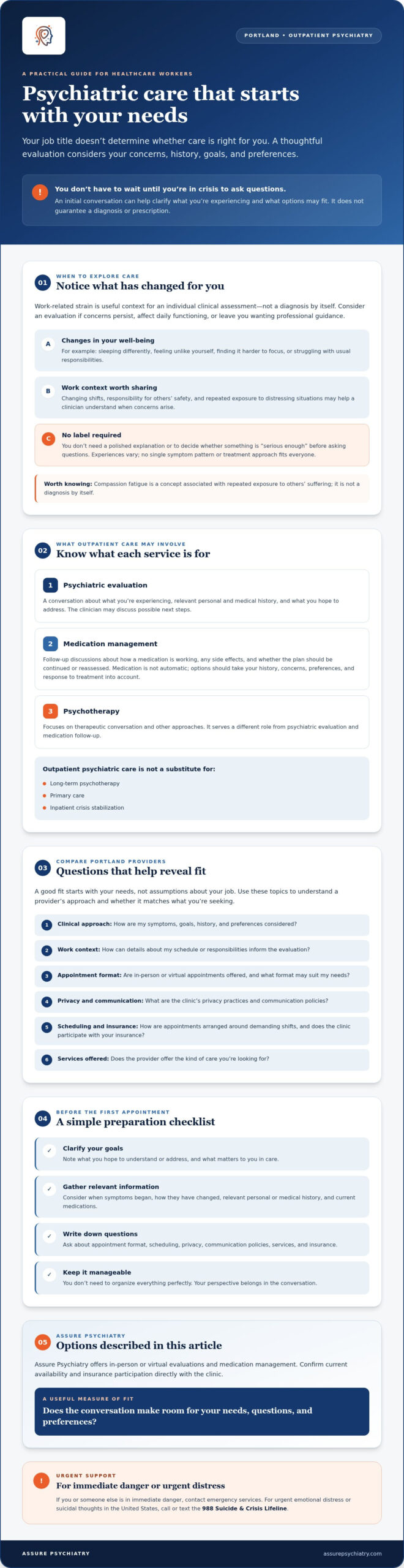
A little preparation can make the first step feel more manageable. If you’re considering psychiatric care for healthcare workers Portland clinics provide, use a simple sequence: clarify what you want help with, gather useful information, and confirm practical details with the clinic and your insurer.
Plan around your work schedule
Before choosing a provider, ask which appointment formats and current scheduling options may fit your routine. Don’t assume a clinic offers evening, weekend, or shift-specific appointments; confirm directly. If you choose a virtual visit, consider where you could speak comfortably and privately, and ask the clinic about technology requirements.
Before the appointment, jot down what you hope to discuss and any questions you don’t want to forget. A brief note is enough. The goal is not to prepare a perfect explanation, but to use the appointment in a way that feels useful to you.
Prepare questions about privacy and insurance
If workplace privacy is on your mind, ask the clinic how it handles clinical records, patient communications, and requests for information. You can also ask where appointment reminders or messages may appear and how to update your communication preferences. Policies and applicable rules matter, so request the clinic’s current explanation rather than relying on assumptions about who can access information.
Check insurance details before care begins. Assure Psychiatry accepts most major insurance plans, but participation and benefits can vary by plan. Contact both your insurer and the clinic to verify:
- Whether the specific clinician and service are covered or in network.
- Whether your plan requires a referral or prior authorization.
- What deductible, copay, coinsurance, or other patient responsibility may apply.
Ask how the clinic handles benefit verification, and confirm your coverage directly with your insurer as well. For an overview of what an evaluation involves, you can also read the guide Psychiatric Evaluation in Portland.
Once you’ve clarified your priorities and logistics, review Assure Psychiatry’s care options, including psychiatric evaluations and medication management. Contact the practice to confirm current appointment formats, scheduling, privacy practices, and insurance participation.
Starting Psychiatric Care with Assure Psychiatry in Portland
Finding care that fits your needs and routine can start with a simple question: what kind of support are you looking for? Assure Psychiatry is a Portland outpatient practice offering in-person visits and virtual telepsychiatry. These options may suit different preferences and circumstances. Confirm current appointment availability and whether virtual care is appropriate for your situation.
The practice offers psychiatric evaluations and medication management, including care related to ADHD, anxiety, depression, and PTSD. These services are options to discuss, not guaranteed outcomes. Healthcare workers can share how their schedules and workplace experiences affect their concerns, but Assure Psychiatry does not advertise a worker-only program or specialized service.
Which Assure Psychiatry services may fit your needs
A psychiatric evaluation gives you an opportunity to discuss symptoms, relevant history, and concerns with a clinician, then consider possible next steps. If medication management is clinically appropriate and you agree to it, follow-up appointments provide an opportunity to discuss how the plan is working and whether it needs reassessment. Neither a diagnosis nor a prescription is automatic.
It’s also helpful to understand the boundaries before you begin. Assure Psychiatry does not provide long-term psychotherapy, inpatient crisis stabilization, or primary care. If you’re looking for one of those services, ask what type of provider or setting may be appropriate. A good fit includes both care that aligns with your goals and clarity about what the practice offers.
How to take a practical next step
Before contacting the practice, jot down what you hope to address, whether you prefer an in-person or virtual appointment, and any scheduling constraints you want to ask about. If you’re changing clinicians, you may also want to ask how to coordinate relevant records or ongoing care. The guide How to Switch Psychiatrists can be a useful topic to look for as you plan a transition.
Assure Psychiatry accepts most major insurance plans, but participation and benefits vary. Confirm your specific plan, covered services, and any expected patient responsibility with both the clinic and your insurer. You can review Assure Psychiatry’s services and contact the practice with questions about care options, insurance, appointment formats, or a possible next step. An inquiry can help you decide whether to explore an evaluation without committing to a particular treatment.
Take a Thoughtful First Step Toward Care
Choosing psychiatric care for healthcare workers Portland offers is less about finding a provider who makes assumptions about your profession and more about finding one who listens, explains their scope, and includes your priorities in care decisions. An evaluation can help clarify concerns and possible next steps. Medication management may be discussed if it fits your needs, but neither diagnosis nor medication is automatic.
Before you begin, compare appointment formats, ask about privacy and communication policies, and confirm your specific insurance benefits with both the clinic and your insurer. Assure Psychiatry offers in-person appointments in Portland and virtual telepsychiatry, along with psychiatric evaluations and medication management. The practice accepts most major insurance plans, but confirm individual coverage directly.
To explore a possible next step, review psychiatric care options with Assure Psychiatry and ask about current appointment formats and insurance participation. You can move at a pace that feels manageable. Seeking clarity is a meaningful start.
Frequently Asked Questions
Can healthcare workers in Portland see a psychiatrist for work-related stress?
Yes. A Portland psychiatrist can evaluate concerns related to work stress, including changes in sleep, mood, focus, or daily functioning. Work context can help explain what you’re experiencing, but it does not establish a diagnosis by itself. Psychiatric care for healthcare workers Portland providers offer should reflect your symptoms, history, goals, and preferences, not your job title alone. An evaluation can help clarify whether outpatient psychiatric care may be appropriate.
Is psychiatric care confidential if I work in healthcare?
Your profession doesn’t automatically determine who can access your clinical information, but don’t assume how records or communications are handled. Ask the clinic about its privacy practices, who may access records, how messages and appointment reminders are sent, and when information might be shared under applicable rules. If you have a specific concern involving your employer or insurance, raise it with the clinic before starting care.
What happens during a first psychiatric evaluation in Portland?
A first evaluation typically involves discussing your symptoms, relevant personal and medical history, current medications, concerns, and goals. The clinician may ask when changes began and how they affect your daily life. You can bring a short timeline and a list of questions, but you don’t need to prepare perfectly. The conversation helps the clinician understand your needs and discuss possible next steps; it does not guarantee a diagnosis or prescription.
Can I use telepsychiatry if I work irregular healthcare shifts?
Possibly. Virtual appointments may offer a useful format, but whether they fit your shift pattern depends on current scheduling options and your circumstances. Ask the clinic about available appointment times, eligibility for telepsychiatry based on your location, and technology requirements. Consider whether you can join from a private location with a reliable connection. Confirm availability directly with the practice rather than assuming virtual care means flexible or after-hours scheduling.
Does seeing a psychiatrist mean I will have to take medication?
No. A psychiatric evaluation doesn’t automatically lead to a medication recommendation or prescription. The clinician can discuss what you’re experiencing and possible care options, taking your history, preferences, and concerns into account. If medication is raised, you can ask about potential benefits, risks, and alternatives before deciding what feels appropriate. Medication management is an option to discuss when clinically appropriate, not an inevitable outcome of seeking an evaluation.
Does Assure Psychiatry accept insurance for Portland appointments?
Yes. Assure Psychiatry accepts most major insurance plans, but that doesn’t guarantee your specific plan or service will be covered. Before scheduling, contact both the clinic and your insurer to check plan participation, benefits, any referral or authorization requirements, and your expected out-of-pocket responsibility. Coverage depends on plan details, so verify your individual benefits directly rather than relying only on a general list of accepted insurers.
Can a Portland psychiatrist provide both evaluation and medication management?
Yes. A psychiatric practice may offer both services, and Assure Psychiatry provides psychiatric evaluations and medication management in Portland, with in-person and virtual care options. An evaluation helps the clinician understand your concerns and discuss possible next steps. Medication follow-up may be considered if it’s clinically appropriate and you agree. Ask the practice whether the clinician who evaluates you can also provide follow-up, and confirm current appointment options.
Recent Comments