

An evaluation that helps you get care may not answer a disability claim. If you’re searching for a diagnostic psychiatric evaluation Oregon residents can turn to, it’s understandable to hope one appointment will clarify a diagnosis, describe daily challenges, and provide everything a claim requires. But treatment-focused assessments and disability evaluations have different purposes, and a diagnosis alone doesn’t determine benefit eligibility.
Symptoms can be hard to explain, especially when their effects change from day to day. A clinical evaluation may help a provider understand your mental health and plan care, but it may not include the claim-specific opinions or documentation an agency needs. The right next step depends on what you need assessed and what the clinician can provide.
This article explains how treatment evaluations differ from independent or disability-focused assessments, what records and examples of daily limitations to bring, and what to ask an Oregon clinician about credentials, scope, and documentation. Assure Psychiatry is a Portland outpatient practice offering psychiatric evaluations for clinical care. Its disability-claim scope should be confirmed directly. The questions here can help you choose a provider without assuming a diagnosis guarantees approval.
Key Takeaways
- A diagnostic psychiatric evaluation from an Oregon clinician may serve a different purpose than an assessment requested for a disability claim. Clarify the purpose before scheduling.
- Compare treating and independent evaluators by who requests the assessment, what the report covers, and whether an ongoing care relationship is expected.
- Before choosing a professional, ask about qualifications, records reviewed, report scope, fees, insurance coverage, and possible follow-up.
- Prepare an accurate timeline of symptoms, treatment, medications, and changes in everyday functioning to make the appointment more focused.
- Assure Psychiatry offers psychiatric evaluations and medication management for clinical care. Ask directly whether its evaluation scope and documentation policies fit your needs.
Oregon Psychiatric Evaluations and Disability Claims
Seeking clarity about symptoms and how they affect your life is a reasonable step. A psychiatric diagnostic evaluation is a clinical assessment of a person’s symptoms, health history, and treatment needs. If you’re considering a diagnostic psychiatric evaluation in Oregon, first clarify its purpose. An evaluation for clinical care may help a clinician understand your situation and plan treatment, but it isn’t automatically a disability assessment.
The clinician may discuss your mental health history, current concerns, medications, and relevant life circumstances. They may also ask how symptoms affect work, relationships, and everyday activities. Depending on the appointment’s purpose and your circumstances, the assessment may include a structured conversation, review of available records, or observations of your presentation. A Mental Status Examination (MSE) is one framework for describing aspects of psychological functioning, such as mood, thought, and attention.
Clinical observations aren’t legal advice or a formal disability determination. An agency may request its own examination if it needs additional information, but that examination has a different purpose from an appointment you arrange for treatment. If a claim is involved, ask what the evaluation is designed to address and what documentation, if any, the clinician can provide. Don’t assume a routine clinical assessment includes a claim-specific report.
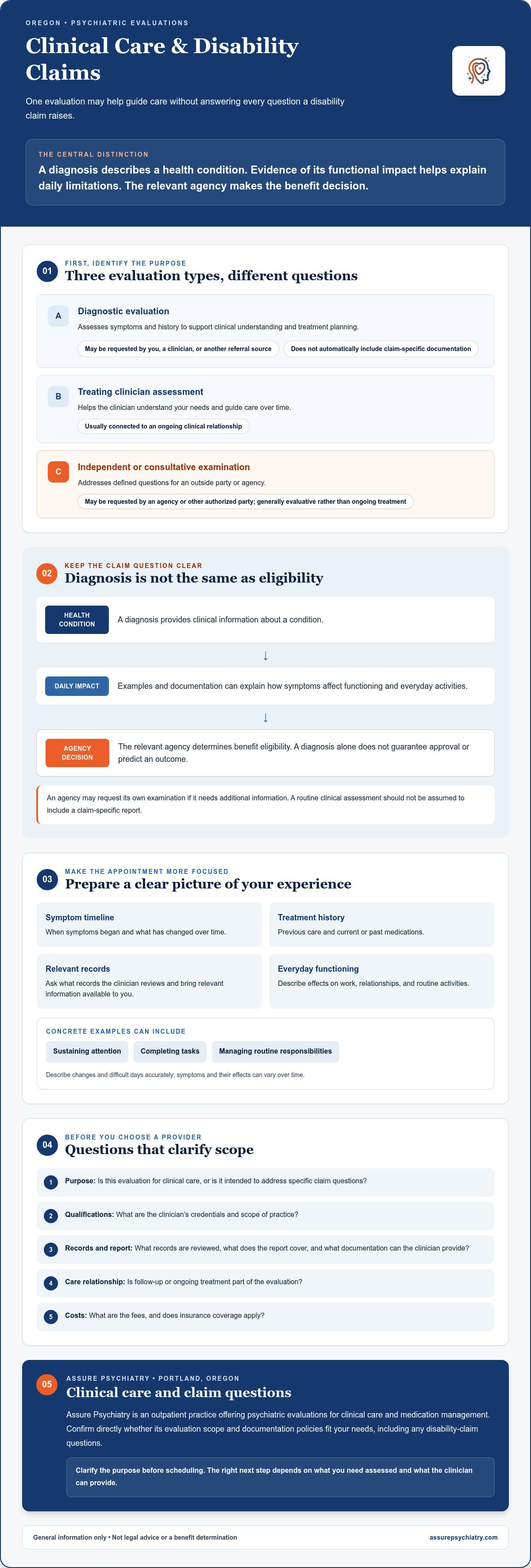
A diagnosis describes a health condition. Evidence of its functional impact helps explain daily limitations. The relevant agency makes the benefit decision.
What happens during a psychiatric diagnostic evaluation?
You’ll typically have an opportunity to explain what you’ve been experiencing, when symptoms began, and what has changed over time. The clinician may ask about previous care, current medications, and life circumstances that help put your concerns in context. Be specific about effects on work and daily activities, such as difficulty sustaining attention, completing tasks, or managing routine responsibilities. The methods used vary by clinician, referral reason, and individual needs.
Does a psychiatric diagnosis automatically qualify someone for disability?
No diagnosis by itself guarantees benefits or predicts a claim outcome. A diagnosis is important clinical information, but a claim may also involve evidence about how symptoms affect functioning and whether that information meets the applicable program’s rules. Experiencing symptoms is not the same as documenting their effects, and neither alone determines eligibility. For current requirements, consult official Social Security Administration disability guidance or a qualified benefits attorney. This information is general, not legal advice.
Diagnostic, Treating, and Independent Psychiatric Evaluations: Know the Difference
Not every psychiatric evaluation is designed to answer the same question. A diagnostic psychiatric evaluation in Oregon may help a clinician understand symptoms and consider treatment needs, while a disability-focused assessment may address specific questions raised by a claim. Knowing who requested the appointment and how its findings will be used can help you choose the right next step.
| Evaluation type | Purpose | Who requests it? | Relationship to ongoing care |
|---|---|---|---|
| Diagnostic evaluation | Assess symptoms and history to support clinical understanding and treatment planning. | You, a clinician, or another referral source may request it. | May inform care. Ongoing treatment isn’t necessarily part of the evaluation itself. |
| Treating clinician assessment | Understand your needs and guide care over time. | You or the clinician as part of seeking or continuing care. | Usually connected to an ongoing clinical relationship. |
| Independent or consultative examination | Address defined questions for an outside party or agency. | An agency or other authorized party may request it. | Generally evaluative rather than an ongoing treatment relationship. |
How is a treatment evaluation different from a disability-focused assessment?
Treatment commonly centers on what you’re experiencing, what care may help, and how to plan next steps. A claim-focused assessment may address specific referral questions, but its scope and report contents can vary. Before booking, ask who will receive the report, what it will cover, which records may be reviewed, and whether the clinician accepts the referral’s purpose. Don’t assume a clinical evaluation provides claim-specific documentation.
When might an independent or consultative evaluation be involved?
An independent examiner evaluates information for a requesting party and may not provide ongoing care. An agency may request a consultative examination when additional information is needed. The agency or other authorized requester determines whether an assessment is needed and provides instructions. Verify the evaluator, appointment purpose, and report scope with the organization that referred you. For Oregon federal-benefit information, see the state’s Oregon Disability Determination Services resource, and check current procedures with official Social Security Administration guidance.
If your priority is clinical care, Assure Psychiatry offers psychiatric evaluations and medication management in Portland and through telepsychiatry in Oregon. Its stated services don’t identify disability-specific or independent examinations, so ask whether the evaluation’s scope fits your needs before booking. Learn more about psychiatric evaluation and medication management.
How to Choose a Psychiatric Evaluator for a Disability Claim in Oregon
The right clinician depends on what you need the appointment to accomplish. A provider who offers outpatient psychiatric evaluations may focus on clinical understanding and care planning. That doesn’t mean they conduct independent or disability-specific assessments. Before scheduling a diagnostic psychiatric evaluation in Oregon for a claim-related need, confirm the clinician’s scope rather than relying on the service name alone.
Questions to ask before scheduling an evaluation
Ask what kind of assessment the clinician provides and whether they accept the purpose of your referral. Clarify what the report may address, who may receive it, and whether the clinician can provide any documentation for a disability claim. Policies vary, and a provider may not be able to prepare the report you need.
- Purpose and scope: Is this a treatment evaluation, an independent evaluation, or another specified assessment?
- Records and report: What records will be reviewed, what questions will the report address, and who can receive it?
- Qualifications: What credentials and relevant evaluation experience does the clinician have? Confirm their Oregon practice status through the official licensing board or registry for their profession.
- Practical details: What are the fees, does insurance apply to this service, and is follow-up available if questions arise?
- Location: Is an in-person appointment in Portland or a virtual appointment within Oregon available for your specific needs?
Before scheduling, confirm the clinician’s Oregon status and relevant qualifications, assessment purpose and report scope, records reviewed, fees and insurance, follow-up options, and whether the appointment format fits your needs.
How Oregon location and telepsychiatry may affect access
Assure Psychiatry is a Portland outpatient practice offering psychiatric evaluations and medication management in person and through telepsychiatry in Oregon. Its stated services don’t identify disability-specific, forensic, or independent medical examinations, so contact the practice to ask whether its clinical evaluation scope matches your needs. Confirm current virtual appointment availability, eligibility to receive care by telehealth in Oregon, and privacy expectations before booking. If you’re searching from Seattle, Washington, check that a provider can serve you at your location. Assure Psychiatry’s stated virtual care is in Oregon.
For information about federal disability programs and Oregon resources, consult the state’s Federal Disability Benefits in Oregon page. If an agency or another organization referred you, verify its instructions and the evaluator’s identity with that requester. A clinical provider can support your care, but only the relevant agency can decide a benefits claim.
Preparing for a Disability Psychiatric Evaluation
Preparation can help you explain your experience clearly without needing to rehearse or prove anything. Start by confirming the appointment’s purpose and the evaluator’s instructions. A diagnostic psychiatric evaluation in Oregon may be for clinical care rather than a disability claim, so ask what kind of assessment is planned and what information the clinician wants beforehand.
Gather relevant records if they’re available and requested. Then make a short timeline and write down questions you want answered. Keep it practical; you don’t need to collect every document you’ve ever received. Before sending sensitive information, ask how records should be submitted, stored, and shared, and who may access them.
Records and personal notes that may help the clinician
Depending on the evaluator’s instructions, useful materials may include prior psychiatric evaluations, treatment records, and current or past medication history. Your notes can track when symptoms began, how they’ve changed, and any treatment tried. For example, note how often a difficulty occurs, how long it tends to last, and what it makes harder at work or at home. Follow the evaluator’s guidance about which records to provide.
- List medications, including changes you remember, and note any questions about your treatment history.
- Describe practical effects, such as trouble completing a task, keeping a routine, or managing interactions.
- Include supports or strategies you use, along with tasks that become harder on more challenging days.
Don’t assume every record is necessary. Share information through the method the evaluator specifies, and take care to protect sensitive details that aren’t relevant to the appointment.
How to describe symptoms and functional limitations clearly
Concrete, truthful examples are more helpful than labels alone or guesses about what an evaluator should conclude. Instead of saying only “I can’t focus,” explain what happens during a specific task, how often it occurs, and what support helps you complete it. Describe variation, too: symptoms and their effects can differ across situations and days. You don’t need to exaggerate or perform your symptoms.
If a question feels unclear, ask the clinician to explain or rephrase it. It’s okay to pause, check your notes, or say you don’t remember. Your goal is to communicate your experience accurately, not to give a perfect answer.
Agency forms and instructions can change. If the appointment is connected to a benefits application, verify current forms and submission instructions directly with the requesting agency or official source before completing or sending them. For clinical care, review psychiatric evaluation information and ask Assure Psychiatry whether its evaluation scope fits your needs. The practice does not confirm a disability-specific evaluation service.
Finding the Right Next Step: Clinical Care, Claim Questions, and Assure Psychiatry
Your next step depends on what you need help with. If symptoms are affecting your well-being, a clinical evaluation may help clarify what you’re experiencing and what treatment options to discuss, whether or not you’re pursuing benefits. If you’re preparing a claim, separately confirm what records or assessments the relevant agency requires. A diagnosis or treatment visit doesn’t guarantee claim documentation or approval.
When a treatment-focused psychiatric evaluation may be a useful step
Assure Psychiatry is a Portland outpatient practice offering psychiatric evaluations and medication management. Care is offered in person in Portland and through telepsychiatry in Oregon, subject to current availability. Its stated services don’t identify disability-specific evaluations, so ask the practice whether its current evaluation scope fits your clinical needs and whether any documentation may be available under its policies. If ongoing medication care is part of your plan, ask what follow-up options are offered and whether Medication Management in Portland may be relevant.
When to seek a different professional for claim-specific questions
If an agency, representative, or benefits program has requested an assessment, check whether it specifies an evaluator, assessment type, or submission instructions. Confirm those details with the requester before arranging an appointment. For eligibility rules, deadlines, procedural questions, or appeals, use official Social Security resources or speak with a qualified benefits attorney or advocate. A clinician can address clinical questions, but shouldn’t be assumed to provide legal advice or determine your claim.
If you’re considering a diagnostic psychiatric evaluation in Oregon for clinical care, ask the practice about fit before booking. A brief conversation can clarify whether the service matches your needs, what the appointment is intended to address, and what to expect next. If your questions are about a claim, check those requirements with the responsible agency or a qualified benefits professional as well.
For a low-pressure first step, ask Assure Psychiatry whether its evaluation services fit your needs. Confirm current service availability and scope directly; the practice does not advertise a confirmed disability-specific evaluation service.
Choose a Next Step That Fits Your Needs
A clinical evaluation can help you understand symptoms and treatment needs, but it isn’t the same as a disability assessment or a decision about benefits. Before scheduling a diagnostic psychiatric evaluation in Oregon, clarify the appointment’s purpose, what documentation the clinician may provide, and what the requesting agency requires. For claim rules or appeals, consult official Social Security resources or qualified benefits counsel.
If you’re seeking clinical care, Assure Psychiatry is a Portland outpatient practice offering psychiatric evaluations and medication management. In-person Portland and virtual care options are available in Oregon, but confirm current availability. The practice accepts most major insurance plans; check whether your specific plan and the service are covered. Its services don’t confirm a disability-specific evaluation, so ask about scope before booking.
Ask Assure Psychiatry whether its evaluation services fit your needs. You deserve clear answers and a next step that supports your well-being, whatever the outcome of a benefits claim.
Frequently Asked Questions
Can a psychiatric evaluation help with a disability claim in Oregon?
A diagnostic psychiatric evaluation Oregon residents arrange may provide clinical information about symptoms, history, and functioning that could become part of a medical record. It isn’t a benefits decision, and an evaluation or diagnosis alone doesn’t guarantee eligibility or approval. Before scheduling, ask the clinician what the assessment is intended to address, whether documentation can be provided, and who may receive it. Confirm the requesting agency’s documentation requirements separately.
Does a psychiatric diagnosis automatically qualify me for disability benefits?
No. A psychiatric diagnosis identifies a clinical condition, but it doesn’t automatically establish eligibility for disability benefits. Claim reviewers may consider how symptoms affect a person’s ability to function, along with other information and the rules of the specific program. The diagnosis and its documented effects are relevant evidence, not a guaranteed outcome. For current requirements, consult official Social Security Administration guidance or a qualified benefits attorney or advocate.
What is the difference between a psychiatric evaluation and a consultative examination?
A psychiatric evaluation arranged for clinical care generally helps a clinician understand symptoms and treatment needs. An agency may request a consultative examination to address particular questions in a claim process; it isn’t necessarily part of an ongoing care relationship. The purpose, evaluator, and report scope can differ. If you receive a notice or referral, verify the instructions and evaluator with the requesting organization, and check current procedures with official agency sources.
Can my treating psychiatrist complete disability paperwork?
Possibly, but it depends on the clinician’s policies, knowledge of your care, and the type of form or documentation requested. Some clinicians may provide records or complete certain forms, while others may not offer claim-related documentation or may have limits on what they can attest to. Ask your treating psychiatrist what they can provide, about any associated process or fees, and who will receive the information. Don’t assume completion is guaranteed.
How should I prepare for a psychiatric evaluation related to a disability claim?
First, confirm the appointment’s purpose and follow the evaluator’s instructions. If requested, gather relevant prior evaluations, treatment records, and medication history. Write a timeline of symptoms and changes, then note truthful examples of how they affect work and daily tasks, including how often difficulties occur and what support helps. You don’t need to rehearse or exaggerate. Ask how records should be submitted, stored, and shared, and verify current agency forms with the requester.
Can I have a psychiatric evaluation through telepsychiatry in Oregon?
Telepsychiatry may be an option, depending on the clinician’s current availability, the assessment’s purpose, and whether a virtual appointment is suitable for your circumstances. Ask whether the clinician can see you at your Oregon location, how privacy is handled, and whether any part of the assessment requires an in-person visit. Assure Psychiatry is based in Portland and offers virtual care in Oregon, but confirm current availability and service fit directly.
Does Assure Psychiatry provide disability evaluations in Oregon?
Assure Psychiatry offers outpatient psychiatric evaluations and medication management, but its stated services don’t confirm disability-specific, forensic, or independent evaluations. The Portland practice offers in-person care and virtual telepsychiatry in Oregon; confirm current availability and fit directly. If you need claim-related documentation, ask what the practice’s policies permit before booking. Assure Psychiatry accepts most major insurance plans, but verify whether your specific plan and the service are covered.
Recent Comments