

You sit down to search for a provider, but after twenty open tabs and a mounting sense of overwhelm, you close your laptop and wonder if it’s even worth the effort. It’s a common cycle when your executive function is already stretched thin, especially when you’re worried a doctor might dismiss your concerns or that you’ll get lost in a sea of paperwork. Seeking an adult ADHD diagnosis Washington state can feel like a maze of shifting regulations and long waitlists, but your desire for clarity is valid. You deserve a professional environment where you feel seen and heard rather than just processed through a system.
We understand that the path to mental tranquility starts with a collaborative partnership, not a clinical interrogation. This guide will help you navigate the diagnostic process with confidence so you can stop wondering and start healing. We’ll explore the current 2026 telehealth flexibilities for medication management, explain what a comprehensive psychiatric evaluation actually looks like, and show you how to establish a treatment plan that feels like a supportive alliance. By the end of this guide, you’ll have a clear roadmap to the professional support and restorative care you’ve been looking for.
Key Takeaways
- Learn to recognize how adult ADHD presents as internal restlessness and why a formal adult ADHD diagnosis Washington state is the essential first step toward accessing medication and workplace support.
- Discover how to simplify the diagnostic process by gathering historical evidence and selecting a provider who prioritizes a collaborative, human-centered approach.
- Navigate the differences between academic clinics, telehealth sites, and private practices to find a care model that aligns with your specific needs.
- Use our evaluation checklist to manage insurance details and intake paperwork early, ensuring your appointment is a calm and productive experience.
- Understand how a psychiatric evaluation serves as a gateway to long-term medication management and a treatment plan designed for your lasting mental tranquility.
Understanding the Adult ADHD Diagnostic Landscape in Washington
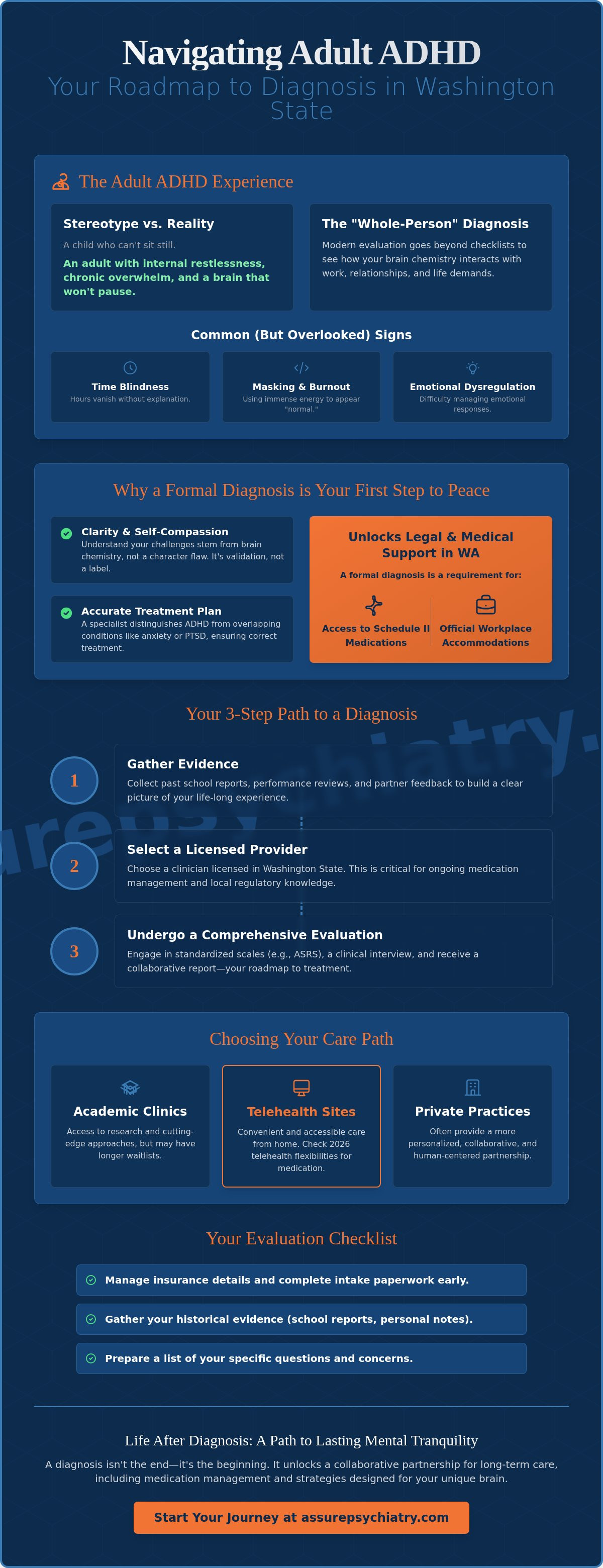
Many people still believe that ADHD only affects children who can’t sit still in a classroom. For most adults, however, the experience is much more internal. It often feels like a persistent sense of restlessness or a chronic overwhelm that makes even simple daily routines feel like an uphill climb. In 2026, the process for obtaining an adult ADHD diagnosis Washington state has evolved to move beyond simple symptom checklists. Modern diagnostic standards now prioritize a “whole-person” view. This means your clinician looks at how your unique brain chemistry interacts with your professional demands, your relationships, and your overall mental tranquility. This shift ensures that a diagnosis isn’t just a clinical label, but a collaborative gateway to understanding your life.
While your primary care doctor is a vital part of your health team, seeking a specialist for an ADHD evaluation is often the more supportive path. Specialists possess the nuanced expertise required to untangle complex adult presentations, especially when ADHD coexists with other conditions. In Washington, a formal diagnosis from a qualified professional is a legal requirement if you wish to access Schedule II medications or request official workplace accommodations. This step isn’t about jumping through hoops; it’s about establishing a stable foundation for your long-term care and ensuring you have the legal protections you deserve.
Common Signs of Adult ADHD You Might Overlook
Adult ADHD frequently manifests as significant struggles with executive function. You might experience “time blindness,” where hours seem to vanish without explanation, or find that starting a project feels like trying to push a boulder up a mountain. In high-pressure environments like the Seattle and Bellevue tech hubs, many high-achieving adults engage in “masking.” This involves using immense cognitive energy to hide struggles and appear “normal” to colleagues. Understanding Adult ADHD helps reveal that this constant effort often leads to deep exhaustion and emotional dysregulation. You aren’t failing; your mind is simply racing without a pause button, making it difficult to find the quiet focus you need.
Why a Professional Evaluation is Your First Step Toward Peace
A professional psychiatric evaluation is essential because ADHD symptoms often overlap with anxiety, PTSD, or bipolar disorder. A specialist can help distinguish these conditions to ensure your treatment plan actually addresses the root cause of your distress. ADHD is a neurodevelopmental condition that persists into adulthood. Receiving a formal diagnosis often brings an incredible sense of relief and validation. It allows you to replace self-criticism with self-compassion. When you realize that your challenges stem from brain chemistry rather than a character flaw, you can finally stop fighting against yourself and start working with your brain to find lasting peace.
How to Get an Adult ADHD Diagnosis in Washington State
Seeking an adult ADHD diagnosis Washington state is a journey that requires both clinical precision and personal reflection. It’s not a test you pass or fail. Instead, it’s a collaborative process to understand how your unique brain functions. The first step involves gathering “evidence” from your past and present. This might include old school reports that mention you were “not living up to your potential” or feedback from a partner about your daily habits. These personal insights provide the context that standardized forms can’t capture on their own. They help tell the story of your life beyond the symptoms.
Once you’ve reflected on your history, you’ll need to select a provider licensed specifically in Washington. This ensures they’re familiar with local regulations and can provide ongoing medication management if that becomes part of your treatment goal. During your psychiatric evaluation, you’ll likely complete standardized assessment scales like the DIVA-5 or the ASRS. These tools help clinicians look for consistent patterns across different areas of your life. The process concludes with a clinical interview and a comprehensive report. This document isn’t just a list of symptoms; it’s a roadmap that outlines your strengths and identifies specific strategies for success.
Telehealth vs. In-Person Evaluations in 2026
In 2026, Washington residents have more flexibility than ever. Current federal regulations have extended telehealth flexibilities through December 31, 2026. This allows for the prescription of controlled substances via telehealth without an initial in-person visit. This is a significant relief for those whose executive dysfunction makes commuting to a physical office feel impossible. You should ensure your provider uses a HIPAA-compliant platform to protect your privacy. For many, the comfort of their own home provides the safety needed to speak openly. It lowers the barrier to care.
The Role of DSM-5 Criteria in Your Assessment
To reach a formal diagnosis, clinicians follow the DSM-5 criteria, which require evidence of impairment in two or more settings, such as work and home. Understanding Adult ADHD Symptoms is a helpful starting point, but a professional must also verify that these symptoms were present before the age of 12. While online self-screening tools are a wonderful way to start your self-discovery, they don’t carry the legal weight of a professional diagnosis. A clinical assessment ensures that your symptoms aren’t better explained by other conditions. This provides the clarity you need to move forward with confidence and tranquility.
Choosing Between Academic Clinics, Telehealth Sites, and Private Practices
Finding the right provider for an adult ADHD diagnosis Washington state often feels like choosing between two extremes. On one side, you have large academic centers like the University of Washington. These institutions offer incredible clinical depth and rigorous testing, but they’re often overwhelmed. It’s not uncommon to face waitlists ranging from six to twelve months. For someone already struggling with executive dysfunction, waiting a year for help can feel like an impossible burden. On the other side, mass-market telehealth platforms have surged in popularity. While they offer speed, they often prioritize volume over value. This can lead to “cookie-cutter” care where you feel like a number on a spreadsheet rather than a human being with a complex history.
Private practices like Assure Psychiatry offer a “middle way” that balances clinical rigor with a personalized touch. We believe that your evaluation shouldn’t just be a transaction; it should be the start of a supportive partnership. By maintaining high standards similar to those found in a psychiatric evaluation portland residents trust, we ensure that every patient receives a thorough assessment that looks at the whole person. This approach provides the clinical depth of an academic center without the demoralizing wait times, allowing you to move toward clarity and treatment much sooner.
Questions to Ask a Potential ADHD Specialist
When you’re interviewing a provider, it’s okay to be direct about your needs. You’re looking for a long-term ally, not just a one-time signature. Consider asking these questions during your initial contact:
- “Do you provide ongoing medication management after the initial diagnosis?” Some clinics only diagnose and then send you back to your primary care doctor, who may not be comfortable managing stimulants.
- “Are you comfortable treating co-occurring conditions like anxiety or depression?” ADHD rarely travels alone. You need someone who understands how these conditions interact.
- “How do you handle pharmacy communications for controlled substances in Washington?” Stimulant shortages and local regulations require a provider who is proactive and responsive to pharmacy issues.
The Assure Psychiatry Difference: Compassionate Partnership
We’ve designed our practice to be a sanctuary from the chaos of the traditional healthcare system. Our focus extends beyond the clinical label to the ultimate goal of mental tranquility. In our space, you aren’t just a set of symptoms to be managed; you’re an individual with a unique life path. We provide culturally competent, inclusive care that respects your identity. By creating a non-judgmental environment, we lower the barrier for you to speak honestly about your struggles. This allows us to build a collaborative treatment plan where you’re an active participant in your own healing journey.
Preparing for Your ADHD Evaluation: A Checklist for Success
Walking into a clinical appointment can feel daunting when your mind is already crowded with unanswered questions. To ensure your visit is a restorative experience rather than a stressful one, a little preparation goes a long way. This isn’t about being perfect; it’s about giving yourself the space to be heard. When seeking an adult ADHD diagnosis Washington state, having your logistics in order allows you to focus on the conversation with your provider rather than fumbling for details. How can you set yourself up for a successful evaluation?
- Verify your insurance benefits. Contact your carrier to ask specifically about “outpatient mental health” coverage and whether they cover specific “diagnostic codes” for ADHD evaluations. Under Washington’s HB 1432, insurers are held to stricter standards for mental health parity, so don’t hesitate to advocate for your coverage.
- Respect the 48-hour rule. Complete all intake paperwork at least two days before your appointment. This gives your clinician time to review your history and ensures you aren’t rushing through forms in the waiting room, which can spike anxiety.
- Document your medical history. List your current medications and any past experiences with mental health treatments. Whether a previous trial was a success or a struggle, that data is a vital piece of your wellness puzzle.
- Identify your primary pain points. Is your executive dysfunction causing friction at work, straining your relationships, or creating a sense of constant internal chaos? Being specific about these challenges helps your provider understand the real-world impact of your symptoms.
What to Expect During Your Appointment
Your evaluation is a deep dive into your medical and developmental history. You’ll discuss how your symptoms affect your daily goals and long-term aspirations. We follow a quality clinical framework similar to what you might find when looking for an adhd psychiatrist portland residents rely on. This means the encounter is thorough, validating, and focused on your unique identity. The goal is to move past a simple checklist and toward a genuine understanding of your brain’s architecture. It’s a chance to see your struggles not as flaws, but as part of a neurodevelopmental profile that we can manage together.
Navigating Washington Pharmacy and DEA Regulations
The regulatory environment for ADHD care is constantly shifting. In 2026, the DEA and HHS have extended telehealth flexibilities, allowing for virtual prescriptions of controlled substances through the end of the year. However, pharmacy friction remains a common challenge for many. Maintaining a consistent relationship with a provider for medication management portland and Washington patients trust can significantly reduce these hurdles. At Assure Psychiatry, we leverage our regional expertise to support you through these complexities, ensuring your path to mental tranquility remains as smooth as possible. If you’re ready to find clarity, schedule your psychiatric evaluation today.
Life After Diagnosis: Transitioning to Medication Management
Receiving your official adult ADHD diagnosis Washington state is often a moment of profound clarity, but it’s helpful to remember that the diagnosis is the beginning of a journey rather than the final destination. This new understanding acts as a key, unlocking doors to treatment options that were previously inaccessible. The next phase is about building a collaborative partnership with your provider to define what success looks like for your specific life. For some, success means sitting through a business meeting without a racing mind; for others, it’s the ability to engage deeply with family at the end of a long day without feeling overstimulated.
A critical part of this transition is the titration phase. This is a careful, scientific process of finding the right molecule and dose that resonates with your unique brain chemistry. It requires patience and open communication. Medication isn’t a “magic pill” that changes who you are; instead, it’s a tool that helps level the playing field. When you combine medication with intentional lifestyle strategies, such as improved sleep hygiene and executive function coaching, it becomes a pillar of a holistic wellness plan. This integrated approach ensures that you aren’t just managing symptoms, but actively building a life that feels sustainable and rewarding.
The Importance of Follow-Up Care
Brief, recurring appointments are a cornerstone of safe and effective care. These check-ins allow us to monitor side effects and adjust your plan as your life circumstances evolve. If you live in the Vancouver or Southwest Washington area, you might find our insights on telepsychiatry oregon particularly relevant, as we provide seamless virtual care that respects the unique regulations of the Pacific Northwest. Consistent follow-up ensures that your treatment remains a source of support rather than another item on your to-do list. It’s about maintaining the momentum you’ve worked so hard to build.
Achieving Mental Tranquility
The ultimate goal of ADHD treatment is mental tranquility. When you find the right balance, the “background noise” of your symptoms begins to fade, allowing your true self to emerge with greater clarity. There is a restorative power in a brain that can finally choose where to focus its energy. We invite you to take this first step toward a more stable and peaceful life. You don’t have to navigate this path alone; we are here to act as your compassionate ally, providing the professional expertise and emotional safety you need to thrive.
Your Journey Toward Mental Tranquility Starts Here
The search for clarity doesn’t have to be a source of further stress. By understanding the unique diagnostic landscape and preparing for your clinical evaluation with a clear checklist, you’ve already taken the most difficult steps. You now know that a specialized private practice can offer the clinical depth you need without the demoralizing wait times of larger academic institutions. Whether you’re navigating new telehealth regulations or seeking a long-term partner for medication management, your goal remains the same: a life defined by focus rather than chaos.
An adult ADHD diagnosis Washington state is more than just a medical requirement; it’s an invitation to rediscover your potential. At Assure Psychiatry, we’re dedicated to providing the compassionate, culturally competent care you deserve while accepting most major insurance plans. Our telehealth services bring expert psychiatric support directly to you, providing convenience and safety no matter where you are in Washington. We’re here to act as your ally, ensuring you feel seen and heard throughout every step of your restorative journey.
Schedule your comprehensive ADHD evaluation with Assure Psychiatry today.
You deserve a treatment plan that respects your individual identity and leads you toward lasting mental tranquility. We look forward to helping you find the peace and stability you’ve been seeking.
Frequently Asked Questions
Is an online ADHD diagnosis from a telepsychiatry provider valid in Washington?
Yes, an online diagnosis is legally valid in Washington as long as your provider is licensed to practice within the state. Current federal regulations have extended telehealth flexibilities through December 31, 2026, which allows clinicians to perform virtual evaluations and prescribe necessary medications without a prior in-person visit. This ensures you can access professional care from the safety and comfort of your own home while meeting all clinical and legal standards.
How much does an adult ADHD evaluation typically cost in Washington?
The cost of an evaluation varies depending on the provider’s expertise and the depth of testing required for your specific case. While out-of-pocket rates for an adult ADHD diagnosis Washington state can vary across the Pacific Northwest, many patients find that using their insurance benefits helps manage these costs. It’s always best to contact your insurance carrier directly to verify your “outpatient mental health” coverage and any potential copays for diagnostic services.
Can a primary care doctor diagnose ADHD, or do I need a psychiatrist?
Both primary care physicians and psychiatric specialists are authorized to diagnose ADHD in Washington. However, many adults find it more supportive to work with a psychiatric specialist who has nuanced expertise in neurodevelopmental conditions. Specialists are often better equipped to distinguish ADHD from co-occurring struggles like anxiety or PTSD. This ensures your treatment plan is tailored to your unique brain chemistry and long-term goals for mental tranquility.
What happens if I was diagnosed as a child but don’t have the records?
You don’t need to produce childhood medical records to receive a professional diagnosis as an adult. While historical documents are helpful, clinicians primarily rely on detailed clinical interviews to establish that symptoms were present before age 12. Your personal memories of school, social interactions, and early behaviors provide essential evidence. A compassionate provider will guide you through this reflection to build a comprehensive picture of your history without the stress of lost paperwork.
Does insurance in Washington usually cover adult ADHD testing?
Most insurance plans in Washington cover ADHD evaluations, especially following the implementation of House Bill 1432. This law strengthens mental health parity requirements, ensuring that insurers cover medically necessary mental health services to the same extent as medical services. Many private practices work with major carriers like Premera Blue Cross or Regence Blue Shield. We recommend checking your specific plan details to understand how your benefits apply to diagnostic evaluations and ongoing care.
What are the common medications prescribed for adult ADHD in 2026?
Treatment plans in 2026 typically include a combination of stimulant and non-stimulant options tailored to your needs. Common stimulants include molecules like methylphenidate or amphetamine salts, while non-stimulants such as atomoxetine or viloxazine offer restorative alternatives for those who prefer them. Your provider will work closely with you during a titration phase to find the right medication and dose. This collaborative approach ensures the medication effectively lowers “background noise” while minimizing side effects.
How long does the entire diagnostic process take from start to finish?
The diagnostic process generally requires two to four appointments to ensure a thorough and accurate assessment. While large academic centers in Seattle or Spokane may have waitlists of several months, private practices often provide a more streamlined experience. Once you’ve completed your initial psychiatric evaluation and standardized scales, you can often begin a collaborative treatment plan within a few weeks. This steady rhythm helps reduce the anxiety often associated with seeking mental health support.
What if my evaluation shows that I don’t have ADHD?
If your evaluation determines that you don’t meet the criteria for ADHD, it’s still a vital step toward finding clarity. Many symptoms of ADHD overlap with other conditions like depression, chronic sleep issues, or anxiety. Ruling out ADHD allows your provider to identify the actual root cause of your struggles and pivot toward a more effective treatment plan. Every assessment is a path toward understanding your mind and achieving the mental tranquility you deserve.
Recent Comments