

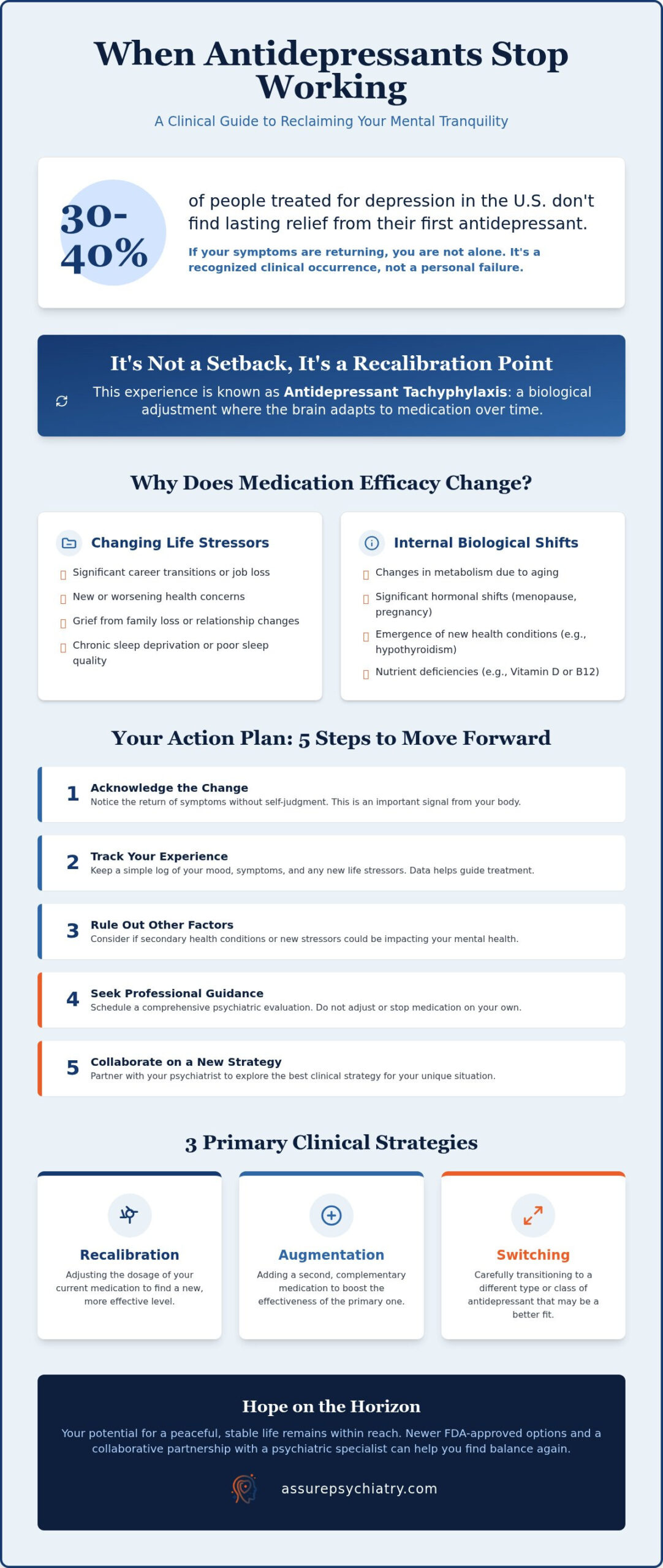
Did you know that approximately 30 to 40 percent of people treated for depression in the United States don’t find lasting relief from their first antidepressant? If you’ve noticed your heavy symptoms returning, you aren’t alone and you haven’t failed. It’s a common clinical occurrence that often leaves patients feeling frustrated by a cycle of trial and error. When the fog begins to roll back in, the most important step is understanding what to do when antidepressants stop working so you can reclaim your path to mental tranquility.
We understand how frightening it feels to worry that your treatment is no longer effective. This article will explain the biological reasons why medications can lose their efficacy over time and provide you with a clear, clinical plan for your next psychiatric appointment. We’ll explore how expert recalibration, including newer FDA-approved options like Auvelity or Spravato, can help you move past this plateau. You’ll discover that while your current medication might have changed, your potential for a peaceful, stable life remains entirely within reach.
Key Takeaways
- Understand that losing medication efficacy, often called tachyphylaxis, is a recognized biological occurrence rather than a personal failure or a permanent plateau.
- Discover exactly what to do when antidepressants stop working with a clinical five-step plan designed to move you safely from frustration toward a resolution.
- Learn about the three primary strategies psychiatrists use—recalibration, augmentation, and switching—to restore your emotional balance and mental tranquility.
- Identify how changing life stressors and environmental factors can impact your medication’s effectiveness and when it is time for a professional re-evaluation.
- Find hope in the latest FDA-approved treatment options and the importance of a collaborative partnership with a psychiatric medication management specialist.
Understanding the ‘Silence’: When Antidepressants Seem to Lose Their Voice
For many, starting an antidepressant feels like finally finding a sturdy shield against a relentless storm. It provides a quiet space where you can breathe, think, and engage with life again. But what happens when that shield begins to thin? You might notice a familiar heaviness creeping back in, or a sudden “silence” where the medication’s protection used to be. This experience is often called breakthrough depression. It isn’t a sign that you’ve done something wrong or that you’re beyond help. Instead, it’s a signal from your body that your current treatment plan needs a professional adjustment.
Clinical data indicates that approximately 33 percent of people treated for depression may experience a return of symptoms even while remaining consistent with their medication. Knowing that antidepressant treatment tachyphylaxis is a documented medical phenomenon can help lower the immediate anxiety of the moment. It’s a common clinical milestone, not a dead end. Understanding the biological shift is the first step in learning what to do when antidepressants stop working for your unique chemistry.
Is it Breakthrough Depression or Tolerance?
It’s vital to distinguish between a temporary dip in mood and a true loss of medication efficacy. Life is unpredictable. New stressors, such as a career change, health concerns, or family loss, can temporarily overwhelm a dose that was previously stable. This is often a situational “breakthrough” rather than a failure of the drug itself. However, if the symptoms persist for weeks without a clear external cause, you might be experiencing tolerance. Tachyphylaxis is a biological adjustment where the brain adapts to the medication over time, rather than a permanent state or a sign of treatment failure.
The Emotional Impact of Worsening Symptoms
When symptoms return, fear often follows quickly. You might worry that you’re “treatment resistant” or that you’ll never feel like yourself again. These thoughts are heavy, but they aren’t facts. At Assure Psychiatry, we view this transition as a recalibration point. Our ally model of care means we don’t just look at a diagnosis; we look at the person behind it. We partner with you to navigate this shift safely, ensuring you feel seen and heard rather than just managed. This collaborative approach helps demystify the process and replaces fear with a clear, actionable path forward.
Your journey toward mental tranquility hasn’t stopped; it’s simply evolving. By identifying the specific reasons why your medication has shifted, we can work together to restore the balance you’ve worked so hard to achieve. Peace is still possible, and this recalibration is the next logical step in your wellness journey.
The Science of Efficacy: Why Medications Stop Working
Understanding the mechanics of your recovery is essential for long-term stability. When a dose that once felt life-saving begins to falter, it’s rarely a sign of personal weakness. Instead, it often reflects a shift in your internal or external environment. Life is dynamic. A medication regimen that supported you through a stable period might struggle to provide the same protection when you face significant life changes, such as a career transition, family loss, or even chronic sleep deprivation. These “changing stressors” can overwhelm your system, making it difficult to maintain your hard-won mental tranquility.
Your biology also changes over time. As we age, our metabolism shifts, which directly impacts how our bodies absorb and process medication. This is a primary reason why many patients find themselves asking Why Aren’t My Antidepressants Working? after years of success. Identifying these biological shifts is a key part of knowing what to do when antidepressants stop working, as it allows us to target the root cause rather than just the symptoms. To find clarity, a comprehensive psychiatric evaluation in Portland is often the most effective way to rule out these variables and determine your next steps.
Biological Shifts and Secondary Health Conditions
Sometimes, the issue isn’t the antidepressant at all, but a secondary health condition that mimics or worsens depressive symptoms. Conditions like hypothyroidism, vitamin D or B12 deficiencies, and significant hormonal shifts during pregnancy or menopause can all alter your emotional state. These physical health issues can starve the brain of the biological building blocks it needs to maintain a stable mood. We frequently recommend specific laboratory work to ensure your physical health is aligned with your psychiatric care. This holistic view ensures that your brain has the resources it needs to respond effectively to treatment.
The Question of Misdiagnosis: Could it be Bipolar Disorder?
Another critical factor in medication efficacy is diagnostic accuracy. If an underlying condition is actually Bipolar Disorder rather than unipolar depression, traditional antidepressants can lose their effectiveness or even trigger mood cycling. Differentiating between these states requires a nuanced, expert approach. Consulting with a bipolar disorder specialist in Portland can help clarify whether your “breakthrough” symptoms are actually part of a different clinical picture. If you feel stuck in a cycle of trial and error, our team is here to act as a collaborative guide in your recalibration process; this is the first step in deciding what to do when antidepressants stop working for you.
Your Action Plan: Steps to Take When Meds Lose Efficacy
When you feel the familiar shadow of depression returning, your first instinct might be to change your dose or stop the medication entirely. Please don’t do this. Abruptly stopping psychiatric medication can cause “discontinuation syndrome,” leading to physical illness and intense emotional distress. Instead, focus on a structured path toward clinical resolution. Knowing exactly what to do when antidepressants stop working starts with gathering data and seeking professional medication management in Portland. This collaborative approach ensures that every change is safe, calculated, and aimed at restoring your mental tranquility.
Research from Johns Hopkins Medicine on Why Antidepressants Stop Working highlights that a loss of efficacy is a clinical signal, not a personal failure. To move forward, follow this structured action plan:
- Stay Consistent: Maintain your current dosage to avoid withdrawal symptoms until you speak with a specialist.
- Document Symptoms: Use a journal to track your daily emotional state and physical changes.
- Schedule an Evaluation: Book a specialized psychiatric appointment to discuss the shift in your symptoms.
- Check Physical Health: Review your medical history for new health conditions or hormonal changes that might interfere with your meds.
- Collaborate: Work with your provider on a new recalibration strategy, which may include dose adjustments or augmentation.
The Recalibration Checklist
Effective treatment relies on high-quality information. For the seven days leading up to your appointment, track your sleep patterns, appetite changes, and any recurring “dark thoughts.” Are these feelings constant, or do they spike after specific triggers like work stress or social conflict? Distinguishing between “biological dips” and external triggers helps your psychiatrist determine if you need a dose adjustment or a different class of medication altogether. During your visit, be direct. Ask your provider: “Is my current medication still the best fit for my specific symptoms, or should we consider augmentation to boost its effect?”
When the Situation Becomes Urgent
While most recalibrations can wait for a scheduled appointment, some symptoms require immediate attention. If you experience thoughts of self-harm, a complete inability to care for yourself, or sudden, extreme mood swings, please reach out for crisis care immediately. Safety is the non-negotiable foundation of your wellness journey. In a psychiatric context, urgent care is necessary whenever your symptoms compromise your physical safety or your fundamental ability to function in daily life. Knowing what to do when antidepressants stop working includes recognizing these red flags and acting quickly to protect your well-being. We’re here to act as your compassionate ally during these difficult transitions, ensuring you never have to navigate the process alone.
Clinical Strategies: How Psychiatrists Restore Balance
Once you’ve identified that a shift is happening, the next step is a clinical recalibration. Psychiatrists generally look at three distinct paths to restore your emotional balance. The first is a dose adjustment. Sometimes the solution is as simple as a slight increase to reach a therapeutic level that matches your current biological needs. This is often the most straightforward first step because it minimizes the risk of new side effects.
If a single medication provides partial relief but doesn’t quite lead to mental tranquility, we might suggest augmentation. This involves adding a secondary agent, such as a mood stabilizer or a low-dose atypical antipsychotic, to “boost” the primary antidepressant’s effect. Think of it as adding a specialist to a team to handle a specific challenge. Finally, there is switching. When a medication truly loses its voice, changing to a different chemical class is often the best route. We manage this through a “cross-taper,” where we slowly lower one dose while introducing the new one. During these transitions, telepsychiatry in Oregon allows for the frequent, low-pressure check-ins needed to ensure your safety and comfort as you navigate what to do when antidepressants stop working.
Switching Medication Classes: SSRIs vs. SNRIs vs. NDRI
Different medications speak different chemical languages. SSRIs like Zoloft focus primarily on serotonin. SNRIs like Effexor add norepinephrine to the mix, while NDRIs like Wellbutrin target dopamine. If your brain has become too accustomed to one pathway, switching classes can effectively “reset” your response to treatment. For cases that remain persistent despite these shifts, newer FDA-approved options like Esketamine offer rapid-acting relief by targeting the glutamate system. This variety of options ensures that a plateau in your current treatment is never the end of your journey.
The Role of Integrative Support
Mental tranquility is rarely achieved through a single pill alone. We view treatment as “medication plus.” This means supporting your pharmaceutical plan with strong sleep hygiene and balanced nutrition. These lifestyle factors provide the physical foundation your brain needs to process medication effectively. Short-term therapy can also act as a vital bridge, providing you with practical coping tools while your new medication settles. This comprehensive approach ensures that when you’re deciding what to do when antidepressants stop working, you have a foundation that supports long-term peace. If you’re ready to move beyond trial and error, schedule a consultation with Assure Psychiatry today to begin your personalized recalibration.
Finding a Collaborative Ally in Portland and Beyond
Reclaiming your peace of mind requires more than just a new prescription; it requires a dedicated partnership. When the medication that once provided stability begins to fade, the path forward involves finding a specialist who listens to your specific experience rather than just your diagnosis. Assure Psychiatry serves as that collaborative ally for patients across the Pacific Northwest. Whether you’re visiting our clinic for in-person care in Portland or connecting via telepsychiatry from Seattle or rural Oregon, our focus remains on providing expert, inclusive care that respects your individual identity. Navigating the complexities of what to do when antidepressants stop working can feel like wandering through a fog without a map, and we’re here to provide the clinical expertise needed to find your way back to clarity.
Why a Specialized Evaluation Matters
Dr. Olumide Aruwajoye’s approach is built on the belief that a diagnosis does not define you. A specialized evaluation at our practice looks beyond the surface symptoms to understand the biological and environmental nuances of your life. If your current treatment has plateaued, it might be time for a fresh perspective from a provider who specializes in complex medication management. Many patients hesitate to leave a provider they’ve seen for years, but learning how to switch psychiatrists can be the most empowering step in your recovery journey. We prioritize diagnostic accuracy to ensure your treatment plan is as dynamic as you are. Our commitment to culturally competent and diverse care standards ensures that every patient feels seen and heard, creating a safe space for true recalibration.
Starting Your Journey Toward Mental Tranquility
We’ve designed our practice to lower the barriers to high-quality psychiatric care because we know how exhausting the “trial and error” process can be. When you’re already struggling with a return of heavy symptoms, the last thing you need is a complicated scheduling process or financial uncertainty. By accepting major insurance plans, we aim to reduce the anxiety that often accompanies the search for a new specialist. We offer a stable environment where you can be an active participant in your own wellness plan. Reclaiming your mental tranquility is a journey of small, manageable steps, and it begins with a conversation about what to do when antidepressants stop working for your unique chemistry. You deserve a plan that works and a partner who stays with you until you find relief.
Your path to a peaceful, stable life is still open. Taking the first step might feel daunting, but you don’t have to do it alone. Schedule your psychiatric evaluation with Assure Psychiatry today.
Reclaiming Your Path to Mental Tranquility
Feeling the weight of depression return while you’re still taking medication is a difficult experience, but it isn’t the end of your wellness journey. As we’ve explored, biological shifts like tachyphylaxis are common clinical milestones that simply signal it’s time for a professional recalibration. Whether through dose adjustments, augmentation, or a strategic switch to a new medication class, your path to stability remains open. Understanding what to do when antidepressants stop working is about moving from frustration to a structured, expert-led action plan that prioritizes your safety and long-term health.
At Assure Psychiatry, Dr. Olumide Aruwajoye provides the expert care and inclusive, culturally competent treatment plans you need to navigate these transitions safely. We offer the flexibility of in-person visits in Portland and telepsychiatry across Oregon and Washington, ensuring you have a compassionate ally no matter where you are located. Don’t let a temporary plateau define your future or your potential for peace. Schedule a Psychiatric Evaluation at Assure Psychiatry today to begin your personalized recalibration. Mental tranquility is still achievable, and we’re here to help you reach it.
Frequently Asked Questions
Is it normal for antidepressants to stop working after several years?
Yes, it is a recognized clinical phenomenon that many patients face. Often called tachyphylaxis, it happens when the brain adapts to the medication’s presence over time. Research suggests about 33 percent of patients experience breakthrough symptoms after long-term use. It doesn’t mean the medication was a failure; it simply indicates that your brain chemistry or life circumstances have shifted, requiring a professional recalibration of your treatment plan to find relief.
What are the signs that my depression medication is no longer effective?
Persistent returning symptoms are the primary indicator that your current plan needs a shift. You might notice a lack of interest in hobbies, changes in sleep or appetite, or a return of the “heavy” emotional fog you previously escaped. If these feelings last for more than two weeks without a clear external stressor, it’s a vital sign to discuss what to do when antidepressants stop working with a specialized provider to explore new strategies.
Can I just double my dose if I feel my antidepressant isn’t working?
No, you should never change your dosage without professional guidance from your psychiatrist. Increasing your dose independently can lead to severe side effects or serotonin syndrome. A medical professional needs to evaluate if an increase is safe or if a different class of medication would be more effective for your current state. Safety is always our priority, and every adjustment must be a collaborative, clinically sound decision to protect your long-term health.
How long does it take to see results after switching antidepressants?
Most patients begin to feel a difference within two to four weeks, though full therapeutic effects often take six to eight weeks. Some newer medications can show improvements in as little as one week. During this transition, we use frequent check-ins via telepsychiatry to monitor your progress and ensure the new regimen is moving you toward your goal of mental tranquility. Patience is key as your brain adjusts to the new chemical balance.
What is ‘antidepressant poop-out’ and is it real?
Yes, “poop-out” is a common, informal term for antidepressant treatment tachyphylaxis. It describes the biological process where a medication that was once effective slowly loses its efficacy over time. This is a very real physiological event, not a psychological failure. Understanding this helps remove the guilt many feel when symptoms return, allowing them to focus on what to do when antidepressants stop working to achieve emotional restoration and stable mental health.
Does Assure Psychiatry offer virtual appointments for medication management in Washington?
Our practice provides comprehensive telepsychiatry services for patients located throughout Washington and Oregon. This includes thorough initial evaluations and ongoing medication management to ensure your treatment remains effective over time. Virtual care allows you to receive expert, inclusive psychiatric support from the comfort of your own home. This makes it much easier to maintain the consistency needed for long-term emotional stability and the mental tranquility you deserve as you move forward.
How do I know if I need a new psychiatric evaluation?
You should seek a new evaluation if your current symptoms aren’t improving or if you feel your provider isn’t addressing the loss of medication efficacy. A fresh look at your diagnosis is especially important if you suspect a misdiagnosis, such as bipolar disorder. A specialized evaluation ensures your treatment plan is accurate, inclusive, and designed to meet your specific biological needs. It’s the first step in reclaiming control over your wellness journey.
Will I have withdrawal symptoms if I switch to a different medication?
We use a professional “cross-taper” method to minimize the risk of withdrawal symptoms during a medication transition. This involves slowly decreasing your old medication while gradually introducing the new one under close supervision. While some mild adjustments are possible, this strategy helps prevent the intense discontinuation syndrome that occurs when stopping meds abruptly. Our team acts as a collaborative guide to ensure your transition is safe, comfortable, and focused on your ultimate stability.
Recent Comments