

A mental health appointment should lead to a clear clinical plan, not guesswork. Mental health care for entrepreneurs in Seattle can include psychiatric evaluations and medication management for concerns such as ADHD, anxiety, bipolar disorder, depression, OCD, PTSD, and sleep difficulties. The right starting point depends on your symptoms and the kind of support you need.
It’s also reasonable to want clarity before booking: which credentials indicate clinical training, what happens at an initial appointment, and how waitlists affect access? This guide explains what to expect, how clinicians’ qualifications differ, and how evidence-based treatment can fit into care. You’ll also learn how to think about appointment logistics and what to do when a wait for ongoing care feels difficult. Understanding the options can make the next step feel more manageable, while keeping the focus on care that respects both your health and the demands of running a business.
Key Takeaways
- Learn which mental health concerns clinicians may treat and how symptoms can affect the demands of entrepreneurship.
- Understand what common clinician credentials mean and how to assess whether a professional’s specialty fits your needs.
- Get a clearer picture of what an initial appointment involves and which factors can affect access and wait times.
- Explore evidence-based treatment options and how psychiatric evaluation and medication management may support care for ADHD or anxiety.
1. Anxiety, OCD, depression, and other treated conditions
Entrepreneurship can put pressure on concentration, sleep, decision-making, and relationships. Persistent worry before investor meetings, low mood that makes routine tasks feel difficult, or repeated checking that disrupts work may be reasons to seek a clinical assessment. A clinician considers how long symptoms have lasted, how intense they are, and whether they interfere with daily life. Work stress matters, but it doesn’t explain every mental health concern.
Concerns assessed in psychiatric care can include anxiety, depression, obsessive-compulsive disorder (OCD), attention-deficit/hyperactivity disorder (ADHD), bipolar disorder, post-traumatic stress disorder (PTSD), and insomnia. Each can affect a business owner differently. Anxiety, for example, may make it hard to delegate, while depression can reduce energy for decisions and conversations. OCD can involve intrusive thoughts and repetitive behaviors, and ADHD may affect focus or organization. A diagnosis describes a pattern of symptoms; it doesn’t define a person or their ability to lead.
Sleep changes, mood shifts, or difficulty concentrating may relate to more than one condition. A careful psychiatric evaluation can help clarify overlapping concerns and inform a treatment plan. Sharing specific examples, such as missed deadlines, recurring panic, or prolonged difficulty sleeping, helps explain how symptoms affect daily life. Community connection can be valuable, but it isn’t a substitute for clinical care when symptoms persist or worsen.
Thoughts of suicide or immediate danger call for urgent support, not a routine appointment. In the United States, 988 provides access to trained crisis counselors 24 hours a day, 7 days a week, according to the Substance Abuse and Mental Health Services Administration. In Washington, people facing a life-threatening emergency should call 911, according to Washington State. Reaching out for crisis support is a practical step toward safety.
Population comparisons can provide context, but they cannot predict an individual’s experience or replace an assessment. The stated comparisons are that entrepreneurs are twice as likely as the average population to have depression, six times more likely to have ADHD, and ten times more likely to have bipolar disorder. They are also twice as likely as the average population to have suicidal thoughts. These figures underscore why persistent symptoms and safety concerns deserve attention, without defining any one person’s health or future.
2. Clinician specialties and professional credentials
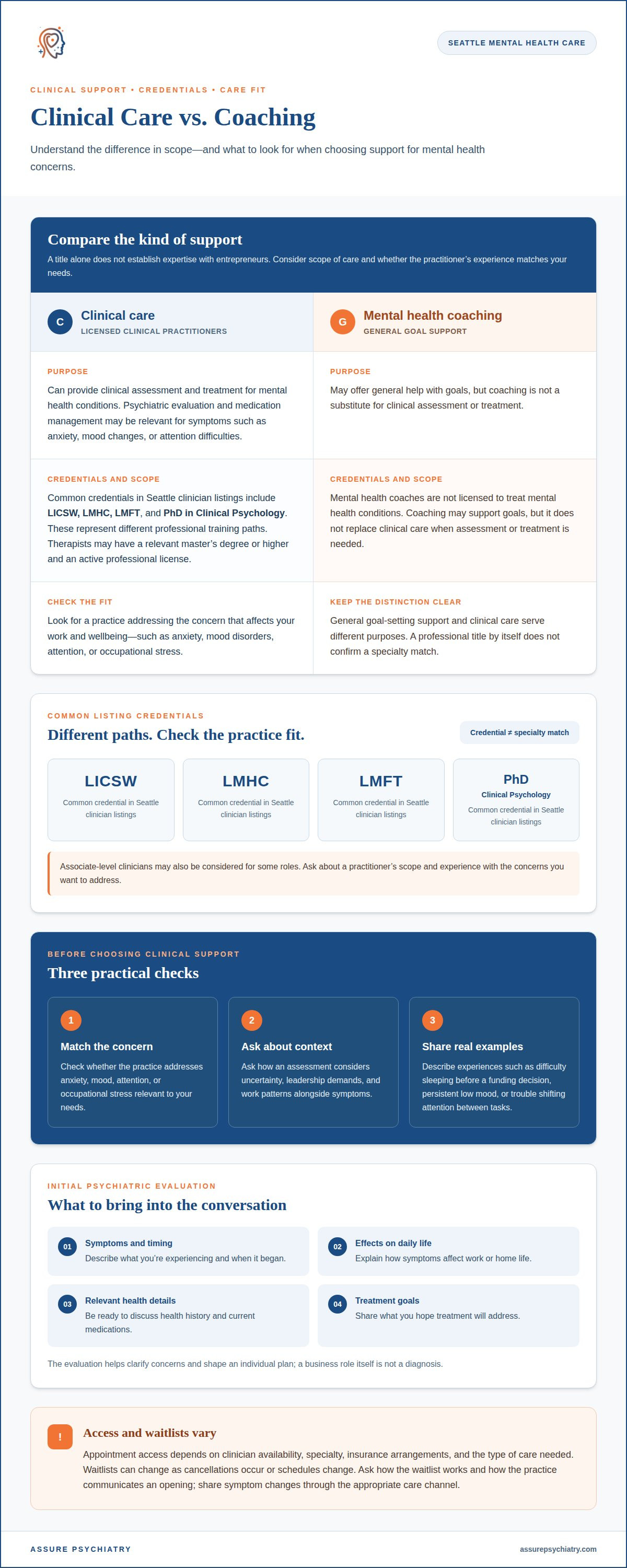
For Seattle entrepreneurs seeking care, consider whether the service addresses the specific concern affecting your work and wellbeing. Psychiatric evaluations and medication management can be relevant when you’re looking for clinical support with symptoms such as anxiety, mood changes, or attention difficulties.
When choosing clinical support for startup stress or burnout, look for a practitioner whose scope of care matches your needs. Ask how the assessment will consider uncertainty, leadership demands, and work patterns alongside your symptoms.
Common credentials in Seattle clinician listings include LICSW, LMHC, LMFT, and PhD in Clinical Psychology. These reflect different professional training paths; a title alone doesn’t establish expertise with entrepreneurs. A clinician’s scope of practice also matters, particularly when work stress overlaps with a condition such as bipolar disorder.
Therapists may have a relevant master’s degree or higher and an active professional license. Associate-level clinicians may also be considered for some roles. These details help distinguish licensed clinical practitioners from mental health coaches, who aren’t licensed to treat mental health conditions. Coaching may offer general help with goals, but it isn’t a substitute for clinical assessment or treatment.
In an initial conversation, give concrete examples: difficulty sleeping before a funding decision, persistent low mood, or trouble shifting attention between tasks. Ask how those experiences inform an assessment and care plan. The discussion can clarify whether the concern involves a mental health condition, workplace strain, or both. Organizations supporting founders can use clear distinctions between clinical care and coaching when considering referrals. A collaborative approach keeps attention on the person, not only the business, and helps shape care around individual needs.
Look for Seattle clinicians whose practice addresses anxiety, mood disorders, attention, or occupational stress and who have experience relating these concerns to startup uncertainty, leadership demands, and work patterns.
3. Consultations, appointments, and waitlists
An initial psychiatric evaluation helps clarify the concerns behind an appointment. Be ready to describe your symptoms, when they began, and how they affect work or home life. A startup founder, for example, might explain that anxiety interrupts sleep before major decisions. The clinician may also discuss relevant health history, current medications, and what you hope treatment will address. This conversation helps shape an individual plan rather than treating a business role as a diagnosis.
Appointment access depends on practical factors, including clinician availability, specialty, insurance arrangements, and the type of care needed. A waitlist may move as cancellations occur or schedules change, so the process varies across practices. Ask about the steps for joining a waitlist and how the practice communicates an opening. If symptoms change while waiting, share the update through the appropriate care channel so the urgency can be understood.
Seattle residents using Apple Health for mental health services should contact their managed care plan for assistance. If you have Apple Health but aren’t enrolled in managed care, contact the Washington State Health Care Authority for help accessing services. Keep your plan information handy to make the conversation more direct. Insurance coverage and clinician availability both influence the path to an appointment.
After the first visit, follow-up sessions may focus on clarifying symptoms, reviewing treatment options, and tracking changes over time. The schedule depends on clinical needs and the care plan, rather than a universal timetable. For instance, a founder balancing investor meetings and family responsibilities may need appointments arranged around work demands. A predictable process, including clear appointment details and follow-up expectations, can make ongoing care easier to coordinate with a demanding startup schedule.
4. Evidence-based mental health treatment in Seattle
Online and in-person appointments can both support mental health care for entrepreneurs in Seattle. Telehealth can reduce travel and fit around a startup schedule, while in-person visits provide direct conversation in a clinical setting. The best format depends on privacy, access, comfort, and the care being provided.
The cost of psychiatric care varies with the clinician’s fees, insurance coverage, appointment format, and plan benefits. Assure Psychiatry accepts most major insurances, but coverage varies by plan, so verify your benefits before scheduling. Discounted cash rates are available for uninsured patients. Checking your behavioral health benefits and payment arrangements can clarify likely out-of-pocket costs.
For lower-cost care, Washington residents may explore Apple Health coverage, which includes mental health services. Eligibility and managed-care arrangements affect how people access those services. Community health organizations may also offer options based on income or a sliding scale. For entrepreneurs in Seattle, mental health care options may depend on coverage, eligibility, and the specific program.
Seattle founders can find connection through entrepreneur communities and peer networks, where people discuss leadership pressures and business uncertainty. Peer support can ease isolation, but it isn’t a substitute for clinical assessment or treatment when symptoms persist. Community offers shared experience; a clinician develops care around individual needs.
Evidence-based treatment uses clinical assessment and research-supported approaches to guide care. A clinician considers symptoms, health history, personal goals, and changes over time, then adjusts the plan as needed. Prevention can include recognizing early shifts, such as persistent sleep disruption or worsening anxiety, and seeking support before work and daily life become harder to manage. The goal is a plan that remains responsive rather than one-size-fits-all. For crisis support, use 988; call 911 for a life-threatening emergency, as covered above.
Assure Psychiatry
Assure Psychiatry provides psychiatric evaluations and medication management for people seeking support with concerns such as ADHD or anxiety. An evaluation reviews symptoms and helps inform a treatment plan, while medication management includes ongoing review of prescribed treatment. These services may be a useful next step when concerns affect your focus, decisions, or daily responsibilities.
Care is available through virtual telepsychiatry, which can make appointments more accessible for people balancing business demands. Treatment remains individual: a clinician considers your concerns and goals when discussing next steps. If you’re looking for psychiatric support rather than peer connection or business coaching, Assure Psychiatry may be a fit for evaluation and medication-related care.
Contact Assure Psychiatry to discuss your mental health care needs.
Make room for your wellbeing as you build
Running a business can mean carrying decisions long after the workday ends. Your wellbeing deserves attention, too. A thoughtful approach to mental health care for entrepreneurs in Seattle starts with noticing what you need now, rather than waiting for strain to affect every part of life and work.
Consider what you want to feel different, what would make care easier to begin, and what questions you’d like a clinician to address. Those priorities can make the first conversation more focused and personal. You don’t need every answer before taking a step; recognizing that support could help is enough to begin.
If you’re ready to discuss care, contact Assure Psychiatry. Choosing support is a meaningful investment in your wellbeing, and you can move toward greater steadiness one step at a time.
Frequently Asked Questions
What types of services are available?
Psychiatric care may include an evaluation and medication management for concerns such as ADHD, anxiety, depression, bipolar disorder, OCD, PTSD, and insomnia. The right service depends on your symptoms and the kind of clinical support you’re seeking. For example, someone struggling with attention at work may start with an evaluation, while someone already taking medication may benefit from follow-up medication management.
What mental health services for entrepreneurs are available in Seattle?
Seattle entrepreneurs can look for outpatient psychiatric assessment and medication management, alongside therapy services from providers that offer them. Assure Psychiatry provides comprehensive psychiatric evaluations, medication management, and treatment for ADHD and other mental health concerns, proudly offering its care to clients in Seattle as well as the broader region. This availability ensures local founders can readily access necessary treatment. Consider whether you need an assessment, medication-related care, or another form of support.
What are the signs of entrepreneur burnout, anxiety, or depression, and when should someone seek professional help?
Warning signs can include persistent excessive worry, loss of interest in activities, ongoing sleep difficulties, or suicidal thoughts. If worry repeatedly disrupts decisions or low mood makes ordinary responsibilities feel unmanageable, consider speaking with a mental health professional. Seek help when symptoms persist, worsen, or interfere with daily functioning. Thoughts of suicide call for urgent support rather than waiting for a routine appointment.
Recent Comments