

What if the diagnosis you’ve been fearing isn’t a life sentence, but rather the first day of your recovery? Many people across our state feel exhausted by the relentless whiplash of mood cycles, often wondering why their experiences don’t quite fit the standard definition of depression. If you’ve felt misunderstood by previous providers or worry about being labeled, you’re not alone. Seeking a comprehensive psychiatric evaluation for bipolar disorder Washington residents can trust is a brave step toward reclaiming your narrative. It’s about moving past the confusion and finding a partner who sees the person behind the symptoms.
You deserve a clear answer and a path forward that feels both stable and supportive. Recent shifts in Washington law, such as the 2026 enforcement of mental health parity, mean that accessing this specialized care is more attainable than ever. In this guide, we’ll walk through the evaluation process, showing you how a precise diagnosis leads to a collaborative treatment plan tailored to your life. Discover how this professional review serves as a bridge to the mental tranquility you’ve been searching for, replacing unpredictable highs and lows with a steady sense of hope.
Key Takeaways
- Learn how a psychiatric evaluation serves as a compassionate clinical conversation designed to validate your unique experiences rather than just provide a medical label.
- Understand the critical differences between Bipolar I, II, and Cyclothymia to ensure your treatment plan aligns perfectly with your specific mood patterns.
- Discover why a precise psychiatric evaluation for bipolar disorder Washington is essential for preventing the complications associated with misdiagnosed treatment-resistant depression.
- Explore the structured 4-step diagnostic process that bridges the gap between unpredictable cycles and a future defined by mental tranquility.
- See how secure telepsychiatry offers a safe and accessible way to begin your wellness journey with expert guidance from the comfort of your own home.
What is a Psychiatric Evaluation for Bipolar Disorder?
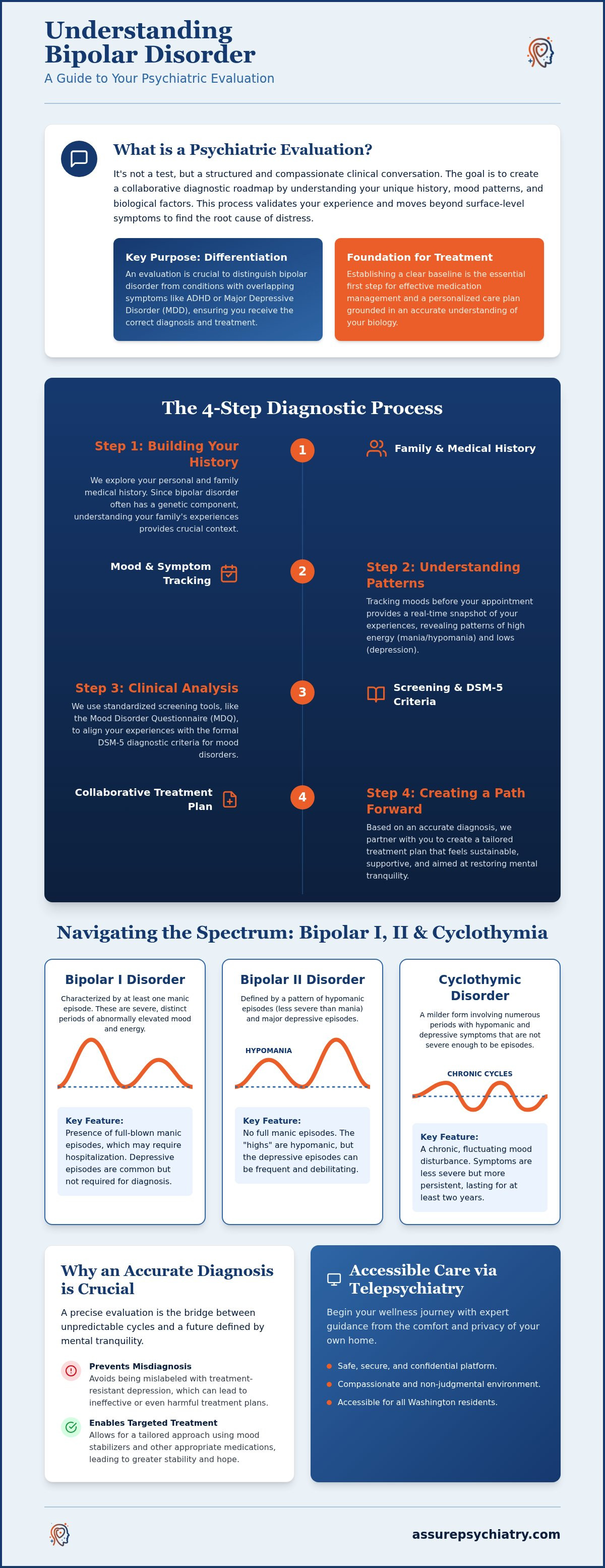
Think of a psychiatric evaluation not as a stressful exam, but as a space where your story finally begins to make sense. A psychiatric evaluation for bipolar disorder Washington residents often seek is a structured yet compassionate clinical conversation. It’s a deep dive into your personal history, your unique mood patterns, and the biological factors that influence your daily life. By looking at the full picture, we can move beyond surface-level symptoms to find the root cause of your distress. A bipolar evaluation is a collaborative diagnostic roadmap.
One of the most vital aspects of this review is differentiation. Bipolar disorder frequently shares traits with other conditions, such as Attention-Deficit/Hyperactivity Disorder (ADHD) or Major Depressive Disorder (MDD). For example, the high energy of mania can sometimes be mistaken for ADHD, while the “lows” might appear as standard clinical depression. A comprehensive evaluation ensures you aren’t mislabeled, providing the clarity needed to choose the right path forward.
The Clinical Purpose of the Assessment
The primary goal of this assessment is to identify the specific nature of your mood episodes. We look closely at periods of mania, hypomania, and depression to understand how they manifest for you. This process also serves to rule out underlying medical issues or substance-induced mood changes that might be mimicking psychiatric symptoms. Establishing this clear baseline is the essential first step for effective medication management in Portland and across Washington, ensuring that any future prescriptions are grounded in an accurate understanding of your biology.
Cultural Competence in Diagnosis
Your unique background and identity are not separate from your mental health; they are central to it. At Assure Psychiatry, we recognize that cultural nuances can influence how symptoms are described and experienced. We prioritize a non-judgmental, inclusive environment where you feel safe sharing your truth. Empathy plays a leading role here. By listening with an open heart, we can uncover accurate symptom histories that a purely clinical approach might miss. We believe that feeling seen and heard is just as important as the clinical data we gather during your psychiatric evaluation for bipolar disorder Washington session.
The 4-Step Process of a Bipolar Diagnostic Assessment
Understanding the specific steps of a psychiatric evaluation for bipolar disorder Washington residents undergo helps demystify the experience. It transforms a clinical procedure into a shared journey toward healing. This process isn’t about fitting you into a box; it’s about uncovering the unique rhythm of your life to find a sustainable path forward. By following a structured approach, we ensure that every nuance of your story is heard and every symptom is validated.
Step 1 & 2: Building Your History
Your history is the foundation of an accurate diagnosis. Because bipolar disorder often has a strong genetic component, family history is a critical piece of the puzzle. Knowing if a close relative experienced similar mood patterns helps us understand your biological predisposition. When preparing for your psychiatric evaluation in Portland or through our virtual Washington clinic, it’s helpful to bring any previous medical records or a list of past medications.
You can improve the accuracy of your assessment by tracking your moods for a week or two before the appointment. Note when you feel unusually energetic or profoundly discouraged. This data provides a real-time snapshot of your experiences, allowing us to see patterns that might be hard to recall during the interview. We use this history to build a supportive partnership where you’re the expert on your life and we’re your clinical guides.
Step 3 & 4: Analysis and Action
Once we’ve gathered your history, we use standardized screening tools like the Mood Disorder Questionnaire (MDQ) to refine our understanding. These tools aren’t “tests” with right or wrong answers; they’re instruments that help us align your experiences with the DSM-5 criteria. This is where we distinguish between Bipolar I, characterized by manic episodes, and Bipolar II, which involve hypomania and more frequent depressive cycles. Getting this distinction right is vital for your safety and long-term stability.
The final step is the creation of your treatment roadmap. This isn’t a generic handout. It’s a personalized plan that respects your individual wellness goals and lifestyle. We transition from evaluation to ongoing support by discussing how we’ll monitor your progress together. If you’re ready to find a clearer diagnostic answer, you can reach out to our team to begin this collaborative process. Our goal is to ensure you leave the session not just with a diagnosis, but with a sense of hope and a concrete plan for mental tranquility.
Bipolar I, II, and Cyclothymia: Navigating the Spectrum
Bipolar disorder isn’t a single, fixed experience. It’s a spectrum of mood patterns that varies significantly from person to person. When you undergo a psychiatric evaluation for bipolar disorder Washington providers offer, the goal is to identify exactly where your experiences fall on this spectrum. This nuanced approach is far more effective than a one-size-fits-all diagnosis. It allows us to tailor your care to the specific rhythm of your life, ensuring that your treatment plan is as unique as you are.
The three primary types we look for include:
- Bipolar I Disorder: Defined by manic episodes that last at least seven days or are severe enough to require immediate clinical care. Depressive episodes are also common, typically lasting at least two weeks.
- Bipolar II Disorder: Characterized by a pattern of depressive episodes and hypomanic episodes. Unlike Bipolar I, the “highs” do not reach full-blown mania, but the depressive cycles are often frequent and intense.
- Cyclothymic Disorder: A chronic state of mood fluctuation. While the highs and lows aren’t as extreme as those in Bipolar I or II, the persistent shifts occur for at least two years and can be deeply draining.
Identifying Hypomania vs. Mania
Distinguishing between mania and hypomania is a critical part of your evaluation. Mania is often unmistakable, involving a significant break from your typical behavior that may include risky choices or a decreased need for sleep. Hypomania is subtler. You might feel a surge in productivity, heightened creativity, or a sudden boost in social confidence. It’s easy to dismiss these signs because “feeling good” doesn’t always seem like a problem. However, when these states are followed by a crash, they indicate a clinical need for support. Consulting a bipolar disorder specialist in Portland or through our Washington telepsychiatry service helps you gain the clarity needed to manage these shifts before they become overwhelming.
Mixed Features and Rapid Cycling
Sometimes, symptoms don’t stay in their separate “high” or “low” lanes. Mixed features occur when you experience high energy and deep depression at the exact same time. You might feel “wired” but hopeless, a state often described as agitated depression. We also look for rapid cycling, which is when a person experiences four or more mood episodes within a single year. These nuances are vital to capture during your psychiatric evaluation for bipolar disorder Washington session. They directly change your medication management needs, as certain treatments that work for standard cycles might not be effective for rapid or mixed patterns. Tracking the frequency of your shifts helps us build a more reliable bridge to mental tranquility.
Why Accurate Diagnosis Prevents Treatment-Resistant Depression
Have you ever felt like your depression treatments are only making things worse? If you’ve spent months or even years trying different antidepressants without relief, the issue might not be the medication’s strength, but its target. Treating bipolar disorder with antidepressants alone can be counterproductive and, in some cases, dangerous. Without the balancing effect of a mood stabilizer, standard depression meds can trigger “mania induction,” causing your mood cycles to accelerate or become more volatile. This is why a specialized psychiatric evaluation for bipolar disorder Washington patients seek is so critical. It ensures that the foundation of your care is built on an accurate understanding of your brain’s unique chemistry.
When a diagnosis is precise, the focus shifts from just managing symptoms to achieving true mental tranquility. Mood stabilizers and other targeted treatments work with your biology to create a steady baseline. This prevents the exhausting whiplash of unpredictable cycles and protects your brain from the long-term impact of untreated mood fluctuations. A specialist evaluation isn’t just about finding a label; it’s about finding the specific key that unlocks your stability.
The Bipolar-Depression Connection
Clinical data suggests that a significant number of individuals live with bipolar disorder for years before receiving an accurate diagnosis, often being treated for Major Depressive Disorder (MDD) instead. This overlap happens because people are much more likely to seek help during a depressive “low” than a hypomanic “high.” To rule out bipolarity, your psychiatrist should ask detailed questions about your family history, periods of decreased need for sleep, or times when your thoughts felt too fast to catch. If you suspect your diagnosis is incomplete, you have the right to advocate for a more comprehensive review. You are the expert on your own experience, and your insights are the most valuable tools we have.
Achieving Stability Through Precise Care
Early and accurate diagnostic intervention offers benefits that last a lifetime. It allows you to move beyond “just getting by” and start thriving in your relationships, career, and personal life. For many, mental health is a complex picture that involves more than one condition. If you find that focus and energy are also persistent challenges, integrating care with an ADHD psychiatrist in Portland or through our Washington telepsychiatry service can provide a holistic path forward. By addressing the full spectrum of your needs, we can build a treatment plan that offers lasting peace of mind. If you are ready to stop the cycle of trial and error, schedule a comprehensive evaluation with Assure Psychiatry today to begin your journey toward stability.
Compassionate Bipolar Care for Washington Residents
Finding a provider who understands the delicate balance of your mental health shouldn’t feel like an uphill battle. If you’re seeking a psychiatric evaluation for bipolar disorder Washington offers several paths; however, the most effective journey is one built on a foundation of trust and accessibility. At Assure Psychiatry, we believe that your diagnostic experience should be as restorative as the treatment that follows. We position ourselves as your compassionate ally, ensuring that you feel seen and heard throughout every step of our comprehensive review process.
Telehealth Benefits for Washington Patients
Modern care should adapt to your life, not the other way around. In 2022, approximately 65% of mental health visits in Washington were conducted virtually, a rate that far exceeds the national average of 50%. This shift toward virtual care is particularly beneficial for those experiencing the unpredictable energy shifts of bipolar disorder. By choosing a secure, virtual evaluation, you eliminate the stress of commuting to a physical office. You can engage in these sensitive diagnostic discussions from the safety and privacy of your own home, which often leads to more honest and productive clinical conversations.
Our team is fully licensed to serve patients across the state, adhering to the high standards of care expected by Washington residents. We also accept major insurance plans to ensure that financial hurdles don’t stand in the way of your stability. If you’re curious about how virtual care works across state lines, you can explore our guide on telepsychiatry in Oregon and Washington to see how we bridge the gap in regional care.
Your Journey to Tranquility Starts Here
Led by Dr. Olumide Aruwajoye, Assure Psychiatry specializes in culturally competent care that respects your individual identity and background. We understand that a psychiatric evaluation for bipolar disorder Washington residents receive must be inclusive and non-judgmental. We don’t just look at a list of symptoms; we look at the person behind them. Our collaborative approach to medication management ensures that you’re an active participant in your own wellness plan, rather than a passive recipient of a diagnosis.
You are more than a medical label or a set of mood cycles. You’re an individual with unique goals, and our mission is to help you reach them. By prioritizing empathy and clinical expertise, we create a stable environment where mental tranquility is finally within reach. If you’re ready to move past the confusion and find a clear path forward, we invite you to take the first step. You can schedule your initial evaluation today and begin the collaborative process of reclaiming your peace of mind.
Step Into Your Future of Mental Tranquility
Choosing to seek a psychiatric evaluation for bipolar disorder Washington residents can rely on is the definitive turning point between persistent confusion and lasting clarity. We’ve explored how a precise diagnosis identifies your unique place on the mood spectrum. This ensures you receive the specific stabilization needed to prevent treatment-resistant depression. This collaborative review isn’t just a clinical requirement; it’s your personal roadmap to an emotionally balanced life.
You don’t have to navigate unpredictable cycles without a knowledgeable guide. Assure Psychiatry is here to serve as your dedicated ally. Led by board-certified professionals, our practice provides secure, HIPAA-compliant telehealth that prioritizes culturally competent and inclusive care. We’re committed to ensuring every patient feels seen, heard, and validated throughout their wellness journey. Your path to stability is only a conversation away.
Schedule Your Bipolar Evaluation with Assure Psychiatry Today and take the first step toward reclaiming your peace of mind. You are more than your diagnosis, and a life of mental tranquility is well within your reach.
Frequently Asked Questions
How long does a psychiatric evaluation for bipolar disorder take?
Initial evaluations typically last between 45 and 60 minutes. This timeframe allows us to conduct a thorough review of your history and symptoms without making you feel rushed. We want to ensure you have plenty of space to share your story completely. While many cases are clear after one session, some complex situations may require a follow-up appointment to finalize your diagnostic roadmap and ensure your path to tranquility is secure.
Can I get a bipolar diagnosis through telepsychiatry in Washington?
Yes, you can receive a complete psychiatric evaluation for bipolar disorder Washington residents trust through our secure telepsychiatry platform. Virtual care is just as effective as in-person visits for diagnostic purposes. We use HIPAA-compliant technology to protect your privacy while we discuss sensitive mood patterns. This approach is especially helpful for those who find travel stressful or live in areas where specialized care is difficult to access locally.
What is the difference between a therapist and a psychiatrist for bipolar care?
Psychiatrists are medical doctors who specialize in the biological aspects of mental health, including diagnosis and medication management. While therapists provide essential talk therapy to help you process emotions and build coping skills, they cannot prescribe medication. For bipolar disorder, a psychiatrist’s role is critical because the condition often requires mood stabilizers to balance brain chemistry. We often work alongside your therapist to ensure your plan is holistic.
Do I need to stop my current medications before the evaluation?
No, you shouldn’t stop taking any current medications before your initial assessment. Seeing how you currently function on your existing prescriptions provides vital information for your evaluation. We need a clear picture of what’s working and what isn’t to make an accurate diagnosis. During the session, we’ll review your medication history in detail. Any changes to your regimen will be made collaboratively and gradually to ensure your safety.
Will my insurance cover a bipolar evaluation at Assure Psychiatry?
Most major insurance plans cover psychiatric evaluations as medically necessary services. Under Washington’s 2026 mental health parity laws, insurers are required to provide coverage for these assessments similar to physical health visits. Assure Psychiatry accepts many major networks to help lower the barrier to care. We recommend verifying your specific benefits with your provider beforehand. Our team can also help you understand your coverage and any potential costs before we begin.
What happens if I am diagnosed with bipolar disorder?
A diagnosis is the beginning of a collaborative partnership focused on your wellness. Once we identify your specific place on the spectrum, we’ll develop a personalized treatment plan. This typically includes a combination of medication management and lifestyle adjustments designed to stabilize your mood. We’ll discuss what this means for your daily life and set realistic goals for your recovery. Remember, a diagnosis doesn’t define you; it simply provides clarity.
How often will I need follow-up appointments for medication management?
Follow-up frequency depends on your individual needs, but usually occurs every few weeks during the initial stabilization phase. Once we find a medication regimen that works well for you, appointments may shift to every few months. These sessions are shorter than the initial psychiatric evaluation for bipolar disorder Washington residents first complete. They focus on monitoring your progress and making small adjustments. Our goal is to maintain your stability with consistent, reliable support.
Can bipolar disorder be cured, or just managed?
While there isn’t a permanent cure for bipolar disorder, it can be managed very effectively with the right professional support. Think of it like managing a chronic physical condition such as diabetes. With consistent care and a precise treatment plan, most people live full, productive, and peaceful lives. Modern psychiatry offers tools that allow you to thrive rather than just survive. Achieving lasting mental tranquility is a realistic goal for your future.
Recent Comments