

What if the label you’ve been dreading is actually the key that finally unlocks the door to your inner peace? For many living in the Pacific Northwest, the line between everyday mood swings and a clinical condition feels blurry and overwhelming. You might find yourself searching for a bipolar disorder diagnosis Washington residents can trust, hoping to find a provider who understands both the clinical complexity and the human experience. It’s common to feel a sense of anxiety about being categorized. However, a professional evaluation is often the first step toward shedding the weight of uncertainty and finding a compassionate ally in your wellness journey.
We understand that the path to mental wellness shouldn’t be a solitary struggle or a confusing maze of insurance hurdles. With Washington’s 2026 mental health parity laws ensuring better coverage for initial evaluations, accessing the expertise you deserve is more attainable than ever. This article will guide you through the comprehensive process of obtaining a professional diagnosis and explain how specialized psychiatric care creates a personalized roadmap for your recovery. You’ll discover how a clear clinical perspective can transform confusion into a structured path toward lasting mental tranquility and stability.
Key Takeaways
- Learn why a professional diagnosis is the essential first step toward effective medication management and reclaiming your mental tranquility.
- Understand exactly what to expect during a comprehensive psychiatric evaluation to receive a bipolar disorder diagnosis Washington residents can trust.
- Discover the clinical differences between Bipolar I, Bipolar II, and Cyclothymia to ensure your treatment plan is tailored to your specific needs.
- Explore how telepsychiatry makes it easier to receive expert psychiatric care and ongoing support without the stress of a long commute.
- Find out how a collaborative, non-judgmental approach to care empowers you to be an active participant in your journey toward stability.
Understanding Bipolar Disorder: Why a Professional Diagnosis Matters
Living with intense mood shifts can feel like being caught in a tide that pulls you in different directions without warning. You might experience days of boundless energy followed by weeks of heavy, immovable exhaustion. While it’s easy to dismiss these patterns as personality traits or stress, they are often the physiological markers of a clinical condition. Obtaining a professional bipolar disorder diagnosis Washington residents can rely on is the first step toward reclaiming your sense of self. It moves you away from the exhaustion of “powering through” and toward a structured, supportive path of healing.
A formal diagnosis serves as the vital foundation for effective medication management in Portland and throughout the Pacific Northwest. Without a professional’s perspective, many people attempt to self-diagnose, which carries significant risks. Bipolar symptoms often overlap with other conditions like ADHD or PTSD. For example, the restlessness of a manic phase can look like hyperactivity, while the emotional withdrawal of a depressive cycle might mirror trauma responses. Professional screening ensures you aren’t treating the wrong condition, which could inadvertently worsen your symptoms. Early intervention is vital. It helps prevent the long-term social, professional, and physical strain that untreated cycles place on your life.
The Spectrum of Mood: More Than Just Highs and Lows
Understanding Bipolar Disorder requires looking beyond simple happiness or sadness. Mania involves more than just a good mood; it often manifests as a decreased need for sleep, racing thoughts, and a sense of invincibility that can lead to impulsive choices. Conversely, depressive episodes bring a persistent sadness and a complete loss of interest in activities you once loved. A skilled practitioner also looks for “mixed features,” where symptoms of both states occur simultaneously. This state is particularly distressing and is frequently missed by those without clinical training.
The Goal of Diagnosis: Achieving Mental Tranquility
A diagnosis is not a label meant to limit you. Instead, it provides a necessary vocabulary for your experiences. It transforms vague confusion into a clear roadmap for restorative action. When you receive validation from a bipolar disorder specialist in Portland, the emotional barriers of shame or “being difficult” begin to lower. You realize that your struggles aren’t a failure of will, but a manageable health condition. This shift in perspective is where mental tranquility begins. It allows you to become a collaborative partner in your own treatment, working toward a life defined by stability rather than the next unpredictable shift in mood.
The Process of Seeking a Bipolar Disorder Diagnosis in Washington
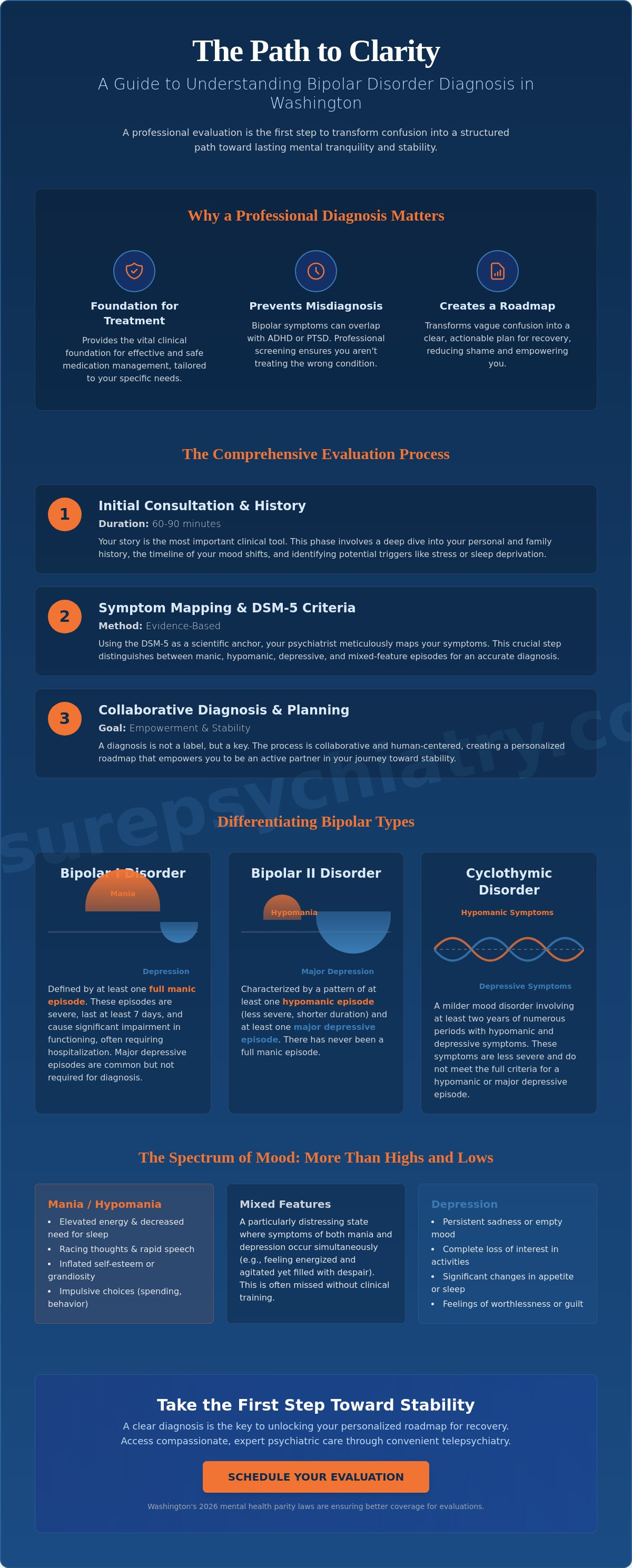
Seeking a bipolar disorder diagnosis Washington residents can feel confident in requires more than just a quick conversation. It demands a dedicated space where your personal history is respected and your symptoms are meticulously mapped. This journey often begins with a comprehensive psychiatric evaluation in Portland or through a secure telehealth platform. Unlike a standard medical checkup, these evaluations typically last 60 to 90 minutes. This duration ensures that every nuance of your experience is captured, allowing for a diagnosis that is both accurate and safe. The Process of Seeking a Bipolar Disorder Diagnosis involves using DSM-5 criteria as a scientific anchor, but the heart of the process remains collaborative and deeply human.
Step 1: The Initial Consultation and History
Your story is the most important clinical tool we have. During the initial phase, we’ll review your family history together, as genetics often play a significant role in mood disorders. We look at the timeline of your mood shifts over years, not just the past few weeks. By identifying specific triggers like chronic stress, sleep deprivation, or changes in your environment, we can begin to see the patterns that define your unique experience. This isn’t about being labeled; it’s about understanding the “why” behind your emotional state.
Step 2: Clinical Screening Tools and Assessment
Accuracy requires a blend of clinical expertise and standardized assessment tools. We utilize specific scales to measure the severity of both manic and depressive symptoms. This stage is crucial for differentiating between conditions that often mimic one another. For instance, the high energy of hypomania can sometimes be mistaken for the hyperfocus seen in ADHD. We also consider physical health factors, ensuring that medical issues like thyroid dysfunction aren’t the underlying cause of your mood fluctuations. If you’re ready to find clarity, scheduling a psychiatric evaluation can provide the professional answers you need.
Step 3: Formulating a Collaborative Treatment Plan
Once the assessment is complete, we discuss the findings in a transparent and non-judgmental manner. This is a moment of empowerment, where we move from uncertainty to action. We’ll set short-term goals to achieve immediate stability and long-term goals that focus on your overall wellness and mental tranquility. We’ll also introduce the role of medication management as a supportive tool to help maintain your internal balance. In this partnership, you are an active participant, and your preferences and values always guide the path forward.
Differentiating Bipolar Types: I, II, and Cyclothymia
Every person’s journey with a mood disorder is unique, which is why a nuanced approach is essential. When you seek a bipolar disorder diagnosis Washington specialists provide, the goal is to identify exactly where you sit on the spectrum. This isn’t just about clinical accuracy; it’s about making sure your treatment plan matches the reality of your daily life. Differentiating Bipolar Types is the first step in moving from a place of confusion to a state of mental tranquility. By understanding whether you are experiencing Bipolar I, Bipolar II, or Cyclothymia, we can create a roadmap that truly supports your healing and long-term stability.
Bipolar I: Managing Intense Manic Episodes
Bipolar I is characterized by at least one full manic episode. These aren’t simply periods of high energy. They are intense, often disruptive phases that can lead to significant life changes or even require hospitalization for your safety. During mania, you might feel a decreased need for sleep, racing thoughts, or a sense of grandiosity that feels impossible to control. The clinical focus here is on immediate stabilization. We work closely with you to build a safety plan that protects your health and relationships. By utilizing precise medication management, we aim to level these peaks and prevent the inevitable, heavy crash into depression that often follows a manic high.
Bipolar II: The Challenge of Persistent Depression
Bipolar II is often more difficult to spot. It involves at least one major depressive episode and at least one hypomanic episode. Because hypomania is less severe than full mania, it’s often mistaken for a period of high productivity or a “good mood.” You might feel extra creative or energetic, which doesn’t always feel like a clinical symptom. This is why Bipolar II is frequently misdiagnosed as standard clinical depression. Our role is to look deeper. We help you identify these unsustainable “up” periods so we can address the underlying cycle. The priority is reducing the frequency and weight of the depressive episodes that can otherwise feel like an endless cycle.
Cyclothymic disorder represents a milder, yet chronic form of mood cycling. If you have cyclothymia, you experience periods of hypomanic and depressive symptoms for at least two years. While these shifts aren’t as extreme as those in Bipolar I or II, the constant movement can be incredibly draining. Finding a bipolar disorder diagnosis Washington residents can trust means finding someone who recognizes these subtle, ongoing patterns. We focus on providing the steady, reliable support needed to anchor your mood and help you find a lasting sense of peace. Whether your symptoms are mild or severe, having a clear name for your experience is the beginning of your path to wellness.
Preparing for Your Virtual Psychiatric Evaluation in Washington
Modern healthcare has evolved to meet you where you feel most comfortable. For many living in the Pacific Northwest, telepsychiatry offers a seamless way to access expert care, whether you’re in the heart of Seattle or the quiet suburbs of Vancouver. Data from 2022 shows that approximately 65% of mental health visits in Washington were conducted virtually, which is significantly higher than the national average of 50%. This shift highlights how effective and trusted virtual care has become for those seeking a bipolar disorder diagnosis Washington providers can deliver with precision. Washington residents can also benefit from telepsychiatry in Oregon through licensed practitioners, expanding your options for finding a compassionate ally in your wellness journey.
To get the most out of your session, preparation is key. We suggest finding a private, quiet space where you feel safe to speak openly about your history. Having your previous medical records or a list of past medications ready can be incredibly helpful. It allows your provider to see the full picture of your health journey without missing vital details. This collaborative preparation ensures that your evaluation is as thorough as an in-person visit while allowing you to remain in a familiar, calming environment. When you have your information organized, it lowers the initial stress of the consultation, letting us focus entirely on your path to stability.
Technical and Emotional Readiness
Before your appointment begins, take a few minutes to test your camera and microphone. A stable connection helps maintain a steady, calm rhythm during our conversation, preventing technical distractions from interrupting the flow of your story. It’s also natural to feel a sense of vulnerability during a first session. We encourage you to acknowledge those feelings rather than pushing them away. Virtual care maintains the exact same clinical standards as in-person visits, ensuring you receive high-level expertise while we work together toward your mental tranquility. This digital space is designed to be a sanctuary of safety and understanding.
What to Ask Your Psychiatrist During the Evaluation
Empowerment comes from being an active participant in your care. We encourage you to ask questions that help you understand the path forward and reduce any lingering anxiety about your treatment. You might consider asking:
- “What specific symptoms point toward this bipolar disorder diagnosis Washington criteria requires for accuracy?”
- “How will we monitor the effectiveness of my treatment plan over the coming months?”
- “What are the potential side effects and the long-term benefits of the suggested medications for my specific type of bipolar disorder?”
Asking these questions helps clarify the process and ensures that the roadmap we create together aligns with your individual goals. If you’re ready to take this step from the comfort of your home, you can schedule a psychiatric evaluation today to begin your journey toward lasting stability and peace.
Compassionate Bipolar Care at Assure Psychiatry
Finding clarity through a clinical assessment is a profound relief, but it is only the beginning of your restorative journey. At Assure Psychiatry, we provide a stable environment where your search for a bipolar disorder diagnosis Washington residents can trust evolves into a sustainable plan for health. We believe that a diagnosis should never define you. Instead, it serves as a roadmap that we navigate together. Our practice is built on the foundation of quiet strength and reliability, ensuring that you feel seen as an individual rather than just a set of symptoms. By choosing a partner who values your input, you move from a place of emotional uncertainty toward lasting mental tranquility.
Our approach fundamentally values empowerment over paternalism. We recognize that you are the expert on your own lived experience, and our role is to act as a knowledgeable authority who guides you toward balance. This collaborative spirit is central to every session, from the initial evaluation to ongoing medication management. We are committed to providing inclusive care that respects your unique identity and background. This consistency in support is what allows our patients to build a life defined by peace rather than the unpredictable cycles of their condition.
A Collaborative Guide to Your Wellness
We view our relationship with you as a professional partnership. We don’t just prescribe; we listen, validate, and adjust based on your feedback and goals. This dedication to restorative action means we are constantly looking for ways to optimize your stability and reduce the burden of your symptoms. Since the enforcement of House Bill 1432 in January 2026, Washington’s mental health parity laws have made it easier for residents to access the medically necessary care they deserve. We honor this commitment to accessibility by accepting most major insurance plans, ensuring that expert psychiatric care remains within reach for our community.
Next Steps: Booking Your Evaluation
Taking the first step toward stability shouldn’t be a source of additional stress. We’ve streamlined our process to be as welcoming and transparent as possible. When you reach out to us, we handle the complexities of insurance verification on your behalf, allowing you to focus entirely on your mental health. Whether you are seeking your first evaluation or looking for more reliable medication management, our team is here to provide the steady support you need. Start your journey toward peace of mind today by scheduling a consultation through our secure portal. Your path to mental tranquility is waiting, and we are ready to walk it with you.
Reclaiming Your Peace and Stability
The journey toward mental tranquility begins with a single, courageous step toward clarity. You’ve learned that obtaining a professional bipolar disorder diagnosis Washington residents can rely on is more than just a clinical requirement. It is a roadmap that transforms years of confusion into a structured, manageable path of healing. By understanding the nuances between Bipolar I, II, and Cyclothymia, you empower yourself to seek the specific care your body and mind deserve. You are moving away from the exhaustion of unpredictable mood shifts and toward a life defined by steady balance.
At Assure Psychiatry, we act as your compassionate ally in this restorative process. Our team provides culturally competent care and specialized medication management tailored to your individual identity. We accept most major insurance plans to ensure that expert support remains accessible and stress-free for our community. Whether you prefer the convenience of telepsychiatry or an in-person consultation, our focus remains on your long-term reliability and peace.
Are you ready to move beyond the highs and lows? Schedule Your Comprehensive Psychiatric Evaluation Today to begin your partnership with a team that values your empowerment. You don’t have to navigate this path alone; we are ready to support your wellness journey every step of the way.
Frequently Asked Questions
How is bipolar disorder diagnosed in adults in Washington?
A professional bipolar disorder diagnosis Washington clinicians provide involves a comprehensive psychiatric evaluation and a detailed review of your mental health history. Your provider assesses your symptoms against established clinical criteria, looking specifically for distinct patterns of mania, hypomania, and depression. This process often includes standardized screening tools to rule out other conditions and a deep discussion about how these mood cycles impact your daily life and relationships.
Can I get a bipolar diagnosis through telepsychiatry?
You can absolutely receive a professional diagnosis through a secure telepsychiatry platform. Virtual evaluations maintain the same high clinical standards as in-person visits, allowing you to share your history from a comfortable and private environment. This is an effective and convenient option for residents across the state who require expert psychiatric care but prefer the safety and ease of a home-based consultation.
What is the difference between bipolar disorder and borderline personality disorder?
The primary difference lies in the duration and nature of the mood shifts. Bipolar disorder is characterized by distinct episodes of mania or depression that typically last for days or weeks at a time. In contrast, borderline personality disorder often involves rapid emotional shifts that are frequently triggered by interpersonal stress and may last only a few hours. A professional evaluation is essential to distinguish between the two, as their treatment paths differ significantly.
Will my insurance cover a bipolar disorder evaluation at Assure Psychiatry?
We accept most major insurance plans to ensure that your path to stability remains as accessible as possible. Since Washington’s 2026 mental health parity laws require insurers to cover medically necessary evaluations, most patients find that their initial diagnostic session is covered. Our team handles the insurance verification process for you, so you’ll have clear information about your coverage before your first appointment begins.
How long does a typical psychiatric evaluation take?
A typical psychiatric evaluation lasts between 60 and 90 minutes to ensure a thorough understanding of your unique needs. This time allows your provider to listen to your full history, explore your current symptoms, and answer any questions you have about the diagnostic process. This unhurried approach is vital for creating an accurate and personalized treatment plan that respects your individual journey and promotes long-term stability.
Is it possible to be diagnosed with both ADHD and bipolar disorder?
It’s possible to have a co-occurring diagnosis of both ADHD and bipolar disorder. Because the symptoms of hyperactivity and mania can overlap, a careful clinical assessment is required to identify if both conditions are present. Successfully managing these together involves a nuanced treatment plan that addresses the specific challenges of each, ensuring that your care plan supports your overall goal of mental tranquility.
What happens if I am diagnosed with bipolar disorder?
If you receive a diagnosis, the next step is developing a collaborative treatment plan focused on achieving lasting stability. This usually involves specialized medication management to balance mood cycles and supportive guidance to help you navigate your daily life. You aren’t just given a label; you are given a roadmap and a compassionate partner to help you reclaim your sense of peace and move toward a more predictable future.
Recent Comments